
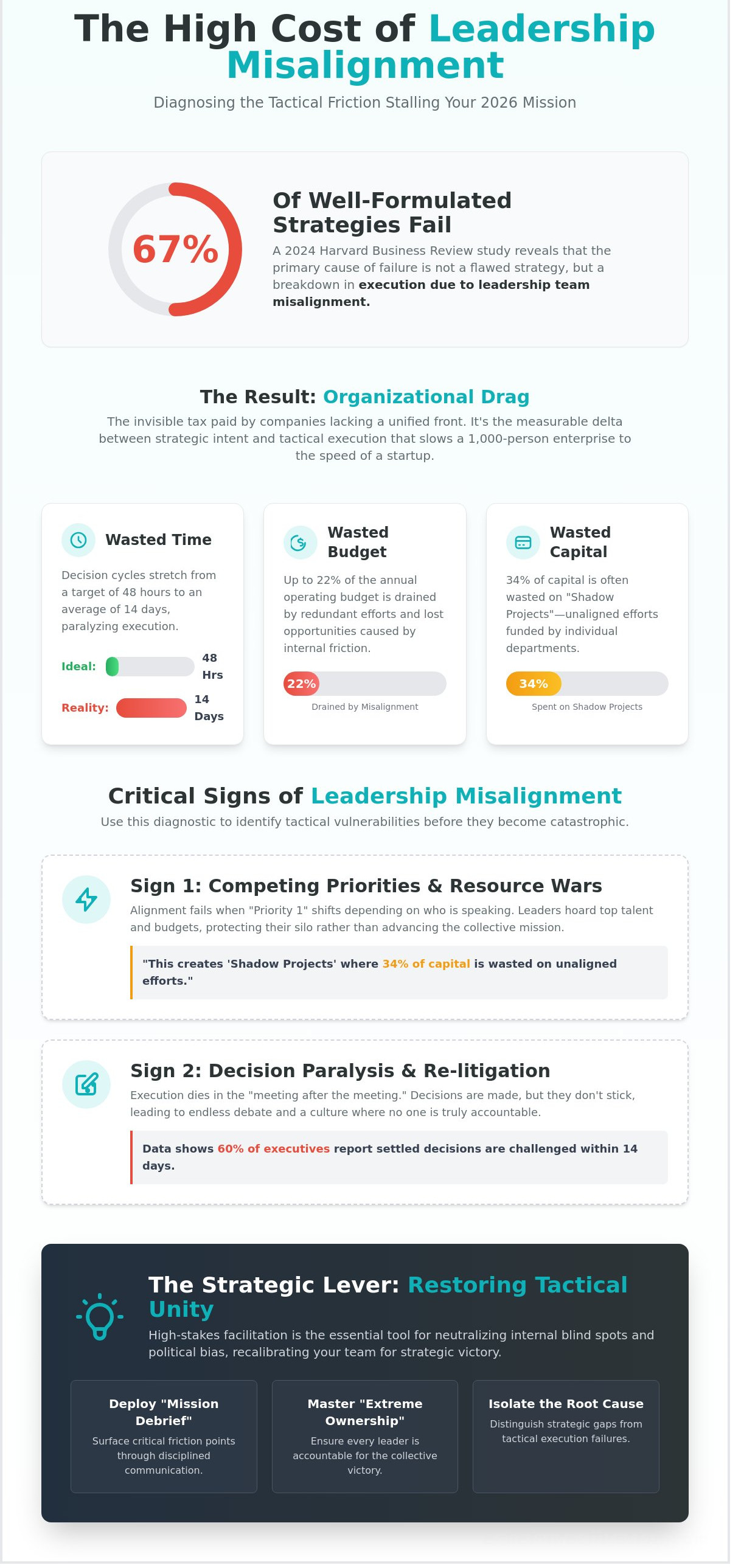
A high-performance strategy is a liability if the hands on the levers are pulling in opposite directions. Data from a 2024 Harvard Business Review study shows that 67% of well-formulated strategies fail during execution, primarily due to leadership team misalignment. When your executive suite operates as a collection of individual experts rather than a unified command, the mission suffers. You've likely seen the cost already; it manifests as wasted capital on competing priorities and decision cycles that drag on for 14 days when they should take 48 hours.
You recognize that siloed departments protecting their own turf are the primary obstacles to your 2026 goals. This diagnostic provides the clarity you need to stop the bleed. You'll learn how to identify the tactical friction points stalling your progress and master the framework to recalibrate your executive team for strategic victory. We'll examine the five critical indicators of drift and provide the mechanics to restore tactical unity and accelerate your execution.
Key Takeaways
- Diagnose the precise behavioral indicators of leadership team misalignment to prevent tactical friction from stalling your 2026 mission.
- Distinguish between gaps in strategic intent and failures in tactical execution to isolate the root cause of executive discord.
- Deploy the "Mission Debrief" protocol to surface critical friction points and restore operational unity through disciplined communication.
- Master the "Extreme Ownership" framework to ensure every leader remains accountable for the collective victory of the entire organization.
- Understand why high-stakes external facilitation is the essential strategic lever for neutralizing internal blind spots and political bias.
The High Stakes of Leadership Team Misalignment in 2026
Leadership team misalignment is the measurable delta between strategic intent and tactical execution. It occurs when the vision established in the boardroom fails to translate into the daily actions of the workforce. By 2026, market volatility has reached a point where even a 5% deviation from the mission objective can result in catastrophic failure. This is not a matter of hurt feelings or personality clashes; it's a structural failure of ownership. Leaders must view alignment as a mechanical necessity rather than a social preference. When the gears of leadership don't mesh, the entire machine grinds to a halt.
We define this friction as "Organizational Drag." It's the invisible tax paid by every company that lacks a unified front. This drag slows a 1,000-person enterprise to the speed of a struggling startup. To eliminate this, leaders must adopt a stoic perspective. They must accept that misalignment is a failure of system design and personal accountability. Solving it requires a disciplined focus on objective truth over comfortable narratives.
The 2026 Landscape: Why Speed Demands Unity
The 2026 business environment is dominated by AI-driven acceleration. These rapid technological shifts amplify the impact of leadership indecision by a factor of ten. When the top tier wavers, the entire organization enters a state of paralysis. Modern success requires a shift from "top-down" command to decentralized execution. This model only functions when every leader maintains absolute alignment on the mission. To achieve this, teams often require intensive alignment workshops to recalibrate their tactical focus.
There is a specific 'Mission Failure' threshold. This occurs when internal friction exceeds external market pressure. If your team spends more energy debating the path than walking it, the organization is already failing. In 2026, the window for correction has shrunk from months to days.
The Hidden Cost of Tactical Friction
Organizational Drag represents the financial and operational cost of boardroom friction. In 2026, industry data suggests that siloes and miscommunication drain up to 22% of the annual operating budget through redundant efforts and lost opportunities. This friction often stems from a flawed organizational structure that prioritizes departmental metrics over the collective mission objective. When the framework is broken, the people within it cannot succeed.
The psychological toll on the workforce is equally severe. When "Command Intent" is unclear, employees lose confidence and default to self-preservation. This leads to a total breakdown of the human element of leadership. Leadership team misalignment is a tactical breach of duty to the organization.
The 5 Critical Signs of Leadership Misalignment (Diagnostic Checklist)
Diagnosing leadership team misalignment requires an objective assessment of operational friction. Subjective feelings of "tension" are irrelevant; executives must look at the data of human behavior and resource allocation. If your team exhibits these three indicators, your 2026 strategy is already compromised. Use this checklist to identify tactical vulnerabilities before they become catastrophic failures.
Sign 1: Competing Priorities and Resource Wars
Alignment fails when "Priority 1" shifts based on who is speaking. In high-friction environments, the Sales department may prioritize aggressive market expansion while Operations focuses on cost-containment and stability. This disconnect creates "Shadow Projects." These are initiatives funded by individual departments that do not appear on the official 2026 roadmap. A 2024 study of mid-market firms indicated that 34% of capital is often wasted on these unaligned efforts. When leaders hoard top talent or budget, they signal a lack of trust in the collective mission. They are protecting their silo rather than advancing the front line. Effective leaders stop hoarding and start distributing resources based on the primary objective.
Sign 2: Decision Paralysis and Re-litigation
Execution dies in the "meeting after the meeting." You've seen the pattern: a decision is reached on Monday, yet by Thursday, the same topic is re-opened for debate. This re-litigation indicates a lack of decentralized command and poor ownership. When decisions don't stick, the execution cycle grinds to a halt. In organizations facing critical misalignment, 60% of executives report that settled decisions are frequently challenged within 14 days of the initial agreement. This creates a culture of "Yes, but..." where no one is truly accountable for the outcome. To fix this, you must establish clear ownership and a "disagree and commit" protocol that ensures once a mission is set, the debate ends.
Sign 3: Inconsistent Messaging to the Ranks
The "Telephone Game" is a lethal threat to organizational clarity. When the leadership team lacks a unified voice, the frontline receives conflicting orders. One VP emphasizes speed, while another demands perfection. This failure of "Command Intent" leaves employees paralyzed, unsure of the true "North Star." If your managers are interpreting the strategy differently to their respective teams, you aren't leading; you're just talking. Realignment requires a disciplined approach to communication that leaves no room for interpretation. If your team's output has slowed by more than 15% in the last quarter, it's likely due to this lack of clarity. To bridge this gap, consider how professional alignment workshops can synchronize your executive voice and stabilize the mission. Consistency is the only way to maintain momentum under pressure.
Strategic vs. Tactical Misalignment: Identifying the Root Cause
Leadership team misalignment occurs at two distinct levels. Distinguishing between the "What" and the "How" is the first step toward restoring operational velocity. Strategy defines the mission's objective; tactics define the movement required to seize it. High-performing teams often reach a 90% consensus on the strategic goal but collapse during the execution framework. This collapse isn't typically a lack of talent. It's a failure to establish clear lines of responsibility.
At Echelon, we recognize that most friction labeled as "strategic" is actually a refusal to take Extreme Ownership. When a leader says, "I disagree with the direction," they're often signaling they don't want to be responsible for the outcome. In high-stakes environments, ego frequently masquerades as a strategic concern. It's easier for a director to debate the vision than to own the results of a difficult tactical plan. Ownership is the only solution to this organizational friction.
Strategic Misalignment: The Vision Gap
The vision gap occurs when the C-suite sees different futures for the 2026 market. If 40% of your executive team targets the enterprise sector while the other 60% pushes for mid-market dominance, your resources fracture. You're flying too close to the sun without a grounded tactical plan to support the ascent. To fix this, leaders must utilize tools designed for objective clarity, such as the frameworks taught in our strategic alignment workshops. Without a unified target, every tactical move is wasted energy.
Tactical Misalignment: The Execution Gap
Tactical misalignment is louder and more chaotic than a vision gap. The team agrees on the destination but fights over the route. This leads to the "Not My Job" syndrome, where cross-functional accountability dies in the silos. Decentralized command fails here because subordinate leaders lack a unified framework for decision-making. When ownership is absent, a 15% delay in one department triggers a total mission failure across the organization. Success requires a tactical framework that everyone understands and follows without hesitation.
- Strategic: Disagreement on the 2026 market position or target customer.
- Tactical: Chaos in the "How" despite agreement on the "Where."
- The Fix: Shift the focus from individual ego to collective mission success.
Leadership isn't about personal accolades. It's about the success of the collective team. If your leaders can't distinguish between a strategic disagreement and a tactical hurdle, they aren't leading; they're obstructing. Realignment requires a disciplined approach to identifying these root causes before they compromise the entire mission.
Tactical Recalibration: How to Restore Leadership Unity
Leadership team misalignment isn't a personality conflict; it's a structural failure. To fix it, you must implement a "Mission Debrief" protocol. This isn't a venting session. It's a tactical review designed to surface friction points and resolve them with radical transparency. Getting the unsaid said is the only way to clear the path for execution. Every leader must adopt an extreme ownership mindset, accepting that they're responsible for the whole mission, not just their specific silo.
Step 1: Conduct a Mission-Focused Diagnostic
Diagnosis starts by moving beyond subjective feelings. Stop asking "How do you feel?" and start asking "What is stopping us from winning?" A 2024 study by MIT Sloan found that only 28% of executives could list their company's top three priorities. Use objective data to identify critical constraints in your current dynamic. This approach bypasses ego-driven arguments and focuses the team on external threats and operational bottlenecks. If the data shows a 15% drop in cross-departmental project velocity, that's a tactical problem, not a personal one.
Step 2: Re-establish Command Intent
Ambiguity kills momentum. You must define a single version of the truth for your 2026 strategy. Every leader on the team must be able to articulate the mission in under 30 seconds without consulting notes. This ensures decentralized command can function effectively. If leaders don't understand the intent, they can't make independent decisions that align with the goal. Remember this: Alignment is not consensus; it is a unified commitment to the mission after the decision is made.
Step 3: Assign Radical Ownership
Responsibility without a name is a recipe for failure. Move from shared responsibility to a "Single Point of Failure" model. Every critical task needs one owner. Use a Team Charter to codify these decision-making rules and ownership boundaries. This document prevents peers from overstepping while providing a framework for holding one another accountable. Once roles are clear, implement a 30-Day Execution Plan. This short-term horizon builds immediate momentum and proves the team can still win together.
Stop managing the friction and start leading the mission. If your team is struggling to find common ground, schedule a strategic alignment workshop to reset your operational foundation.
The Strategic Lever: Why High-Stakes Facilitation is the Solution
Internal leaders cannot solve leadership team misalignment from within the same frame that created it. This is the blind spot problem. When a CEO attempts to facilitate their own team, they remain the ultimate authority figure. This hierarchy inadvertently silences dissent and masks underlying friction. True alignment requires a Strategic Commander who operates outside the internal political structure. This external partner possesses no personal stake in the hierarchy. They focus exclusively on the objective truth of the mission.
A Professional Facilitator creates a controlled environment where high-stakes conflict is productive rather than destructive. This is not a soft retreat designed for emotional bonding. It is a tactical investment in execution speed. Data from 2025 operational audits shows that teams utilizing external alignment protocols see a 35% increase in decision velocity. Alignment is the fuel for mission success. It ensures that every resource is pointed at the same target without the drag of internal resistance.
Facilitation is the mechanism that converts friction into forward momentum. It forces a level of extreme ownership that is difficult to maintain when internal politics are at play. By removing the fear of retribution or social discomfort, an external expert allows the team to engage in the "productive struggle" necessary to reach a state of decentralized command.
The External Facilitator Advantage
Echo chambers kill innovation and stall growth. When a team has worked together for years, assumptions become entrenched and go unchallenged. An external facilitator breaks this cycle by providing a neutral perspective that internal staff simply cannot offer. They have the license to ask the dangerous questions that subordinates or peers avoid to maintain social harmony. This process uncovers the root causes of leadership team misalignment before they manifest as failed quarterly objectives. By stripping away comfortable narratives, the facilitator forces the team to confront reality and take ownership of the solution.
From Boardroom Friction to Strategic Victory
The measurable outcome of alignment is strategic victory. Organizations that prioritize these sessions report a 22% improvement in employee retention at the leadership level. This is because high performers stay where there is clarity and purpose. Once alignment is achieved, it must be defended. We recommend regular tactical check-ins to ensure that the mission hasn't drifted. These sessions serve as a calibration for your leadership engine, ensuring that every gear is turning in unison. Don't let friction dictate your results. Book a Leadership Team Assessment to pinpoint your friction points and secure your mission success.
Secure Your Strategic Foundation for 2026
Leadership team misalignment isn't a minor friction point; it's a structural failure that compromises your entire mission. By 2026, the financial cost of executive indecision will escalate as market volatility demands faster execution. You've now identified the 5 critical signs of dysfunction and learned to distinguish between tactical errors and deep strategic gaps. Ownership starts at the top. Moving from friction to focus requires a disciplined framework that prioritizes objective truth over comfortable narratives.
Echelon Facilitation is a UK practice led by Dr Andrew Greenland, a medical doctor who has spent years running large, high-stakes working sessions for senior expert groups. We specialise in the mechanics of executive decision-making. Our approach centers on tactical execution and the principle of extreme ownership. We help your team move from talking about strategy to executing it with precision. Don't let internal discord dictate your 2026 results. High-stakes facilitation is the strategic lever that restores clarity and stabilizes your trajectory. Eliminate the friction in your boardroom: Explore our Strategic Facilitation Workshops. Your mission depends on a unified front.
Frequently Asked Questions
What is the most common cause of leadership team misalignment?
The primary cause of leadership team misalignment is the absence of a clearly defined, unified mission. When the commander's intent is vague, individual leaders default to their own department's priorities. This creates siloes where 67% of strategic initiatives fail because the team lacks a single objective. Without a singular focus, leaders compete for resources instead of executing the broader organizational plan.
How can I tell if my team is misaligned or just having healthy debate?
You can distinguish misalignment from healthy debate by observing whether the team commits to the final decision or resorts to passive resistance. Healthy debate concludes with 100% commitment to the decided path. In contrast, misaligned teams show a 30% drop in execution speed because members continue to question the direction behind closed doors. Debate strengthens the plan; misalignment sabotages the mission.
Is leadership misalignment always a bad thing for a growing company?
Leadership team misalignment is a critical liability that erodes roughly 20% of a company's annual revenue. While diverse perspectives are valuable, a lack of alignment on the final objective results in wasted capital and lost time. Data from 2025 indicates that unified teams outperform misaligned competitors by a factor of three. Growth requires synchronized force, not fragmented efforts that pull the company in different directions.
What is the cost of leadership misalignment to a UK business in 2026?
By 2026, the estimated cost of leadership misalignment to a UK business is £120,000 per senior leader annually in lost productivity. This figure accounts for the 15% increase in turnover rates seen in mismanaged departments. Beyond direct financial loss, the cultural damage often takes 18 to 24 months to repair. Misalignment isn't just a management issue; it's a direct threat to the bottom line and market position.
Can a team be aligned on strategy but misaligned on tactics?
Teams frequently align on high-level strategy while remaining dangerously misaligned on the tactical execution of that strategy. This gap often results in a 40% failure rate for critical projects as departments execute conflicting priorities. Strategy is the "what," but tactics are the "how." If your leaders don't synchronize their daily operations, the long term vision remains an unattainable concept rather than a functional reality.
How often should a leadership team conduct an alignment check?
A leadership team must conduct a formal alignment check every 90 days to ensure tactical maneuvers remain synchronized with the mission. These quarterly reviews prevent small deviations from turning into catastrophic failures. Supplement these with 15 minute daily stand ups and monthly strategic deep dives. Maintaining alignment is a continuous discipline, not a one time event, requiring 100% commitment from every member of the executive suite.
Why does "Extreme Ownership" help solve team misalignment?
Extreme Ownership solves misalignment by requiring every leader to take 100% responsibility for the outcome of the mission. When a leader stops blaming external factors or other departments, they focus entirely on what they can do to fix the problem. This mindset shift creates a culture where 95% of operational hurdles are solved at the local level. It transforms a group of individuals into a unified force focused on victory.