
Unchecked ambition masks systemic fragility. When leadership teams ignore the internal friction necessary for sound decision-making, they inevitably fly too close to the sun and risk a catastrophic strategic failure. You likely recognise the pressure to pursue aggressive growth targets, yet you understand that without honest dissent in the boardroom, your organisation is merely drifting toward an avoidable crisis.
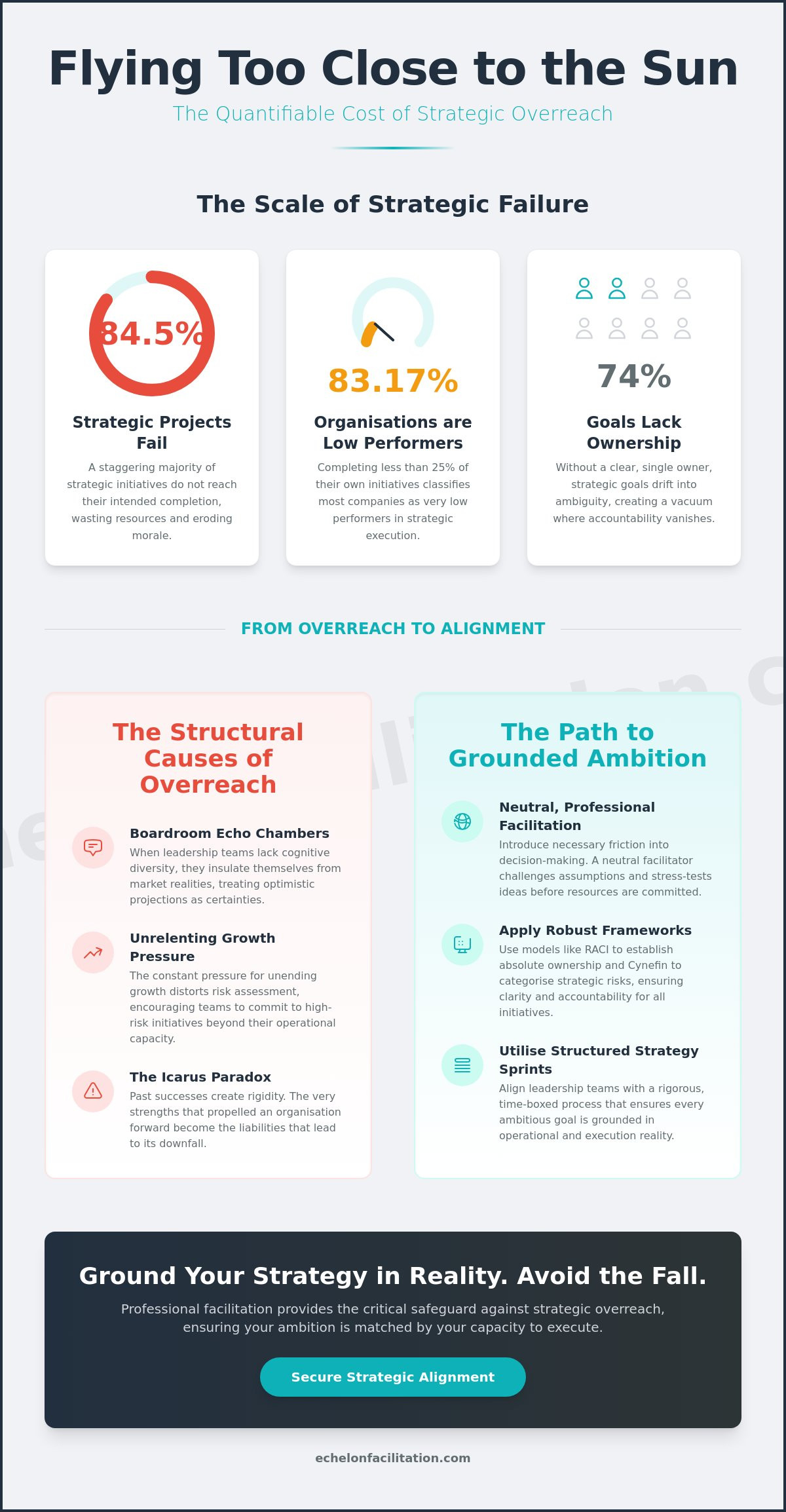
The cost of this over-extension is quantifiable and severe. Research from 2025 indicates that 84.5% of strategic projects failed to reach completion, whilst 83.17% of organisations are classified as very low performers because they complete less than 25% of their initiatives. These failures stem from a lack of ownership and a refusal to ground vision in operational reality. When 74% of strategic goals lack a clear owner, the gap between ambition and execution becomes a terminal threat.
Learn to identify the signs of organisational overreach and use professional facilitation to keep your leadership team grounded whilst pursuing growth. A robust framework balances ambition with reality, allowing you to challenge assumptions without killing momentum. This approach ensures clearer strategic alignment and prevents the over-extension of critical resources.
Key Takeaways
- Recognise the specific indicators of strategic overreach where executive ambition outstrips the organisation's actual operational capacity.
- Identify the structural causes, such as boardroom echo chambers and growth pressure, that cause even high-performing teams to fly too close to the sun.
- Apply the Cynefin framework and RACI models to categorise strategic risks and establish absolute ownership of all key initiatives.
- Introduce necessary friction into the decision-making process through neutral facilitation to stress-test assumptions before resource allocation.
- Utilise structured Strategy Sprints to align leadership teams and ensure that every ambitious goal remains grounded in execution reality.
Fly too close to the sun: Identifying the signs of strategic overreach
Ambition is not strategy. In a corporate environment, to fly too close to the sun describes the specific moment when a leadership team's vision decouples from their firm's operational reality. It represents a state of over-extension where the reach of the strategy exceeds the grasp of the delivery teams. This misalignment often occurs during periods of rapid growth or after a significant market victory that emboldens decision-makers beyond the limits of their current infrastructure.
Success often breeds the very behaviours that cause failure. This phenomenon, known as the Icarus Paradox, explains how a company's past victories create a rigid adherence to a single way of working. The strengths that propelled the organisation to its current height, such as aggressive sales or rapid product cycles, become the exact liabilities that lead to a catastrophic plunge. When a team begins to believe their own internal narrative over objective data, they lose the ability to course-correct.
Healthy growth relies on a constant feedback loop between strategy and execution. Sun-blindness occurs when executives become so enamoured with a vision that they view operational constraints as mere lack of commitment or negative thinking. Strategic overreach is the systematic ignoring of resource constraints in favour of optimistic projections.
The transition from ambition to organisational risk
The shift from healthy ambition to organisational risk is rarely sudden. It begins with the "certainty trap," where the board assumes that past performance guarantees future results despite 84.5% of strategic projects failing to reach completion in 2025. You can identify this transition when dissent is silenced in favour of alignment. If your boardroom lacks the friction of honest disagreement, you've already lost your primary safeguard against failure.
Senior teams frequently ignore the warnings of their own "Daedalus" figures. These are the pragmatic operators and COOs who warn that the organisation's wings are melting under the heat of unrealistic deadlines. When leadership prioritises the speed of the mission over the stability of the foundation, they inevitably fly too close to the sun. Recognising these early warning signs is the first step toward reclaiming strategic control.
The structural causes of why executive teams fly too close to the sun
High-performing teams often become victims of their own cohesion. When a board consists of like-minded individuals who have shared previous successes, they inadvertently create echo chambers that insulate them from market realities. This lack of cognitive diversity makes avoiding leadership hubris nearly impossible. Without a mechanism for professional friction, the team begins to treat optimistic projections as certainties rather than hypotheses that require testing.
The structural pressure for unending growth often distorts risk assessment at the highest levels. In 2025, research showed that 74% of strategic goals had no clear owner, creating a vacuum where accountability vanishes. When decision rights are poorly defined, the leadership team collectively over-extends resources because no single individual feels empowered to challenge the trajectory. This lack of ownership ensures that teams fly too close to the sun by committing to multiple high-risk initiatives without the operational capacity to sustain them.
Consider the case of a UK tech firm specialising in FMCG supply chain software. In early 2024, emboldened by a successful funding round, the board greenlit simultaneous expansions into the US, UAE, and Singapore. They diverted 60% of their engineering capacity to localisation efforts for these new markets. By mid-2025, their core UK operations suffered a 22% increase in churn because the domestic product had stagnated. The ambition to dominate three continents simultaneously compromised the very foundation that funded the expansion.
The danger of unfiltered optimism in the boardroom
A "culture of yes" often masks critical strategic gaps. During rapid scaling phases, groupthink becomes a defensive mechanism against the discomfort of complexity. Teams prioritise momentum over accuracy; they view dissenting voices as obstacles to progress rather than essential safeguards. Establishing a rigorous strategy process helps break this cycle by forcing a confrontation with objective reality before resources are committed. When a board chooses to fly too close to the sun, it is rarely due to a single bad decision, but rather a series of unchallenged assumptions.
Practical frameworks to avoid flying too close to the sun
Execution fails when leadership treats complex systems as simple linear problems. The Cynefin framework allows boards to categorise strategic moves into four domains: clear, complicated, complex, and chaotic. Strategic overreach often occurs when a team applies "complicated" solutions, such as rigid planning and expert analysis, to a "chaotic" market shift that requires rapid experimentation instead. By correctly identifying the domain, you prevent the organisational strain that occurs when you fly too close to the sun with inflexible plans in a volatile environment.
Establishing clear ownership is the secondary defence against over-extension. Using a RACI matrix ensures that every strategic milestone has a single point of accountability, preventing the "responsibility dilution" seen in the 74% of projects that lacked clear owners in 2025. Academic research on CEO overconfidence and strategic risk-taking confirms that without these structural checks, individual ambition frequently overrides collective resource constraints. Frameworks do not limit ambition; they provide the floor upon which ambition can safely stand.
A "Pre-Mortem" exercise should be a mandatory component of every strategy session. Unlike a post-mortem, this involves imagining the project has already failed and working backwards to determine the causes. It forces the team to voice dissent that the "culture of yes" usually suppresses. To implement these tools effectively, consider booking one of our leadership team workshops to embed these frameworks into your decision-making process.
Gauging strategic altitude with objective data
External benchmarks serve as a necessary corrective to internal optimism. Compare your growth projections against industry averages from the last 36 months to identify outliers. If your plan requires a 50% increase in efficiency whilst entering two new markets, the data suggests you are preparing to fly too close to the sun. Establish "kill-switch" criteria at the start of any aggressive project. These are non-negotiable metrics, such as a specific burn rate or a missed regulatory deadline, that trigger an immediate cessation of the initiative to protect the wider organisation.
Securing alignment through professional facilitation
Internal leadership teams often lack the detachment required to critique their own initiatives. When you are the architect of a high-growth strategy, your proximity to the project creates a significant blind spot. You fly too close to the sun because the momentum of the board feels like validation, yet this momentum is often divorced from the operational capacity of the workforce. Professional facilitation introduces a neutral third party to provide the necessary friction required for safe navigation. This external perspective ensures that assumptions are challenged before they become expensive failures.
A Strategy Sprint serves as a high-intensity tool for stress-testing ambitious goals. During these sessions, the facilitator forces a confrontation between the executive vision and the 84.5% failure rate of strategic projects recorded in 2025. By subjecting a plan to rigorous, objective scrutiny, the facilitator identifies where the wax is melting on your organisation's wings. This process moves the team beyond unfiltered optimism and into a state of disciplined readiness. It ensures that every member of the executive team understands the resource constraints that dictate the speed of execution.
The facilitator as the guardian of strategic clarity
Facitation uncovers hidden dissent that leaders might otherwise miss due to their positional authority. In a typical boardroom, junior executives or pragmatic operators often hesitate to challenge a CEO's preferred trajectory. A facilitator creates a structured environment where these dissenting views are treated as vital intelligence rather than obstacles. This transition from blind ambition to aligned execution is essential for long-term stability. Our leadership team workshops centre the human element of leadership, ensuring that every team member takes extreme ownership of the final, stress-tested plan. Alignment is not the absence of conflict; it is the result of resolving it through objective truth.
Grounding Ambition in Execution Reality
Strategic success requires a disciplined balance between visionary growth and operational capacity. You've seen how the absence of honest dissent leads organisations to fly too close to the sun; resulting in the 84.5% project failure rate observed in 2025. By implementing rigorous frameworks like Cynefin and ensuring clear ownership through RACI; your leadership team can transition from unfiltered optimism to aligned execution. Professional facilitation provides the neutral friction needed to uncover hidden risks before they compromise your core operations.
Echelon Facilitation; led by Richard Kasriel; specialises in high-stakes executive alignment for global leadership teams from our base in Twickenham. We help you stress-test your most ambitious goals to ensure they remain achievable and grounded in reality. Book a complimentary diagnostic call to ground your strategy and secure your organisation's future. Your vision deserves a foundation that can sustain its height. Build that foundation today.
Frequently Asked Questions
What does it mean to fly too close to the sun in business?
To fly too close to the sun in a corporate context means pursuing growth targets that your current infrastructure cannot support. It is the specific intersection where executive ambition outstrips the team's ability to execute. When this happens, the organisation risks a catastrophic plunge as core operations stagnate under the weight of new, unproven initiatives.
How can a leadership team identify if they are overreaching?
Identifying overreach requires a cold analysis of your project completion rates. If your organisation falls into the 83.17% of firms classified as low performers who complete less than 25% of their projects, you are overreaching. Other warning signs include resource dilution; where 60% or more of your talent is diverted to secondary missions; and a boardroom culture that treats dissent as a lack of commitment.
Why is it difficult for CEOs to recognise when they are overreaching?
CEOs often suffer from "sun-blindness" caused by their own previous victories. Success breeds a rigid adherence to specific strategies; making it difficult to recognise when market conditions have shifted. Research from May 2026 indicates that 72% of CSOs remain optimistic about their own prospects despite global economic instability; illustrating how internal narratives often override external reality.
Can professional facilitation prevent strategic failure?
Professional facilitation prevents failure by decoupling the strategy from the egos in the room. It provides a structured environment to apply frameworks like Cynefin; which help teams distinguish between complicated and chaotic moves. This external oversight ensures that your leadership team does not fly too close to the sun by committing to unrealistic timelines that lack clear ownership.
What is the Icarus Paradox in leadership?
The Icarus Paradox describes how a leader's greatest assets eventually lead to their failure. A CEO's decisive nature; which was vital during a startup phase; can become a liability during a scaling phase if it evolves into hubris. This paradox forces a company into a state of decline because the leadership refuses to evolve their behaviour to match a more complex operational reality.

Article by
Andrew Greenland
Dr Andrew Greenland is the founder of Echelon Facilitation, a UK practice that designs and runs high-stakes leadership sessions for executive teams who need decisions, not more discussion. A medical doctor and medical educator, Andrew brings a clinician's discipline to the messy, political work of leadership alignment - surfacing the real disagreement, forcing the real choices, and ensuring every session produces a documented decision log with named owners and deadlines. He works with CEOs, executive teams, transformation leads, and boards across the UK and internationally. Based in Twickenham.