
Most executive teams operate under the illusion of consensus while harbouring deep-seated misalignment that cripples execution. You recognise that a single passive-aggressive nod in a strategy session can derail months of work. Implementing best practices for Echelon Facilitation ensures that these sessions move beyond polite agreement to reach a state of unshakeable strategic clarity.
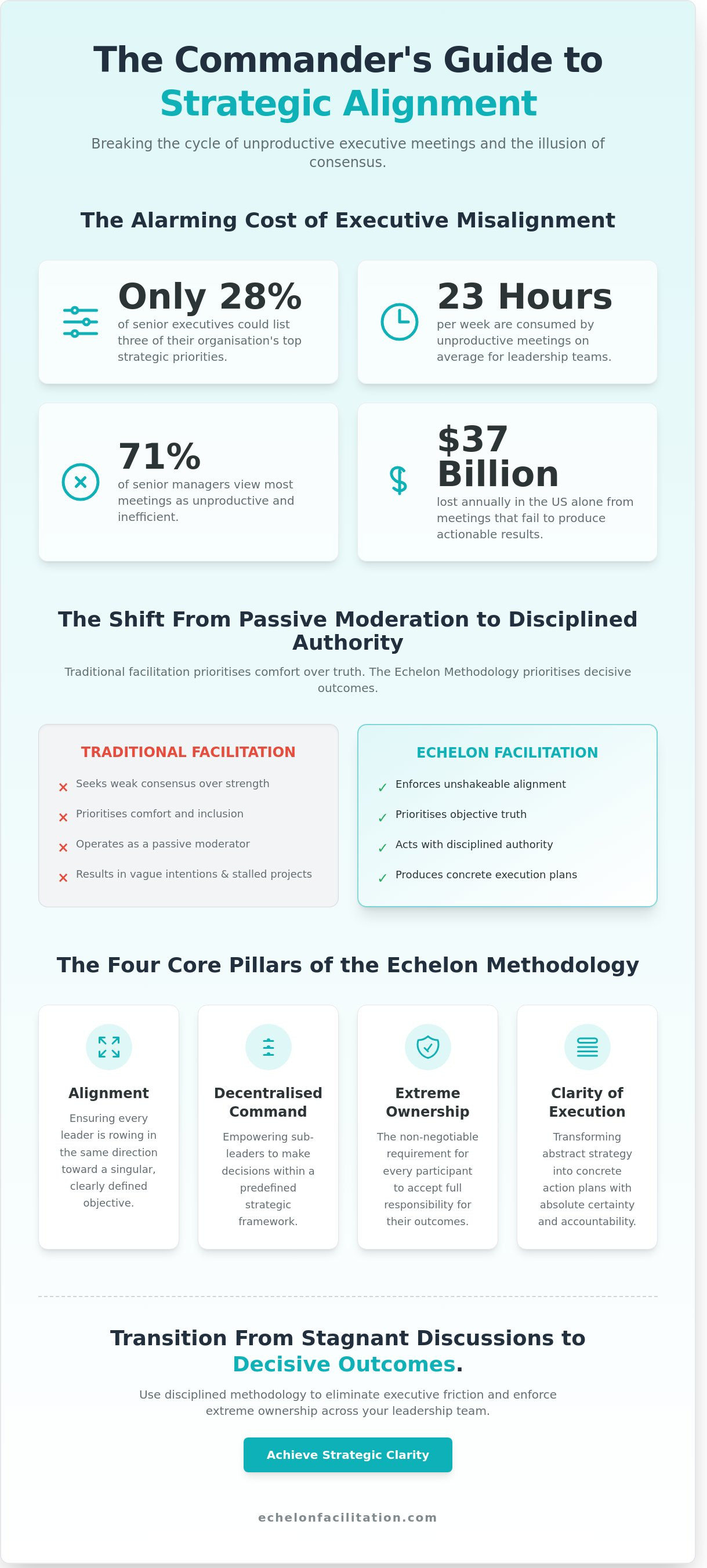
According to a 2023 survey by MIT Sloan, only 28% of senior executives could list three of their organisation's top strategic priorities. This lack of clarity forces leadership teams into a cycle of unproductive meetings that consume an average of 23 hours per week. When alignment fails, the resulting friction creates a vacuum of ownership where accountability disappears. The financial and cultural cost is measured in stalled growth and the slow erosion of professional trust among the C-suite.
You will learn the disciplined methodology required to eliminate executive friction and enforce extreme ownership across your leadership team. This framework provides the tools to move from abstract strategy to concrete execution plans with real clarity.
Key Takeaways
- Shift from standard meeting coordination to a disciplined methodology that removes organisational friction and prioritises objective truth.
- Establish alignment by empowering leaders to make decisions within a clear strategic framework, ensuring every team member works toward a singular objective.
- Understand why internal leaders often struggle to facilitate their own teams and how external authority bypasses hierarchy to foster honest communication.
- Adopt the best practices for Echelon Facilitation by using diagnostic intelligence and objective-led agendas to turn high-stakes sessions into concrete results.
- Transition from one-off workshops to perpetual alignment by implementing post-session debriefs and team charters that enforce extreme ownership.
Redefining Facilitation as a Strategic Mission
A leadership team sits in a boardroom for eight hours, yet leaves with no clear accountability for a failing project. This failure to align is not a lack of effort but a lack of structure. Implementing the Best practices for Echelon Facilitation transforms these sessions from passive conversations into high-stakes strategic missions. Facilitation is the tactical removal of organisational friction; it is not simple meeting management or the passive recording of notes on a whiteboard.
According to a 2023 report by the Harvard Business Review, 71% of senior managers view meetings as unproductive and inefficient. This lack of clarity results in an estimated $37 billion lost annually in the United States alone due to unnecessary meetings. When executive sessions fail to produce actionable results, the organisational friction ripples downward, stalling execution and eroding trust across the entire workforce. This section outlines the shift from passive moderation to disciplined authority. It establishes the foundational principles required to turn stagnant discussions into decisive outcomes.
Traditional "soft" facilitation prioritises comfort and inclusion over objective truth. The Echelon Facilitation Methodology rejects this approach, favouring disciplined authority and a Mission First mindset. In high-pressure environments, the facilitator must remain composed, ensuring that the group stays focused on the objective rather than individual egos. Adopting these Best practices for Echelon Facilitation ensures that every minute spent in the boardroom translates into operational momentum. This disciplined stance creates the stability necessary for a team to confront uncomfortable realities and make hard decisions.
The Facilitator as a Strategic Commander
An effective facilitator operates as an objective outsider to internal politics. This detachment allows them to challenge comfortable narratives and expose hidden friction that internal leaders may ignore to avoid conflict. By exercising disciplined authority, the facilitator creates a safe environment for radical candour. When the rules of engagement are clear, participants feel empowered to speak the truth without fear of political retribution. This environment is essential for identifying the root causes of failure and establishing Best practices for Echelon Facilitation within the leadership tier. Our approach to how we work emphasises this role as a neutral but firm guide through complex strategic terrain.
Moving Beyond the Talking Shop
Alignment is a position of strength; consensus is often a sign of weakness. Nice facilitation often leads to strategic failure because it seeks a middle ground that satisfies everyone but achieves nothing. High-impact outcomes require setting the stage long before the session begins. The facilitator must define the desired end state and ensure every participant understands their responsibility in reaching it. This focus on execution ensures that the strategy session results in clear ownership and a decisive path forward, rather than a list of vague intentions.
The Core Pillars of the Echelon Facilitation Methodology
Best practices for Echelon Facilitation rely on four non-negotiable pillars that convert high-level theory into functional output. Without these foundations, leadership teams remain trapped in a cycle of circular discussion and stalled progress. This methodology prioritises discipline over fleeting motivation and results over excuses. Adhering to these best practices for Echelon Facilitation prevents the common pitfall of strategy stagnation by focusing on the following:
- Alignment: Ensuring every leader is rowing in the same direction toward a singular objective.
- Decentralised Command: Empowering sub-leaders to make decisions within a predefined strategic framework.
- Extreme Ownership: The non-negotiable requirement for every participant to accept full responsibility for their outcomes.
- Clarity of Execution: Transforming abstract strategy into operational reality through precise, boots-on-the-ground actions.
Implementing the best practices for Echelon Facilitation ensures that every leader operates within a decentralised command structure, allowing for rapid response to changing conditions without losing sight of the primary goal.
Forging Unshakeable Executive Alignment
Silent dissent is a primary killer of organisational momentum. A 2023 study by MIT Sloan found that only 28% of executives could list three of their company’s top strategic priorities. This disconnect often stems from a fear of boardroom conflict, leading to a false consensus. We use structured conflict to force disagreements into the open. By debating the hard truths early, leaders reach a state of true strategic agreement. Consider a London-based fintech where one director quietly disagrees with the expansion plan - surfacing that single point of silent dissent early could save months of wasted operational effort. The Echelon workshop methodology is designed to get boards aligned in a single day, replacing the standard industry advice of seeking harmony with a focus on objective truth.
The Mechanism of Extreme Ownership
Ownership is the only sustainable solution to leadership friction. During a facilitated session, we require a shift from the passive "we should" to the definitive "I will." This transition is critical because collective responsibility often equals zero responsibility. We implement a modified RACI framework where accountability is public, recorded, and time-bound. Harvard Business Review reports that 70% of strategic initiatives fail due to poor execution, usually because no single individual felt responsible for the outcome. By assigning clear ownership, we ensure every objective has a specific name attached to it. This level of transparency eliminates the excuses that typically follow a failed project. You can learn more about how we implement these standards by reviewing how we work with executive teams.
Strategic Friction: Why Internal Facilitation Fails the Mission
Internal leaders often find themselves trapped by their own rank. A CEO cannot facilitate a debate where their own strategy is the subject of critique. This "prophet in his own land" syndrome ensures that team members default to deference rather than providing the radical candour required for growth. When HR or junior staff members lead these sessions, the result is often a watered-down consensus. These facilitators often lack the political capital to push back against senior executives. McKinsey & Company reports that 70% of change programmes fail to achieve their goals, largely due to poor alignment and a lack of honest engagement from the top down.
The Bias Trap in Leadership Meetings
The HiPPO effect, where the Highest Paid Person’s Opinion dominates the room, remains the primary barrier to objective decision-making. Internal facilitators naturally prioritise social harmony over productive conflict. They avoid the sensitive topics that actually drive performance because they must work with these colleagues the next day. Reviewing a guide to high-stakes facilitation ensures an external expert identifies these biases and neutralises them before they compromise the strategy. An outside perspective is essential to challenge long-held business assumptions that internal staff may be too close to see or too fearful to question.
High-Stakes Decision Making Frameworks
Standard brainstorming sessions often devolve into unstructured noise. The Echelon approach replaces this with the Decision Sprint model. This framework forces executive teams to think clearly and decide together, moving from ambiguity to a defined plan of action in hours rather than weeks. Best practices for Echelon Facilitation mandate that the facilitator remains detached from the outcome to ensure the team takes full ownership of the result. External facilitation is a strategic investment in organisational clarity that prevents the catastrophic costs of executive misalignment.
Tactical Execution: Best Practices for High-Stakes Facilitation
Execution begins long before the first participant arrives in the boardroom. Effective pre-session intelligence involves diagnostic interviews that uncover the structural friction points leaders often ignore in their daily reporting. A 2023 study by Harvard Business Review found that 71% of senior managers view meetings as unproductive because they lack this foundational clarity. Best practices for Echelon Facilitation require identifying these systemic gaps early to ensure the session addresses root causes rather than symptoms. This diagnostic phase transforms a standard meeting into a precision instrument for organisational change.
Designing the Results-Driven Agenda
Most offsite agendas fail because they attempt to solve every organisational problem in a single afternoon. This lack of focus dilutes impact and exhausts the leadership team. A results-driven structure adheres to the One Primary Objective rule, where every discussion block serves a singular, predefined outcome. Leaders must allocate at least 60% of the session to deep work and decisive debate, leaving administrative updates for pre-read materials. This ensures the schedule serves the mission, not the clock.
Facilitating the Perspective Shift
Leaders often struggle to move from operational details to strategic overwatch. Facilitators use the "Fly Too Close to the Sun" metaphor to warn against strategic overreach, where teams attempt too many initiatives and burn out. Structured red-teaming forces executives to challenge their own assumptions, moving them out of the weeds of daily operations. According to data from McKinsey, organisations that successfully align their top teams are 1.9 times more likely to have above-average financial performance. Implementing best practices for Echelon Facilitation ensures that this alignment is rooted in objective truth rather than comfortable narratives.
Ownership is the only path to sustained momentum. Every high-stakes session must conclude with a 30-day execution plan that assigns clear accountability for immediate actions. This prevents the common post-workshop slump and ensures decisions translate into measurable progress. Facilitators must lean into productive conflict during these closing stages; unresolved friction is simply a delayed failure. By the end of the session, every leader must know exactly what they own and how success will be measured.
Establish clear accountability and drive immediate results for your leadership team. Learn more about our approach at Echelon Facilitation.
From Workshop to Victory: Establishing Perpetual Alignment
Execution begins the moment the room clears. A Harvard Business Review study found that 67% of well-formulated strategies fail due to poor execution. To avoid this, the post-facilitation debrief must occur within 24 hours. This session confirms every leader understands their specific ownership of the objectives established during the event. Best practices for Echelon Facilitation dictate that a Team Charter is not a static document; it is a contract that governs daily interactions and prevents the return of organisational friction. This charter survives the transition back to daily operations by serving as the primary reference point for conflict resolution and decision rights.
The 30-Day Execution Cycle
The first 72 hours determine the trajectory of the entire project. Leaders must establish a reporting rhythm that bypasses traditional bureaucracy. This involves setting up a dashboard that tracks progress against the new strategic objectives. If ownership drift occurs, it usually manifests by day 14 as old habits resurface. By implementing these best practices for Echelon Facilitation during the first month, leaders prevent the degradation of the strategy. Regular operational reviews, scheduled every seven days, act as a corrective measure to ensure the team remains on the designated path. These check-ins focus on barrier removal rather than simple status updates, maintaining the momentum generated during the workshop.
Securing Your Leadership Legacy
High-performing executives view bespoke workshops as a standard operational procedure rather than a one-time fix. The long-term ROI is clear; aligned teams make decisions 2.5 times faster than those operating in silos. A leader’s primary duty involves ensuring the team stays prepared for the objectives ahead. Discipline in execution reflects the strength of the initial alignment. Results follow those who refuse to settle for vague commitments. The Echelon diagnostic serves as the necessary first step to identify where clarity is lacking and where alignment must be reinforced for future growth.
Transforming Strategic Friction into Operational Victory
High-stakes decisions require more than a managed agenda; they demand a framework that forces accountability and resolves underlying friction. Internal teams often struggle with the significant productivity loss associated with misaligned leadership. Research indicates that organisations with aligned executive teams grow revenue 58% faster than those without. By implementing the best practices for Echelon Facilitation, leaders move beyond temporary consensus toward a state of disciplined execution. This process ensures that every participant accepts extreme ownership of the resulting strategy.
Dr Andrew Greenland, a medical doctor who has spent years running large, high-stakes working sessions for senior expert groups, founded Echelon Facilitation in Richmond, London to provide this level of objective clarity for leadership teams. We specialise in high-stakes executive alignment where the cost of failure is absolute. Our methodology bridges the gap between high-level strategy and the practical reality of leading a team. Waiting for alignment to happen naturally is a risk your organisation cannot afford. Professional facilitation transforms strategic friction into a competitive advantage by removing the emotional weight of internal politics and focusing on the collective mission.
Take the first step toward securing your team's future today. Book a Complimentary Diagnostic Call with Echelon Facilitation to identify the gaps in your current alignment strategy.
Frequently Asked Questions
What is the difference between a moderator and an Echelon facilitator?
A moderator manages the agenda and ensures participants speak in turn, whereas an Echelon facilitator drives the leadership team toward a specific strategic outcome. Moderators focus on the process of the meeting; Echelon facilitators challenge assumptions and enforce accountability. They use best practices for Echelon Facilitation to ensure every leader takes ownership of the final decisions rather than just participating in a discussion.
How much does a professional facilitation session cost in the UK?
Professional facilitation fees in the UK typically range from £1,500 to £5,000 per day according to data from the Association of Facilitators. This investment covers the design of the workshop, the live delivery, and the post-session documentation. Costs fluctuate based on the complexity of the organisational structure and the number of senior stakeholders involved in the alignment process.
Can Echelon facilitation help with board-level conflict resolution?
Echelon facilitation resolves board-level conflict by refocusing the group on objective strategic goals rather than personal grievances. Facilitators introduce frameworks that strip away emotional bias and highlight where misalignments exist. A 2023 study by PwC found that 45% of board members identify poor communication as a primary source of friction; professional facilitation corrects this by establishing clear decision rights and communication protocols.
How long does a typical strategic alignment workshop take?
A standard strategic alignment workshop requires one to two full days of intensive engagement to produce a viable execution plan. This duration allows the team to move through the discovery of existing frictions, the debate of core priorities, and the finalisation of a roadmap. Using best practices for Echelon Facilitation ensures that these hours are spent on high-value decision-making rather than administrative updates.
What happens if our leadership team cannot reach a consensus during the session?
If a team cannot reach a consensus, the facilitator employs a predefined decision-making framework such as the RAPID model to identify the ultimate decision-holder. The goal of the session is informed commitment rather than universal agreement. Once a path is chosen, every leader must commit to the execution of that decision to prevent internal friction and ensure the organisation moves forward as a single unit.
Is Echelon facilitation suitable for small businesses or just large corporations?
Echelon facilitation is effective for any organisation where leadership alignment is a prerequisite for growth. Small businesses with 10 to 50 employees often face higher stakes because they have fewer resources to waste on strategic errors. While large corporations use facilitation to manage scale, smaller firms use it to establish the discipline and clarity necessary to compete with larger market players.
How do we prepare our team for a high-stakes facilitation session?
Prepare your team by distributing a comprehensive pre-read package seven days before the session and defining the specific outcomes required. Every participant must arrive with a clear understanding of the current data and a willingness to engage in honest, direct dialogue. This preparation ensures the session focuses on solving complex problems rather than catching up on basic information, which maximises the return on time invested.
What is the typical ROI of a facilitated strategy offsite?
The ROI of a facilitated strategy offsite is measured by increased operational speed and the reduction of project slippage. Research from the Harvard Business Review indicates that organisations with highly aligned leadership teams grow revenue 58% faster than those with misaligned executives. By eliminating the hidden costs of confusion and duplicated effort, a single facilitated session can save an organisation hundreds of thousands of pounds in wasted resources.