
A three-hour board session concludes with a vague consensus on 'moving forward', yet no director leaves the room knowing exactly what they must deliver by Monday morning. This failure of leadership discipline ensures strategic stagnation, making a professional board meeting facilitator hire essential for reclaiming control over these critical governance sessions.
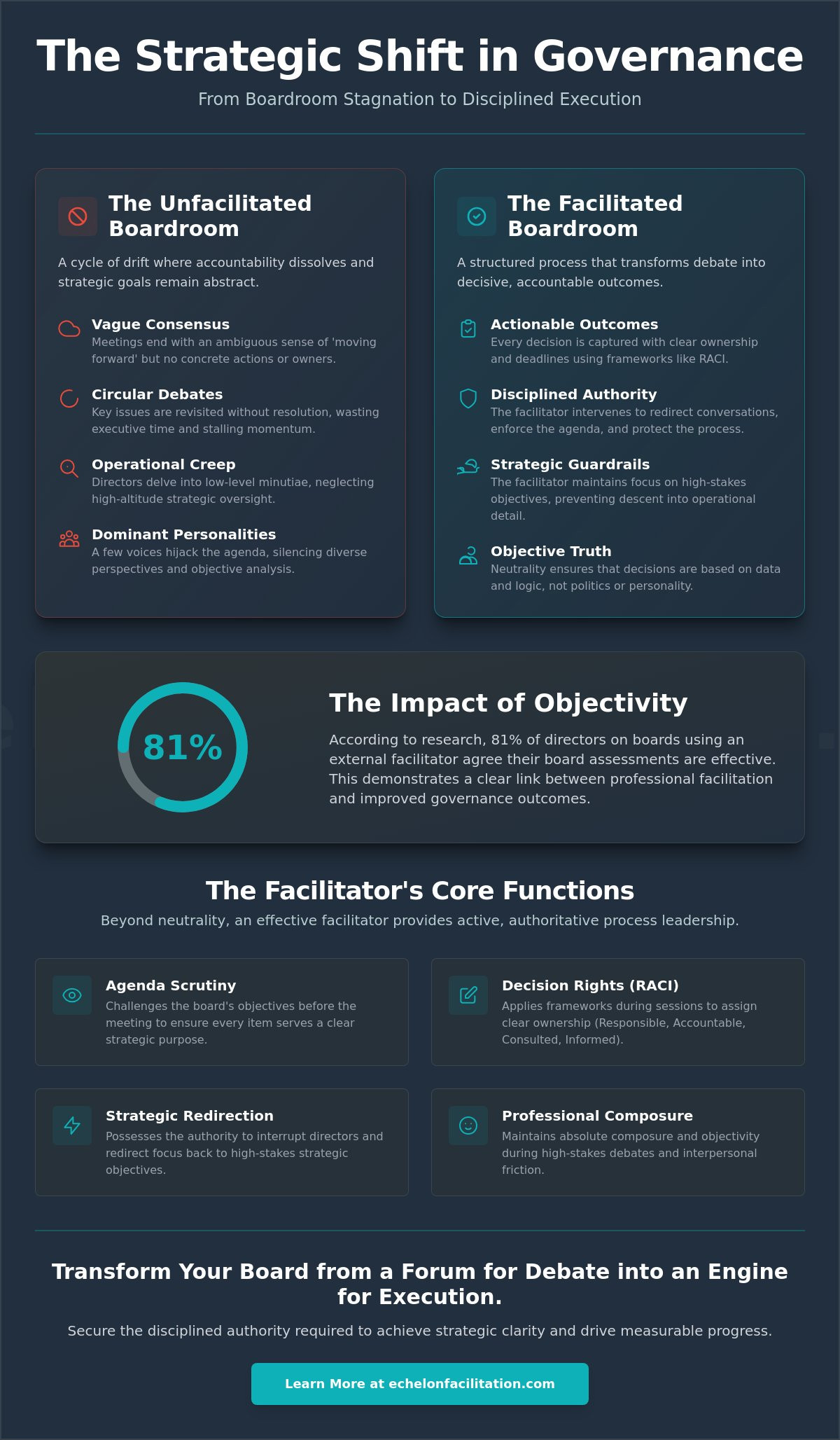
The cost of such indecision is staggering. When boards fail to reach clear outcomes, the organisation drifts without a rudder, wasting executive time and shareholder capital. According to research, 81% of directors on boards that utilise an external facilitator for board assessments agree that their assessments are effective. Yet many chairs still struggle to manage dominant personalities or overrunning agendas alone. Without a strategic board meeting facilitator hire, meetings often devolve into theatre rather than a disciplined mechanism for results.
You recognise that current board dynamics are preventing the rapid execution your strategy requires. A professional board meeting facilitator hire replaces aimless debate with a structured framework for decision-making and ownership. A board meeting facilitator hire transforms stagnant governance into a high-performance engine for strategic execution. Choosing the correct board meeting facilitator hire is the first step toward reclaiming executive accountability.
Key Takeaways
- Identify how a board meeting facilitator hire serves as a strategic lever to transform passive governance into a disciplined engine for execution.
- Recognise why neutrality is insufficient and how the Disciplined Authority Framework allows for the active redirection of stagnant board conversations.
- Apply the RACI framework during sessions to assign clear ownership and ensure every decision results in individual executive accountability.
- Evaluate potential facilitators based on their strategic literacy and their ability to maintain professional composure during high-stakes corporate scenarios.
- Shift board dynamics from circular debate to a structured process that prioritises objective truth and measurable organisational progress.
The Strategic Necessity of a Board Meeting Facilitator Hire
A board meeting facilitator hire is not an admission of administrative failure. It is a calculated strategic lever designed to ensure the highest level of executive performance. Whilst a chairman manages the legal and procedural requirements of the board, an external facilitator focuses entirely on the quality of the thinking and the finality of the decisions. This objective distance is critical. Internal chairs often struggle to remain impartial when their own reputation or department is under scrutiny. By removing the burden of process management from the chair, the board can focus on its primary duty of high-level governance.
Organisations typically seek this expertise during three critical phases: strategy pivots where alignment is fractured, crisis management requiring rapid consensus, and governance resets designed to purge unproductive habits. Adopting this approach demonstrates leadership maturity. It signals that the board values objective truth over comfortable narratives. Understanding The Strategic Necessity of a Board Meeting Facilitator allows leaders to move beyond the logistical challenges of self-facilitation and address the strategic risk of misaligned objectives.
Eliminating Circular Debates and Operational Drift
Boards frequently succumb to operational creep. Directors waste hours debating low-level management details instead of long-term strategy because operational problems are often easier to solve than strategic ones. A professional facilitator implements Strategic Guardrails to keep the conversation at the appropriate altitude. They possess the authority to interrupt directors who delve into minutiae, redirecting the collective focus toward the high-stakes objectives defined in the alignment process.
The ROI of Disciplined Governance
Shareholder confidence relies on the perception of a decisive, unified board. When decisions are swift and transparent, the market reacts with stability. Conversely, the cost of delayed pivots in competitive markets is often measured in lost market share and eroded capital. Securing a board meeting facilitator hire ensures that sessions don't end without actionable outcomes. This discipline creates a clear audit trail of decision rights, providing the transparency that modern investors demand.
Beyond Neutrality: Why a Board Meeting Facilitator Hire Requires Authority
Industry advice often prioritises neutrality, positioning the facilitator as a passive referee. This is a strategic error. In a high-stakes boardroom, passive neutrality is a liability that allows dominant personalities to hijack the agenda. A professional board meeting facilitator hire must instead exercise disciplined authority. This means possessing the professional weight to interrupt a Chief Executive or redirect a Chairman when the conversation drifts from the agreed objectives. This authority is not about personal power; it is about protecting the integrity of the process.
Effective facilitation begins with Agenda Scrutiny. Before the session, the facilitator must challenge the board on its own objectives, ensuring that every item serves a strategic purpose. This process surfaces the objective truth of the organisation’s position, stripping away comfortable narratives that often mask underperformance. By Developing Facilitation Skills rooted in psychological safety and firm boundary-setting, a facilitator ensures that the board remains focused on high-stakes outcomes rather than interpersonal dynamics.
Managing Interpersonal Friction and Challenging Cultures
Consider a hypothetical FTSE 250 board where two founding directors stall a critical merger due to ego-driven friction. The board is paralysed by their history. A facilitator might use Deliberate Silence, refusing to fill the uncomfortable gaps following circular arguments. This forces the founders to reflect on their stated goals versus their current behaviour. By confronting the friction directly, the board can move from personal animosity to a Decision-Rights Reset that prioritises the collective objective.
The 80:20 Rule of Strategic Contribution
A successful session follows a strict ratio: directors provide 80% of the strategic insight whilst the facilitator manages 100% of the process. This structure prevents dominant voices from stifling the quiet experts in the room. The facilitator uses structured contribution windows to ensure every director’s expertise is utilised. This disciplined approach ensures that a board meeting facilitator hire results in a comprehensive analysis of the facts, leading to decisions based on data rather than the loudest voice in the room.
Establishing Decision Rights and the Board Meeting Facilitator Hire
A board meeting facilitator hire provides the structural discipline required to move from vague discussions to definitive action. Without a clear framework, board resolutions often dissipate into a cloud of collective responsibility where no single individual feels the weight of execution. To solve this, we utilise the RACI framework: Responsible, Accountable, Consulted, and Informed. Whilst many organisations use this for project management, its application at the board level is a transformative governance tool that ensures every decision has a clear owner.
Securing a professional board meeting facilitator hire ensures that the 'Accountable' designation is never left ambiguous. Only one director can hold this status for a specific resolution. This prevents the common failure where a board assumes 'everyone' is responsible, which in reality means no one is. During the session, the facilitator forces the board to name this individual. This process, often referred to as a Decision-Rights Reset, clears away overlapping responsibilities and ensures that the Chief Executive and the board are aligned on who owns the final outcome.
To ensure these decisions survive the meeting room, the facilitator maintains a Decision Log. This is not a set of passive minutes; it is a live execution template that records:
- The Decision: A concise, declarative statement of what was agreed.
- The Accountable Owner: The single individual answerable for the result.
- The RACI Matrix: Who must be consulted or informed during implementation.
- The Deadline: A firm date for the first progress report.
Eliminating the Ambiguity of "Group Consensus"
Total consensus is often the enemy of effective strategy. Seeking a solution that everyone likes usually results in a diluted, lowest-common-denominator approach. A professional facilitator identifies when the board is hiding behind consensus to avoid difficult choices. They force a 'Commit or Dissent' stance from every member. This ensures that even if a director disagrees with a direction, they agree to commit to the board’s final decision, eliminating the passive-aggressive resistance that often follows a meeting.
Mapping Post-Meeting Accountability
Execution fails when board decisions aren't linked to operational milestones. We map every board resolution to 30, 60, and 90-day execution targets. This creates a rhythmic cycle of accountability that forces directors to report on tangible progress rather than providing subjective updates. If your current board sessions lack this level of execution clarity, consider a Decision-Rights Reset to re-establish the boundaries of executive authority and ownership.
Evaluating a Facilitator for High-Stakes Sessions
Selecting a facilitator for a high-stakes board session is a governance decision of significant weight. Some industry advice suggests utilising internal staff or "friends of the organisation" to lead these discussions. This is dangerous guidance. Internal facilitators lack the professional distance and objective authority required to challenge a dominant CEO or manage entrenched board friction. A professional board meeting facilitator hire must be evaluated against four rigorous criteria to ensure they can deliver the disciplined environment your strategy demands.
- Strategic Literacy: The facilitator must possess the commercial acumen to speak the language of the P&L and balance sheet. If they cannot grasp the financial implications of a strategic pivot, they cannot guide a board toward a viable decision.
- High-Pressure Track Record: Verify their experience in volatile environments such as M&A integrations, corporate turnarounds, or rapid scaling. These scenarios require a facilitator who remains composed whilst the stakes are at their highest.
- The Stance: Evaluate their willingness to confront senior leadership. A facilitator who lacks the confidence to redirect a Chief Executive is merely an expensive timekeeper.
- Methodology: Demand a structured process for pre-meeting diagnostics and post-meeting follow-up.
The Diagnostic Phase: Ensuring the Right Conversation
The "meeting before the meeting" is the most critical element of a successful engagement. A professional facilitator conducts individual interviews with directors to surface hidden agendas and interpersonal friction before the group convenes. This diagnostic phase ensures the board spends its time solving the right problems rather than debating symptoms. To understand more about our commitment to this level of preparation, you can read about Echelon and our approach to executive alignment.
Logistics and Engagement Structures
Structure must always follow strategy. Whilst a specific problem-solving workshop might be resolved in a single day, comprehensive governance resets or strategy pivots often require a 2-day offsite to allow for deep reflection and finality. Whether you require a focused Strategy Sprint or broader Board & Leadership Sessions, the engagement must be structured to provide the time necessary for clear, actionable outcomes. The location should be neutral, removing the board from daily operational distractions to ensure total focus on the high-stakes objectives at hand.
Reclaiming Boardroom Discipline
Board effectiveness is not a product of group harmony. It's the result of a rigorous, disciplined process that prioritises objective truth over comfortable narratives. Securing a professional board meeting facilitator hire allows you to transition from circular debates and operational drift to a culture of unwavering executive accountability. This shift requires more than a neutral moderator. It demands a partner with the strategic literacy to challenge senior leadership and the methodology to enforce clear decision rights through frameworks like RACI.
At Echelon, led by Dr Andrew Greenland - a medical doctor who has spent years running large, high-stakes working sessions for senior expert groups - we specialise in high-stakes strategic execution. Our focus remains on disciplined authority rather than generic team building, ensuring that sessions result in finality and assigned ownership. Through Decision-Rights Resets and Executive Alignment Sprints, we provide the structural clarity required to drive results in the most complex corporate environments. The success of your organisation depends on the board's ability to make swift, transparent, and binding decisions. Don't allow ambiguity to stall your strategic progress.
Book a complimentary diagnostic call to align your board and establish the discipline your strategy requires.
Frequently Asked Questions
What is the typical cost for a professional board meeting facilitator hire?
Professional fees for a board meeting facilitator hire vary based on the complexity of the organisational challenge and the depth of the pre-meeting diagnostic phase. Rates generally reflect the facilitator's strategic literacy and their experience in managing high-stakes corporate environments. You should expect the investment to cover the bespoke design of the session, individual director interviews, and the development of a post-meeting execution framework.
How far in advance should we engage a facilitator for a board retreat?
Engage a facilitator at least six to eight weeks before your scheduled session. This lead time is essential for a thorough diagnostic phase, which includes individual interviews with directors to surface hidden misalignments. Rushing this process compromises the facilitator's ability to establish the disciplined authority required to drive a successful outcome during the actual retreat.
Can a facilitator help with a toxic board culture or internal disputes?
A facilitator addresses cultural friction by refocusing the board on objective truth and shared strategic goals. Whilst they don't offer formal mediation or legal dispute resolution, they use frameworks like the Decision-Rights Reset to clear up overlapping responsibilities that often cause interpersonal tension. This process forces directors to move past personal grievances and commit to collective organisational objectives through structured contribution windows.
What is the difference between a board facilitator and a management consultant?
Management consultants typically provide external reports and strategic recommendations for the board to review. In contrast, a facilitator manages the group process to ensure the board reaches its own decisions and takes full ownership of the execution. A board meeting facilitator hire ensures that the strategy is driven by the directors themselves, which is vital for establishing long-term executive accountability.
How much preparation time is required from the Board Chair before the session?
The Board Chair should expect to invest approximately three to five hours in the preparation phase. This time is spent on Agenda Scrutiny sessions and reviewing the findings from the facilitator's initial diagnostic interviews. This collaboration ensures that the Chair and facilitator remain aligned on the session’s objectives and the specific friction points that require firm redirection during the meeting.

Article by
Andrew Greenland
Dr Andrew Greenland is the founder of Echelon Facilitation, a UK practice that designs and runs high-stakes leadership sessions for executive teams who need decisions, not more discussion.
A medical doctor and medical educator, Andrew brings a clinician's discipline to the messy, political work of leadership alignment - surfacing the real disagreement, forcing the real choices, and ensuring every session produces a documented decision log with named owners and deadlines.
He designs Echelon’s sessions for CEOs, executive teams, transformation leads and boards. Based in Twickenham.