
A senior director watches a critical product launch stall because three departments cannot agree on who owns the final approval step. This friction often necessitates a business process improvement workshop facilitator to dismantle silos and replace expensive manual workarounds with streamlined flows that actually work.
These inefficiencies carry a heavy price. The global Business Process Management market is projected to reach up to $25.88 billion by 2026 as organisations scramble to fix broken systems. Without a structured intervention, firms frequently sacrifice a significant portion of their revenue to redundant labour and stalled decisions. Effective process management is no longer a luxury; it is a strategic necessity for leaders who demand clarity and total accountability across their operations.
You understand that documentation alone does not change behaviour. This article explains how a professional facilitator identifies bottlenecks and establishes the unambiguous ownership required to transform stagnant processes into efficient workflows. Discover the mechanics of driving operational clarity and reducing overheads through disciplined execution.
Key Takeaways
- Neutralise proximity bias through the intervention of a business process improvement workshop facilitator who prioritises objective truth over internal politics.
- Establish a baseline for clarity using SIPOC and Value Stream Mapping to isolate waste within complex operational workflows.
- Employ structured techniques like the 'Five Whys' to ensure data-driven decisions prevail over the loudest voice in the room.
- Protect post-workshop results by integrating a RACI matrix and a Decision-Rights Reset to enforce individual accountability and clear ownership.
The Role of a Business Process Improvement Workshop Facilitator in High-Stakes Environments
A professional business process improvement workshop facilitator acts as a catalyst for objective truth. They are not merely meeting administrators; they are strategic assets who manage complex group dynamics to extract productive outcomes. High-stakes environments require a facilitator who maintains a calm, stoic presence whilst enforcing the discipline needed to dismantle inefficient legacy systems. This role demands a focus on results over excuses, ensuring that every participant remains accountable to the shared goal of operational excellence.
Internal leaders frequently struggle to lead their own process overhauls due to proximity bias. They are often too close to the friction points to see them clearly, or they fear the political repercussions of challenging established "sacred cows." A facilitator brings disciplined authority, ensuring that the session focuses on operational reality rather than comfortable narratives. This approach is distinct from generic meeting management. It aligns with the rigorous principles of Business process re-engineering, where the goal is a fundamental rethink of how an organisation delivers value.
Overcoming the Internal Blind Spot
Established hierarchies often stifle honest critique. Junior staff may hesitate to point out flaws in a process designed by their superiors, whilst senior leaders might ignore the manual workarounds their teams use to survive. An expert outsider identifies these redundant steps because they have no stake in the status quo. They see the "invisible" waste that internal teams have come to accept as normal, forcing a confrontation with inefficiency that internal leaders often avoid.
Establishing a Neutral Ground for Cross-Functional Dialogue
Operational silos thrive on isolation. When departments collide, the result is usually blame rather than resolution. A professional workshop environment breaks these barriers by prioritising the collective objective over departmental self-interest. The facilitator ensures that data and objective truth take precedence. This shift allows teams to move from defensive posturing to collaborative problem-solving, creating a foundation for scalable growth and total accountability.
Objective Frameworks for Mapping Complex Operational Workflows
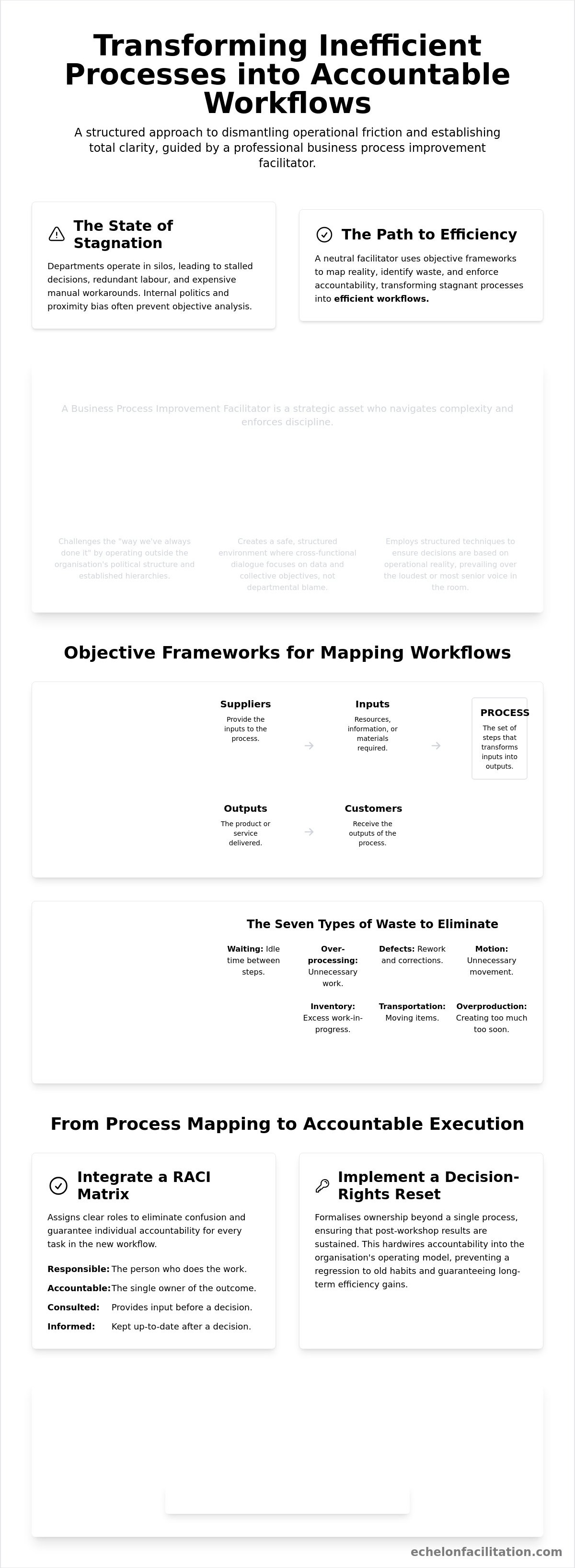
Visualising a process is the first step toward fixing it. A business process improvement workshop facilitator often utilises the 'Brown Paper' methodology to create a physical, high-impact map of current operations. By taping large sheets of paper to a wall and mapping every step with sticky notes, teams confront the physical reality of their complexity. This tactile approach prevents the abstraction common in digital diagrams and forces participants to acknowledge where work actually stalls.
The SIPOC Framework: Defining Boundaries
Discipline begins with clear boundaries. The SIPOC framework (Suppliers, Inputs, Process, Outputs, Customers) serves as a baseline for clarity before any changes are proposed. During a session led by a business process improvement workshop facilitator, SIPOC prevents scope creep by defining exactly where a process starts and ends. It requires the team to identify every stakeholder involved, ensuring that a change in one department does not inadvertently break a critical link elsewhere in the chain.
Value Stream Mapping for Waste Identification
Operational efficiency requires the ruthless elimination of non-value-add activities. Value Stream Mapping (VSM) distinguishes between steps that a customer would pay for and those that exist solely due to legacy friction. Using advanced process improvement analysis techniques, facilitators categorise tasks into seven specific types of waste:
- Waiting: Idle time between process steps.
- Over-processing: Doing more work than the customer requires.
- Defects: Time spent correcting errors.
- Motion: Unnecessary movement of people or data.
- Inventory: Excess work-in-progress clogging the system.
- Transportation: Moving items further than necessary.
- Overproduction: Creating more than is needed.
Consider a hypothetical UK-based manufacturing firm struggling with stagnant delivery schedules. By applying these mapping frameworks during a Strategy Sprint, the leadership team might find that 40% of their lead time is spent in 'waiting' states between departments. Reorganising the approval workflow could then cut total lead times by 30% within a single quarter.
Identifying and Eliminating Hidden Bottlenecks Through Structured Facilitation
Objective data must always override departmental hierarchy. In many organisations, "The Loudest Voice" often dictates the perceived location of operational friction, leading to "fixes" that only shift the bottleneck elsewhere. A business process improvement workshop facilitator neutralises this dynamic by enforcing a data-driven environment where evidence takes precedence over seniority. This discipline is vital because, as research cited by Harvard Business Review suggests, process complexity often conceals hidden costs that erode up to 30% of an organisation's potential revenue.
Identifying these costs requires a facilitator who can navigate interpersonal resistance whilst maintaining a focus on the collective objective. They use structured bottleneck analysis to isolate the specific step where work piles up. Once identified, these points of failure are scrutinised to determine if they are caused by resource constraints, poor information flow, or redundant approval loops. This methodical approach ensures that the leadership team solves the right problem rather than treating a convenient distraction.
Root Cause Analysis: Moving Beyond Symptoms
Symptoms are frequently mistaken for the problem itself. For instance, a professional services firm might identify "missed project deadlines" as their primary issue. A business process improvement workshop facilitator uses the "Five Whys" technique to drill beneath this surface level. They may discover that deadlines are missed because of high rework rates. This rework is caused by vague initial briefs, which in turn stem from a lack of a standardised client intake process. The root cause is the intake workflow, not the speed of the staff. The facilitator maintains a steady, rhythmic pace during this diagnostic phase to prevent the team from settling for easy, superficial answers.
Prioritisation Matrix: Effort vs Impact
Analysis without prioritisation leads to exhaustion. Facilitators use a 2x2 matrix to categorise every proposed improvement into four distinct quadrants:
- Quick Wins: High impact, low effort. These should be executed immediately to build momentum.
- Strategic Projects: High impact, high effort. These require dedicated resources and longer timelines.
- Fill-ins: Low impact, low effort. These are secondary tasks for idle time.
- Thankless Tasks: Low impact, high effort. These should be abandoned.
This framework forces the leadership team to commit to the most valuable interventions first. If your organisation needs to transition from identifying bottlenecks to delivering results, a Strategy Sprint provides the rigorous structure required to execute these prioritised changes with speed and total accountability.
Transitioning from Process Mapping to Accountable Execution
A beautifully drawn process map is worthless if it remains on a whiteboard. Execution requires a shift from collective brainstorming to individual responsibility. Without a formal shift in ownership, a session led by a business process improvement workshop facilitator risks becoming an expensive academic exercise. You must move from the "what" to the "who" with absolute precision to ensure that new workflows do not revert to legacy habits.
This transition demands a "Decision-Rights Reset." Many organisations suffer from consensus-based paralysis where everyone is involved but no one is truly responsible. By the end of the workshop, every new process step must have a single point of ownership. This clarity prevents the diffusion of responsibility that often occurs when cross-functional teams return to their respective silos. Strategic success depends on the disciplined enforcement of these new boundaries from day one.
The RACI Matrix: Eliminating Ambiguity
The RACI matrix is the primary tool for post-workshop success. It removes the ambiguity that leads to operational friction by categorising roles into four distinct areas:
- Responsible: The individual who performs the actual work to complete the task.
- Accountable: The single person who owns the outcome and signs off on the result. There can only be one "A" per task.
- Consulted: Subject matter experts who provide essential input before a decision is finalised.
- Informed: Stakeholders who are updated on progress but do not influence the immediate workflow.
Teams struggling with overlapping authority or chronic indecision often require a Decision-Rights Reset to establish these roles. This framework ensures that the business process improvement workshop facilitator leaves the team with a functional governance model rather than just a diagram.
Maintaining Momentum: The First 30 Days
The first month following a process overhaul is critical. Establish a 30-day execution plan that includes a weekly 15-minute stand-up meeting. During these sessions, the "Accountable" parties report on progress against clear Key Performance Indicators (KPIs), such as the 30% reduction in lead times in the hypothetical manufacturing scenario discussed earlier. These metrics provide the objective truth needed to verify that the new process is working. The facilitator's final duty is to ensure these leaders are empowered to lead the change, maintaining a steady, rhythmic pace of execution until the new behaviour becomes the organisational standard.
Securing Operational Excellence Through Disciplined Execution
Operational clarity is the product of continuous, disciplined execution rather than a one-off mapping exercise. A professional business process improvement workshop facilitator ensures your team moves beyond theoretical diagrams to achieve total accountability. By integrating frameworks like RACI and SIPOC, organisations can eliminate the hidden waste that erodes profit margins. This level of impact requires replacing comfortable narratives with objective truth and establishing clear decision rights across every department.
The transition from stagnant workflows to efficient operations depends on your willingness to challenge the status quo. If your organisation is ready to dismantle silos and establish a foundation for scalable growth, the next step is a rigorous assessment of your current constraints. Book a diagnostic call to identify your operational constraints. Take control of your processes today to ensure your team remains focused on the objectives that matter most.
Frequently Asked Questions
What does a business process improvement workshop facilitator actually do?
A business process improvement workshop facilitator manages the high-stakes dynamics of a session to ensure objective truth prevails over internal politics. They apply rigorous frameworks to map workflows, identify waste, and force decisions on ownership. Unlike a passive administrator, they challenge assumptions and ensure the team remains focused on the primary objective. Their goal is to transition the group from identifying friction to establishing a concrete execution plan with total accountability.
How long should a process improvement workshop last for a senior team?
High-impact workshops for senior teams typically last between one and two days. A single-day session focuses on a specific, high-friction process, whilst a two-day session allows for deeper root cause analysis and a full Decision-Rights Reset. Senior leaders require a compressed, high-intensity schedule that respects their time whilst ensuring no critical detail is overlooked. Anything longer than two days often leads to diminishing returns and decision fatigue amongst the leadership group.
What is the difference between a process facilitator and a management consultant?
A facilitator extracts solutions from your own experts whilst a management consultant typically brings external answers. Consultants often produce lengthy reports that lack internal buy-in, leading to stalled execution and wasted investment. A business process improvement workshop facilitator ensures your team owns the process changes by guiding them to identify their own bottlenecks. This approach builds internal accountability and ensures that the final workflow is practical rather than a theoretical model imposed from the outside.
How do we prepare our data before the facilitator arrives?
Preparation requires gathering objective evidence of current performance. You should compile lead times, error rates, and any existing process documentation. Identify the specific friction points where departments currently clash. Having this data ready allows the facilitator to move straight into analysis rather than spending time on discovery. Objective data prevents the session from devolving into anecdotal arguments and ensures decisions are based on operational reality rather than comfortable narratives.
Can a facilitator help with process improvement in a remote or hybrid team?
Yes, facilitation is highly effective for remote and hybrid teams using digital whiteboarding tools to visualise workflows. The core principles of accountability and clear ownership remain the same regardless of the physical setting. A remote session requires even more discipline to maintain momentum and ensure every participant remains engaged. The facilitator manages the digital environment to ensure that cross-functional dialogue remains focused and that the resulting RACI matrix is clear to all stakeholders.

Article by
Andrew Greenland
Dr Andrew Greenland is the founder of Echelon Facilitation, a UK practice that designs and runs high-stakes leadership sessions for executive teams who need decisions, not more discussion.
A medical doctor and medical educator, Andrew brings a clinician's discipline to the messy, political work of leadership alignment - surfacing the real disagreement, forcing the real choices, and ensuring every session produces a documented decision log with named owners and deadlines.
He designs Echelon’s sessions for CEOs, executive teams, transformation leads and boards. Based in Twickenham.