
A London-based FTSE 250 board sits in silence whilst the CEO and Chairman disagree on a critical acquisition, stalling a £200 million deal. You understand that boardroom friction is inevitable, but when it calcifies into paralysis, the organisation’s survival is at risk.
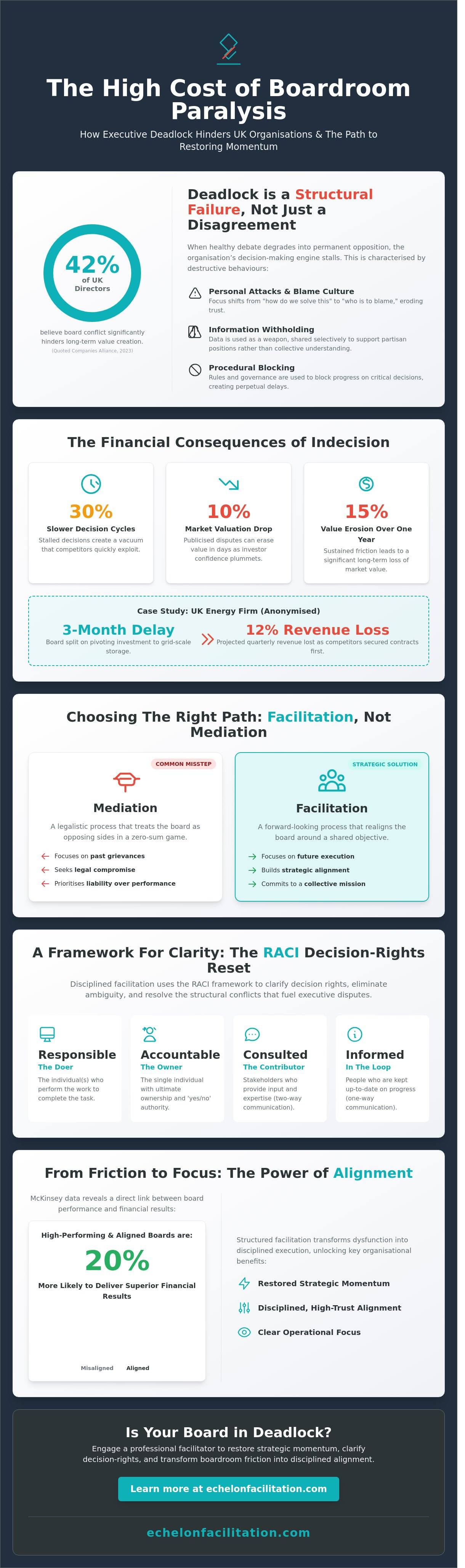
According to a 2023 report by the Quoted Companies Alliance, 42% of UK directors believe board conflict significantly hinders long-term value creation. When trust between executive and non-executive directors erodes, decision-making cycles slow by an average of 30%. This delay creates a vacuum that competitors quickly fill, whilst publicised disputes can wipe 10% off a firm's market valuation within days. Engaging a professional facilitator for board dispute resolution UK is no longer a luxury; it's a necessity for maintaining operational stability and strategic clarity.
This article outlines how disciplined facilitation frameworks restore strategic momentum and clarify decision-rights. You'll discover the mechanics of the RACI model for executive alignment and learn how to transition from deadlock to a focused board committed to its core mission.
Key Takeaways
- Identify why boardroom deadlock is a structural failure that halts organisational momentum and creates an ownership vacuum.
- Differentiate between mediation and facilitation to ensure the board prioritises future execution over past grievances.
- Implement a Decision-Rights Reset using the RACI framework to resolve structural conflict and clarify accountability.
- Establish the criteria for selecting a facilitator for board dispute resolution UK capable of managing high-stakes executive dynamics.
- Restore strategic momentum by transforming boardroom friction into disciplined alignment and clear operational focus.
Facilitator for Board Dispute Resolution UK: Restoring Executive Alignment
A board in deadlock is an organisation in paralysis. When the highest level of leadership cannot reach a consensus, the resulting friction filters down through every layer of the hierarchy, stalling progress and eroding value.
McKinsey data reveals that high-performing boards are 20% more likely to deliver superior financial results, yet 70% of directors report that their boards struggle with inefficiency. In the UK, executive friction often leads to a 15% erosion of market value within one year of a publicised dispute. Adhering to corporate governance principles is essential, but the Chair often lacks the neutrality required to break a structural deadlock without external intervention.
This section examines the structural failure of boardroom deadlock and the financial risks of executive indecision. It explains how a neutral facilitator for board dispute resolution uk restores objective focus and provides a framework for breaking the deadlock.
The Strategic Cost of Boardroom Deadlock in UK Organisations
Board deadlock is not merely a disagreement; it is a structural failure that halts organisational momentum. When directors reach a state of permanent opposition, the decision-making engine of the company ceases to function. This misalignment at the top creates a vacuum of ownership throughout the hierarchy. Without clear direction, middle management becomes hesitant, and operational teams lose sight of the primary objectives. The result is a stagnant organisation that reacts to external pressures rather than driving market change.
The UK Corporate Governance Code places the responsibility for board harmony on the Chair. However, when the Chair is perceived as a partisan actor or is personally embroiled in the conflict, their ability to mediate disappears. Engaging an external facilitator for board dispute resolution uk becomes a necessity to restore the balance of power. This intervention shifts the focus from interpersonal grievances back to the collective mission, ensuring that individual egos do not compromise the long-term viability of the organisation.
The Financial Impact of Executive Indecision
Indecision at the board level carries a heavy price tag. The cost of indecision is most visible in the loss of market share and the rapid decline of investor confidence. When a board cannot agree on a strategic direction, it misses critical windows for innovation or expansion. For instance, imagine a UK energy firm that fails to pivot its investment strategy toward grid-scale storage because the board remains split between legacy asset maintenance and new infrastructure. A three-month delay of this kind can cost a meaningful share of projected revenue as competitors secure the necessary permits and contracts first.
Identifying the Point of No Return
Recognising the signs of leadership team misalignment is vital for timely intervention. Healthy debate is a hallmark of a functional board; it involves the objective analysis of facts and a shared commitment to the best outcome. In contrast, destructive deadlock is characterised by personal attacks, the withholding of information, and the use of procedural rules to block progress. To resolve these issues, we implement a RACI framework (Responsible, Accountable, Consulted, Informed) to clarify decision rights and eliminate the ambiguity that often fuels executive conflict. When debate shifts from "how do we solve this" to "who is to blame," the point of no return has been reached, necessitating a structured resolution process.
Facilitation vs Mediation: Choosing a Facilitator for Board Dispute Resolution UK
Directors often default to legal mediation when boardroom friction becomes disruptive. This reflex prioritises liability over performance. Mediation resolves past grievances through legal compromise; it treats the board as two opposing sides in a zero-sum game. Conversely, a facilitator for board dispute resolution uk treats the board as a single unit struggling with execution. While legal routes satisfy the UK Government's Dispute Resolution Framework for governance and tax remits, they rarely restore the trust required for high-stakes decision-making.
Lawyers are trained to find the middle ground to avoid litigation. This leads to compromise, where every party leaves dissatisfied. Facilitation aims for commitment. It identifies the shared mission and removes the friction points preventing its achievement. The goal isn't to agree on the past; it's to align on the future. When a board is deadlocked, a facilitator for board dispute resolution uk doesn't look for who is right. They look for what is required for the organisation to win.
When to Appoint a Strategic Facilitator
Appoint a facilitator when the dispute involves the "how" of the mission rather than the "what" of legal rights. If the disagreement centres on strategic direction or operational execution, legal mediation is the wrong tool. Use this criteria to decide:
- Does the dispute involve strategic priorities or resource allocation? (Facilitator)
- Are there allegations of breach of contract or fiduciary duty? (Mediator)
- Is the goal to keep the leadership team intact and functional? (Facilitator)
- Is the goal to exit a director or dissolve a partnership? (Mediator)
A facilitator for board dispute resolution uk ensures the board remains focused on organisational health. If the board is deadlocked on a growth strategy, a lawyer searches for voting rights violations. A facilitator searches for misaligned incentives and hidden agendas.
The Neutrality of the External Perspective
Internal chairpersons often struggle to remain neutral because they are part of the board's history. An external expert provides unwavering clarity. They are not beholden to historical alliances or internal politics. This objectivity allows the facilitator to challenge assumptions that directors might be too polite or too intimidated to address. This external perspective replaces comfortable narratives with objective truths.
It forces the board to own the reality of their situation. Effective executive alignment requires this level of detached, professional scrutiny to break the cycle of dysfunction. By removing the emotional weight of past disagreements, the facilitator creates a space where the board can return to its primary function: the disciplined execution of strategy.
Implementing a Decision-Rights Reset to Resolve Structural Conflict
Most boardroom disputes stem from structural ambiguity rather than personal animosity. When executive boundaries blur, friction becomes the default state. A Decision-Rights Reset addresses this by codifying who owns which outcome. This framework ignores the common industry preference for "empathy building," which often fails to resolve underlying power struggles. Instead, it prioritises accountability as the primary lever for alignment.
Engaging a facilitator for board dispute resolution UK ensures that the organisation moves past polite disagreement and into execution. By focusing on the human element through the lens of ownership, boards can eliminate the "grey zones" that lead to 85% of executive-level friction. Clarity is the only functional antidote to political infighting. When every director knows exactly where their authority begins and ends, the need for constant mediation disappears.
The RACI Framework in the Boardroom
Ambiguity regarding "Accountability" is the root cause of most board-level paralysis. The RACI framework provides a definitive map for decision-making. In this model, only one individual can be Accountable for a specific result, whilst multiple people may be Responsible for the execution. This distinction prevents the "too many cooks" syndrome that stalls critical projects. Most disputes occur because three people believe they have the final say, or worse, nobody does.
- Responsible: The individual performing the task.
- Accountable: The one person with final approval and ownership of the outcome.
- Consulted: Stakeholders whose input is required before a decision is finalised.
- Informed: Those notified of the decision after it is made.
Moving from Consensus to Commitment
The pursuit of consensus is a myth that frequently leads to mediocrity and delayed action. Boards don't require total agreement to function; they require total commitment. A Strategy Sprint compresses months of circular bickering into a single day of structured alignment. This process forces the team to confront objective truths and commit to a single path forward, regardless of initial disagreements.
When a facilitator for board dispute resolution UK introduces this level of rigour, the focus shifts from individual ego to the mission. Decisions are made, ownership is assigned, and the board regains its capacity to lead. If your board is stuck in a cycle of indecision, it's time to reclaim executive alignment through a decision-rights audit.
Selecting an Expert Facilitator for Board Dispute Resolution in the UK
Selecting an expert facilitator for board dispute resolution uk is a strategic decision that determines whether an organisation recovers its momentum or descends into terminal dysfunction. A passive mediator cannot manage the friction present in a room of senior directors. The role requires a battle-tested professional who prioritises objective truth over the preservation of comfortable narratives. High-stakes environments demand a facilitator who values discipline and authority. Senior executives often possess strong personalities that can overwhelm standard mediation techniques. An effective facilitator maintains control of the room by focusing on the collective mission rather than individual grievances. They ensure that every voice is heard, yet they do not allow the session to devolve into circular debates or emotional grandstanding.
The Qualities of an Effective Board Facilitator
A facilitator for board dispute resolution uk must possess the professional weight to challenge senior directors. Research by the Harvard Business Review indicates that 43% of board members find their colleagues' behaviour to be the primary barrier to effectiveness. A facilitator must possess the disciplined authority to address these behaviours directly. They must identify the root causes of misalignment without fear of ego-driven pushback. This requires a focus on objective data over subjective opinions and individual accountability for collective failures. The facilitator acts as a corrective lens, forcing the board to see the organisational reality as it is, not as they wish it to be.
The criteria for selection should include:
- Proven Experience: A track record of managing conflict within FTSE 250 or equivalent private equity-backed boards.
- Discipline: The ability to enforce a structured process that prevents the loudest voices from dominating the agenda.
- Authority: A professional presence that commands respect from Type-A personalities and senior executive leaders.
Next Steps: From Conflict to Execution
The Echelon Facilitation approach focuses on radical accountability. We strip away the ambiguity that allows conflict to fester. This process involves identifying decision rights and establishing clear ownership of outcomes. We don't aim for superficial consensus; we aim for absolute alignment on the mission. By removing the human element of friction, the team can return its focus to strategic growth and operational excellence.
The path from a fragmented board to a high-performing executive team begins with a precise assessment of current constraints. Start the process by booking a diagnostic call. This 30-minute session identifies the specific bottlenecks stalling your leadership team. It provides the clarity needed to move from internal friction to external execution. Stop managing the symptoms of board conflict and start addressing the cause.
Re-establishing Boardroom Momentum Through Executive Alignment
Boardroom deadlock isn't just a governance failure; it's a direct threat to organisational stability. Research by PwC indicates that 40% of directors believe at least one peer on their board should be replaced, often due to persistent misalignment. Resolving these disputes requires moving beyond simple mediation toward a structured decision-rights reset. By clarifying who owns specific outcomes and how strategic trade-offs are evaluated, organisations transform friction into a catalyst for growth.
Engaging an expert facilitator for board dispute resolution uk ensures that these conversations remain focused on objective strategic goals rather than personal grievances. Echelon Facilitation, led by Dr Andrew Greenland, a medical doctor who has spent years running large, high-stakes working sessions for senior expert groups, specialises in high-stakes strategy sprints that provide the clarity needed to break through inertia. We bring an independent, structured approach to your most complex structural conflicts, replacing ambiguity with disciplined alignment.
The cost of inaction remains too high for any leadership team to ignore. You can restore the focus of your board and return your organisation to its trajectory of success.
Book a diagnostic call to resolve your board deadlock
Frequently Asked Questions
What is the difference between a board mediator and a facilitator for board dispute resolution UK?
Mediation prioritises a formal settlement to avoid litigation, whereas a facilitator for board dispute resolution UK focuses on restoring functional alignment and decision-making capacity. Mediators often work towards a signed agreement between opposing parties to conclude a legal dispute. Facilitators intervene in the board's operational rhythm to address the underlying friction preventing execution. Research by the Centre for Effective Dispute Resolution (CEDR) suggests that 90% of commercial mediations settle on the day, but facilitation ensures the board remains functional long after the immediate conflict resolves.
How long does a typical board facilitation process take to resolve a dispute?
A standard board facilitation process requires between two and four weeks to reach a sustainable resolution. This timeline includes a 48-hour diagnostic phase involving individual interviews followed by a structured one-day or two-day intervention. Complex cases involving multi-party disagreements or structural reorganisations may extend to six weeks. A study by the Quoted Companies Alliance indicates that early intervention saves an average of 30 days of executive time otherwise lost to internal friction.
Can a facilitator help if the board is completely deadlocked on a strategic decision?
Facilitators break deadlocks by introducing objective decision-making frameworks such as the RAPID model or the Cynefin framework. These tools strip away personal biases and force the board to evaluate the strategic decision against agreed-upon organisational objectives. When a board reaches a 50/50 split, the facilitator identifies the specific data gaps or risk assessments causing the paralysis. This process converts an emotional standoff into a technical problem-solving exercise, allowing the chair to cast a decisive, informed vote.
Is board facilitation confidential for sensitive UK corporate matters?
Confidentiality remains the foundation of all professional board facilitation within the UK corporate sector. All discussions occur under strict Non-Disclosure Agreements and comply with the UK Corporate Governance Code's provisions regarding sensitive information. Facilitators maintain a neutral stance and ensure that session notes remain internal to the board. This secure environment encourages directors to speak with the extreme ownership required to resolve deep-seated issues without fear of public or shareholder repercussions.
How much does it cost to hire a facilitator for board dispute resolution in the UK?
Costs for professional board facilitation vary based on the complexity of the dispute and the seniority of the facilitator. Industry benchmarks from the Civil Mediation Council suggest that professional fees for high-level commercial dispute resolution typically range from £2,500 to £5,000 per day for lead facilitators. This investment represents a fraction of the cost associated with board failure or litigation. According to a 2023 report by the London School of Economics, poorly managed board conflict can reduce a firm’s valuation by up to 20% over a 12-month period.