
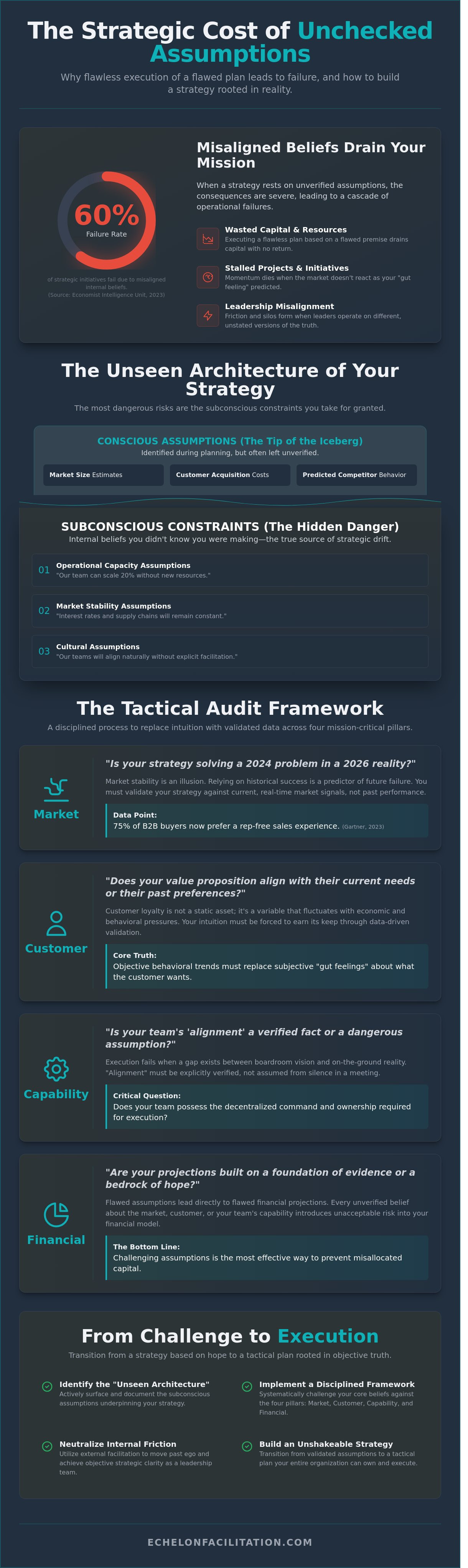
Most executive teams aren't failing because of poor effort; they're failing because they're executing a flawless plan based on a lie. A 2023 study by the Economist Intelligence Unit revealed that 60% of strategic initiatives fail due to misaligned internal beliefs. To win in a shifting market, you must ruthlessly challenge business assumptions before they drain your capital and stall your mission. You've likely felt the friction of a team working at cross-purposes or watched a project stall because the market didn't react as your "gut feeling" predicted. It leads to wasted resources and a leadership team that's out of sync with the objective truth of the field.
It's time to replace intuition with a disciplined, tactical framework. You'll learn a repeatable process for strategic auditing that reduces operational risk through validated data. We'll break down the specific steps to identify hidden biases and ensure every member of your team owns the mission-critical objectives required for victory. This is about moving from passive observation to decisive action. We will outline the mechanics of the Echelon framework, ensuring your next strategic pivot is backed by evidence rather than hope.
Key Takeaways
- Identify the "unseen architecture" of your strategy to prevent misallocated capital and flawed projections.
- Implement a disciplined, commander-level framework to challenge business assumptions and isolate the core facts supporting your mission.
- Neutralize the internal friction of ego and defensiveness by utilizing external facilitation to achieve objective strategic clarity.
- Build an unshakeable strategy by transitioning from validated assumptions to a tactical plan rooted in decentralized command and execution.
The Strategic Cost of Unchecked Business Assumptions
Every strategy rests on an unseen architecture of business assumptions. These are the load-bearing walls of your mission. If these foundations are brittle, the entire organization risks a catastrophic failure during execution. Static assumptions lead directly to flawed projections and wasted capital. A 2023 report by Gartner indicated that 60% of corporate strategies fail because they are built on unverified market data. High-stakes leadership requires you to challenge business assumptions with the same intensity you apply to your quarterly P&L. Comfort with the status quo is a luxury that market shifts quickly punish.
Conscious vs. Subconscious Constraints
Strategic execution requires you to distinguish between what you chose to believe and what you took for granted. You likely identified your conscious assumptions during the planning phase. These involve market size estimates, customer acquisition costs, or predicted competitor behavior. The real danger lies in subconscious constraints. These are the internal beliefs you didn't know you were making about your team's agility or your technological debt.
- Operational capacity assumptions: Believing your team can scale 20% without additional resources.
- Market stability assumptions: Presuming interest rates or supply chains will remain constant for the next 12 months.
- Cultural assumptions: Thinking your decentralized units will align without explicit facilitation and ownership.
Strategic drift is the result of allowing unverified assumptions to steer your mission away from market reality.
The Link Between Assumptions and Misalignment
Friction within the C-suite usually traces back to conflicting hidden assumptions. One leader might assume the mission is market share at any cost; another assumes it is margin protection. These individual gut feelings erode trust because they lack an objective basis. When strategies rely on unstated premises, execution stalls and silos form. This misalignment creates a vacuum where ownership dies and excuses thrive.
Leaders must resolve these conflicts through rigorous tactical re-evaluation to ensure the team remains focused on a single, unified objective. If you find that your executives are operating on different versions of the truth, you must challenge business assumptions to restore clarity. To address these gaps and build a unified front, consider the impact of professional alignment workshops to reset your strategic focus.
Identifying Your Mission-Critical Assumptions
Executive leadership demands more than a cursory glance at a quarterly report. You must apply the Commander’s Intent to your strategy. This means auditing your plan not for what you hope will happen, but for the fundamental truths that must exist for the mission to succeed. When you challenge business assumptions, you strip away the comfort of "business as usual" to reveal the structural integrity of your plan.
High-performing teams prioritize objective truth over comfortable narratives. They recognize that intuition is a powerful tool, but it's often a biased one. In a volatile market, your gut feeling doesn't replace a rigorous, evidence-based strategy. You must categorize your current assumptions into four distinct pillars: Market, Customer, Capability, and Financial. This framework ensures no blind spots remain in your operational theater. If a core belief cannot survive a data-driven interrogation, it shouldn't dictate your resource allocation.
The Market and Customer Audit
Leaders frequently fall into the trap of solving a 2024 problem while the environment shifts toward a 2026 reality. If your strategy assumes market stability, you've already lost the initiative. A 2023 Gartner study revealed that 75% of B2B buyers now prefer a rep-free sales experience. This data directly contradicts the traditional assumption that high-touch relationships are the only way to secure loyalty.
Customer loyalty is not a static asset; it's a variable that fluctuates with economic pressure. You must force your intuition to earn its keep by validating it against current behavioral trends. Don't rely on historical success as a predictor of future performance. Instead, use real-time market signals to determine if your value proposition still aligns with the customer's actual needs rather than their past preferences.
Internal Capability and Resource Assumptions
Execution fails when there's a gap between the boardroom vision and the boots on the ground. One of the most dangerous assumptions a leader can make is that "alignment" exists simply because no one voiced a contradiction. Alignment requires explicit verification. You must confirm that your team has the decentralized command and technical capacity to move the needle by your Q4 2025 deadlines.
Do you actually have the personnel and the infrastructure to execute this mission? If you haven't verified resource availability, you're operating on hope, not strategy. To bridge this gap, leaders must take extreme ownership of their strategic execution through rigorous internal audits. When you challenge business assumptions regarding your team's capability, you move from theoretical planning to tactical readiness. Every resource must be accounted for, and every team member must understand their role in the collective victory.
The Tactical Audit: A Framework to Challenge Business Assumptions
Strategy without scrutiny is a liability. Executive leaders must employ a Tactical Audit to dismantle the biases that cloud decision making and ensure every resource is directed toward a verified objective. This five step framework provides the structure necessary to challenge business assumptions with the precision of a military debrief.
- Step 1: Isolate the Core Objective (The Mission). Define the singular goal. If the mission is to increase Q4 retention by 12%, every subsequent interrogation must relate back to this specific target.
- Step 2: List every 'fact' currently supporting that objective. Document the data points, market trends, and historical performance metrics that justify your current path. Ownership of these facts is mandatory.
- Step 3: Apply the 'Red Team' method to interrogate each fact. Actively seek to disprove the evidence. This step is designed to challenge business assumptions by exposing weak links in your logic before the market does it for you.
- Step 4: Categorize findings into Validated, Risky, or False. Validated facts have 100% data backing. Risky facts rely on projections. False facts are based on outdated 2022 market conditions or anecdotal evidence.
- Step 5: Re-align the strategy based on the new objective reality. Pivot the execution plan to rely only on validated truths and mitigated risks.
Applying the Red Team Method
Assign a specific leader to the Devil’s Advocate role during every high-stakes briefing. This individual has the explicit mandate to find flaws in the prevailing narrative without fear of professional reprisal. Creating this safe environment for disciplined dissent is the only way to neutralize groupthink. A 2022 study by the Journal of Applied Psychology indicated that teams practicing structured dissent made 25% more accurate forecasts than those seeking immediate consensus. Leaders can refine these skills through strategic workshops that focus on decentralized command and objective truth.
The 'What If' Scenario Analysis
Stress-testing your strategy requires looking for the single point of failure. Identify the one variable, such as a 15% increase in raw material costs or a sudden shift in regulatory policy, that would render your current plan obsolete. A pre-mortem is a strategic exercise where a team imagines a project has already failed and works backward to identify the specific causes of that hypothetical disaster. This process forces the team to confront uncomfortable possibilities before they become operational crises. Tactical success depends on your ability to remain composed when these "what if" scenarios become reality.
Facilitating the Perspective Shift in Leadership Teams
Leadership teams often operate within an echo chamber. Confirmation bias creates a feedback loop where legacy strategies go untested because they've become part of the corporate identity. To effectively challenge business assumptions at the executive level, you need a catalyst that exists outside the internal hierarchy. Internal leaders carry the weight of past decisions and departmental loyalties. This proximity makes objective analysis nearly impossible. A neutral third party provides the distance required to view the mission with tactical clarity.
The human element is the primary barrier to strategic evolution. Ego and ownership often manifest as defensiveness. When a leader has spent 12 years building a specific vertical, they view any challenge to that vertical's assumptions as a personal critique. This creates silos where leaders prioritize "protecting their patch" over the collective mission. Professional facilitation neutralizes this friction. It shifts the focus from individual performance to objective truth. This process isn't about finding fault; it's about ensuring the organization's survival and growth through disciplined alignment.
Breaking the Cycle of Comfortable Narratives
Every organization harbors "Sacred Cows." These are the legacy processes or market beliefs that remain unchallenged because they're comfortable. According to a 2023 study by the Strategic Management Institute, 68% of failed corporate pivots were linked to leadership teams refusing to abandon outdated core assumptions. You can't dismantle these narratives through standard meetings. You need a structured environment that forces a perspective shift. Utilizing Echelon Facilitation Workshops allows teams to stress-test their beliefs in a controlled, high-stakes setting. This approach strips away the fluff and leaves only the data that supports the mission.
Building Collective Ownership of the New Strategy
Alignment is the bridge between a plan and its execution. If a single leader doesn't buy into the validated assumptions, the entire strategy is at risk of decentralized failure. The transition from the "challenging" phase to the "execution" phase requires 100% buy-in. This isn't about reaching a polite consensus; it's about achieving extreme ownership. When every leader understands the "why" behind the shift, they can lead their own teams with unwavering confidence. This collective commitment ensures that when the mission begins, the team moves as a single, disciplined unit. You don't just need a new plan. You need a team that's ready to own it.
Ready to eliminate the blind spots in your strategy? Schedule a Facilitated Strategy Session to align your leadership team and secure the mission.
From Challenge to Execution: Building Unshakeable Strategy
Validation is worthless without a clear path to execution. Once you successfully challenge business assumptions, the resulting insights must be codified into a tactical plan that drives the mission forward. This transition requires decentralized command. Leaders cannot micromanage every pivot. Instead, you must empower subordinates to make decisions based on the new reality. A 2023 study by the Harvard Business Review found that organizations with decentralized decision-making structures respond 2.5 times faster to market shifts than centralized counterparts. Strategic clarity comes from knowing that your team understands the intent behind every shift.
Strategy is never static. It is a living document that requires constant refinement as new data enters the theater of operations. When you dismantle a false constraint, you create a vacuum. Fill that space with disciplined action. The final goal is unshakeable leadership confidence. This confidence isn't born from arrogance. It is forged through the knowledge that your strategy is built on objective truth rather than comfortable myths. You must maintain a steady rhythm of assessment to ensure that today's solutions don't become tomorrow's blind spots.
Establishing a Cadence of Accountability
You must revisit your core beliefs without stalling momentum. Establish "tripwires" for every major initiative. These are specific, quantifiable metrics that signal when an assumption needs immediate re-testing. For example, if customer acquisition costs exceed $150 or if project milestones slip by more than 10 days, the team must halt and re-evaluate the underlying premise. This disciplined focus ensures the team remains aligned with the mission. The leader's role is to enforce these boundaries. You provide the stability required for the team to operate with speed and precision. Accountability is the mechanism that prevents strategic drift and ensures that every resource is allocated toward victory.
- Set quarterly "Assumption Audits" to review the five most critical drivers of your current strategy.
- Define clear "Red Lines" that, when crossed, trigger an automatic tactical pause.
- Ensure 100% alignment on mission objectives before delegating execution to department heads.
Conclusion: The Commander’s Final Review
Leaders must take extreme ownership of the truths that govern their organizations. If you allow unverified assumptions to dictate your path, you've already surrendered the initiative. High-stakes environments demand a relentless pursuit of clarity. You've seen the framework. You understand the risks of complacency. Now, you must act. Dismantle the constraints that hold your team back and replace them with a strategy forged in reality. Victory belongs to those who refuse to be blinded by their own past successes.
If you're ready to secure your organization's future and challenge business assumptions that are limiting your growth, the next step is a deep dive into your operational DNA. Book a Strategic Diagnostic with Echelon Facilitation to begin the process of building an unshakeable strategy.
Secure Your Strategy Through Decisive Alignment
Unchecked assumptions are the silent failure points of any high-stakes operation. This guide has outlined the tactical audit framework and the perspective shifts required to move from vulnerability to unshakeable execution. You've learned how identifying mission-critical blind spots prevents strategic drift and secures your foundation. To effectively challenge business assumptions, leadership teams must trade comfortable narratives for objective truth. This discipline ensures that every resource is aligned with the actual operational reality rather than a flawed projection.
Alignment doesn't happen by accident. Dr Andrew Greenland, a medical doctor who has spent years running large, high-stakes working sessions for senior expert groups, founded Echelon Facilitation to bring that discipline to executive alignment. Echelon uses a disciplined, structured facilitation framework that prioritises objective truth over internal politics. We focus on the human element of leadership to ensure every member takes extreme ownership of the mission. This isn't just theory; it's the practical mechanics of organizational victory.
Take the first step toward a strategy that lands with impact. Book a Strategic Diagnostic with Echelon Facilitation to stress-test your roadmap. Your next objective is within reach when you lead with precision.
Frequently Asked Questions
What are the most common business assumptions that fail?
Market stability and permanent customer loyalty are the primary assumptions that lead to organizational failure. A 2023 study by CB Insights found that 35% of startups fail because there's no market need, often rooted in the false assumption that customers want the product. Other failures stem from the belief that historical 5% annual growth rates will continue regardless of new competitors or shifting economic cycles. Leaders must identify these blind spots before they compromise the mission.
How often should a leadership team challenge its business assumptions?
Executive teams must audit their core assumptions every 90 days during quarterly strategic reviews. This cadence ensures that the mission remains aligned with current market realities. Waiting for an annual retreat is too slow; the 2022 Gartner report on strategic planning notes that organizations with agile review cycles are 2.5 times more likely to outperform their peers in volatile markets. Regular intervals prevent the accumulation of strategic debt.
Can challenging assumptions lead to strategic paralysis?
Paralysis only occurs when leadership lacks a disciplined framework for decision-making. To avoid this, set a hard 48-hour deadline for moving from assumption testing to execution. Indecision is a failure of leadership, not a result of inquiry. Effective teams use red teaming to challenge business assumptions without losing momentum, ensuring the mission stays on track while mitigating 15% to 20% of avoidable risks.
How do I challenge my CEO's assumptions without causing conflict?
Present objective data and frame the challenge as a method to protect the mission rather than a personal critique. Use the 5 Whys technique to uncover the root of the assumption. When 60% of executives cite internal politics as a barrier to change, decentralized command becomes essential. Focus on the 3 core KPIs that the assumption impacts to keep the conversation grounded in tactical reality and professional respect.
What is the difference between a business assumption and a hypothesis?
An assumption is an unverified belief taken as truth, whereas a hypothesis is a testable statement designed for validation. Assumptions are often invisible and dangerous. A hypothesis requires a specific metric, such as a 10% increase in conversion, to prove its validity. Shifting from blind assumptions to rigorous hypotheses reduces resource waste by 25% according to Lean Methodology standards. This transition is vital to challenge business assumptions effectively.
Why is external facilitation better for challenging assumptions?
External facilitators provide the objective distance required to identify cognitive biases that internal teams often overlook. In-house teams suffer from groupthink in 75% of high-pressure scenarios. A professional facilitator enforces discipline and ensures extreme ownership of the outcome. They act as a neutral party who can ask the difficult questions that internal hierarchies might suppress, leading to 30% better alignment across the executive suite.
What tools can help identify hidden assumptions in a strategy?
Use the Assumption Mapping matrix and the Pre-Mortem technique developed by Gary Klein in 2007. These tools force teams to imagine a project has failed 12 months in the future and work backward to find the cause. This process uncovers hidden risks that 80% of standard SWOT analyses miss. Mapping assumptions based on importance and certainty provides a clear roadmap for tactical execution and immediate risk mitigation.
How do I know if an assumption has been successfully validated?
Validation is complete when you possess empirical data that confirms a specific outcome within a 95% confidence interval. You shouldn't rely on gut feelings or anecdotal evidence. If a pilot program yields a 12% increase in efficiency over a 30-day period, the underlying assumption is confirmed. Successful validation means the assumption is now a proven fact that can support the weight of your strategic mission and long-term objectives.