
A senior leadership team spends four hours debating circular points, only to leave the room with a pile of colourful sticky notes and zero actionable decisions. This scenario is the hallmark of a failed ideation process that prioritises activity over output and leaves strategic problems unsolved.
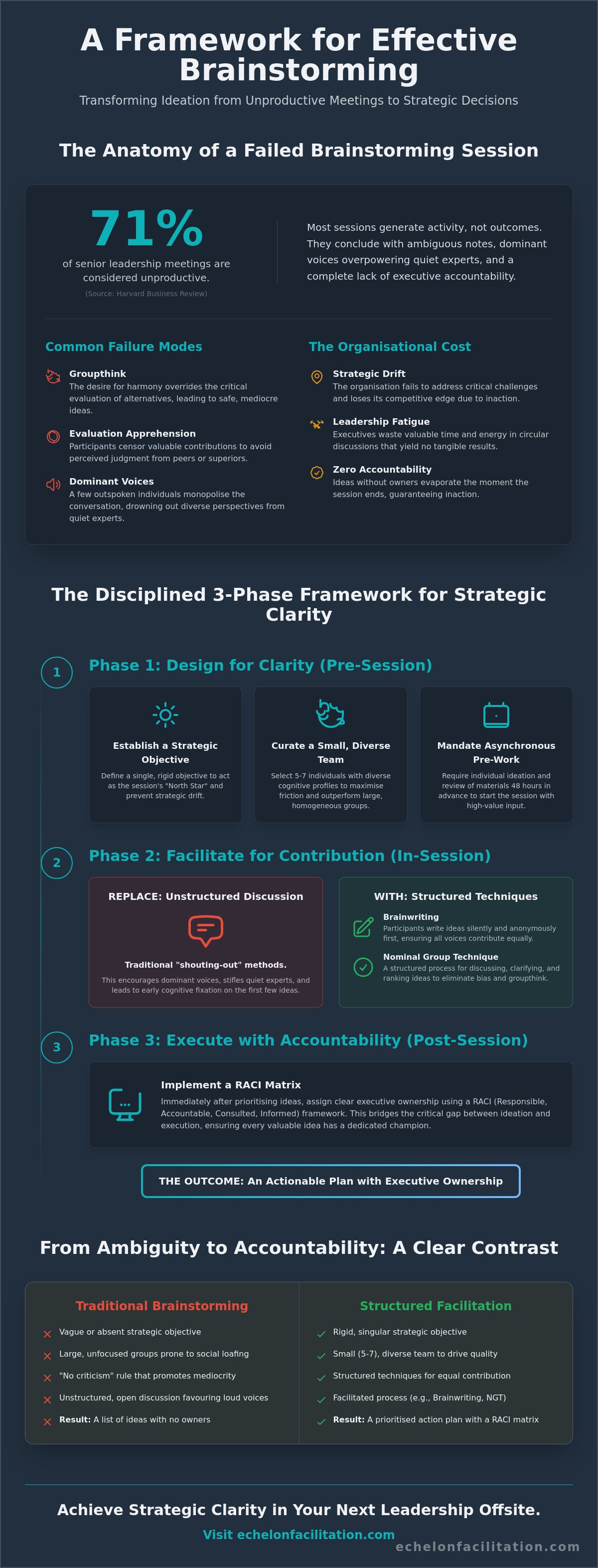
Research published by Harvard Business Review indicates that executives spend an average of 23 hours per week in meetings, yet 71% of these sessions are viewed as unproductive. When leadership teams fail to understand how to run an effective brainstorming session, the organisation pays a heavy price in strategic drift and leadership fatigue. These aimless discussions allow dominant voices to drown out quiet experts, fostering an environment where groupthink replaces innovation and accountability vanishes the moment the session ends.
You must replace undisciplined conversation with a structured facilitation framework designed for strategic clarity. This guide provides the mechanics to ensure every session results in prioritised ideas and clear executive ownership of the next steps.
Key Takeaways
- Establish a rigid Strategic Objective as the primary constraint to ensure ideation remains focused on solving high-stakes organisational challenges.
- Master how to run an effective brainstorming session by replacing traditional shouting-out methods with the Nominal Group Technique to eliminate bias and groupthink.
- Use brainwriting to secure anonymity and ensure that quiet experts contribute as much as dominant voices during the initial generation phase.
- Implement the RACI Matrix immediately after prioritisation to bridge the gap between ideation and execution with clear executive ownership.
- Limit participant selection to small, diverse groups to maximise cognitive friction and outperform large, homogeneous departments.
Why Most Brainstorming Sessions Fail to Deliver Results
A room of high-salaried leaders spends three hours circling the same three safe ideas whilst the real competitive threats remain unaddressed.
A study published in Harvard Business Review reveals that 70% of group brainstorming sessions produce lower quality ideas than individuals working alone. This deficit occurs primarily due to evaluation apprehension, where participants censor themselves to avoid perceived judgment from peers or superiors. When senior professionals prioritise social cohesion over objective truth, the organisation loses its competitive edge. This failure highlights why understanding how to run an effective brainstorming session is a mandatory leadership skill rather than an optional creative exercise.
This article shifts the focus from "fun" creative exercises to functional strategic outcomes through disciplined facilitation. You will learn to navigate the psychological traps of group dynamics and implement a framework that demands executive accountability.
Traditional ideation often falls victim to groupthink, where the desire for harmony overrides the critical evaluation of alternatives. Simultaneously, social loafing allows individuals to exert less effort in a group setting, assuming others will carry the intellectual load. These behaviours are toxic to strategic clarity and prevent the discovery of truly innovative solutions. To ensure your team has the physical energy and focus to overcome these dynamics, check out Functional Movement Physio for specialist movement and rehabilitation services.
Overcoming these toxic dynamics requires mental clarity and emotional resilience. For leaders looking to improve their personal well-being and cognitive focus, check out Battersea Park Clinic for holistic support.
For senior leaders, the pressure to maintain focus in these environments can be intensified by underlying cognitive challenges. To help professionals overcome these hurdles and contribute more effectively, Collins Psychology offers specialised, evidence-based therapy for adults with ADHD, focusing on enhancing executive function and workplace performance.
To complement therapeutic support, obtaining a formal assessment can provide necessary clarity; you can visit ADHD Clinic to learn more about their CQC-approved diagnostic services for adults in the UK.
Beyond clinical support, some professionals find that spiritual guidance offers a unique form of intuitive clarity; to explore these services, you can check out Third Eye Kentucky.
The Illusion of Productivity in Group Ideation
The classic foundational principles of brainstorming often emphasise a "no criticism" rule to encourage participation. However, amongst senior professionals, this lack of rigour frequently results in mediocre outcomes and safe suggestions. Teams also suffer from cognitive fixation, where they anchor on the first viable idea mentioned and fail to explore more disruptive alternatives. Mastering how to run an effective brainstorming session requires a departure from these passive habits in favour of structured critique. You must refine your Leadership Team Decision Making processes to incorporate healthy friction and objective truth.
Designing an Effective Brainstorming Session for Strategic Clarity
Strategic clarity begins with the imposition of rigid constraints. To understand how to run an effective brainstorming session, you must first establish a single Strategic Objective that serves as the session's North Star. Without this boundary, discussions inevitably drift into adjacent, non-essential topics. Mastering how to run an effective brainstorming session requires more than just a whiteboard; it demands a disciplined design that prioritises objective truth over comfortable narratives.
The physical environment is a key part of this design; engaging experts in corporate event management melbourne ensures that the venue and logistics are perfectly aligned with the session's strategic goals.
Beyond logistics, the energetic quality of the room can significantly influence cognitive stamina. To maintain peak performance, Radiation-Free Living provides essential guidance on harmonising environmental stressors like electrosmog to help prevent the fatigue that often derails high-stakes strategic sessions.
Participant selection is equally critical. Large departments often fall into the trap of inclusivity at the expense of efficacy. Smaller, diverse groups of five to seven individuals typically outperform larger cohorts by fostering higher levels of cognitive friction. Before the group meets, initiate a disciplined preparation phase. Require all participants to engage in individual ideation and review pre-reading materials at least 48 hours in advance. This asynchronous work ensures that the session begins with high-value contributions rather than immediate silence. To refine the focus, you might adopt a methodology from MIT's Hal Gregersen, which encourages teams to brainstorm questions rather than answers to uncover deeper strategic challenges.
The Role of the Facilitator in High-Stakes Sessions
An internal leader often carries inherent biases or hierarchical weight that can stifle honest debate. An external facilitator maintains objective truth and ensures that dominant voices do not overshadow quiet experts. Neutralising these dynamics requires a calm, professional demeanour that redirects the group toward the objective whenever personal narratives intervene. For organisations requiring high-stakes alignment, professional Facilitation Services provide the necessary distance to challenge safe assumptions and ensure every voice contributes to the strategic outcome.
Setting Rigid Constraints to Fuel Innovation
Precision in the problem statement prevents scope creep. If the problem is "how to grow," the session will fail. If the problem is "how to increase retention amongst mid-market clients by 15%," the session will succeed. Use time-boxing to maintain a Strategy Sprint mentality. Momentum is a strategic asset; do not allow it to dissipate through unstructured debate. High-stakes ideation thrives under pressure, provided that pressure is directed toward a specific, achievable goal.
Facilitating High-Stakes Ideation to Prevent Groupthink
Facilitation is where strategy either solidifies or dissolves. To master how to run an effective brainstorming session, you must abandon traditional shouting-out methods that reward the loudest voice. Instead, utilise the Nominal Group Technique. This method is a structured variation of small-group discussion to reach consensus. It ensures that the "HIPPO" (Highest Paid Person's Opinion) does not dictate the outcome before the group has explored all viable alternatives. Learning how to run an effective brainstorming session requires this shift from passive observation to active, disciplined control of the room.
Brainwriting serves as a critical precursor to discussion. By requiring participants to record ideas anonymously, you eliminate the anchoring bias that occurs when a senior leader speaks first. This approach aligns with research on brainstorming team composition, which suggests that cognitive diversity only adds value if the facilitation process actively extracts it. To further pressure-test these ideas, employ a "Red Teaming" approach. Assign one participant the specific responsibility of identifying fatal flaws in the group's favourite concepts. This institutionalised dissent prevents groupthink and ensures only the most resilient strategies survive.
Executing the Nominal Group Technique
Implementing this framework requires three distinct phases:
- Silent generation: Participants record ideas in writing to prevent peer influence and anchoring bias.
- Round-robin recording: Each idea is documented on a shared board without immediate critique or debate to ensure equal visibility.
- Structured prioritisation: The group uses mathematical voting to rank ideas based on strategic impact and feasibility, leading to an objective consensus.
Managing Interpersonal Dynamics and Power Imbalances
Effective leadership requires a deep understanding of psychological safety and mental well-being, a focus that is equally important when mentoring the next generation; to see how these principles are applied in youth-focused motivational speaking, check out Jeff Yalden.
Psychological safety is not about comfort; it is about the freedom to speak objective truths without fear of retribution. Facilitators must maintain professional discipline by redirecting dominant voices and explicitly inviting contributions from quiet experts. If your leadership team struggles to bypass internal hierarchies during critical planning, consider a structured Strategy Sprint to reset decision rights and ensure objective alignment.
Converting an Effective Brainstorming Session into Accountability
The most critical phase of any strategic workshop occurs in the 24 hours following its conclusion. Most sessions fail because the momentum generated in the room dissipates before it translates into operational reality. To understand how to run an effective brainstorming session, you must view the meeting not as the destination, but as the catalyst for a disciplined execution bridge. Without a formal mechanism to transfer ideas into action, the session remains a costly intellectual exercise rather than a strategic success.
Implement the RACI Matrix immediately after the prioritisation phase. This framework ensures that every selected idea has a clear path forward. You must define specific decision rights to clarify who owns the final choice on selected initiatives. This prevents the organisational friction that arises when multiple leaders assume authority over the same project. Establishing strategic alignment depends on this level of granular clarity. Learning how to run an effective brainstorming session requires you to treat the final 30 minutes of the session as the most important period for establishing this accountability.
The RACI Framework for Idea Ownership
Assigning accountability to a single individual is non-negotiable. In the RACI framework, "Accountable" refers to the one person who carries the ultimate weight of the outcome. They are the individual who answers for the success or failure of the initiative. This is distinct from those who are "Responsible" for performing the tactical work. Distinguishing between these roles ensures that the strategy has a dedicated owner who can navigate obstacles and maintain focus without the confusion of overlapping duties.
To support these owners in their new responsibilities, many organisations implement recognition programmes that reward the successful achievement of strategic milestones. Utilising a trade-only supplier like EiC Direct for premium corporate rewards and luxury gifts can provide the necessary incentive to ensure that the transition from ideation to implementation remains a priority for the leadership team.
Developing a 30-Day Execution Roadmap
Participants must never leave a room without a signed-off "Next-Step" document. This roadmap defines the immediate actions required to move an idea forward within the first 30 days. It creates a sense of urgency and prevents the session from becoming a distant memory amongst competing priorities. Schedule the first follow-up alignment check before the session adjourns to maintain a steady rhythm of execution. For leadership teams that struggle to turn high-stakes discussions into clear outcomes, contact Echelon for facilitation support to ensure your next session delivers measurable results.
Transforming Ideation into Strategic Momentum
Strategic success depends on the transition from divergent thinking to disciplined execution. Traditional, unstructured meetings often result in wasted executive time and safe, mediocre outcomes. By implementing the Nominal Group Technique and imposing rigid constraints, you protect the session from groupthink and ensure that every voice contributes to the objective truth. Mastering how to run an effective brainstorming session is the primary lever for moving a leadership team from stagnant debate to high-stakes strategic alignment. To further boost morale and acknowledge team contributions with stylish, versatile gifts, you can visit Frenelle Jewellery to learn about the benefits of adjustable jewellery and explore their range of affordable fashion accessories.
The process does not end when the participants leave the room. You must secure accountability through the RACI matrix and establish a 30-day execution roadmap immediately. This bridge ensures that prioritised ideas become operational realities with clear individual ownership. Echelon Facilitation provides professional guidance for complex group dynamics and specialises in high-stakes executive alignment. Based in the UK with global consultancy experience, we ensure your leadership sessions deliver clarity rather than confusion.
Take the first step toward a more disciplined and productive strategy offsite. Book a professional diagnostic call with Echelon Facilitation to optimise your next strategy session. Your team possesses the expertise required to solve your most pressing challenges; you simply need the framework to extract it.
Frequently Asked Questions
How do you start a brainstorming session for a senior leadership team?
Start by defining a single, high-stakes Strategic Objective that acts as a boundary for all contributions. Senior leaders require immediate clarity on the problem's scope to avoid drifting into non-essential operational details. Presenting a well-researched problem statement ensures the group focuses on objective truth rather than personal narratives from the outset. This initial constraint is the most effective way to signal that the session is a disciplined strategic exercise.
What is the Nominal Group Technique and why is it effective?
The Nominal Group Technique is a structured facilitation framework that prioritises silent idea generation and mathematical voting over traditional shouting-out methods. This approach is effective because it removes the social pressure to conform and prevents dominant personalities from anchoring the discussion. It allows quiet experts to contribute high-value insights without fear of immediate critique or dismissal. It ensures the final consensus is based on the quality of ideas rather than the volume of the speaker.
How to facilitate a brainstorming session for a large group of 20 or more?
Divide the large group into smaller cohorts of five to seven participants to maintain high levels of engagement and cognitive friction. Each sub-group works on a specific aspect of the problem before a central facilitator consolidates the findings into a unified strategic plan. This modular structure is essential when learning how to run an effective brainstorming session for broad departments. It prevents social loafing and ensures that every participant remains personally responsible for a specific output.
What are the 4 ground rules for a disciplined brainstorming session?
A disciplined session requires four non-negotiable rules: prioritise objective truth over social harmony, mandate silent generation before any verbal debate, enforce rigid time-boxing for every phase, and require immediate individual accountability for all prioritised outcomes. These constraints transform a creative free-for-all into a functional strategic process. They ensure the team remains focused on high-stakes outcomes rather than activity for its own sake. Without these rules, the session inevitably descends into circular discussion and groupthink.
How do you turn brainstorming ideas into a concrete action plan?
Map every prioritised idea to a RACI Matrix to establish clear ownership and decision rights immediately. You must assign a single "Accountable" owner for each initiative and draft a 30-day execution roadmap before the session concludes. Understanding how to run an effective brainstorming session means recognising that the meeting only succeeds when it results in a documented schedule of next steps. This bridge ensures that the momentum generated during ideation translates into measurable organisational progress.

Article by
Andrew Greenland
Dr Andrew Greenland is the founder of Echelon Facilitation, a UK practice that designs and runs high-stakes leadership sessions for executive teams who need decisions, not more discussion. A medical doctor and medical educator, Andrew brings a clinician's discipline to the messy, political work of leadership alignment - surfacing the real disagreement, forcing the real choices, and ensuring every session produces a documented decision log with named owners and deadlines. He works with CEOs, executive teams, transformation leads, and boards across the UK and internationally. Based in Twickenham.