
Last Tuesday, a Chief Executive watched her leadership team debate for six hours only to leave the boardroom with the same misalignments they'd started with. You likely agree that these wasted hours represent a failure of process rather than a lack of talent. This article demonstrates how to improve Echelon Facilitation to ensure every engagement delivers total strategic clarity and decentralised command.
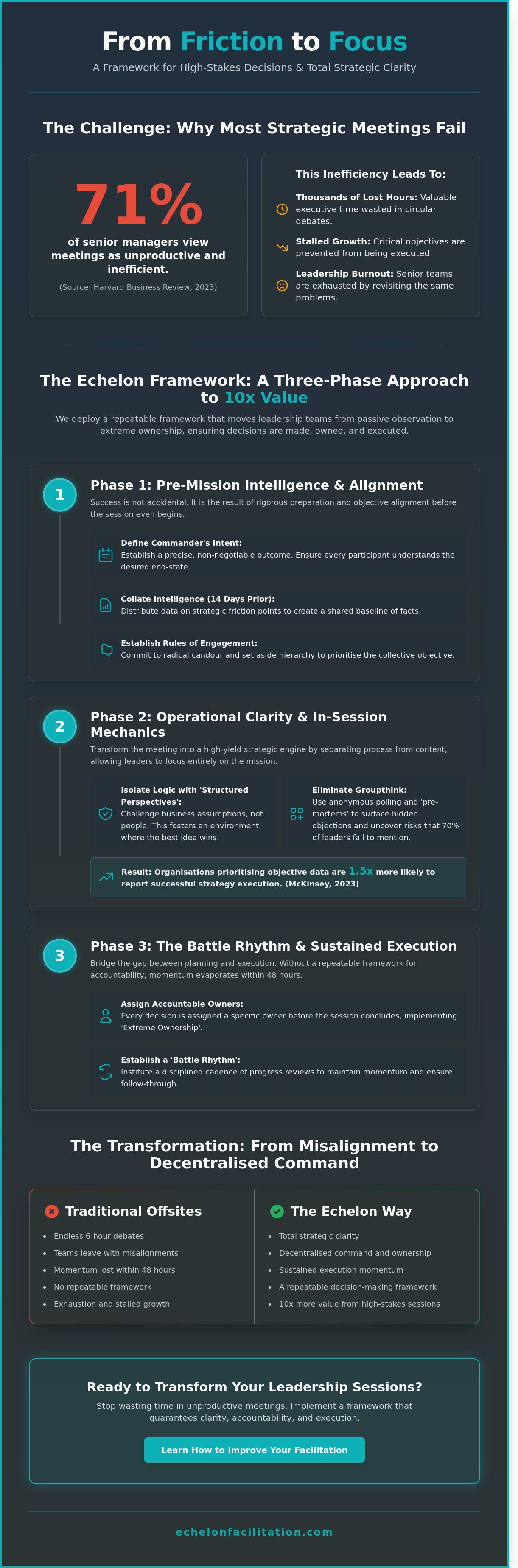
A 2023 study by the Harvard Business Review found that 71% of senior managers view their meetings as unproductive and inefficient. For a large organisation, this friction results in thousands of lost hours and prevents the execution of critical objectives. When strategic offsites fail to produce a repeatable framework for accountability, the momentum typically evaporates within 48 hours. This lack of follow-through forces leaders to revisit the same problems repeatedly, stalling growth and exhausting the senior team.
We will examine the specific mechanics required to extract 10x more value from your high-stakes sessions and provide a repeatable framework for decision making. You'll learn how to move from passive observation to extreme ownership across your entire executive tier.
Key Takeaways
- Define the primary objective before the session to ensure all participants align with the intended strategic outcome.
- Learn how to improve Echelon Facilitation by applying structured frameworks that challenge core business assumptions without causing interpersonal friction.
- Secure long-term results by assigning a specific, accountable owner to every decision before the session concludes.
- Bridge the gap between planning and execution by establishing a disciplined rhythm of progress reviews following the workshop.
- Understand why effective facilitation requires senior leaders to take full ownership of the process rather than delegating responsibility to a moderator.
Defining the Mission: Setting the Stage for Facilitation Success
Professional facilitation is a strategic necessity, not a luxury. High-stakes decision-making often stalls when leadership teams lack a neutral party to navigate complex organisational friction. Learning how to improve Echelon Facilitation begins with establishing a precise Commander's Intent. This concept ensures every participant understands the desired end-state before the session begins. Without this clarity, meetings devolve into circular discussions that waste time and capital. Success is not accidental; it is the result of rigorous preparation and objective alignment.
Leadership teams must identify the Critical Constraints currently hindering their performance. Whether it is a 15% drop in operational efficiency or a disconnect between regional departments, these barriers require objective analysis. Success depends on adhering to established business facilitation principles to ensure the process remains focused on results rather than personal agendas. Establish non-negotiable outcomes early. A session is only a victory if it produces a signed-off roadmap or a definitive resource allocation plan that addresses these constraints head-on.
The Pre-Mission Intelligence Brief
Effective preparation requires data collation at least 14 days before the workshop. Leaders should identify strategic friction points and distribute this intelligence to all participants. This ensures everyone understands the rationale for the engagement and enters the room with a shared baseline of facts. Define the Rules of Engagement clearly. Radical candour is essential. Participants must commit to honest dialogue and set aside hierarchy to prioritise the collective objective. When everyone knows the "Why" behind the engagement, resistance diminishes and focus increases.
Aligning the Leadership Core
Identify the primary decision-makers and their specific responsibilities within the session. Use a RACI (Responsible, Accountable, Consulted, Informed) framework to clarify Decision Rights. This prevents the post-session confusion that often undermines implementation. Every goal set during the facilitation must link directly to the 2026/2027 strategic planning process. This alignment ensures the session isn't an isolated event but a catalyst for long-term growth. Applying these rigorous standards is the most effective way to understand how to improve Echelon Facilitation for sustained organisational impact.
Operational Clarity: Mastering the Mechanics of the Session
Operational clarity transforms a standard meeting into a high-yield strategic engine. The facilitator acts as the process architect, managing the mechanics so the leadership team can focus entirely on the mission. This separation of concerns is vital. When leaders are preoccupied with the clock or the agenda, they cannot engage deeply with complex problems. Understanding how to improve Echelon Facilitation starts with separating the 'how' from the 'what'.
We use 'Structured Perspectives' to challenge underlying business assumptions without creating personal friction. This technique isolates the logic of a proposal from the person presenting it. It forces the group to confront objective reality rather than comfortable corporate narratives. According to a 2023 McKinsey report, organisations that prioritise objective data over internal politics are 1.5 times more likely to report successful strategy execution. By removing the ego from the equation, we foster an environment where the best idea wins.
Eliminating Groupthink and Tactical Friction
Groupthink is a silent killer of strategic progress. We implement anonymous polling and 'pre-mortems' to surface hidden objections before they become roadblocks. A pre-mortem requires the team to imagine a future failure and identify the causes, which typically uncovers risks that 70% of leaders fail to mention in standard discussions. Time-boxed sprints maintain momentum and prevent the circular debates that drain executive energy. Leaders can utilise Echelon's tailored workshops to navigate complex group dynamics and ensure every voice contributes to the objective truth.
The Art of Deciding Together
Consensus is often a pursuit of the lowest common denominator. We move teams toward 'Commitment-Based' decision making. This approach empowers every leader through decentralised command, ensuring they have the authority to speak the truth and the responsibility to back the final choice. We document every decision in real-time to prevent ambiguity. This process mirrors the RAPID framework, ensuring that by the end of the session, every stakeholder can articulate the agreed-upon path forward. When evaluating how to improve Echelon Facilitation, the focus must remain on these rigorous mechanics of execution. For teams seeking a more intensive alignment process, our operational framework provides the necessary structure for decisive action.
Implementing Extreme Ownership in the Room
Facilitation fails when leaders abdicate their authority to the process itself. A strategy session is not a passive event where responsibility is outsourced to a consultant or a series of workshop exercises. True progress requires every participant to embrace extreme ownership of the results. Research from the Harvard Business Review indicates that 70% of strategic initiatives fail due to poor execution, often rooted in ambiguous accountability. To address this, every decision reached must have one specific, accountable owner named before the group adjourns.
Understanding how to improve Echelon Facilitation involves shifting the focus from completing tasks to securing outcomes. Leaders must lead by example. Demonstrating vulnerability by admitting where a previous strategy fell short is not a weakness; it is a strategic advantage that fosters trust. When a leader says, "I own this failure," it sets a standard for the entire organisation. Ownership means being responsible for the final result, not just the checklist of actions leading up to it.
The Ownership Audit
Effective teams conduct an ownership audit to identify "Single Points of Failure" within their current projects. This process requires individuals to acknowledge where they have avoided responsibility in the past. By codifying a culture where "I own that" becomes the default response to friction, teams eliminate the ambiguity that stalls progress. This clarity ensures that when a bottleneck occurs, the solution is found through direct accountability rather than circular debate.
Building Unshakeable Team Confidence
Confidence grows through the successful navigation of high-stakes trade-offs. Using simulated scenarios allows teams to test their decision-making frameworks under pressure without risking capital. This practice should result in a formal Team Charter that defines how members will hold each other accountable. Focusing on collective victory ensures that the team prioritises the organisational mission over individual recognition. Learning how to improve Echelon Facilitation means ensuring that every person in the room is prepared to answer for the final outcome.
The Battle Rhythm: Bridging the Gap to Execution
A workshop is only as good as the first 30 days of execution following it. Discipline sustains what motivation starts. Momentum often dissipates once the leadership team returns to daily operations. Establishing a rhythmic check-in schedule ensures that objectives remain the priority. Leaders often ask how to improve Echelon Facilitation to ensure long-term ROI; the answer lies in the discipline of the follow-up. This process requires an After-Action Review (AAR) to evaluate the facilitation experience. The AAR serves as a grounded assessment of performance, focusing on objective truth rather than comfortable narratives. Results require ownership.
The 30-Day Execution Plan
The first month determines the trajectory of the strategy. Action must be immediate. Within 24 hours of the session, the organisation must distribute a clear Decision Log to all stakeholders. By day seven, owners must present their operational implementation plans to the leadership team. A Mid-Mission Review at day 15 identifies obstacles, allowing for immediate course correction. This structured cadence is a primary method for those seeking how to improve Echelon Facilitation outcomes.
Maintaining Alignment Long-Term
Long-term success depends on integrating outcomes into weekly leadership stand-ups. Accountability is not an event. Teams should use Echelon Diagnostic tools to measure performance shifts over time, ensuring that the initial alignment holds. Regular strategy offsites allow the team to refine their approach as market conditions evolve. Research from the Harvard Business Review indicates that teams using structured debriefs perform 25% better than those that do not. Consistently applying these tools ensures that the organisation maintains its strategic focus by ruthlessly eliminating non-essential tasks.
Scaling Strategic Impact with Echelon Consultancy
Facilitation acts as the catalyst for alignment, yet consultancy provides the sustained force necessary for growth. Partnering with Echelon ensures your strategy remains pragmatic and grounded in operational reality. The shift from isolated workshops to a continuous Strategic Advisory model is essential for leaders who want to know how to improve Echelon Facilitation. This transition moves the organisation from a state of temporary focus to a permanent culture of execution. It focuses on building an executive team that operates with autonomy, reducing the reliance on top-down micro-management.
Data from the Harvard Business Review suggests that 67% of well-formulated strategies fail due to poor execution. Echelon consultancy bridges this gap by embedding a rigorous review cycle into the leadership team’s routine. We move beyond the initial alignment phase to focus on the mechanics of delivery. This ensures that the momentum generated during a strategy offsite doesn't dissipate once the team returns to their daily responsibilities. It's about turning strategic intent into a series of disciplined, repeatable actions.
Beyond the Workshop: Strategic Advisory
Expert advisory solves complex operational efficiency problems that teams often miss when they're too close to the daily grind. High-growth organisations frequently experience a 25% decrease in operational speed as complexity increases. Echelon identifies growth opportunities that internal stakeholders may be too close to the sun to see. We ensure the human element of leadership stays a priority during rapid scaling. Maintaining this element involves addressing the psychological dynamics of the boardroom and using frameworks like the RACI model to clarify decision rights, ensuring every leader understands their specific contribution to the collective goal.
Securing the Future of the Organisation
A legacy of disciplined execution requires unwavering strategic clarity. By developing the next generation of leaders through the Echelon methodology, you ensure that the principles of ownership and accountability become part of the organisational DNA. This approach prevents the common decay of strategy that occurs when key personnel depart. It builds a resilient structure where the mission remains clear regardless of external market volatility. Contact Richard Kasriel to discuss a long-term partnership for your board and secure your organisation's trajectory.
Securing Strategic Alignment through Disciplined Execution
Leadership teams often fail because they treat strategy as a static document rather than a continuous process. Success requires more than a single session; it demands a rigorous rhythm that bridges the gap between high-level intent and operational reality. Framework-driven accountability and decentralised command ensure that decisions made in the boardroom translate into specific outcomes on the ground.
Understanding how to improve Echelon Facilitation involves a commitment to extreme ownership. Research by McKinsey indicates that 70% of change programmes fail because of management behaviour and employee resistance. Echelon Facilitation, founded by Richard Kasriel, counters this by focusing on the human element of leadership dynamics and high-stakes decision making. Based in Twickenham and serving London and international markets, we specialise in resolving organisational friction through objective truth and structured strategic focus.
Book a Complimentary Diagnostic Call with Echelon Facilitation to align your executive team and accelerate your strategic momentum. Your next successful operation starts with a single, disciplined decision.
Frequently Asked Questions
What is the primary goal of an Echelon Facilitation session?
The primary goal is to achieve absolute alignment on strategic priorities and resource allocation. These sessions remove the ambiguity that leads to organizational friction, forcing leaders to commit to a single path forward. By the end of the engagement, every participant understands their specific responsibilities and the collective objectives of the firm.
Success is defined by the team's ability to move from theoretical discussion to concrete action. A 2023 study by Strategy& found that 65% of executives don't believe their company's strategy is understood by employees. Our process closes this gap by ensuring the leadership team speaks with one voice, eliminating the 15% productivity loss typically caused by conflicting internal directives.
How much preparation is required from the leadership team before a workshop?
Leaders must commit exactly four hours to pre-work to ensure the workshop remains focused on high-level decision-making. This preparation involves completing diagnostic assessments and reviewing performance data sets from the previous 12 months. This discipline ensures that 100% of the session time is spent on strategy rather than basic data discovery.
Preparation prevents the common pitfall of wasting the first half of a workshop on context setting. When every leader arrives with a shared understanding of the facts, the group can immediately address the obstacles preventing growth. This rigorous approach respects the time of senior professionals and accelerates the path to a finished strategic plan.
Can an external facilitator really understand our specific industry challenges?
Expert facilitators focus on the mechanics of leadership and decision-making rather than the technical nuances of your specific sector. This objective perspective allows them to identify blind spots that internal teams often overlook due to institutional bias. Understanding this distinction is a vital part of learning how to improve Echelon Facilitation within your organisation.
The facilitator acts as a neutral party who manages the process, while your team provides the industry expertise. This partnership ensures that the resulting strategy is both technically sound and operationally feasible. By focusing on the process, the facilitator identifies the 30% of operational waste that usually stems from poor communication rather than industry-specific hurdles.
What happens if the leadership team cannot reach an agreement during the session?
The facilitator implements a pre-defined decision rights framework, such as the RAPID model, to break any deadlock. This framework identifies who holds the final decision authority before the discussion begins. It prevents the session from stalling and ensures that the team doesn't default to a weak compromise that satisfies no one.
Indecision is more damaging to an organisation than a sub-optimal choice that is executed with full commitment. By using a structured framework, the team avoids the 20% delay in project timelines that typically follows a stalled board meeting. The facilitator ensures that every voice is heard, but the "Decider" makes the final call to maintain momentum.
How do we measure the ROI of a facilitation engagement?
Measure ROI by tracking the speed of execution and the percentage of strategic goals met within the first 90 days following the session. Financial performance is a lagging indicator, so we focus on the leading indicators of team alignment and resource efficiency. McKinsey reports that companies with aligned leadership teams are 1.9 times more likely to achieve above-median financial performance.
We also track the reduction in "re-work" and the time saved by eliminating redundant meetings. If a facilitation session saves the executive team two hours of circular debate per week, the annual return in high-level productivity is substantial. These metrics provide a clear, objective view of the engagement's impact on the bottom line.
Is Echelon Facilitation suitable for small businesses or just large corporations?
This process is suitable for any organisation with a leadership team of three or more people who must coordinate complex tasks. Small businesses often face higher risks from misalignment because they have fewer resources to absorb the cost of mistakes. Clear strategic direction is the primary tool for scaling a small firm into a mid-market leader.
In the UK, 98% of businesses have fewer than 50 employees, and these firms often struggle with the transition from founder-led to team-led operations. Facilitation provides the structure needed to decentralise command and empower junior managers. This transition is essential for any small business that intends to grow beyond its current capacity without sacrificing operational quality.
How often should a leadership team conduct a strategy offsite?
Hold a comprehensive strategy offsite once every 12 months, with shorter quarterly reviews to adjust for market shifts. This cadence ensures that the long-term mission remains steady while the team stays responsive to the 5% annual fluctuations in market conditions. Regular sessions are a fundamental requirement for those looking at how to improve Echelon Facilitation outcomes.
Annual sessions allow the team to step away from daily operations and evaluate the broader competitive landscape. Quarterly reviews then serve as a quality gate, ensuring that the team remains accountable for the goals set during the main offsite. This rhythm prevents strategic drift and keeps the entire organisation focused on the highest-priority tasks.
What is the difference between facilitation and traditional business consultancy?
Facilitators guide your team to discover their own solutions, whereas consultants typically provide a pre-packaged answer. This difference is critical because teams take 100% ownership of solutions they develop themselves. Research indicates that 70% of change initiatives fail when they are imposed by external consultants rather than being built from within.
Consultants focus on the "what," but facilitators focus on the "how" of leadership and execution. Our role is to provide the framework and the discipline required for your team to solve its own problems. This approach builds long-term internal capability, ensuring that the organisation remains resilient long after the facilitator has left the room.

Article by
Andrew Greenland
Dr Andrew Greenland is the founder of Echelon Facilitation, a UK practice that designs and runs high-stakes leadership sessions for executive teams who need decisions, not more discussion.
A medical doctor and medical educator, Andrew brings a clinician's discipline to the messy, political work of leadership alignment - surfacing the real disagreement, forcing the real choices, and ensuring every session produces a documented decision log with named owners and deadlines.
He works with CEOs, executive teams, transformation leads, and boards across the UK and internationally. Based in Twickenham.