
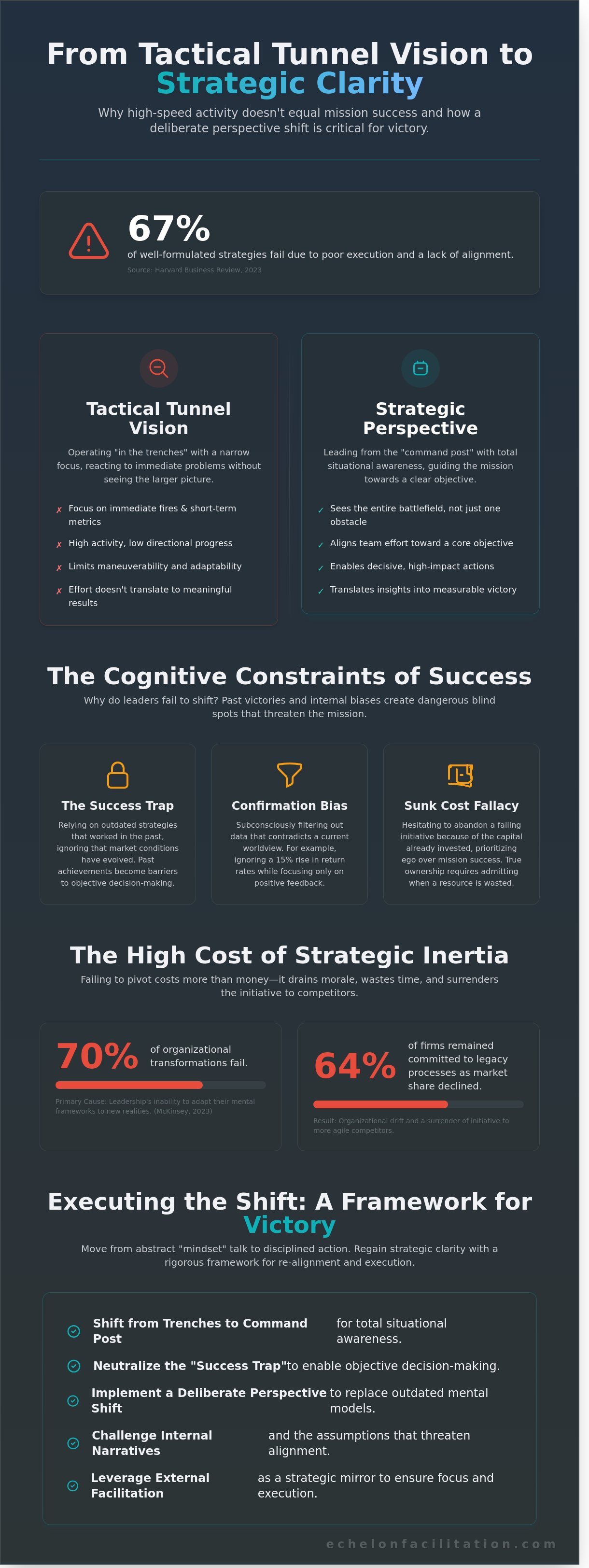
What if the primary obstacle to your mission isn't a lack of resources, but the very lens through which you view the battlefield? Many leaders mistake high-speed activity for progress, yet a 2023 study by the Harvard Business Review found that 67% of well-formulated strategies fail due to poor execution and a lack of alignment. When you're trapped in tactical tunnel vision, your effort doesn't translate to results. You need a fundamental perspective shift to break the cycle of stagnation and see the operational landscape for what it truly is.
You've likely felt the frustration of a team that's working at 100% capacity but moving in different directions. It's a common symptom of leadership teams that have lost sight of the core objective. This article provides the tactical guide you need to regain strategic clarity and drive mission success through disciplined re-alignment. You'll learn a clear framework for re-evaluating business challenges, improving team ownership, and executing decisive action plans that turn new insights into measurable victory.
Key Takeaways
- Eliminate tactical tunnel vision by shifting from the trenches to the command post for total situational awareness.
- Neutralize the "Success Trap" by recognizing when past achievements have become barriers to objective decision-making.
- Implement a deliberate perspective shift to replace outdated mental models with a clear, strategic view of the mission.
- Adopt a rigorous framework to identify internal narratives and challenge the assumptions that threaten organizational alignment.
- Leverage external facilitation to act as a strategic mirror, ensuring the leadership team maintains focus on execution and victory.
Defining the Perspective Shift in High-Stakes Leadership
In high-stakes environments, a perspective shift isn't a suggestion; it's a deliberate change in the mental models used to evaluate strategic data. Most leaders operate with tactical tunnel vision. They focus on immediate fires and short-term metrics while losing sight of the broader mission. This narrow focus limits maneuverability. To lead effectively, you must move from the weeds to the high ground. This transition allows for strategic awareness, where you see the entire battlefield rather than just the obstacle directly in front of you.
Data from a 2023 McKinsey report suggests that 70% of organizational transformations fail. The primary cause isn't a lack of resources; it's the leadership's inability to adapt their mental frameworks to new realities. A shift is a requirement for growth. It's not a luxury reserved for stable times. In fact, volatility demands it. Leaders who refuse to recalibrate their view become liabilities when the mission changes. This recalibration starts with Extreme Ownership. If you don't take total responsibility for every factor affecting your team, you can't objectively analyze the data required to pivot.
The Anatomy of a Leadership Perspective
Your perspective isn't objective truth. It's a composite of three specific components: individual bias, historical precedent, and organizational culture. Individual bias stems from your personal successes and failures. Historical precedent relies on what worked in the past, even if those conditions no longer exist. Organizational culture often rewards "the way we've always done it," creating a stagnant environment. These components create a lens that filters out potentially winning strategies because they don't fit the established pattern.
A strategic lens is the unconscious framework through which a leader views their mission.
Why Traditional "Mindset" Talk Fails the C-Suite
Executives are often skeptical of "soft" skills. In high-pressure environments, 82% of leaders prioritize tactical execution over emotional coaching. They don't want to "feel better"; they want to execute better. The conversation must move away from abstract mindset shifts and toward operational efficiency. When your perspective is clear, decision-making speed increases. You stop wasting time on irrelevant variables and focus on the levers that actually drive the mission forward. This clarity reduces friction and ensures every team member is aligned with the objective. For those ready to implement these changes through disciplined training, our leadership workshops provide the tactical framework necessary for this evolution. We value results over excuses and discipline over fleeting motivation.
Why Leaders Fail to Shift: The Cognitive Constraints of Success
Leaders often fall victim to their own history. Past victories create a psychological ceiling. This "Success Trap" convinces executives that the strategies responsible for yesterday's 12% revenue growth remain valid today. It's a dangerous assumption. When market conditions evolve, relying on outdated maps leads to organizational drift. A 2023 analysis of failed corporate pivots found that 64% of firms remained committed to legacy processes even as market share declined by double digits.
Confirmation bias reinforces this stagnation. Decision-makers subconsciously filter out data that contradicts their current worldview. If a CEO believes a specific product line is the future, they'll focus on positive customer feedback while ignoring a 15% rise in return rates. This isn't just a mistake; it's a failure of discipline. It requires a radical perspective shift to see the battlefield as it actually is, not as you wish it to be.
The sunk cost fallacy compounds the issue. Leaders hesitate to abandon a failing $850,000 initiative because they've already spent the capital. They prioritize protecting an ego-driven investment over achieving the actual mission. True ownership requires the humility to admit when a resource is wasted. Internal teams rarely speak up because they fear the professional fallout of challenging a leader's preferred narrative, leading to a culture of silent compliance rather than honest feedback.
The Hidden Cost of Strategic Inertia
Strategic inertia is the tendency to maintain a failing trajectory despite clear evidence of its obsolescence. It's the opposite of tactical agility. This inertia costs more than just money; it drains team morale and wastes thousands of billable hours that could be spent on high-impact objectives. Leaders must evaluate their strategic execution frameworks to ensure they aren't clinging to a sinking ship. When you fail to pivot, you surrender the initiative to your competitors.
Cognitive Friction and Team Dynamics
Senior leadership teams often become echo chambers. When everyone agrees to avoid conflict, the organization loses its edge. This lack of healthy friction creates decentralized confusion. Instead of empowering teams to take ownership, leaders provide vague directives based on flawed assumptions. True decentralized command only works when there's absolute alignment on the mission. Without a collective perspective shift, the team will continue to execute the wrong plan with maximum effort.
Strategic Perspective vs. Tactical Tunnel Vision
Leadership requires a constant oscillation between two distinct vantage points. The "In the Trenches" view provides the granular detail of daily operations, while the "Command Post" view offers a panoramic understanding of the mission. Success depends on balancing both. When a leader remains buried in the trenches, they lose sight of the horizon. This tactical tunnel vision results in reactive decision-making and wasted resources. A fundamental perspective shift is required to elevate the leader from a mere problem-solver to a strategic architect.
A 2022 report by the Harvard Business Review indicated that 61% of executives struggle to link high-level strategy with daily execution. This gap creates organizational friction. Strategic perspective allows for precise resource allocation. It ensures that every hour of labor aligns with the primary objective. Without this alignment, teams experience "mission creep," where effort is expended on tasks that don't advance the core goals. Leaders must possess the discipline to step away from the immediate fires to evaluate the broader battlefield.
Recognising the Symptoms of a Narrow View
Tactical tunnel vision is a silent killer of organizational momentum. It manifests through predictable patterns that signal a lack of peripheral vision. If your team exhibits these signs, your strategic focus has likely narrowed to a dangerous degree:
- Repetitive Problems: Solving the same operational issue three times in a single 90-day cycle.
- Declining Morale: A 15% or greater dip in employee engagement scores as staff feel like "cogs in a machine."
- Strategic Drift: Missing three consecutive long-term milestones because of "urgent" daily tasks.
Flying too close to the sun obscures the landscape. Leaders who refuse to step back become blind to market shifts or internal rot. Seeing the full battlefield requires the humility to admit that your current proximity to the problem is a liability, not an asset. You can't lead the charge if you're stuck in a foxhole.
The Role of Objective Truth in Strategy
Objective truth consists of data unclouded by ego, departmental bias, or emotional attachment. It's the raw reality of your performance metrics. Maintaining this objectivity is difficult when you're the "owner" of the problem. Your ego often seeks to protect your previous decisions. This creates a blind spot that prevents a necessary perspective shift. To break this cycle, leaders often require a neutral third party to reveal these truths without the filter of internal politics. Engaging in professional workshops can provide the external pressure needed to strip away comfortable narratives and return the focus to mission success. It's about finding the clarity to execute based on what is actually happening, not what you wish were happening.
Executing the Shift: A 5-Step Framework for Leadership Teams
Execution is where strategy meets reality. A perspective shift isn't a one-time event; it's a disciplined process that requires a structured approach to dismantle old habits and install new strategic priorities. To lead a team through this transition, follow this five-step framework.
- Step 1: Identify the Current Narrative (What are we telling ourselves?). Every team operates on a script. You must articulate the internal stories you tell about your market position and competition. If you don't name the narrative, you can't change it. This requires brutal honesty about past failures and current limitations.
- Step 2: Challenge the Core Assumptions (What if the opposite were true?). Apply inversion. Ask, "What if our primary revenue stream disappeared by 2025?" This forces the team to look past comfortable truths. If the opposite of your core belief were true, how would you survive?
- Step 3: Seek External Calibration (Who can see what we are missing?). Internal teams suffer from groupthink. An outside perspective provides the friction necessary to reveal blind spots that insiders are too close to see. You need a partner who doesn't care about your internal politics.
- Step 4: Redefine the Mission (Based on new data, what is the win?). Update the objective. A mission that hasn't evolved in 24 months is likely obsolete. Define what victory looks like in the specific context of the current quarter rather than relying on legacy goals.
- Step 5: Cascade the New Perspective (How do we align the entire organisation?). Alignment must move from the boardroom to the front line. This isn't about a memo; it's about shifting the collective lens of the organization. Execution depends on every individual understanding the "why" behind the shift.
Assumption Auditing for Executive Teams
Red Teaming is the standard for high-stakes decision-making. It involves appointing a team to act as an adversary to your current strategy. This isn't a brainstorming session; it's a tactical assault on your own plan to find vulnerabilities before the market does. Data from 2023 strategic audits indicates that assumption auditing reduces strategic risk by 40% in high-stakes environments. Use these prompts to begin the process:
- Which of our beliefs is most likely to be proven wrong by next year?
- How would a competitor with 10% of our budget disrupt our most profitable line?
- If this plan fails, what will be the primary cause?
Aligning the Team to the New Reality
Compliance is a liability. It creates teams that wait for instructions while the mission evolves. True buy-in happens when a team owns the perspective shift and understands the tactical rationale behind every move. When every leader sees the same reality, confidence becomes unshakeable. This alignment doesn't happen by accident. Engaging in high-stakes workshop facilitation is the fastest route to this state of readiness. It moves the team from passive agreement to extreme ownership of the mission. It ensures that the shift isn't just understood, but executed with precision across every level of the organization.
Facilitating Victory through Perspective Alignment
Leadership teams often operate within an echo chamber. A 2023 study by the Harvard Business Review found that 72% of executives feel their teams are stuck in cognitive entrenchment, where existing expertise prevents the adoption of new ideas. A true perspective shift rarely happens from within because the same mental filters that created the problem are used to solve it. This is why an external catalyst is mandatory. Echelon Facilitation acts as a Strategic Mirror for your leadership team. We reflect your internal dynamics back at you with zero distortion, forcing uncomfortable truths into the light. These truths are the friction points preventing mission success. Victory requires seeing the battlefield as it is, not as you wish it to be.
The Echelon Approach to Strategic Clarity
A standard corporate chat often results in 90 minutes of circular logic and zero accountability. In contrast, a facilitated breakthrough is a surgical operation designed to identify and eliminate strategic blind spots. Echelon brings disciplined authority to the room, ensuring that every voice is heard but no individual ego dominates the mission. This process transforms abstract goals into concrete operational objectives. If your team is ready to move beyond surface-level discussions and achieve real alignment, explore our facilitation services for your next offsite.
- Objective Analysis: We remove the emotional weight from strategic decisions.
- Conflict Resolution: We address the 1 or 2 underlying issues that teams usually avoid.
- Mission Focus: We align every team member with the primary objective.
From New Perspective to Extreme Ownership
A perspective shift only provides value if it results in a measurable change in behavior. Identification is the first step; execution is the final word. Without a clear execution plan, a new viewpoint is just a temporary hallucination. We demand extreme ownership from every participant. This means every leader leaves the room with a specific list of mission-critical tasks they are personally responsible for. Don't let your strategy die in a slide deck. It's time to align your team and secure the win. Book a Strategic Diagnostic with Echelon Facilitation to begin the process.
Command the Horizon: Executing Your Strategic Realignment
Success in high-stakes environments requires more than just effort; it demands the discipline to step back and assess the battlefield. Leaders who succumb to tactical tunnel vision often miss the critical indicators that a change in direction is necessary. By applying our 5-step framework, your team moves beyond cognitive constraints and toward a state of total mission readiness. This process forces a perspective shift that replaces organizational friction with decisive, unified action.
Dr Andrew Greenland, a medical doctor who has spent years running large, high-stakes working sessions for senior expert groups, founded Echelon Facilitation to provide the disciplined execution necessary for UK and global leadership teams to win. We specialize in high-stakes facilitation that cuts through the noise of daily operations. Our frameworks are designed to achieve full executive alignment within single-day sessions, ensuring no time is wasted on indecision. It's your responsibility to lead, and it's our mission to ensure your team is aligned for the fight ahead.
Take the first step toward organizational victory. Secure Strategic Clarity for Your Team. Your team is ready for the next level of execution.
Frequently Asked Questions
What is an example of a perspective shift in business?
A shift from product-centricity to customer-centricity is a primary example of this transformation. In 2021, a McKinsey study found that companies prioritizing customer experience saw revenue increases of 15 percent. Leaders stop asking what they can build and start asking what problem the mission solves for the end user. This change moves the focus from internal features to external impact and operational alignment.
How do you know when your leadership team needs a perspective shift?
You identify the need when the team hits a performance plateau or experiences 3 consecutive quarters of missed KPIs. When 70 percent of your strategic initiatives fail because of internal friction, your current lens is broken. Leaders must recognize that tactical adjustments won't fix a foundational misalignment. A perspective shift becomes necessary when your existing mental models no longer produce the required mission success.
Why is it difficult for leaders to change their perspective?
Cognitive entrenchment and the sunk cost fallacy create significant barriers to change. Leaders with over 10 years of experience often struggle to abandon the frameworks that brought them initial success. It's difficult because it requires extreme ownership of past mistakes. Admitting a previous worldview was flawed threatens the ego. Most executives prefer the comfort of a known failure over the uncertainty of a new strategic reality.
A leader's physical and mental state is the foundation of their cognitive performance. Chronic stress and poor nutrition directly impair decision-making and increase cognitive biases. Just as a business may need to detox from outdated strategies, optimizing personal health can remove biological 'noise' that clouds judgment.
Can a perspective shift happen without an external facilitator?
It's possible but statistically improbable for teams to self-correct without external pressure. Data from Harvard Business Review indicates that 85 percent of high-performing executive teams utilize external advisors to break groupthink. Internal teams often lack the objective distance required to challenge their own biases. Without a neutral party to force accountability, leaders usually revert to established patterns within 48 hours of a strategy session.
What is the difference between a perspective shift and a strategy change?
A strategy change is a tactical pivot, while a perspective shift is a fundamental change in the team's underlying philosophy. Strategy dictates the 12 month roadmap and resource allocation. Perspective determines how the team perceives the entire competitive landscape. If you change the strategy without shifting the perspective, the team will execute new tasks using the same old, ineffective mindset that caused the original stagnation.
How long does it take to achieve a meaningful perspective shift in a team?
A meaningful shift takes 6 to 12 months of disciplined execution to become permanent. While the initial breakthrough can happen in a 2 day intensive session, the real work follows. You must reinforce the new perspective through daily stand-ups and weekly progress reviews. Behavioral change requires consistent repetition. Teams that abandon the new framework before the 180 day mark usually slide back into old habits.
What role does cognitive bias play in strategic planning?
Cognitive bias acts as a filter that distorts objective truth during planning sessions. Confirmation bias affects 90 percent of decision makers, causing them to ignore data that contradicts their current beliefs. This leads to flawed resource allocation and mission failure. Leaders must implement decentralized command structures to ensure diverse viewpoints challenge these biases. Recognizing these mental shortcuts is the first step toward achieving tactical clarity.
How do you measure the success of a perspective shift?
Success is measured by a 25 percent increase in cross-departmental collaboration and the achievement of previously stalled KPIs. You'll see team members taking extreme ownership of outcomes rather than making excuses. Monitor the speed of decision making over a 90 day period. When the team stops debating outdated narratives and starts executing on the new mission with clarity, the shift is successful.