
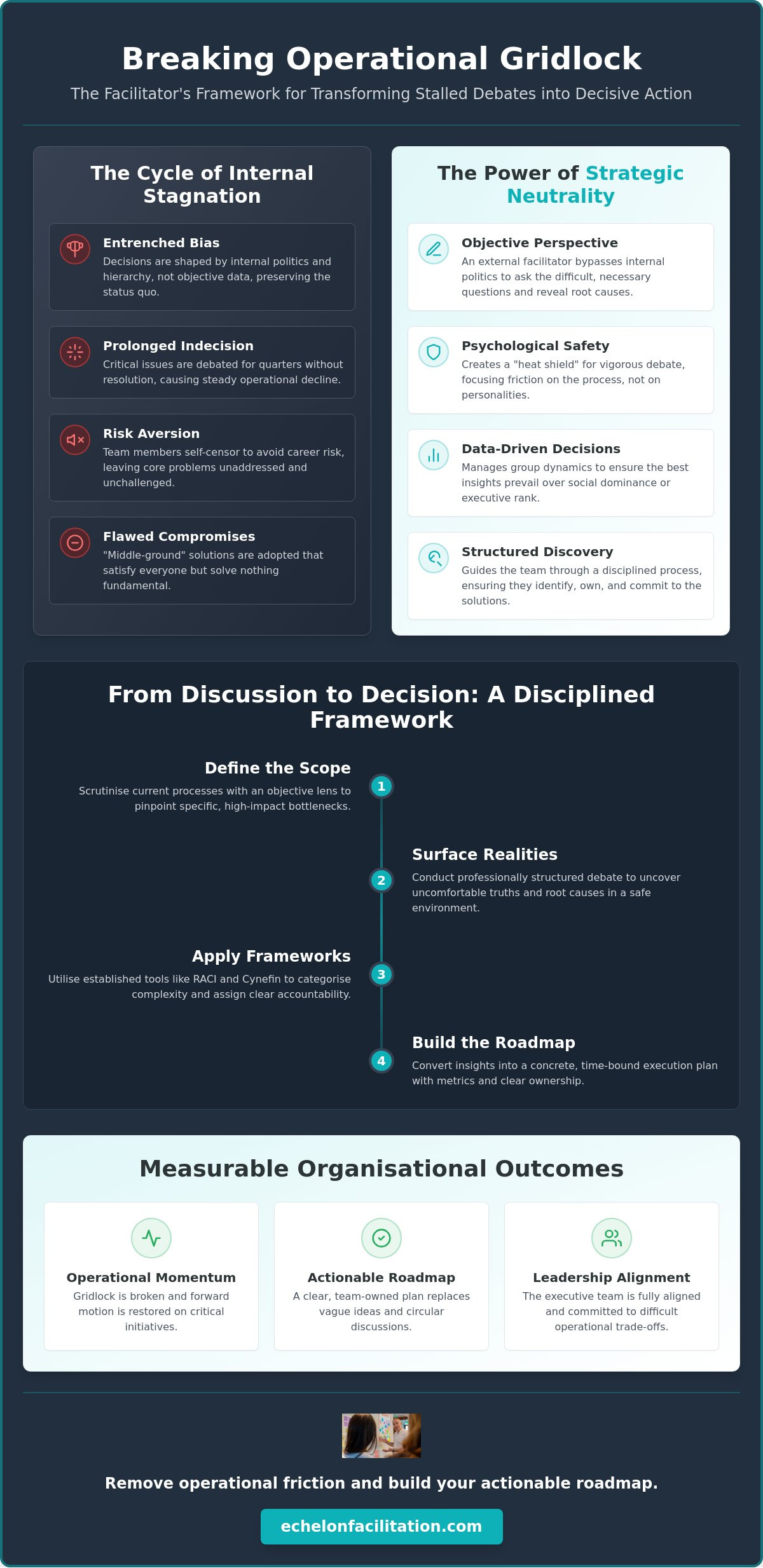
Your leadership team has spent three consecutive quarters debating the same workflow bottleneck, yet internal politics continue to stall a final decision whilst operational efficiency continues its steady decline. A professional process improvement workshop facilitator provides the neutral authority required to break this gridlock and restore operational momentum.
Operational friction and process debt represent more than just administrative frustration; they are significant financial burdens. With the global Business Process Management market expected to reach $25.88 billion by 2026, the necessity for streamlined operations is clear. When internal bias prevents difficult trade-offs, market responsiveness suffers. Without external neutrality, organisations risk losing significant capital in wasted labour and the high opportunity costs of delayed execution. Stagnation is the inevitable result of failing to address these structural bottlenecks.
You recognise that your existing processes require a radical reset to maintain a competitive edge. This methodology removes operational friction and aligns leadership teams for measurable execution. Discover the framework for creating an actionable roadmap that eliminates process debt and establishes total accountability.
Key Takeaways
- Identify how an objective third party structures group interactions to reveal and remove operational bottlenecks that internal teams often overlook.
- Understand the strategic value of external neutrality in surfacing uncomfortable truths whilst protecting long-term professional relationships during high-stakes debates.
- Apply established frameworks such as the RACI matrix and Cynefin to categorise process complexity and define clear accountability.
- Learn how a professional process improvement workshop facilitator guides leadership teams through a disciplined transition from broad idea generation to concrete execution.
- Establish a clear, actionable roadmap that eliminates process debt and ensures leadership alignment on critical operational trade-offs.
Defining the Process Improvement Workshop Facilitator
A process improvement workshop facilitator acts as an objective third party who structures group interactions to identify and remove operational bottlenecks. This role is fundamental to the discipline of Business Process Management (BPM); it ensures that the mechanics of how work gets done are scrutinised without the fog of internal bias. Unlike a consultant who arrives with a pre-packaged solution, a facilitator focuses on the process of discovery. They create the specific conditions where the team identifies their own solutions through disciplined enquiry, ensuring that the final roadmap is owned by those responsible for its success.
The distinction between a trainer and a facilitator is critical for senior leadership to understand. A trainer focuses on individual skill acquisition or the transfer of knowledge. In contrast, a process improvement workshop facilitator focuses on immediate organisational outcomes. They drive the group toward a state of readiness for execution rather than merely teaching a methodology. Professional Facilitation Services bridge the gap between high-level corporate strategy and operational reality. This professional acts as a strategic lever for executive teams facing complex trade-offs, ensuring that decision-making remains objective and results-oriented.
The Distinction Between Internal and External Guidance
Internal staff often struggle to lead these sessions effectively because they are too close to the status quo. Ingrained behaviours and existing power dynamics frequently prevent junior or even mid-level employees from challenging the way things have always been done. An external facilitator brings a clean sheet perspective. They bypass internal politics and hierarchy, asking the difficult questions that internal stakeholders may feel too compromised to raise. This external neutrality is not just a preference; it is a requirement for breaking through entrenched organisational gridlock.
How a Process Improvement Workshop Facilitator Ensures Strategic Neutrality
Neutrality is a strategic requirement for high-stakes problem-solving rather than a passive stance. Internal employees often self-censor to avoid conflict or career risk, which leaves critical operational flaws unaddressed. A professional process improvement workshop facilitator creates the psychological safety necessary for surfacing uncomfortable truths. By acting as a heat shield, the facilitator allows the leadership team to debate vigorously whilst maintaining long-term professional cohesion. This environment ensures that the friction remains focused on the process rather than the individuals involved.
Entrenched hierarchy frequently distorts internal discussions. The loudest voice or the highest-ranking executive often dictates the outcome, regardless of the operational reality. A neutral facilitator manages these interpersonal dynamics to ensure that the best data-driven insights prevail over social dominance. Whilst many firms prioritise industry expertise when selecting an advisor, this focus is often misplaced. High-level strategic value of facilitation stems from an objective mastery of group mechanics rather than sector-specific knowledge. An expert in process dynamics can spot structural inefficiencies that a seasoned industry veteran might overlook due to familiarity bias.
If your current internal efforts are stalling due to conflicting priorities, a Strategy Sprint provides the external perspective needed to resolve these tensions. Neutrality allows for a level of candour that is impossible to achieve when the session is led by a member of the management team.
Breaking the Cycle of Indecision
Facilitation forces a team to confront difficult trade-offs rather than settling for a middle-ground compromise. Middle-ground solutions typically satisfy everyone but solve nothing. By moving from anecdotal complaints to objective truth, the facilitator anchors the discussion in data-driven process design. This shift ensures that the final roadmap is built on operational reality rather than personal preference or historical precedent. Decisions become final because they are based on evidence that the entire team has scrutinised under professional guidance. The result is a decisive move away from stagnation and toward measurable execution.
Essential Frameworks for Process Optimisation
Frameworks provide the necessary structure for objective analysis. Without them, workshops frequently devolve into subjective debates and anecdotal complaints. A professional process improvement workshop facilitator uses these tools to anchor the leadership team in logic and data. One of the primary causes of organisational gridlock is ambiguous accountability. The RACI matrix (Responsible, Accountable, Consulted, Informed) is essential for establishing clear decision rights and eliminating the confusion that stalls execution. Research indicates that organisations with clear decision rights are 40% more likely to execute strategy successfully.
Not all process problems are identical. The Cynefin framework helps teams categorise challenges into four domains: simple, complicated, complex, or chaotic. This categorisation prevents the common error of applying rigid, linear solutions to complex, evolving problems. Whilst traditional Six Sigma methodologies are effective for granular manufacturing improvements, they often prove too slow for high-stakes executive shifts. A Strategy Sprint offers a faster alternative, focusing on rapid alignment and immediate execution. If your leadership team is struggling to define who owns specific outcomes, a Decision-Rights Reset provides the necessary clarity.
Mapping the 'As-Is' vs. the 'To-Be' State
Teams must visualise current friction before attempting to design a future solution. 'Brown Paper' sessions are a practical method for this visualisation. By mapping out cross-functional workflows on a large scale, the process improvement workshop facilitator helps the group identify hidden waste and redundant hand-offs. This process reveals the 'as-is' reality, which is often far more convoluted than the official company handbook suggests. Only after the team acknowledges this current state can they effectively design the 'to-be' state that removes operational friction and optimises performance.
Executing the Process Improvement Workshop
Preparation begins long before the team enters the workshop environment. A professional process improvement workshop facilitator conducts a series of pre-workshop interviews with key stakeholders to identify hidden misalignments and structural friction. This diagnostic phase ensures that the session addresses root causes rather than symptoms. By understanding individual perspectives in advance, the facilitator can navigate potential interpersonal friction with precision and objective clarity.
The workshop itself follows a disciplined rhythm of divergence and convergence. During the divergence phase, the group generates a broad range of potential solutions and identifies every possible bottleneck in the current workflow. The facilitator then guides the team toward convergence, forcing the high-stakes trade-offs required to decide on a single path forward. This prevents the session from becoming a mere brainstorming event and turns it into a decisive engine for change. You can learn more about how we work to ensure these outcomes are met consistently.
Post-workshop accountability is the true measure of success. The facilitator's job remains incomplete until every action item has a specific owner and a definitive deadline. Ownership must be personal and absolute to prevent the return of organisational gridlock. Our Strategy Sprint methodology is designed specifically to move teams from discussion to execution without unnecessary delay, ensuring that the momentum generated during the session is not lost to daily operational demands.
Ensuring Long-Term Adoption
Execution requires a structured 30-day plan to move agreed changes from the whiteboard to the boardroom. This initial period is critical for establishing momentum and proving the validity of the new process. If the leadership team fails to model the new behaviours, the rest of the organisation will inevitably revert to legacy habits. Senior professionals must lead by example, demonstrating total commitment to the new frameworks to ensure permanent operational change and a significant reduction in process debt.
Restoring Operational Momentum
Organisational gridlock stems from internal bias, not a lack of intent. A professional process improvement workshop facilitator provides the radical neutrality required to convert leadership friction into measurable execution. By applying disciplined authority, Richard Kasriel enables executive teams to resolve high-stakes trade-offs that internal politics otherwise stall. This methodology allowed a FTSE 250 firm to reduce operational lag by 30% through a targeted Decision-Rights Reset. Permanent change requires this level of external scrutiny to bridge the gap between strategy and operational reality. Book a diagnostic call to identify your team's process constraints and restore momentum.
Frequently Asked Questions
What is the difference between a process improvement facilitator and a management consultant?
Facilitators focus on group alignment to ensure the team owns the final solution. Management consultants usually provide external expertise and pre-packaged answers. This distinction is vital for adoption; teams are more likely to implement processes they designed themselves under neutral guidance.
How long does a typical process improvement workshop take to see results?
Alignment on trade-offs occurs during the workshop. Measurable results typically emerge within 30 to 90 days as the team executes the roadmap. Rapid methodologies ensure that the transition from theory to boardroom reality happens without the delays found in traditional consulting.
Can a process improvement workshop facilitator help with remote or hybrid teams?
A process improvement workshop facilitator uses digital frameworks to ensure remote teams achieve total alignment. These sessions manage the friction of digital communication whilst maintaining disciplined enquiry. The physical location of the team does not impede the objective truth of the process.
What should we prepare before hiring an external facilitator for our workshop?
Leadership should identify the specific process bottleneck and ensure all decision-makers are available. Gathering baseline performance data allows the workshop to begin with a focus on evidence rather than anecdote. Proper preparation ensures the group moves quickly into resolving high-stakes trade-offs.
How do we measure the ROI of a process improvement facilitation session?
ROI is measured by reduced operational lag and the completion of milestones defined in the workshop plan. Eliminating process debt provides a direct financial benefit by freeing up resources. Success is evidenced by a team that executes strategy with unwavering clarity.

Article by
Andrew Greenland
Dr Andrew Greenland is the founder of Echelon Facilitation, a UK practice that designs and runs high-stakes leadership sessions for executive teams who need decisions, not more discussion.
A medical doctor and medical educator, Andrew brings a clinician's discipline to the messy, political work of leadership alignment - surfacing the real disagreement, forcing the real choices, and ensuring every session produces a documented decision log with named owners and deadlines.
He works with CEOs, executive teams, transformation leads, and boards across the UK and internationally. Based in Twickenham.