
An executive offsite ends with polite nods and a vague action plan that everyone knows will be ignored by Monday morning. This failure to reach true consensus is not just a leadership lapse; it is a direct drain on your organisational capital.
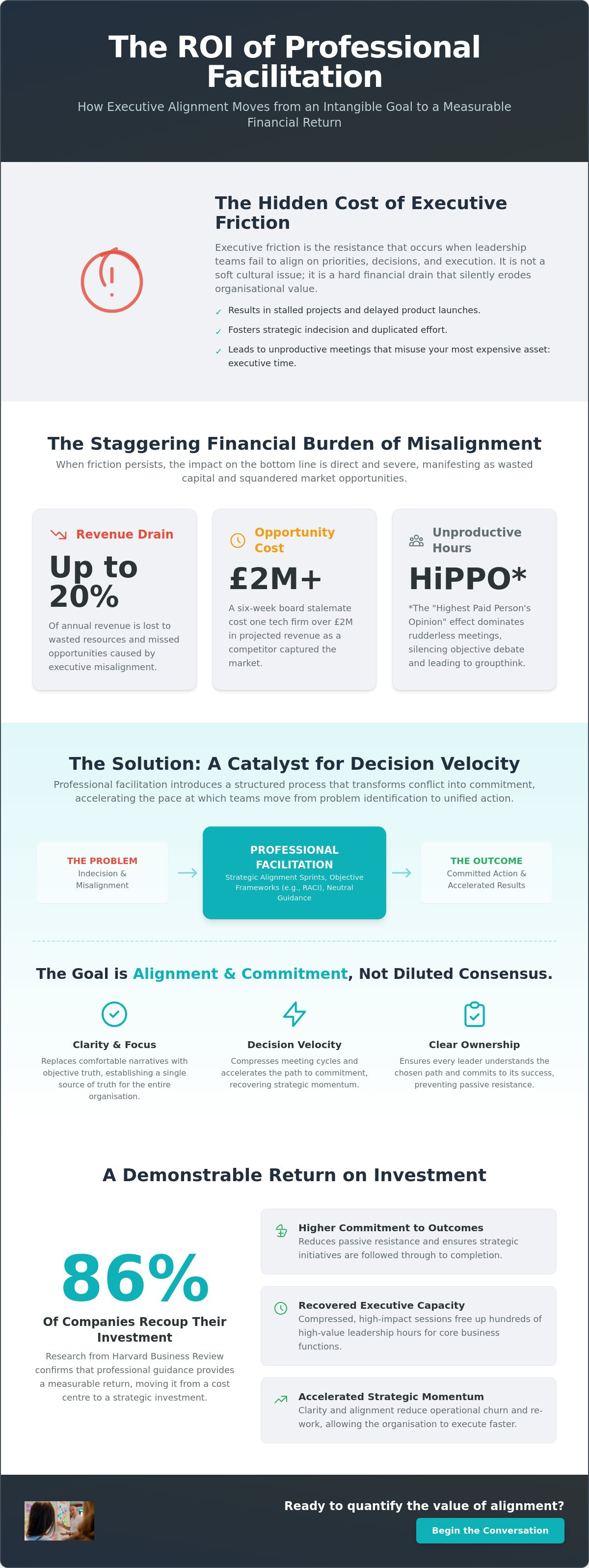
The financial impact of executive friction is staggering. Research from Harvard Business Review indicates that 86% of companies that invest in professional guidance recoup their initial investment, proving the roi of professional facilitation is measurable. Many leadership teams bleed revenue through strategic indecision. When high-salaried executives spend hours in unproductive sessions, the cost exceeds the payroll. It manifests as delayed product launches and stalled projects. Look beyond the fee to the value of recovered time and accelerated decision cycles.
This principle of seeking expert consultation to ensure high-value outcomes is a universal standard for success; just as businesses rely on facilitators for strategic growth, homeowners invest in specialists like Neil Norton Design to provide an architectural approach to bespoke interiors, ensuring that design decisions are both functional and strategically planned.
In a similar vein, the importance of accredited expertise extends to the health and wellness sector; individuals seeking to become qualified health coaches or nutritionists can check out Active Health Group to access training programmes that meet rigorous professional standards.
You likely recognise that alignment is essential but struggle to justify the budget for external support. This article provides a framework to quantify the strategic returns and the roi of professional facilitation, demonstrating how it removes the hidden costs of executive friction. Objective metrics of alignment and the mechanics of accelerated decision-making reveal the tangible impact on your bottom line.
Key Takeaways
- Quantify the hidden costs of executive friction, which can drain up to 20% of organisational revenue through stalled projects and wasted resources.
- Measure the roi of professional facilitation by tracking decision velocity and the speed at which leadership moves from problem identification to committed action.
- Utilise frameworks like RACI to audit current decision-making bottlenecks and establish clear accountability for strategic objectives.
- Implement high-yield interventions such as an Executive Alignment Sprint to replace comfortable narratives with objective truth and disciplined focus.
- Transition from unproductive offsites to a structured process that ensures executive alignment translates into visible financial returns.
The Financial Burden of Executive Friction
Executive friction represents the structural gap between strategic intent and operational execution. It is the resistance that occurs when leadership teams fail to align on priorities or decision rights. This misalignment is not a soft cultural issue; it is a hard financial drain on the business. Understanding what is professional facilitation allows senior leaders to recognise it as a precision tool for removing these barriers. When calculating the roi of professional facilitation, organisations must first look at the capital lost to internal inertia and executive indecision.
Research suggests executive misalignment costs organisations up to 20% of annual revenue through wasted resources and missed opportunities. This financial burden stems from duplicated efforts, contradictory directives, and the slow erosion of employee morale. Whilst a strategy offsite might appear expensive, the cost of a failed session is significantly higher. Misaligned boards often spend months debating identical issues without resolution. This persistent indecision creates a vacuum where competitors gain ground and internal teams lose focus on high-value objectives.
Similarly, in the hospitality and beverage sector, aligning brand identity with executive strategy is crucial for maintaining a competitive edge; to see how specialist guidance can sharpen this focus, check out Pour Decisions Consultancy.
For industrial organisations, this misalignment can also impact regulatory oversight; maintaining high standards for health, safety, and environmental compliance through afnindustrialservices.co.uk requires a board that is unified in its strategic and financial commitment.
Opportunity Cost and the Price of Indecision
Market share is won or lost in the window between identifying a problem and executing a solution. A three-month delay in a critical product launch can permanently shift a firm's market position. For example, an anonymised tech firm recently lost £2M in projected revenue due to a six-week board-level stalemate regarding their platform architecture. The delay allowed a leaner competitor to capture the early-adopter segment. Professional intervention breaks these stalemates by forcing objective truth over comfortable narratives and accelerating the path to commitment.
This agility is equally important when organisations look to upgrade their physical infrastructure; for Irish companies, adopting a managed lighting solution through ecolightservices.ie allows for a swift transition to zero-emission technology, bypassing the typical delays associated with internal capital expenditure approvals.
The Hidden Drain of Unproductive Leadership Hours
Calculate the hourly burn rate of your executive team. An eight-person leadership session involves high-salaried professionals whose time is the company's most expensive asset. Rudderless meetings are a misuse of this capital. Internal facilitators often fail to challenge the "highest paid person's opinion", known as the HiPPO effect, because of existing power dynamics. This lack of objective challenge leads to groupthink and avoids the difficult conversations necessary for true alignment. External facilitation provides the disciplined authority required to hold every leader accountable for tangible results; in the hospitality sector, this accountability ensures that even operational recruitment and interview standards, such as those provided by Operational Chef Consultant, are aligned with the board's strategic vision.
Quantifying the ROI of Professional Facilitation through Decision Velocity
Decision velocity is the primary metric for organisational agility. It defines the speed at which a leadership team moves from problem identification to committed action. In high-stakes environments, the ability to compress this cycle is a critical competitive advantage. Professional facilitators act as process catalysts, identifying and neutralising the cognitive biases that typically stall executive progress. By removing these hurdles, organisations can realise a significant roi of professional facilitation through the recovery of lost time and strategic momentum.
Specific drivers of this return include:
- Compressed meeting cycles that free up executive capacity.
- Higher commitment to outcomes, reducing the likelihood of passive resistance.
- Clear ownership of action items, ensuring accountability across departments.
Many industry advisors suggest that "consensus" is the ultimate goal of a leadership session. We disagree. Seeking total consensus often results in a diluted strategy that pleases everyone but achieves little. True roi of professional facilitation stems from alignment and commitment. Alignment ensures that every leader understands the chosen path and commits to its success, even if it was not their preferred option. This commitment prevents the "veto by silence" that often plagues misaligned teams.
Recovering Lost Capital with Strategic Clarity
A Strategy & Vision Offsite establishes a single source of truth for the executive team. This clarity filters down through the organisation, reducing the operational churn and re-work that occur when middle management receives contradictory signals from above. When leadership is aligned, the entire workforce operates with greater precision.
Measuring the Quality of Decisions
Effective facilitation improves decision durability. This is the measure of whether a decision remains in place or requires revisiting three months later due to poor initial vetting. Research from McKinsey indicates a strong correlation between leadership alignment and superior organisational performance. When calculating the ROI of facilitation, leaders should track the reduction in "zombie projects" that persist despite lacking strategic value. For teams struggling with persistent bottlenecks, a Decision-Rights Reset can provide the necessary structural clarity to accelerate progress.
Frameworks for Measuring Facilitation Yield
Measuring the roi of professional facilitation requires a shift from qualitative feedback to quantitative frameworks. Relying on "participant smiles" is a mistake; true yield is measured by the removal of structural friction. The RACI matrix (Responsible, Accountable, Consulted, Informed) serves as a primary tool for this valuation. By mapping decision rights, organisations eliminate the ambiguity that leads to expensive delays. This disciplined approach ensures that every session contributes to the bottom line.
To calculate this yield accurately, follow a three-step audit process:
- Step 1: Identify current bottlenecks. Use a Decision-Rights Reset to pinpoint where authority is blurred and projects have stalled.
- Step 2: Assign a monetary value to the "Cost of Delay" for your top-priority initiatives. If a product launch representing £1M in monthly revenue is delayed by four weeks, the price of indecision is £250,000.
- Step 3: Compare the investment in a Strategy Sprint against the potential recovery of that delay.
The RACI Matrix as a Value Multiplier
Clear accountability reduces the "bystander effect" where executives assume someone else is driving a project. When roles overlap, friction increases and decision velocity drops. Implementing structured decision-making frameworks ensures that every leader knows their specific contribution. This clarity transforms a passive board into an active leadership engine. It removes the need for follow-up meetings to clarify what was supposedly decided previously.
Practical Template: The Facilitation Value Scorecard
Evaluate performance based on outcomes rather than session energy. Use this three-point checklist to determine the roi of professional facilitation for your next engagement:
- Decision Durability: Did the decision survive the first 30 days without being revisited or undermined?
- Resource Allocation: Were specific budgets and personnel committed before the session adjourned?
- Execution Velocity: Is there a documented 30-day execution plan with clear owners and measurable milestones?
The ultimate metric of success is found in the 30-day execution plan. If you are ready to eliminate the cost of delay and recover lost momentum, contact us to schedule a Decision-Rights Reset.
Securing Organisational Value via Strategic Alignment Sprints
Strategic success depends on the total synchronisation of the leadership team. An Executive Alignment Sprint serves as a high-yield intervention for boards struggling with fragmented priorities. Unlike standard internal workshops that often avoid conflict, the Echelon Facilitation approach relies on disciplined authority. We force leadership teams to confront objective truth rather than hiding behind comfortable narratives. This rigorous process ensures that the roi of professional facilitation is realised through immediate, actionable clarity and the removal of interpersonal friction.
Yield extends beyond the immediate session. It establishes a culture of personal accountability that persists long after the facilitator has left the room. When executives accept total responsibility for collective outcomes, the organisation sheds the weight of internal inertia. This cultural shift is essential for maintaining the momentum gained during the session. To begin this process, leaders should contact Echelon Facilitation for a diagnostic call to identify the specific barriers stalling their progress.
Why External Neutrality is a Non-Negotiable Asset
Internal leaders, including HR directors, often find themselves navigating political landmines that prevent honest discourse. An external expert brings the neutrality required to challenge senior stakeholders without fear of reprisal. This distance is vital for preventing groupthink, a psychological phenomenon that leads to expensive strategic errors and missed market shifts. By introducing an objective perspective, the roi of professional facilitation increases because it protects the organisation from the self-inflicted blind spots that internal facilitators are often forced to ignore. This requirement for external expertise is equally prevalent in the property sector, where madisonmay.co.uk provides the specialist retrofit consultancy needed to help landlords and homeowners meet energy efficiency standards effectively.
From Workshop to P&L Impact
Alignment at the top creates a ripple effect throughout the entire corporate structure. When the executive team speaks with one voice, productivity increases across every department because middle management no longer wastes energy interpreting ambiguous directives. This operational stability translates directly into P&L impact by reducing project churn and accelerating time-to-market for key initiatives. To secure your 2027 objectives and eliminate the cost of misalignment, book a Transformation Alignment session today.
Converting Strategic Alignment into Financial Performance
Executive friction is a quantifiable drain on organisational capital. By shifting the focus from polite consensus to disciplined alignment, leadership teams can recover the 20% of revenue typically lost to strategic indecision. Professional intervention does more than just manage a meeting; it acts as a lever for decision velocity and ensures that every executive is personally accountable for the collective outcome. This transition from rudderless debate to committed action is the foundation for a measurable roi of professional facilitation.
Success requires an objective partner who values truth over comfortable narratives. Richard Kasriel leads Echelon with a focus on disciplined authority, ensuring that boards move beyond political stalemates toward high-stakes objectives. In a recent anonymised case, a misaligned board achieved total strategic synchronisation in a single day, illustrating the speed at which professional guidance delivers results. Don't let indecision stall your 2027 objectives. Secure your strategic ROI with an Echelon Alignment Sprint and ensure your leadership team operates with the clarity required for sustained growth.
Frequently Asked Questions
How do you calculate the ROI of professional facilitation for a strategy offsite?
ROI is calculated by comparing the cost of the engagement against the financial value of recovered time and accelerated project delivery. Organisations should measure the reduction in subsequent meeting cycles and the total elimination of "zombie projects" that drain resources without yielding value. Tracking the delta between problem identification and committed action provides a hard metric for the roi of professional facilitation.
Is an external facilitator more cost-effective than using an internal HR lead?
External facilitators are more cost-effective because they possess the neutrality required to challenge the "highest paid person's opinion" (HiPPO) without fear of reprisal. Internal leads often face political constraints that prevent them from addressing the root causes of executive friction. An external expert avoids the groupthink that leads to expensive strategic errors, ensuring the session produces a high-yield outcome rather than a polite but ineffective consensus.
What is the 'Cost of Delay' in executive decision-making?
The Cost of Delay is the financial penalty an organisation pays for every week a critical decision remains unmade. This includes lost market share, duplicated operational costs, and the erosion of competitive advantage. In the built environment, for instance, delaying a decision on essential structural strengthening can lead to compounding asset damage; specialists like Composites Construction UK are often engaged to rectify these issues once executive gridlock is resolved. If a project worth £1M in monthly revenue is stalled for six weeks due to board misalignment, the Cost of Delay is £1.5M. Professional intervention eliminates this waste by forcing rapid, durable commitments.
Can facilitation improve the ROI of a merger or acquisition?
Facilitation significantly improves the ROI of mergers and acquisitions by accelerating the integration of leadership teams and decision rights. Misalignment during a merger often leads to high talent churn and operational paralysis, which destroys deal value. A structured alignment process ensures both leadership groups commit to a single operating model and clear accountability frameworks, protecting the capital invested in the transaction.
How long does it take to see the financial results of a facilitation workshop?
Financial results typically appear within 30 to 90 days as the leadership team's alignment cascades into increased operational productivity. However, the roi of professional facilitation is also visible immediately through the compression of decision cycles. By resolving a six-month stalemate in a single day, the organisation recovers the immediate value of that executive time and refocuses it on high-priority execution.

Article by
Andrew Greenland
Dr Andrew Greenland is the founder of Echelon Facilitation, a UK practice that designs and runs high-stakes leadership sessions for executive teams who need decisions, not more discussion. A medical doctor and medical educator, Andrew brings a clinician's discipline to the messy, political work of leadership alignment - surfacing the real disagreement, forcing the real choices, and ensuring every session produces a documented decision log with named owners and deadlines. He works with CEOs, executive teams, transformation leads, and boards across the UK and internationally. Based in Twickenham.