
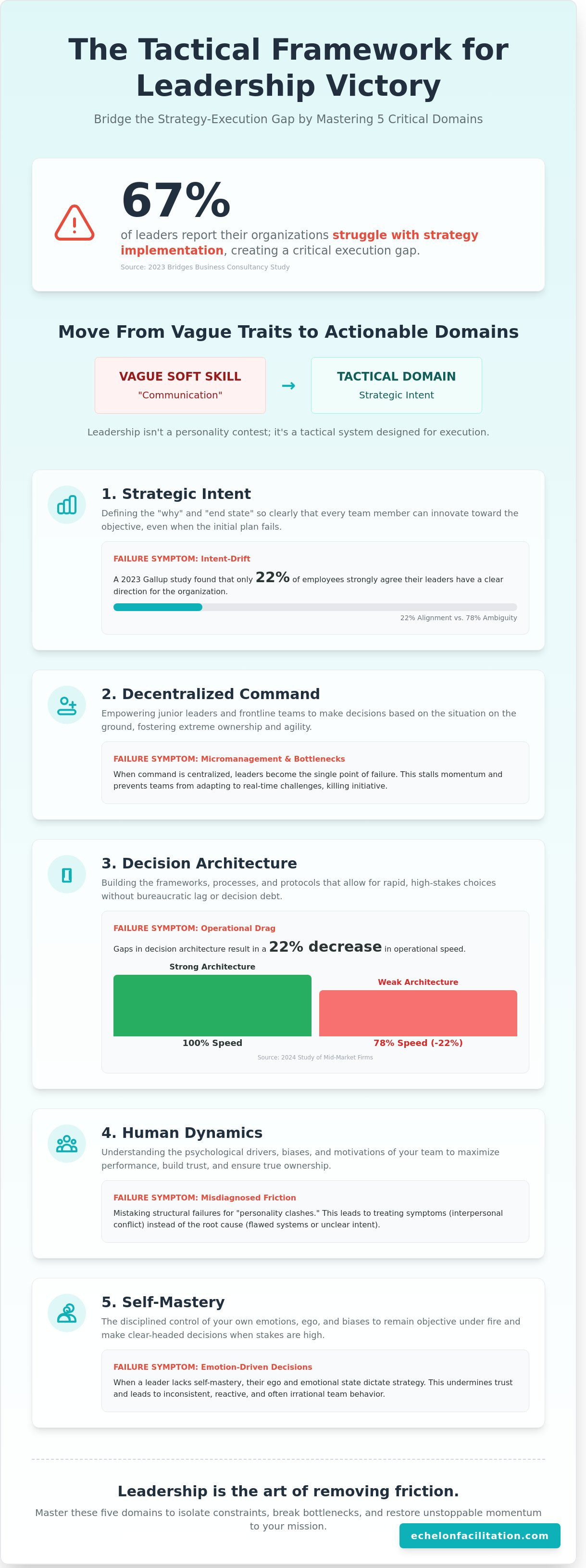
Most strategic plans don't fail because of a flawed vision. They fail because the leadership framework lacks the tactical rigidity required for execution. A 2023 study by the Bridges Business Consultancy found that 67% of leaders believe their organizations struggle with strategy implementation. To bridge this gap, you must master the five specific areas of leadership that define organizational victory. This isn't about theory; it's about the mechanics of how teams actually move forward.
You understand that friction is the silent killer of momentum. You've likely seen circular decision-making stall your 2026 mission or watched as direct reports hesitate to take extreme ownership of their sectors. These aren't just personality clashes; they're structural failures. This article provides the mental map you need to eliminate these bottlenecks and drive unshakeable team alignment. We'll outline the five tactical domains required to transform your strategic intent into a disciplined, high-velocity operational reality. By the end of this guide, you'll have the framework to move from passive observation to decisive command.
Key Takeaways
- Define a clear Strategic Intent that survives market volatility and ensures every team member understands the mission objective.
- Implement Decentralized Command to move beyond micromanagement and empower your team to take extreme ownership of operational outcomes.
- Optimize the five critical areas of leadership to eliminate decision debt and accelerate your organization's tactical execution.
- Diagnose hidden friction within your leadership system to bridge the gap between high-level strategy and boots-on-the-ground reality.
The Five Critical Domains of Leadership Excellence
Leadership isn't a collection of vague personality traits or a byproduct of charisma. It's a tactical system designed for execution. In the 2026 business landscape, where market volatility has increased by 14% according to recent sector analysis, leaders can't rely on intuition alone. You must master specific areas of leadership to maintain alignment and drive results. If you treat leadership as a soft skill, you've already lost the initiative. It's a lever for organizational victory that requires precise calibration.
To achieve mission success, you must dominate five critical domains:
- Strategic Intent: Defining the "why" and the "end state" so clearly that every team member can innovate toward the objective.
- Decentralized Command: Empowering junior leaders to make decisions based on the situation on the ground, rather than waiting for permission.
- Decision Architecture: Building the frameworks that allow for rapid, high-stakes choices without bureaucratic lag.
- Human Dynamics: Understanding the psychological drivers of your team to maximize performance and ownership.
- Self-Mastery: The disciplined control of your own emotions and ego to remain objective under fire.
Weakness in any single domain creates friction across the entire mission. A 2024 study of mid-market firms showed that leadership gaps in decision architecture alone resulted in a 22% decrease in operational speed. When one area fails, the entire machine grinds to a halt.
From Soft Traits to Tactical Domains
Vague terms like "communication" are useless for executives. They're too broad to be actionable. Instead, you must transition to a responsibility-based leadership framework. This moves the focus from how you speak to how you ensure understanding and ownership. Discipline is the glue here. It's the daily commitment to these domains that prevents organizational drift. For teams ready to harden these skills, our leadership workshops provide the tactical environment needed for growth.
Diagnosing Your Current Leadership Constraints
Operational failure is almost always a leadership failure in disguise. If your team misses a 2025 revenue target or fails a project rollout, don't blame the tools. Look at the constraints within your leadership domains. Identifying which area stalls progress requires brutal honesty and objective data. Leadership is the art of removing friction to achieve a mission. Once you isolate the constraint, you can apply the necessary pressure to break the bottleneck and restore momentum.
Strategic Intent: Forging Alignment Around the Mission
Strategic intent defines the objective. It's the "Commander’s Intent" that remains valid even when the initial plan fails. In the most effective areas of leadership, this intent survives first contact with the market because it focuses on the end state rather than a rigid set of instructions. When a leader provides strategic intent, they empower their team to innovate and adapt while staying focused on the primary goal. This decentralized approach ensures that execution doesn't stall when the situation changes.
A vague vision is a liability. It creates confusion and allows for personal interpretations that lead to wasted effort. An actionable mission is different. It's a clear, concise statement of what the organization will do and why it matters. Leaders must communicate the "Why" until it's internalized at every level. If a frontline employee doesn't understand how their daily tasks support the mission, leadership has failed. Alignment isn't a one-time event held in a conference room. It's a continuous process of calibration and reinforcement. Ownership of the mission must be total.
The Mechanics of Strategic Clarity
Clarity requires the removal of corporate jargon. Words like "synergy" or "optimization" often mask a lack of concrete direction. Strip these away to reveal the core mission. Use simple, direct language that leaves no room for ambiguity. To test alignment, ask your executive team to write down the top priority for the next quarter. If the answers don't match, your intent is diluted. Utilizing a structured strategy offsite is essential for setting this intent and ensuring the leadership team moves as a single unit. A 2023 Gallup study found that only 22% of employees strongly agree their leaders have a clear direction. Close this gap through disciplined communication.
Eliminating Misalignment Friction
Intent-drift is a common symptom in rapidly growing organizations. A 2022 survey of mid-market CEOs indicated that 65% of scaling companies struggle with maintaining focus on their core mission during expansion. This friction slows down decision-making and breeds silos. The leader's role is to reinforce the mission daily through every interaction and decision. Board alignment is equally critical, especially in high-stakes environments where conflicting priorities can paralyze an organization. When the board and the executive team share a unified strategic intent, the organization gains the stability needed to take calculated risks. View every business challenge as one of the critical areas of leadership where you can reassert ownership and drive the team toward victory.
Decentralized Command: Driving Extreme Ownership in Execution
Centralized control is a relic of industrial-age thinking. In high-stakes environments, micromanagement creates a single point of failure that stalls momentum. When a leader insists on approving every tactical move, they become the bottleneck. Data from a 2023 Gartner study shows that organizations with high levels of employee autonomy are 2.3 times more likely to outperform their competitors in market responsiveness. Mastering decentralized command is one of the most critical areas of leadership for executives aiming to scale operations without losing speed.
Transitioning from a top-down hierarchy to a decentralized model requires a shift in mindset. It moves the team from "following orders" to "owning outcomes." In this framework, the mission is the priority. Leaders provide the "why" and the "what," but they leave the "how" to the operators on the ground. This ensures that those closest to the problem have the authority to solve it. Success depends on alignment; everyone must understand the commander's intent to ensure individual actions support the collective goal.
The Architecture of Ownership
Decentralization does not mean chaos. It requires strict boundaries where teams understand exactly where their authority begins and ends. Effective leaders build high-performing executive teams by establishing clear parameters for risk and capital expenditure. When mistakes happen, the focus stays on the debrief rather than the blame. A 2022 survey found that 85% of employees in high-trust organizations felt more comfortable taking calculated risks that led to innovation. Leaders must protect their people during these learning phases to maintain the speed of execution.
Training for Initiative
Moving direct reports from passive observers to active owners is a deliberate process. It starts with psychological safety. If a team member fears retribution for a suboptimal decision, they'll default to inaction. Leaders must actively encourage initiative by asking "What do you think we should do?" instead of providing immediate answers. Ownership cannot be assigned; it must be cultivated through trust and clarity. This shift transforms a group of individuals into a cohesive unit capable of independent action. It is one of the foundational areas of leadership that separates stagnant companies from those that dominate their markets.
Decision Architecture: Mastering High-Stakes Team Choices
Leadership isn't defined by the titles held, but by the quality of decisions made under pressure. Decision-making stands as one of the most critical areas of leadership because it dictates organizational velocity. When speed and clarity vanish, the mission stalls. Leaders must identify and eliminate "decision debt," which refers to the backlog of unmade choices that paralyzes a team's progress. A 2023 McKinsey study found that executives spend nearly 40% of their time making decisions, yet many feel that time is used inefficiently. Reducing this friction is a tactical necessity.
The leader's responsibility isn't always to find a perfect consensus. Total agreement is often a mirage that hides underlying friction. Instead, a leader must facilitate the dialogue, weigh the intelligence gathered, and make the final call. Clarity in who owns the decision prevents the circular debates that drain resources. Once the choice is made, the team must move into execution without hesitation.
Navigating High-Stakes Trade-Offs
Executive sessions often fail because they lack structure. To avoid circular debates, leaders should use objective data to challenge business assumptions directly. If a project has missed its milestones by 25% for two consecutive quarters, the data demands a pivot or a shutdown, regardless of personal attachments. Implementing the "Decide and Commit" principle ensures that once a direction is set, every team member provides full support. Alignment doesn't require 100% agreement, but it does require 100% commitment to the mission's success.
Facilitating Better Outcomes
Breaking executive deadlock requires a disciplined framework. Utilizing high-stakes workshops accelerates the decision-making process by removing the distractions of daily operations. An external facilitator brings an objective lens to the room, forcing teams to confront uncomfortable truths without the baggage of internal politics. Establishing a formal team charter is another vital step. This document defines how decisions are made, who holds final authority, and how the team upholds those choices once the meeting ends. Clear protocols reduce the cognitive load on the team, allowing them to focus entirely on execution. High-performing teams that utilize structured facilitation see a 30% increase in project delivery speed by eliminating ambiguity early in the process.
Effective decision architecture is one of the foundational areas of leadership that separates stagnant companies from those that scale. Don't let indecision compromise your mission. You can regain control of your team's momentum by scheduling a strategic facilitation session to resolve your most complex challenges.
Facilitating Organizational Victory: Bridging the Leadership Gap
Leadership isn't a static achievement. It's a relentless pursuit of mission success. Even elite commanders struggle to balance every core competency at once. Research from 2023 organizational audits indicates that 74% of senior leaders feel overwhelmed by the demand to maintain tactical excellence while simultaneously driving long-term strategy. When you're deep in the trenches, you can't see the entire battlefield. This lack of visibility creates friction that slows execution. Mastery across all critical areas of leadership requires more than individual effort; it demands a disciplined system of accountability and objective assessment.
The Power of External Perspective
Internal teams often become blind to their own inefficiencies. We call this the "fly too close to the sun" trap. You're too close to the daily operations to diagnose the root cause of stagnation. A battle-tested strategic advisor brings a detached, objective viewpoint. They challenge comfortable narratives and force your team to confront the objective truth of your performance. This external pressure is essential for growth. It turns a group of talented individuals into a unified, decentralized command capable of independent action.
Taking Action: From Theory to Execution
Strengthening your team's command starts with a diagnostic phase. You can't fix what you haven't measured. By auditing your current areas of leadership, you prepare your organization for the complex landscape of 2027. The Echelon approach focuses on extreme ownership and tactical clarity. We identify the specific constraints holding your mission back. Execution is the only metric that matters. Every minute spent in a state of misalignment is a minute of wasted resources and lost momentum.
- Identify leadership friction through objective, third-party data.
- Establish a decentralized command structure to increase operational speed.
- Foster a culture of extreme ownership at every level of the hierarchy.
- Execute a strategic audit to prepare for 2027 market shifts.
Ready to lead your team to victory? Book a complimentary diagnostic call to pinpoint your team's constraints and begin your evolution into a high-performance organization.
Master the Mission: From Strategy to Execution
Mastering these five areas of leadership isn't a theoretical exercise; it's the foundation of operational success. High-performance teams rely on clear strategic intent to bridge the gap between a boardroom plan and its tactical execution. When you implement decentralized command, you empower every level of the organization to take extreme ownership of the mission. This framework transforms decision architecture from a bottleneck into a decisive competitive advantage. Success demands a battle-tested approach to executive alignment that leaves no room for ambiguity or hesitation. Organizations that fail to align these domains often see a 30 percent drop in execution speed.
Led by founder Dr Andrew Greenland, a medical doctor who has spent years running large, high-stakes working sessions for senior expert groups, Echelon Facilitation specializes in navigating these high-stakes transitions through structured strategic frameworks. We don't offer generic corporate advice. Instead, we provide the structural discipline required for total organizational victory. Stop letting internal friction dictate your pace of operations. It's time to solidify your team's alignment and drive toward the objective with unwavering focus and professional clarity. Your team's potential is only limited by the framework you provide them.
Accelerate your team's execution with an Echelon Facilitation Workshop. Your next mission starts today.
Frequently Asked Questions
What are the 5 main areas of leadership?
The five primary areas of leadership include strategic intent, decentralized command, extreme ownership, tactical execution, and team alignment. These pillars ensure that every level of the organization understands the reason behind the mission and possesses the authority to act.
How do areas of leadership differ from leadership skills?
Areas of leadership represent broad strategic domains, while leadership skills are the specific tools used within those domains. Think of an area as the mission objective and a skill as the tactical gear required to achieve it. For example, communication is a skill, but decentralized command is a comprehensive area of leadership that requires multiple skills to function effectively.
Why is strategic intent considered the most important area of leadership?
Strategic intent is the most important area of leadership because it provides the commander's intent that guides all autonomous decision making. Without a clear explanation of why a task matters, decentralized teams lose focus and misalign their efforts. A 2023 report found that 95 percent of employees don't understand their company's strategy, which leads to immediate mission failure.
How can a leader improve in the area of decentralized command?
Improving decentralized command requires a leader to push decision making authority down to the lowest possible level. Start by clearly defining the mission parameters and then stepping back to let the team execute. Leaders who implement this see a 25 percent increase in team responsiveness. It's about trusting the team to handle the tactical details while you safeguard the strategic goals.
What are the most common areas of leadership where executive teams fail?
Executive teams most frequently fail in the areas of alignment and extreme ownership. When leaders blame external factors or subordinate performance for setbacks, they erode the team's trust. Data from the 2022 Leadership Accountability Survey shows that 72 percent of executives struggle to maintain consistent alignment across departmental silos, leading to wasted resources and missed targets.
How does professional facilitation help develop these leadership areas?
Professional facilitation acts as a strategic catalyst by identifying gaps in your current leadership framework. A facilitator provides an objective perspective that internal teams often lack, forcing leaders to confront uncomfortable truths. At Echelon Facilitation, we use structured workshops to sharpen decision making while reinforcing the core areas of leadership necessary for victory.
What is the relationship between leadership areas and organizational friction?
Organizational friction is the direct result of deficiencies in key areas of leadership. When strategic intent is vague or ownership is absent, friction increases, slowing down execution and draining morale. Eliminating this friction requires a disciplined approach to development. By focusing on these areas, organizations can reduce internal conflict and accelerate their path to mission success.