
Most executive offsites are expensive theatre where the only thing achieved is a temporary sense of camaraderie that dissolves by Monday morning. You likely recognise the frustration of leaving a three day retreat with a vague vision but no clear ownership for the next 90 days. This Complete guide to Echelon Facilitation provides the framework to convert that friction into disciplined action.
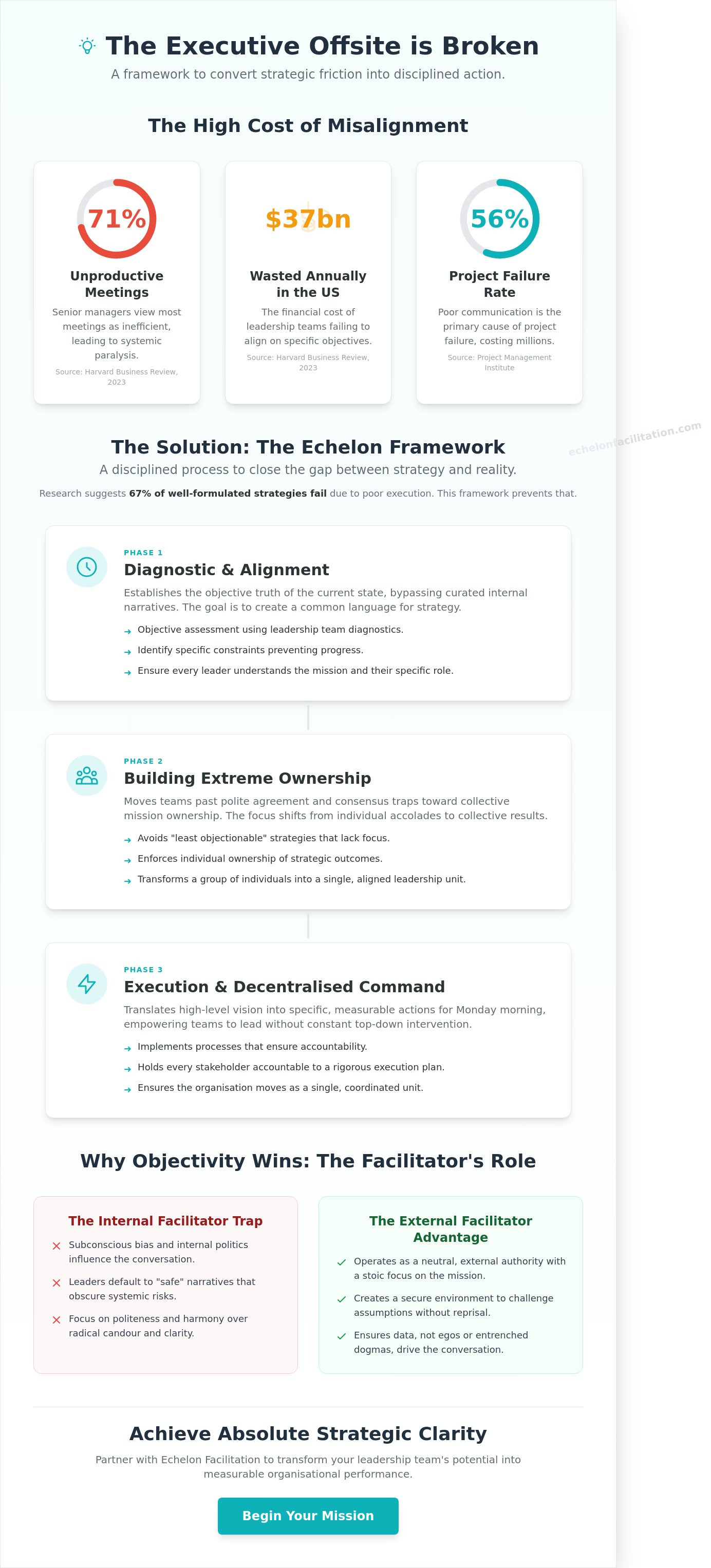
According to a 2023 report by Harvard Business Review, 71% of senior managers view meetings as unproductive and inefficient; this results in an estimated $37 billion in wasted annual salary costs within the United States. When leadership teams fail to align on specific objectives, the resulting decision-making paralysis filters down through every layer of the organisation. This lack of clarity forces teams to guess at priorities, destroying momentum and ensuring that strategic goals remain theoretical rather than operational realities for your staff.
This approach establishes a rigorous execution plan that holds every stakeholder accountable. It ensures your organisation moves as a single, coordinated unit through the implementation of decentralised command.
Key Takeaways
- Eliminate the "CEO trap" by establishing an objective environment where senior leaders can challenge entrenched dogmas without compromising professional relationships.
- Use this Complete guide to Echelon Facilitation to transition from passive meeting management to a disciplined framework that enforces individual ownership of strategic outcomes.
- Solve the "offsite hangover" by implementing processes that translate high-level vision into specific, measurable actions for the following Monday morning.
- Optimise organisational performance by identifying the friction points that prevent leadership teams from reaching a state of absolute strategic alignment.
- Shift the focus from individual accolades to collective results, ensuring every leader understands their specific responsibility within the broader organisational objective.
Defining Facilitation in High-Stakes Environments
Executive boards often confuse polite agreement with genuine strategic alignment. This misunderstanding causes 20% of major corporate initiatives to fail before they even launch. When leaders prioritise harmony over clarity, they leave critical risks unaddressed and opportunities untapped.
Research from the Project Management Institute indicates that poor communication results in 56% of project failures, costing organisations an average of £135 million for every £1 billion spent. This financial drain stems from unresolved leadership friction and a lack of objective clarity. This complete guide to Echelon Facilitation provides the framework to eliminate these inefficiencies and ensure every resource moves the organisation toward its primary objectives.
We begin by defining the rigorous standards of high-stakes facilitation. This section outlines the necessity of external authority and the transition from passive discussion to collective ownership.
High-stakes facilitation is a disciplined process designed to extract objective truth from complex executive dynamics. It differs fundamentally from standard meeting management. While a manager might focus on timekeeping and agenda items, a facilitator operates as a strategic advisor. They navigate the human element to ensure that data, not egos, drive the conversation. Facilitation in business requires a neutral, external authority to bypass internal politics. Without this neutrality, senior leaders often default to safe, comfortable narratives that obscure systemic risks. The facilitator's role is to maintain a stoic focus on the mission, acting as a mirror to the leadership team's current reality.
The Echelon Approach to Leadership Clarity
Clarity is the result of radical candour, not consensus. Our approach creates a secure environment where leaders can challenge assumptions without fear of reprisal. We move teams past superficial agreement toward collective mission ownership. This shift ensures that every executive leaves the room committed to the same objective. It replaces individual silos with a unified front, turning potential friction into a catalyst for organisational progress. By addressing underlying friction directly, we transform a group of high-performing individuals into a single, aligned leadership unit.
When to Deploy Professional Facilitation
Organisations must deploy professional facilitators when the cost of indecision exceeds the cost of intervention. Signs of critical misalignment include recurring debates over the same issues or a failure to execute on previous board decisions. Professional intervention is vital when preparing for a strategic planning process that requires total buy-in. When a decision involves high capital expenditure or a significant shift in market positioning, a structured facilitation process mitigates the risk of fragmented execution. It ensures that the complete guide to Echelon Facilitation is not just read, but actively applied to drive results.
The Echelon Framework: Alignment, Ownership, and Execution
This complete guide to Echelon Facilitation identifies the structural failures that prevent strategy from becoming reality. Most organisations suffer from a clarity gap where research suggests 67% of well-formulated strategies fail due to poor execution. The Echelon Framework closes this gap by synchronising three critical components: alignment, ownership, and execution. This process culminates in decentralised command, which empowers teams to lead without constant top-down intervention.
Phase 1: Diagnostic and Alignment
Effective strategy begins with an objective assessment of the current state. We identify the specific constraints that prevent the executive team from moving at pace. By using leadership team diagnostics, we uncover the ground truth of the organisation rather than relying on curated internal narratives. This phase establishes a common language for strategy. It ensures every leader understands the mission and their specific role in it. To see how this framework applies to your specific context, review how we work with executive teams.
Phase 2: Building Extreme Ownership
Consensus is a frequent trap for leadership teams. It often results in a "least objectionable" strategy that lacks the necessary focus to succeed. We push teams toward commitment instead. This involves challenging every assumption to ensure the plan is robust and battle-tested. We formalise this accountability through a team charter that defines exactly who is responsible for specific outcomes. Developing effective strategic leadership requires moving from "the company's problem" to "my responsibility." When every leader takes total ownership of their vertical, the organisation achieves the stability required for rapid execution. This complete guide to Echelon Facilitation ensures that accountability is never a vague concept but a practical reality.
Internal vs. External Facilitation: Why Objectivity Wins
Internal leaders often fall into the 'CEO Trap' when attempting to lead high-stakes strategy sessions. It is impossible for a senior executive to facilitate a meeting while simultaneously participating as a primary stakeholder. Their presence alone dictates the flow of conversation; subordinates naturally filter their contributions to align with the perceived preferences of the person who controls their career progression. An external partner operates outside this hierarchy, allowing them to challenge established corporate dogmas without fear of political repercussions or social friction.
Objectivity is the only path to strategic clarity. An outsider brings a perspective unburdened by the 'way we've always done things'. They identify the blind spots that internal teams have grown to accept as standard operating procedure. By navigating power dynamics and managing outsized egos, an external partner ensures the agenda remains focused on the mission. This complete guide to Echelon Facilitation underscores that true alignment requires a facilitator who values the objective truth over comfortable narratives.
The Hidden Costs of DIY Facilitation
Attempting to save budget by using an internal facilitator often results in significant financial waste. Groupthink is a silent killer of innovation, occurring when ideas go unchallenged to maintain social harmony. Research from the Harvard Business Review indicates that 67% of strategy meetings fail to produce actionable decisions because the facilitator cannot address the 'elephant in the room'. When a strategy offsite becomes a standard office meeting in a different location, the organisation loses the return on investment for executive time, which often exceeds £10,000 per day for a senior leadership team.
The Echelon Advantage in London and Beyond
Securing a professional workshop facilitator provides a level of discipline that internal staff cannot replicate. This complete guide to Echelon Facilitation highlights the necessity of a partner who is not afraid to speak truth to power. Andrew and trusted associate facilitators push leadership teams to confront difficult data and reach a definitive consensus. Every session concludes with documented outcomes and a clear RACI matrix, ensuring that the strategy moves from the boardroom into the field of execution without delay or ambiguity. We prioritise disciplined action over fleeting motivation, ensuring every minute spent in the room serves the collective mission.
From Strategic Offsite to Operational Reality
The "offsite hangover" describes the rapid decay of enthusiasm that occurs when leaders return to the friction of daily operations. Research published by the Harvard Business Review indicates that 67% of well-formulated strategies fail because of poor execution. This failure typically begins within the first 14 days post-workshop as the reality of existing workloads consumes the capacity for change. This complete guide to Echelon Facilitation provides the structure needed to ensure alignment doesn't dissolve once the whiteboard is erased. Bridging the gap between vision and output requires a 30-day execution plan that prioritises immediate momentum.
Structuring a Results-Driven Strategy Offsite
High-performing organisations design an offsite agenda that forces hard decisions rather than encouraging open-ended discussion. Effective facilitation requires that 70% of the strategic heavy lifting occurs before the session begins through rigorous pre-work and objective setting. This preparation ensures the offsite focuses on resolving resource conflicts and identifying trade-offs necessary for the mission. Leaders must manage team energy by scheduling high-cognitive tasks in the morning and leaving administrative alignment for the afternoon. This complete guide to Echelon Facilitation identifies that the bridge between strategy and reality is built in the first month.
The Mechanics of Execution
Every strategic pillar requires a single point of accountability. Group ownership is a euphemism for no ownership. Leaders must use a framework like the RACI matrix to clarify who is responsible for specific outcomes and who supports them. Success must be defined in measurable terms; if a goal cannot be quantified, it's merely a suggestion. Defining 'Done' for every pillar ensures that the team understands exactly what victory looks like in operational terms. This complete guide to Echelon Facilitation advocates for a fortnightly "Review and Adjust" cycle to address operational friction. This rhythmic communication cadence maintains alignment and prevents the strategy from becoming a static document.
If your leadership team struggles to turn strategic ideas into measurable results, book a strategy sprint to accelerate your execution and secure your objectives.
Partnering with Echelon: Your Mission for Strategic Clarity
Echelon rejects the traditional consultancy model of passive observation and generic reporting. We operate as partners invested in your results. This complete guide to Echelon Facilitation emphasises that strategy fails not due to poor logic, but because of friction within the human element of leadership. We address the psychological and structural barriers that prevent executive teams from moving at pace. Our methodology is designed to give your leadership team confidence in their collective direction, moving from fragmented efforts to a unified front of execution.
Customised Facilitation and Consultancy
Every organisation faces unique constraints that standard templates cannot solve. We tailor engagements to your specific challenges, whether through intensive board alignment workshops or high-impact strategy sprints. We prioritise objective truth over comfortable narratives. A 2023 McKinsey report found that 70% of organisational transformations fail due to people and culture issues. We mitigate this risk by focusing on accountability and clear decision rights. Our commitment is to the results, not to maintaining the status quo or providing superficial affirmations.
Begin Your Perspective Shift
Delaying the resolution of team friction carries a compounding cost. A disciplined leadership culture provides long-term value by reducing the time spent on internal politics and redirected efforts. Research from the Harvard Business Review indicates that teams with high strategic alignment are 50% more likely to achieve their goals. This complete guide to Echelon Facilitation highlights that the first step to high performance is acknowledging existing constraints. Contact Echelon to discuss your team’s perspective shift today to begin the journey toward operational excellence.
Strategic clarity is not a static achievement but a continuous state of alignment. Success requires more than a well-documented plan; it demands a leadership team capable of executing that plan with absolute ownership. By addressing the human element of leadership and removing the friction of ambiguity, organisations transform their executive groups into high-performing units. This shift from passive strategy to active execution ensures that every member of the team understands their role in the broader objectives. When you prioritise objective truth and disciplined accountability, you build a foundation for sustainable growth and unshakeable confidence in your future direction.
Establish Strategic Clarity for Disciplined Execution
Leadership teams often mistake simple agreement for genuine alignment. True alignment requires a neutral arbiter to challenge comfortable narratives and enforce ownership across the executive suite. This complete guide to Echelon Facilitation demonstrates that strategic clarity is a product of disciplined execution rather than mere discussion. Founded by Dr Andrew Greenland, a medical doctor who has spent years running large, high-stakes working sessions for senior expert groups, Echelon specialises in executive alignment, using structured frameworks to help every leader accept responsibility for the collective objective. Research indicates that 67% of well-formulated strategies fail due to poor execution; our process mitigates this risk by grounding high-level theory in operational reality. Avoid the friction of internal bias by prioritising objective, external expertise that remains composed under pressure. Your organisation deserves a strategy that translates into measurable results without the interference of political silos. Take the first step toward a more cohesive leadership structure today.
Book a Strategic Diagnostic Call with Echelon Facilitation
Decisive action ensures your organisation is ready for the challenges ahead.
Frequently Asked Questions about our Complete Guide to Echelon Facilitation
What is the difference between facilitation and traditional business consultancy?
Consultancy provides external answers while facilitation extracts the solution from your own leadership team. This complete guide to Echelon Facilitation clarifies that we don't tell you what to do; we ensure your team owns the outcome. According to a 2023 Harvard Business Review study, 70% of strategic initiatives fail due to lack of buy-in. We mitigate this by making your executives the primary architects of the strategy.
How long does a typical Echelon facilitation engagement last?
A standard engagement spans six to eight weeks from initial discovery to the final review. The core workshop typically requires two consecutive days of focused intensity. We spend the first 21 days conducting diagnostic interviews with every stakeholder to identify hidden friction points. This preparation ensures that the live sessions focus on high-stakes decision-making rather than basic information sharing or status updates.
Can Echelon facilitate virtual or hybrid leadership workshops?
We design hybrid and virtual sessions using structured digital environments to ensure parity between remote and in-room participants. Statistics from 2022 indicate that 68% of leadership teams now operate with at least one remote member. We utilise digital whiteboards and synchronous voting tools to maintain a high tempo. These tools prevent the cognitive drift often associated with standard video conferencing and ensure all voices are heard.
How do you handle conflict between strong personalities in a leadership team?
Conflict is managed by redirecting interpersonal friction toward objective organisational challenges. We utilise frameworks like the Thomas-Kilmann Conflict Mode Instrument to categorise and resolve disagreements. By focusing on the mission rather than individual egos, we transform personality clashes into productive debate. This approach keeps the team's energy on the strategic objective instead of internal politics or personal grievances.
What specific outcomes can we expect after an Echelon workshop?
Clients receive a documented strategy, a 90-day execution roadmap, and a finalised RACI matrix for all critical projects. These outputs provide a clear framework for decentralised command within the organisation. You'll leave with a defined set of priorities that eliminates the ambiguity responsible for 40% of wasted executive time. Every decision is recorded to ensure absolute clarity on ownership, deadlines, and specific performance metrics.
Is Echelon facilitation suitable for small businesses or just large corporations?
Our methodology scales for any leadership team of 5 to 12 people, regardless of the organisation's total headcount. The principles of alignment and ownership are just as vital for mid-market firms as for large corporations. Effective facilitation provides a 25% increase in operational velocity for smaller teams by removing the bottlenecks caused by poor communication. This complete guide to Echelon Facilitation applies to any high-stakes environment.
How do you ensure that the decisions made in the workshop are actually implemented?
Implementation is secured through a mandatory 90-day follow-up cadence and the assignment of extreme ownership for every action item. We integrate these outcomes into your existing project management systems to ensure visibility. Research shows that teams with a formal accountability structure are 95% more likely to achieve their goals. We don't just facilitate a meeting; we install a permanent system for sustained execution and review.
What is the role of the CEO during a facilitated session?
The CEO participates as an active contributor rather than the sole arbiter of truth. To prevent anchoring bias, the CEO often speaks last during critical debates, allowing the team to offer unfiltered insights first. This approach fosters an environment where the most junior person can challenge the most senior. The CEO's role is to set the intent and then empower the team to determine the path toward the objective.