
Short answer: a change management workshop facilitator runs the sessions in which a leadership team agrees what a change programme must achieve, who owns each part and what will stop to make room for it. In the UK, an executive-level change workshop typically costs £4,500 to £6,000 for a full day with preparation and follow-up. The facilitator’s job is not to manage the change but to make sure leaders leave aligned, with named owners and a plan to check progress.
Executive resistance is rarely about the change itself; it is a battle for territory and decision rights that destroys ROI before the first milestone is reached. You have likely sat through strategy sessions where leaders nod in agreement, only to return to their departments and protect their own interests. Engaging a change management facilitator uk resolves this friction by forcing objective truths to the surface and establishing the clear accountability required for strategic progress.
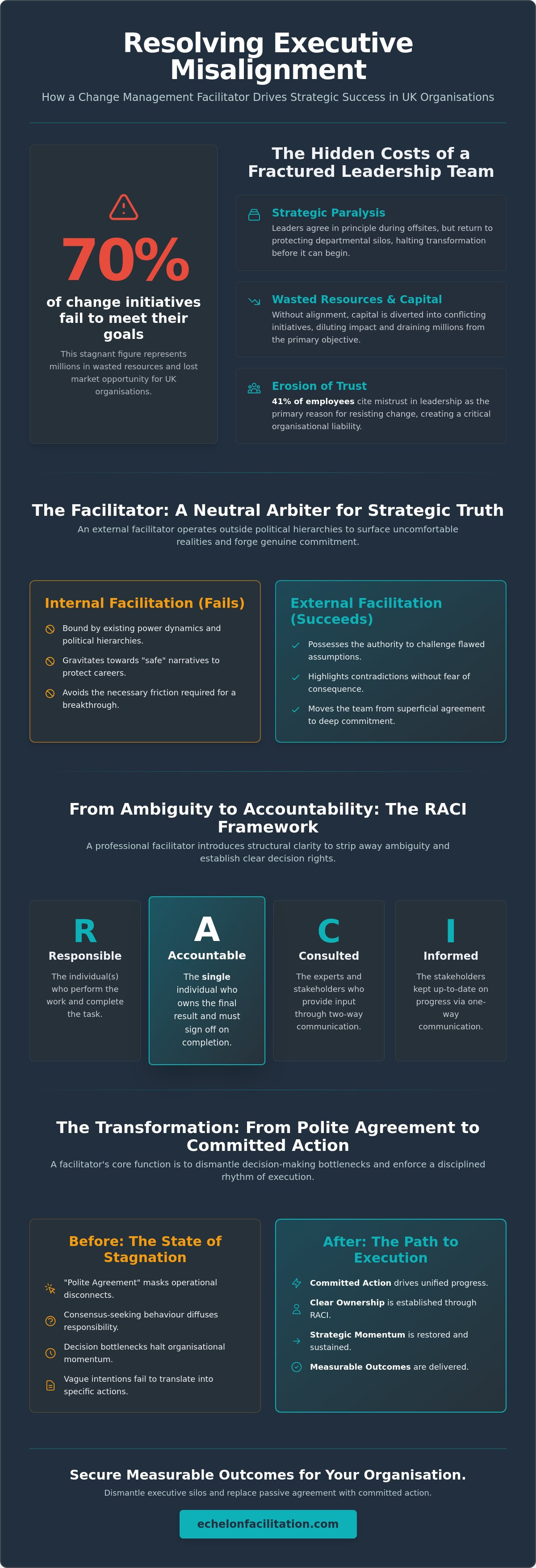
Approximately 70% of change initiatives fail to meet their goals, a figure that has remained stubbornly high for decades. This failure often stems from a disconnect between leadership vision and operational reality, costing organisations millions in wasted resources. When 41% of employees cite mistrust as the primary reason for resistance, the financial burden of a fractured leadership team becomes a liability you cannot ignore. Success requires the discipline to align every leader behind a single, executable strategy to avoid these pitfalls.
Professional facilitation dismantles executive silos and replaces passive agreement with committed action. This process relies on driving strategic alignment and implementing frameworks that ensure every organisational transformation delivers measurable results.
Key Takeaways
- Identify the executive alignment gaps that cause strategic stagnation and learn how to resolve them through neutral arbitration.
- Replace inefficient consensus-seeking behaviours with the RACI framework to establish clear decision rights and personal accountability.
- Evaluate a potential change management facilitator uk by their capacity to challenge senior leaders and provide disciplined authority.
- Transition from the initial workshop to a sustainable rhythm of execution that secures measurable outcomes over a 90-day horizon.
Change Management Facilitator UK: Resolving the Executive Alignment Gap
A professional change management facilitator uk is not a passive scribe or a corporate cheerleader. They function as a neutral arbiter of strategic truth. Their primary objective is to surface the uncomfortable realities that leadership teams often ignore in favour of polite consensus. Many executive boards fall into a predictable trap: they reach a verbal agreement on strategy during a Friday offsite, only for departmental heads to resume protecting their own silos by Monday morning. This disconnect creates a state of strategic paralysis that halts transformation before the first milestone is reached.
Internal facilitation frequently fails because it cannot escape the gravity of existing power dynamics. Staff members tasked with guiding their superiors naturally gravitate toward safe narratives to protect their careers. They avoid the friction necessary for genuine breakthrough. An external facilitator operates outside these political hierarchies. They possess the authority to challenge flawed assumptions and highlight contradictions without fear of consequence. This objectivity is essential for moving beyond superficial agreement to the deep, functional commitment required for large-scale change management initiatives.
The High Cost of Misaligned Leadership
Delayed decision-making and strategic drift represent a significant financial drain for UK organisations. Alignment is the absolute prerequisite for any successful transformation. Without it, capital is diverted into conflicting initiatives that dilute the impact of the primary objective. Consider a UK financial firm that loses 18 months of progress because siloed VPs cannot agree on shared data ownership. A stalemate like this can waste millions of pounds in operational costs and allow competitors to capture market share. Often the deadlock only breaks when a neutral facilitator forces a decision-rights reset that prioritises the organisation over individual departments.
Strategic friction is a choice. Choosing to ignore it guarantees failure, whilst addressing it through disciplined facilitation creates a clear path to execution. Leadership teams must move from "agreement in principle" to "commitment in practice."
Structural Frameworks: Utilising RACI to Clarify Decision Rights
Structural clarity is the antidote to strategic drift. A professional change management facilitator uk introduces frameworks that strip away the ambiguity often found in senior roles. The RACI Process serves as the standard for this transition. It categorises objectives using four distinct filters:
- Responsible: The individual performing the work.
- Accountable: The person who owns the result and must sign off on completion.
- Consulted: Those providing input or expertise.
- Informed: Stakeholders kept updated on progress.
This distinction is vital because consensus-seeking often masks a fear of personal responsibility. Clear ownership drives results whilst consensus frequently causes stagnation. Establishing these decision rights is a core component of Transformation Alignment. It ensures that boardroom agreements translate into specific, measurable actions rather than vague intentions.
Moving Beyond Consensus to Accountability
Many UK leadership teams suffer from "polite agreement." This is a state where leaders avoid direct confrontation, creating a surface-level harmony that hides deep-seated operational disagreement. Such behaviour creates decision-making bottlenecks where projects wait for universal approval, yet belong to no one. By engaging a change management facilitator uk, organisations can dismantle these bottlenecks and restore momentum. The facilitator forces the team to acknowledge where "consultation" has become a stall tactic rather than a value-add.
The Role of the Facilitator in Structural Change
The facilitator enforces the RACI matrix during live sessions to prevent the diffusion of responsibility. They ensure that only one individual holds the "Accountable" tag for any given objective. This rigour prevents the "bystander effect" in corporate strategy, where everyone assumes someone else is leading. For organisations requiring rapid role clarity, a Strategy Sprint provides an accelerated method for pinning down these rights. This structured approach moves the team from vague discussions to a firm contract of execution.
Choosing a Change Management Facilitator in the UK: Selection Criteria
Senior leadership teams do not require a corporate cheerleader; they need a peer capable of holding the room. A professional change management facilitator uk must possess disciplined authority. This is the ability to maintain strategic focus when executive egos or departmental interests threaten to derail the objective. Avoid facilitators who offer "workshop energy" or high-octane enthusiasm without an underlying structural rigour. The goal is not a temporary morale boost but a permanent shift in how decisions are made and executed.
Selecting the wrong partner leads to "polite" sessions that fail to address the root causes of organisational friction. Use this five-step selection process to filter for quality:
- Track record: Evidence of aligning boards during high-stakes transitions or structural shifts.
- Methodology: A documented, repeatable approach for moving a team from friction to a firm decision.
- Neutrality: Total independence from internal politics and past alliances.
- Industry-agnosticism: The ability to apply strategic logic across sectors without being blinded by "industry standard" excuses.
- Challenge-capability: The demonstrated willingness to confront a CEO or Director when their behaviour contradicts the stated organisational strategy.
Be wary of facilitators who rely on team-building clichés or abstract "visioning" exercises. These methods often fail because they ignore the operational reality of the business. If a facilitator cannot explain how their session leads to a clear accountability framework or a reset of decision rights, they are a liability. A preliminary diagnostic call is the most effective way to test for this strategic fit before committing resources.
Experience vs. Methodology: What Matters Most?
Managing group dynamics is the primary skill of an elite facilitator. A facilitator's specific industry background is secondary to their ability to navigate the interpersonal friction that stalls change. Research from Harvard Business Review highlights that external neutrality is a critical lever during strategic pivots. It allows the facilitator to ask the "obvious" questions that internal staff are too afraid to voice. This outside perspective is essential for strategic alignment because it forces the leadership team to justify their positions against objective truth rather than historical precedent. Prioritise a partner who values methodology and discipline over fleeting motivation.
To ensure your next leadership session produces actionable results, book a diagnostic call to discuss your specific alignment challenges.
Transformation Alignment: Ensuring Sustainable Strategic Execution
The value of any executive session is not measured by the quality of the debate, but by the actions taken once the room is empty. A professional change management facilitator uk ensures that the insights gained during a workshop translate into "the work." This transition requires moving beyond high-level concepts into a structured 30, 60, and 90-day execution cycle. Without this rigorous follow-up, the momentum generated during a session evaporates within a week as leaders return to their habitual departmental focuses.
A facilitator's primary duty is to establish a "rhythm of execution" that persists long after their departure. This rhythm relies on the direct link between individual accountability and the successful completion of organisational objectives. Each executive must leave with a clear understanding of their role in the broader transformation. Accountability isn't a burden; it's the mechanism that ensures strategic goals are met on time and within budget. When every leader knows exactly what they are responsible for delivering, the risk of strategic drift is significantly reduced.
The 30-Day Execution Plan
Immediate momentum is non-negotiable for long-term success. A 30-day plan acts as the bridge between strategic intent and operational reality. This plan must include clear owners, hard deadlines, and established reporting lines to prevent the organisation from slipping back into old habits. For a deeper understanding of how these elements integrate, review our Strategic Planning Process. Use the following template to maintain post-workshop discipline:
- Strategic Objective: Define the specific goal agreed upon during the session.
- Accountable Owner: Assign a single leader to own the result (referencing the RACI framework).
- Critical Milestones: Identify three essential actions to be completed within the first 30 days.
- Reporting Cadence: Establish weekly 15-minute alignment checks to track progress and remove blockers.
Transformation fails when it's treated as an event rather than a continuous process of disciplined execution. By embedding these accountability structures early, you ensure that the change actually delivers the measurable ROI promised to the board. To begin resolving the friction in your leadership team and drive results, Organise a Strategy Offsite today.
How Echelon runs change management workshops
Echelon’s Transformation Alignment Workshop is a full-day session for 8-15 leaders, designed for change programmes where leadership commitment is uneven or unstated. Before the day, a diagnostic call and participant pre-work surface where leaders really stand. On the day, independent exercises come before group discussion, so the most senior voices don’t anchor the room.
The team leaves with:
- a shared definition of success at 30, 90 and 180 days
- named risks, each with an owner responsible for mitigating it
- a sponsorship and communication commitment log, so every leader tells the same story
- a decision log, and a 30-day follow-up call to check commitments are holding
A full-day session costs £4,500 to £6,000, with founding client rates available. Optional 90-day reviews and quarterly review retainers help keep a long programme on track. See our pricing and how we work.
Securing Strategic Momentum through Disciplined Alignment
Strategic transformation remains a theory until a leadership team accepts the discipline of shared accountability. Surface-level consensus is a liability that wastes capital and stalls progress. Engaging an expert change management facilitator uk ensures that board-level friction is resolved through objective truth rather than political compromise. This process replaces vague intentions with a rigid structure of decision rights, ensuring that every member of the executive team knows exactly what they are accountable for delivering.
Success requires a partner who understands the mechanics of high-stakes executive alignment. Echelon Facilitation, led by founder Dr Andrew Greenland - a medical doctor who has spent years running large, high-stakes working sessions for senior expert groups - specialises in navigating these complex interpersonal dynamics. As a UK practice based in Twickenham, we provide the authority and neutrality required to turn ambitious strategies into sustainable operational realities. Establishing a rhythm of execution today prevents the strategic drift that compromises tomorrow's growth.
Contact Echelon Facilitation to discuss your transformation alignment and establish the clarity your organisation needs to thrive.
Frequently Asked Questions
What is the difference between a change manager and a change management facilitator?
A change manager typically focuses on the operational rollout and employee adoption of a new system or process. In contrast, a change management facilitator uk operates at the leadership level to resolve the executive friction that prevents a strategy from reaching the implementation phase. One manages the project mechanics; the other manages the decision-makers and their alignment.
How long does a typical change management facilitation engagement last in the UK?
Strategic alignment engagements vary based on the complexity of the organisational challenge. A high-impact Strategy Sprint or Decision-Rights Reset typically lasts between one and three days for the live session. The full cycle of transformation alignment often encompasses a 90-day execution window to ensure that the decisions made during the workshop translate into measurable operational results.
Can an internal HR leader facilitate a high-stakes change workshop?
Internal HR leaders rarely possess the neutral authority required to challenge a board of directors effectively. Power dynamics and career risks often prevent internal staff from surfacing the uncomfortable truths that cause strategic paralysis. An external facilitator provides the necessary distance to question flawed assumptions and force accountability without the fear of internal political repercussions or professional bias.
How much does a professional change management facilitator cost in the UK?
General workshop facilitation in the UK often costs around £1,200 to £2,500 a day, while executive-level change facilitation typically costs £3,000 to £6,500 a day or more. Echelon’s full-day Transformation Alignment Workshop costs £4,500 to £6,000, including the diagnostic call, participant pre-work, the session, a written decision log and a 30-day follow-up call.
What frameworks do facilitators use to ensure executive alignment?
Elite facilitators utilise structural frameworks to bring clarity to complex leadership dynamics and prevent strategic drift. The RACI matrix is a standard tool for defining decision rights and personal accountability. Other methodologies, such as the Cynefin framework, help teams categorise challenges to determine the appropriate response. These tools move the conversation from subjective opinion to objective, results-driven strategy.

Article by
Andrew Greenland
Dr Andrew Greenland is the founder of Echelon Facilitation, a UK practice that designs and runs high-stakes leadership sessions for executive teams who need decisions, not more discussion. A medical doctor and medical educator, Andrew brings a clinician's discipline to the messy, political work of leadership alignment - surfacing the real disagreement, forcing the real choices, and ensuring every session produces a documented decision log with named owners and deadlines. He designs Echelon’s sessions for CEOs, executive teams, transformation leads and boards. Based in Twickenham.