
A strategic plan that exists only as a static document is an administrative burden that creates a false sense of security whilst the organisation drifts. If your strategic planning process does not result in immediate, coordinated action, it has failed its primary purpose.
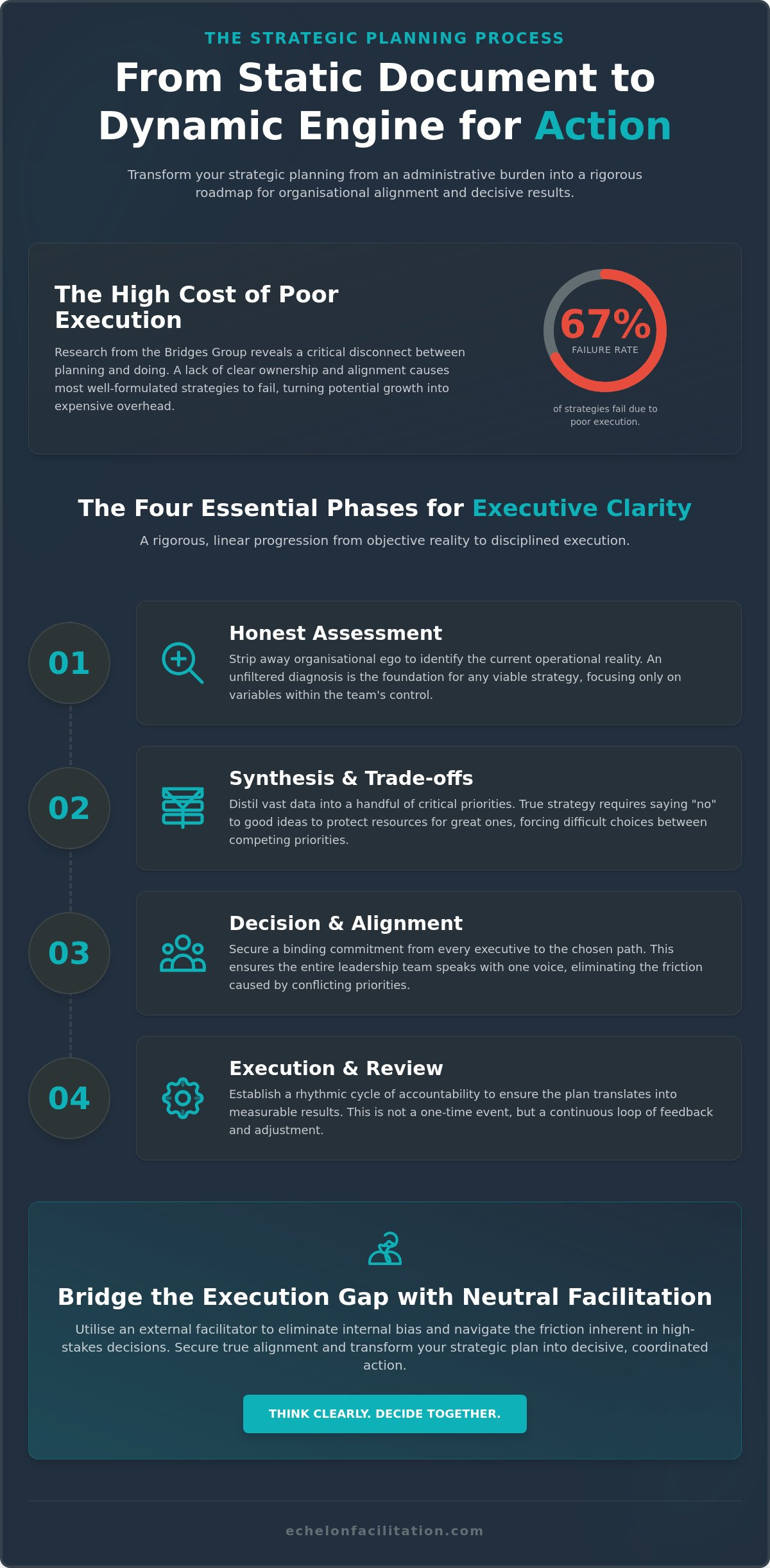
This lack of cohesion is expensive. Research by the Bridges Group in 2020 revealed that 67% of well-formulated strategies fail because of poor execution and a lack of alignment. When leadership teams lack clear ownership, they lose momentum and revert to siloed behaviours. This framework converts abstract goals into a rigorous, 36-month roadmap for decisive action. You will learn to transform your strategic planning process from a static document into a dynamic engine for organisational alignment and decisive action.
Establishing the mechanics of executive buy-in and structural accountability ensures every leader owns the outcome. Absolute clarity on decision rights optimises the path to execution whilst addressing the human element of leadership to ensure the team remains fully bought into the chosen direction.
Key Takeaways
- Shift from static documentation to a disciplined cycle of assessment and decision-making to maintain executive clarity.
- Identify the operational reality by stripping away assumptions and distilling numerous distractions into a few critical priorities.
- Bridge the execution gap by implementing the RACI framework to establish clear ownership and accountability across the leadership team.
- Transform your strategic planning process into a dynamic engine for alignment that prioritises decisive action over passive reporting.
- Utilise neutral external facilitation to eliminate internal bias and navigate the friction inherent in high-stakes decision-making.
Redefining the Strategic Planning Process for Executive Clarity
The strategic planning process is not a periodic administrative obligation; it's a disciplined cycle of assessment, decision-making, and alignment. Research from the Bridges Strategy Implementation Survey indicates that 67% of well-formulated strategies fail due to poor execution. This failure often stems from a fundamental misunderstanding of the Strategic Planning cycle. When leaders treat strategy as a static annual event, they fall into the "reporting trap," producing documents that gather dust whilst the market shifts. A living strategy requires active execution and a commitment to objective truth over comfortable narratives.
Success requires a shift from passive observation to extreme ownership. If a leadership team cannot acknowledge the reality of their operational environment, they cannot lead. We must define strategy as a continuous loop of feedback and adjustment rather than a fixed destination. This approach centres on the belief that a plan is only as valuable as the clarity it provides to those responsible for its delivery.
Strategic Friction represents the primary obstacle to organisational victory. This friction occurs when internal processes, conflicting priorities, and unclear communication slow down the speed of execution. It acts as a silent tax on every initiative, turning potential growth into expensive administrative overhead. Eliminating this friction requires a refusal to accept mediocrity in the planning phase and a focus on removing the barriers that prevent clear, decisive action.
The Four Essential Phases of the Strategic Planning Process
A high-functioning strategic planning process demands a linear progression from objective reality to disciplined execution. It is not a creative exercise; it is a rigorous filter designed to separate essential priorities from operational noise. Leaders must move through four distinct phases to ensure the resulting plan is both viable and supported by the entire board. A thorough assessment is the first milestone of any effective strategic planning process, providing the raw data required for difficult executive decisions.
- Phase 1: Honest Assessment. Stripping away organisational ego to identify the current operational reality without filters or excuses.
- Phase 2: Synthesis and Trade-offs. Distilling vast amounts of data into a handful of critical priorities that move the needle.
- Phase 3: Decision and Alignment. Securing a binding commitment from every executive to the chosen path, ensuring the team speaks with one voice.
- Phase 4: Execution and Review. Establishing a rhythmic cycle of accountability to ensure the strategic planning process translates into measurable results on the ground.
Conducting an Unfiltered Assessment
Success begins with an uncompromising look at the internal and external environment. Standard frameworks like SWOT or PESTLE are useful only when applied through the lens of extreme ownership. This means ignoring external excuses and focusing on variables within the team's control. Executives must challenge every business assumption, from market share projections to internal capacity. A thorough leadership team assessment helps identify if personal biases or friction are clouding this diagnostic stage. Without an accurate baseline, the entire strategy rests on a foundation of fiction.
The Art of the Strategic Trade-off
A strategy that attempts to satisfy every stakeholder is merely a list of aspirations. True strategy requires saying no to good ideas to make room for great ones. Michael Porter famously argued in What is Strategy? that strategic positioning means performing different activities from rivals or performing similar activities in different ways. This necessitates difficult choices between competing priorities. Facilitating these sessions requires a firm hand to force decisions. Leaders must define what the organisation will stop doing to protect its resources. If you find your team struggling to narrow their focus, consider a structured strategy sprint to accelerate these critical decisions and secure the necessary alignment.
Bridging the Execution Gap in Your Strategic Planning Process
The most frequent criticism of any strategic planning process is the failure to move from the boardroom to the front line. Research from Kaplan and Norton indicates that 67% of well-formulated strategies fail due to poor execution. This gap exists because leaders treat the plan as a finished product rather than a starting point for action. To bridge this, you must demand a 30-day execution plan immediately following the planning session. This document identifies the immediate moves required to validate the strategy and ensures that the first steps are taken whilst the intent is still clear amongst the leadership team.
Ownership is the primary solution to organisational friction. We use the RACI framework (Responsible, Accountable, Consulted, Informed) to eliminate the bystander effect. Every objective must have exactly one Accountable individual. When accountability is shared, it is diluted. By assigning a single owner who has the authority to direct resources, you remove the ambiguity that often stalls progress. This clarity allows for decentralised command; once the senior team sets the objective, subordinate leaders must have the autonomy to execute without constant oversight. They operate within the boundaries of your intent, making real-time adjustments to achieve the mission.
Establishing Clear Decision Rights
Group ownership is an illusion that leads to no ownership. In many executive teams, decisions stall because the boundaries of authority are blurred. A Decision-Rights Reset fixes these execution bottlenecks by defining who makes the final call on specific investments, hires, and pivots. This framework prevents the "consensus trap" where progress slows to the speed of the most hesitant member. When decision rights are clear, the organisation moves with speed and precision.
Maintaining Forward Momentum
Strategy is not a static event; it requires a steady communication rhythm. We implement a Strategy Sprint to move from vision to operational reality in defined, high-intensity intervals. This approach ensures every level of the organisation understands the mission and their specific role within it. To maintain this pace, you should follow the 7 essential steps of strategic planning, which centre on continuous revision and execution. This ensures the strategic planning process remains a live document that evolves based on real-world feedback rather than gathering dust on a shelf.
Stop letting your strategy stall at the finish line. Contact Echelon Facilitation to align your team for execution.
Securing Mission Success through a Facilitated Strategic Planning Process
Internal leaders cannot facilitate their own strategy sessions without compromising the result. Cognitive bias and existing power hierarchies inevitably stifle honest dissent, leading to a consensus that prioritises comfort over growth. Research from the Harvard Business Review indicates that 67% of strategies fail due to poor execution, often rooted in a lack of genuine alignment during the initial design phase. An external facilitator brings the stoic confidence required to challenge senior executives and manage high-stakes friction. They operate outside the internal political structure, ensuring the strategic planning process remains objective and grounded in reality.
A Strategy & Vision Offsite serves as a critical circuit breaker for the executive team. It removes leaders from daily operational noise, allowing for deep focus on long-term objectives. This environment transforms a standard meeting into a strategic lever for organisational victory. It forces a shift from passive observation to active accountability, ensuring the team addresses the hardest truths without distraction.
The Role of the Neutral Facilitator
Neutrality prevents the loudest voice from dictating the path forward. Facilitators focus on outcomes, cutting through circular debates that stall progress. They ensure every participant takes extreme ownership of the final plan. This discipline prevents a culture of endless discussion and maintains a steady rhythm toward execution. By managing group dynamics, the facilitator ensures the strategic planning process incorporates diverse perspectives rather than just the highest-paid person's opinion.
Planning for 2027 and Beyond
The 2026 planning cycle requires a diagnostic of current leadership constraints before setting new targets. High-performing teams use a structured strategic planning process to identify where silos or lack of clarity currently hinder performance. Utilising a 2026 Strategic Planning Template provides the structure necessary to move from abstract goals to concrete accountability. Success in 2027 depends on addressing these human elements today to ensure the organisation remains resilient against future market shifts.
Converting Strategy into Operational Reality
A strategic planning process is only as effective as the accountability it produces. Research suggests that 67% of well-formulated strategies fail due to poor execution; this is a failure of leadership, not intent. By implementing the RACI framework, executive teams transform vague intentions into specific, measurable responsibilities. Dr Andrew Greenland, a medical doctor who has spent years running large, high-stakes working sessions for senior expert groups, applies the same discipline to help leadership teams replace internal friction with a unified direction and objective truth.
High-performance organisations do not leave their future to chance. They build it through disciplined facilitation and a refusal to accept comfortable narratives. Secure your strategy for 2027 with an Echelon Strategy Sprint to help your team move with absolute purpose and precision. Your leadership deserves the stability and forward momentum that comes from a structured framework. Your organisation is ready to lead.
Frequently Asked Questions
What is the most critical step in the strategic planning process?
Executive alignment represents the most critical step in the strategic planning process. Without a unified leadership team that accepts extreme ownership of the objectives, execution remains impossible. Harvard Business Review reports that 85% of executive teams spend less than one hour per month discussing strategy. This lack of focus ensures that even sophisticated plans fail to transition from the boardroom to operational reality.
How long should a typical strategic planning cycle take for a mid-sized organisation?
A standard cycle for a mid-sized organisation requires 8 to 12 weeks. This timeframe allows for a comprehensive internal audit, market analysis, and 3 intensive facilitation sessions. Rushing this sequence results in superficial objectives, whilst extending it beyond 90 days leads to momentum loss. A disciplined cadence ensures the leadership team remains focused on the primary objective without neglecting daily operational requirements.
Who should be involved in the strategic planning process sessions?
The core executive team must lead the sessions, but involvement should extend to key department heads who oversee execution. Limiting the strategic planning process to the C-suite creates a vacuum that prevents operational buy-in. Including 10 to 15 key influencers ensures that the strategy reflects the ground-level reality of the organisation. This structure facilitates decentralised command, where every leader understands the intent and acts with autonomy.
Why do most strategic plans fail during the implementation phase?
Implementation failures stem from a lack of clear ownership and the absence of a structured review cadence. The Bridges Business Consultancy suggests that 48% of organisations fail to meet at least half of their strategic targets. When leaders don't assign specific accountability for key results, the daily operational whirlwind inevitably consumes the resources intended for growth. Success requires a rigid framework that prioritises action over theoretical planning.
How often should a leadership team review their strategic plan?
Leadership teams should conduct formal strategy reviews at least once per month. These sessions focus on variance analysis and removing obstacles to execution. A quarterly cadence allows for more significant adjustments based on market shifts or internal performance data. Waiting for an annual review is a fatal error; 67% of well-formulated strategies fail because organisations don't adapt their plans to real-time feedback and changing conditions.