
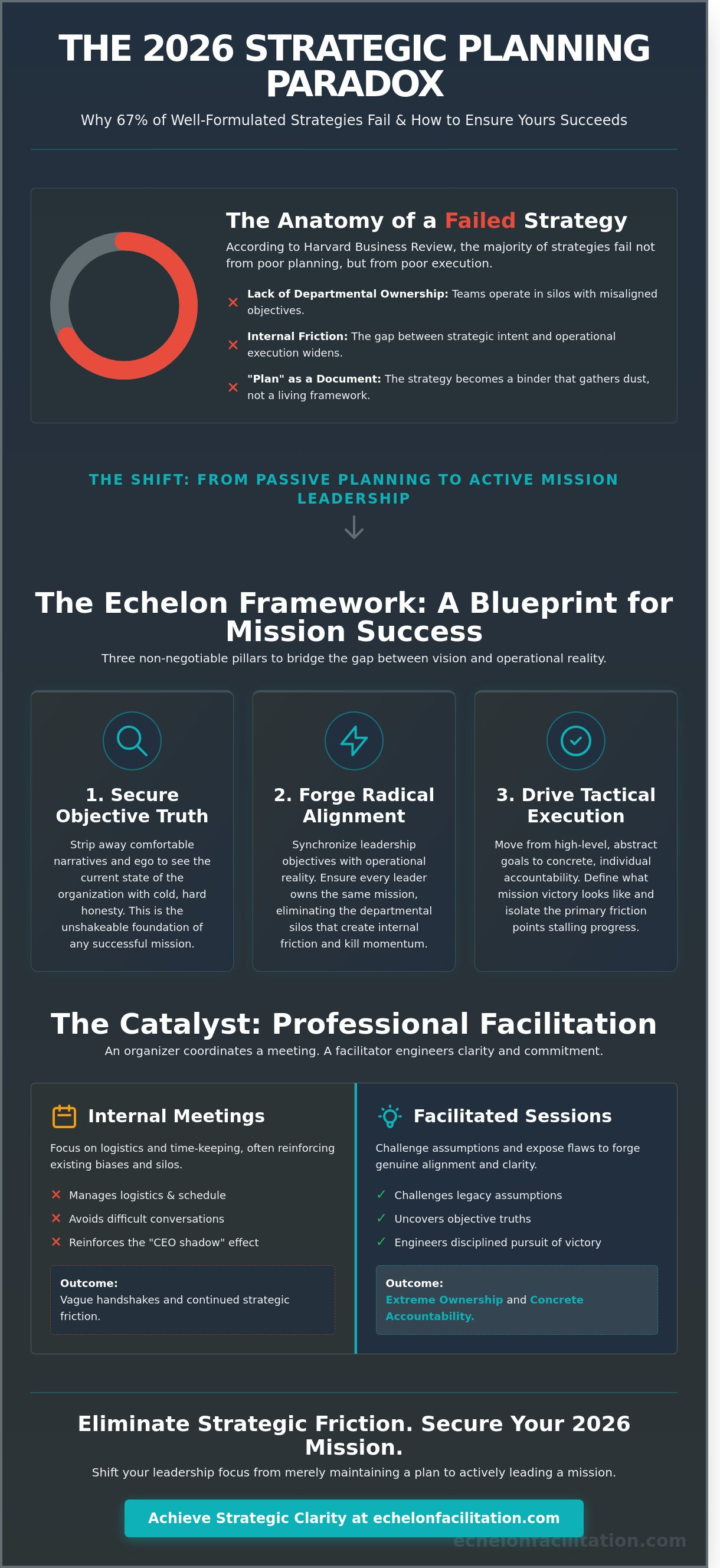
A strategic plan is not a document; it's a commitment to mission success that most leadership teams fail to honor. Research from the Harvard Business Review indicates that 67% of well-formulated strategies fail because of poor execution and a lack of departmental ownership. Your 2026 planning shouldn't result in another binder that gathers dust while your executive team operates in silos. You've felt the frustration of high-stakes meetings that end in vague handshakes rather than concrete accountability.
We agree that a plan without execution is a waste of organizational resources. This article delivers a professional planning template designed to move your leadership team from internal friction to mission-focused clarity. We'll outline a tactical roadmap and a repeatable process for strategic execution that ensures every department head takes extreme ownership of your 2026 objectives.
Key Takeaways
- Identify the "Planning Paradox" to ensure your strategy focuses on tactical execution rather than administrative documentation.
- Apply the Echelon Framework to synchronize leadership objectives with operational reality for more effective 2026 planning.
- Eliminate the "CEO shadow" effect by leveraging professional facilitation to uncover objective truths within your executive team.
- Utilize a structured tactical template to define mission victory and isolate the primary friction points stalling your progress.
- Shift your leadership focus from merely maintaining a plan to actively leading a mission through extreme ownership.
Beyond the Diary: Why 2026 Planning Requires Strategic Facilitation
A leather-bound diary or a digital calendar app might suffice for personal scheduling, but they are insufficient for the complexities of a $50 million enterprise. High-stakes corporate strategy demands a level of rigor that consumer-grade tools cannot provide. Effective 2026 planning isn't about filling in dates; it's about the cold, hard alignment of resources against a defined mission. Many executive teams fall into the Planning Paradox, where they spend 100+ hours generating thick strategy binders that ultimately gather dust. Research from the Bridges Business Consultancy indicates that 67% of well-formulated strategies fail due to poor execution. This disconnect happens when documentation is prioritized over collective ownership.
The stakes for the coming year are high. Economic forecasts for 2026 suggest continued interest rate volatility and shifting geopolitical trade lanes that will require mid-year pivots. Success requires more than a static document. It demands Strategic planning that functions as a living framework. Facilitation acts as the strategic lever here, moving the team from passive observation to active mission success. It forces a confrontation with reality, ensuring that the 2026 roadmap is built on objective truths rather than comfortable boardroom narratives.
The Cost of Misaligned Planning
Indecision is a silent profit killer. When executive teams lack alignment, the hidden cost of indecision manifests as wasted capital and missed market windows. Passive planning creates departmental silos where the marketing team's objectives have no bearing on operational capacity. This lack of cohesion leads to strategic friction. Strategic friction is the gap between intent and execution. To eliminate this, leaders must move beyond standard meetings and engage in high-impact workshops that force horizontal alignment across every department. Without this, the 2026 planning cycle becomes a bureaucratic exercise rather than a competitive advantage.
Facilitation vs. Coordination
It's a mistake to confuse a meeting organizer with a strategic facilitator. An organizer manages the logistics, orders the catering, and keeps the time. A facilitator challenges legacy assumptions and exposes the flaws in the current operating model. They bring an external perspective that internal leaders often lack due to proximity to the problems. This role is critical for establishing extreme ownership within the 2026 mission. Every team member must understand their specific tactical requirements and the consequences of failure. Facilitation isn't about consensus; it's about clarity and the disciplined pursuit of organizational victory. It ensures that the mission remains the focus, regardless of the inevitable mid-year shifts in the economic environment.
The Echelon Framework: Three Pillars of 2026 Strategic Re-alignment
Strategic Re-alignment is the disciplined process of synchronising leadership objectives with operational reality. It's not a passive review of last year's spreadsheets. It's an active, aggressive recalibration of resources and intent. Most organizations fail because they treat planning as a bureaucratic ritual rather than a tactical necessity. Research indicates that 67% of well-formulated strategies fail due to poor execution or a lack of genuine alignment within the leadership tier. Your 2026 planning must bridge the gap between high-level vision and the boots-on-the-ground reality of your team.
The Echelon Framework rests on three non-negotiable pillars. The first is Objective Truth. This involves stripping away comfortable narratives to see the current state of the organization without ego. The second is Radical Alignment. This ensures every leader owns the same mission, eliminating the silos that create internal friction. The third is Tactical Execution. This pillar moves the organization from high-level goals to concrete accountability. Strategic planning often fails when it becomes a detached analytical exercise. As highlighted in The Fall and Rise of Strategic Planning, real strategy requires synthesis and intuition, not just the mechanical processing of data. For teams ready to move beyond theory, a professional strategy workshop provides the environment needed to forge this alignment.
Securing Objective Truth
Honesty is the foundation of any successful mission. Before 2026 planning begins, leaders must conduct a leadership team assessment to diagnose friction points. You must identify the "elephants in the room" that stall progress. These are the persistent cultural or operational issues that everyone sees but no one addresses. Use data-driven honesty over optimistic projections. If your Q3 2025 growth was 4% lower than forecasted, don't mask it with jargon. Own the deficit so you can solve it.
Achieving Radical Alignment
Conflicting departmental priorities act as a drag on momentum. Radical alignment requires resolving these conflicts before the workshop concludes. We utilize the "Commander’s Intent" model for 2026 planning, which focuses on the desired end state rather than just a list of tasks. This allows for decentralized command where team members understand the "why" behind the mission. Alignment is a binary state: you are either synchronised or you are drifting. There is no middle ground in high-stakes leadership. Every department head must leave the room with a shared understanding of the primary objective, ensuring that individual efforts compound into collective victory.
Facilitated Sessions vs. Internal Meetings: Evaluating Your Strategy
Leadership teams often mistake activity for progress. Internal meetings frequently devolve into a cycle of status updates and circular debates that fail to produce actionable results. This friction costs organizations more than just time; it stalls the entire mission. A professionally facilitated workshop replaces this drift with disciplined execution. While your 2026 planning might have functioned within departmental silos, the complexity of the coming year requires a unified strategic front. Professional facilitators remove the "CEO shadow" effect, a phenomenon where 70% of team members withhold dissenting views to align with the perceived preference of the senior leader. This silence is the enemy of objective truth.
Efficiency is the primary metric of a successful workshop. A single eight-hour session, led with tactical clarity, can achieve what typically requires 15 to 20 hours of fragmented internal meetings spread across three months. This compression is possible because a neutral party enforces a strict pace and keeps the group focused on the mission. It ensures that every participant takes extreme ownership of the outcomes rather than deferring to the loudest voice in the room. High-stakes decision-making demands a level of psychological safety that internal hierarchies often suppress.
When to Facilitate Internally
Internal facilitation serves a specific, limited purpose. It's effective for low-stakes, operational updates where the primary goal is information transfer rather than strategic pivot. Use your internal Project Managers or HR leads for routine check-ins or maintaining momentum between major shifts. However, recognize their limitations. Because these individuals exist within the corporate hierarchy, they cannot challenge executive groupthink without risking their own standing. They are participants in the culture, not objective observers of it. Save internal resources for the maintenance of established processes, not the creation of new ones.
The Case for the External Facilitator
Complex strategic shifts require a facilitator who operates outside your internal politics. Navigating board alignment workshops requires a neutral third party who can bridge the gap between executive vision and board expectations. An external expert identifies the "unspoken" barriers that stall execution. They provide the disciplined authority needed to break through executive deadlock. Correcting the inefficiencies found in your 2026 planning requires an objective lens that only an outsider provides. Echelon’s approach ensures that sessions remain mission-focused, forcing teams to confront uncomfortable data and make the hard choices necessary for organizational victory. This methodology values results over comfortable narratives, ensuring every leader leaves the room with absolute clarity on their responsibilities.
The 2026 Strategic Planning Template: Executing with Extreme Ownership
Strategy without execution is a hallucination. Effective 2026 planning demands a framework that prioritizes results over activity. This template moves your team from abstract goals to operational reality by applying the principles of extreme ownership. Victory requires more than a vision statement; it requires a tactical roadmap that survives contact with reality.
- Step 1: Mission Definition. Define what victory looks like on December 31, 2026. This isn't a list of tasks. It is a measurable end state. If you can't quantify the win, you can't lead the team toward it.
- Step 2: Constraint Identification. Name the primary friction point. A 2015 study by the Harvard Business Review found that 67% of well-formulated strategies fail due to poor execution. Identify the bottleneck before it identifies you.
- Step 3: Resource Allocation. Stop spreading resources thin. Align your budget and top talent directly to the 2026 mission. If a project doesn't serve the primary objective, cut it.
- Step 4: Accountability Mapping. Assign ownership of outcomes. One person must own the success or failure of a specific goal. Tasks are for checklists; outcomes are for leaders.
- Step 5: Communication Cadence. Establish a steady rhythm. Monthly reviews ensure the team maintains a high level of strategic focus throughout the year.
Phase 1: The Diagnostic
Preparation starts with data, not opinions. Deploy pre-workshop surveys to measure team sentiment and strategic clarity. This process reveals the gap between leadership's intent and the front line's reality. Preparing the leadership team for a perspective shift is non-negotiable. It forces the team to look past immediate fires to see the long-term objective. Use these diagnostic tools to map where the organization is currently misaligned.
Phase 2: The Tactical Workshop
The agenda must be rigorous. Structure your sessions to maximize output and minimize circular debate. Utilize Echelon Workshops for professional agenda design that keeps the mission on track. Implement "Red Teaming" during the session. This technique involves a dedicated group challenging every assumption in your 2026 planning. It uncovers vulnerabilities before the market does. This stress-test ensures your strategy is built on objective truth, not comfortable narratives.
Build your roadmap now. Schedule a strategic workshop to align your leadership team for 2026 victory.
Securing the 2026 Mission: Professional Facilitation for Strategic Clarity
Effective 2026 planning isn't a clerical task. It's a test of leadership. Many organizations treat strategy as a yearly ritual of filling out templates and checking boxes. This approach fails because it ignores the human element of friction and the reality of execution. A 2022 Gartner report indicated that 80% of executives struggle to align their strategic goals with operational reality. This gap isn't closed by more meetings; it's closed by better leadership. When you stop viewing your strategy as a static document and start treating it as a live mission, your team’s focus shifts from compliance to victory. You aren't just managing a calendar; you're directing a force toward a specific, measurable objective.
Leaving your 2026 outcomes to internal bias or chance is a risk your organization shouldn't take. Internal teams often struggle to identify their own blind spots or challenge the status quo without fear of political repercussions. Echelon Facilitation steps in to remove the noise. We provide the external perspective needed to challenge comfortable narratives and identify the objective truth of your situation. We don't offer excuses; we focus on results. Our role is to act as a catalyst for alignment, ensuring that every leader in the room is pulling in the same direction with absolute conviction.
The Echelon Approach to 2026
We bring disciplined authority to every engagement. We specialise in high-stakes environments where executive friction stalls progress. We strip away fluff and force teams to confront hard questions that internal moderators often avoid. This process is designed to build clarity across your command structure. Explore our strategic workshops to move past the status quo. The first step is booking a diagnostic call to assess your current operational readiness and identify the friction points slowing your execution.
Your Mission Starts Now
The time for passive observation has ended. Re-aligning your team and solidifying your 2026 planning requires immediate action. Every day spent in misalignment is a day of wasted resources and lost momentum. Take ownership of the strategy today to ensure the success of the collective team tomorrow. Waiting for the perfect moment is a tactical error. Leaders who value results over excuses understand the mission is already underway.
Discipline is the foundation of every victory.
Command Your Future: Execute the 2026 Mission
Strategic victory depends on the transition from high-level vision to tactical execution. Effective 2026 planning demands more than a series of calendar entries; it requires a disciplined framework that enforces executive alignment. We've explored how the three pillars of the Echelon Framework replace organizational friction with extreme ownership. Internal meetings often succumb to comfortable narratives, whereas professional facilitation extracts the objective truths necessary for growth. Based in Richmond, London, Echelon Facilitation is led by Dr Andrew Greenland, a medical doctor who has spent years running large, high-stakes working sessions for senior expert groups. Every session is designed to make each mission objective clear and each leader accountable. High-stakes environments leave no room for ambiguity. Your team's success relies on the stability and strategic focus established today. Secure your position at the front of the market by choosing a partner who values results over excuses. The window for alignment is closing. Take decisive action to ensure your leadership team is prepared for the challenges ahead.
Secure your 2026 mission by booking a Facilitated Strategy Workshop with Echelon
The mission is waiting. Let's get to work.
Frequently Asked Questions
What is the best time of year to start 2026 planning?
Start your 2026 planning in early September of 2025 to allow for a 90 day lead time before the new year begins. This window provides the necessary buffer to cascade objectives from the executive level down to frontline teams without the pressure of year end closing activities. Waiting until Q4 often results in a reactive strategy that lacks the depth required for sustained mission success.
How long should a 2026 strategic planning workshop last?
A 2026 strategic planning workshop requires two full days of uninterrupted focus. This 16 hour block ensures the team moves past surface level discussion into deep tactical alignment and rigorous mission planning. Shorter sessions usually produce half baked strategies that fail during the first 30 days of execution because the team didn't pressure test their assumptions.
Who should be involved in the 2026 planning process?
Limit the primary planning session to the core leadership team, typically 5 to 7 key decision makers. These individuals must have the authority to commit resources and the accountability to own the results. Including more than 10 participants often dilutes the intensity of the debate and slows the decision making process, which compromises the clarity of the final 2026 planning document.
How do we ensure the 2026 plan is actually executed?
Ensure execution by assigning a single owner to every strategic objective and establishing 30 day review cycles. According to the 2023 Strategy Implementation Report, 67 percent of well formulated strategies fail due to poor execution. Implementing a decentralized command structure where every team member understands their specific role in the mission prevents the plan from becoming a static document on a shelf.
What is the difference between a strategy offsite and a planning meeting?
A strategy offsite focuses on high level mission alignment and long term direction, while a planning meeting addresses immediate tactical execution. Offsites remove the team from daily operational noise to solve complex organizational friction and set the trajectory for 2026 planning. In contrast, weekly planning meetings track progress against those goals and adjust for real time variables in the field.
Can we use a digital planner for corporate 2026 planning?
Use digital planners as a repository for documentation, but rely on physical whiteboards during the live workshop. Visible, shared spaces foster better collaboration and immediate feedback loops during the intense phases of the session. Once the workshop concludes, migrate the 100 percent finalized objectives into a digital system of record to maintain accountability across decentralized teams throughout the year.
How do we handle a leadership team that is already misaligned for 2026?
Resolve leadership misalignment by conducting a pre planning audit to identify specific friction points before the workshop begins. If 40 percent or more of your leaders report conflicting priorities, the session must start with an objective truth session to clear the air. Leaders must commit to the collective mission and set aside individual agendas to ensure the organization moves in a single, lethal direction.
What are the most common 2026 planning mistakes to avoid?
Avoid the mistake of creating too many priorities; focus on 3 to 5 critical objectives for the year. Data from the Harvard Business Review shows that 95 percent of employees don't understand their company's strategy. Overcomplicating the process leads to confusion and a lack of ownership at the tactical level, which is where most missions are won or lost.