
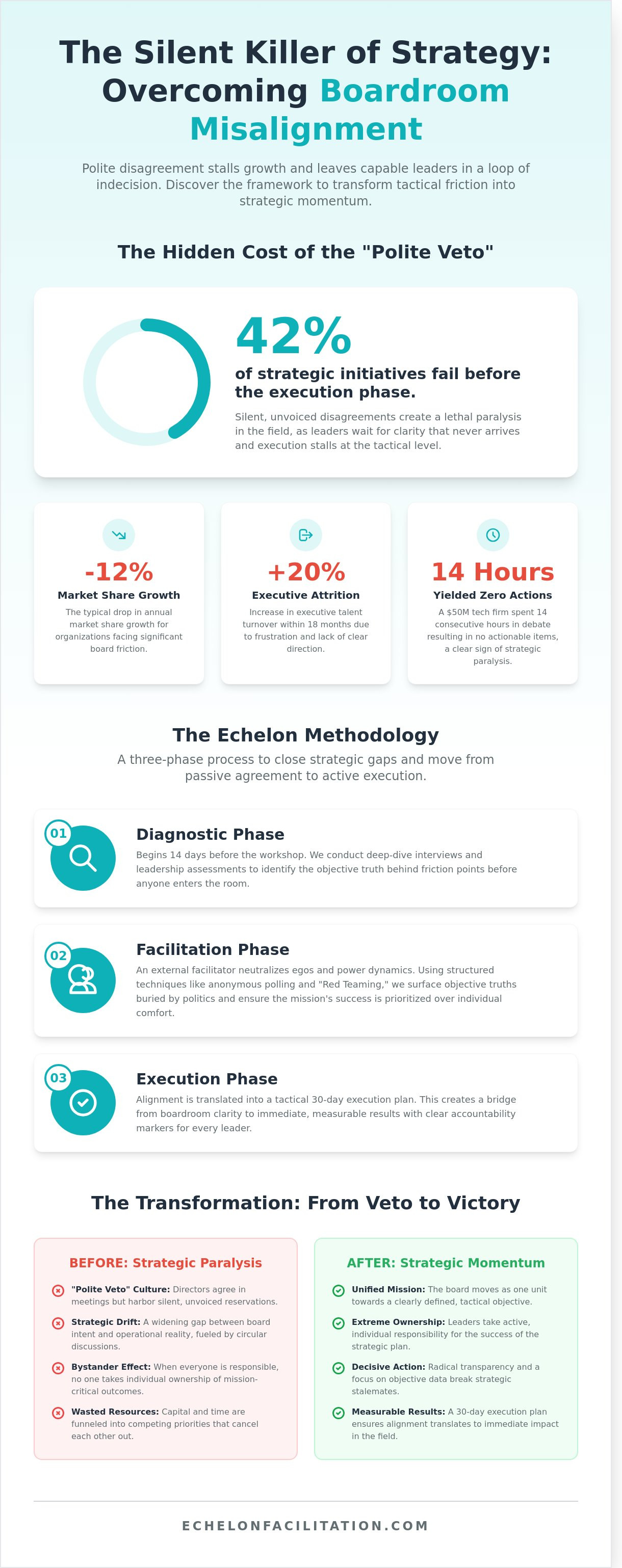
Polite disagreement in the boardroom is the silent killer of 42% of strategic initiatives before they ever reach the execution phase. You've likely sat through sessions where every executive nods in agreement, yet no one takes individual responsibility for the mission's success. This "polite" misalignment stalls growth and leaves your most capable leaders stuck in a loop of indecision. Picture a $50M technology firm where 14 consecutive hours of board debate yield zero actionable items. Implementing a rigorous board alignment workshop is the tactical lever required to stop this cycle and restore strategic focus.
We agree that a board's primary function is to provide unwavering clarity, yet internal friction often creates a fog of war that prevents decisive action. This illustrative scenario shows how a structured framework transforms executive hesitation into extreme ownership and strategic momentum. You'll learn the mechanics of moving from a state of paralysis to a unified front on mission-critical decisions. We'll outline a process designed to produce a concrete 30-day execution plan, ensuring every leader knows their objective and the cost of failure.
Key Takeaways
- Identify the hidden costs of the "Polite Veto" and learn how silent boardroom disagreement creates operational paralysis across your organization.
- Utilize a disciplined board alignment workshop to transform tactical friction into a unified mission focused on extreme ownership and strategic momentum.
- Implement a pre-workshop diagnostic phase to pinpoint the objective truth behind executive friction before the first session begins.
- Explore how a hypothetical £500M firm could break a year-long strategic stalemate by shifting from passive consensus to radical transparency and decisive action.
- Establish a rigorous 30-day execution plan that bridges the gap between boardroom alignment and immediate, measurable results in the field.
The Hidden Cost of Boardroom Misalignment
Boardroom misalignment isn't a personality clash. It's a failure of strategic architecture. When a board lacks a unified vision, the organization suffers from a structural defect that no amount of corporate culture initiatives can repair. This often manifests as the "Polite Veto." In this scenario, directors nod in agreement during the meeting but harbor deep reservations they never voice. This silence creates a lethal paralysis in the field. Leaders wait for clarity that never comes; execution stalls at the tactical level.
The financial impact of this indecision is quantifiable and severe. Organizations facing board friction typically see a 12% drop in annual market share growth and a 20% increase in executive talent attrition within 18 months. Wasted capital follows. Without a clear strategic planning process, resources are funneled into competing priorities that effectively cancel each other out. Internal facilitation rarely solves this. Power dynamics and existing biases prevent internal leaders from challenging the status quo. A professional board alignment workshop provides the external pressure required to force objective truth to the surface and demand extreme ownership.
The Anatomy of Strategic Drift
Strategic drift is the widening gap between board intent and operational reality. It begins when circular discussions dominate the agenda. If your board spends 45 minutes debating the same agenda item for three consecutive sessions without a resolution, you have a mission clarity crisis. This drift is fueled by hidden agendas. Individual directors often prioritize departmental silos or personal legacies over the collective mission, stalling alignment to protect their own interests.
The Psychological Barrier to Ownership
Executive teams often fall victim to the bystander effect. When everyone is responsible for a strategic outcome, no one takes ownership of the results. Vague board minutes exacerbate this issue; they provide a record of ambiguity that allows leaders to dodge accountability when targets are missed. This lack of ownership is a primary indicator of organizational friction. To solve this, boards must undergo a rigorous leadership team assessment to diagnose the friction points that prevent a board alignment workshop from achieving lasting impact.
The Echelon Methodology: Beyond Consensus to Extreme Ownership
A board alignment workshop is a disciplined, facilitated intervention designed to secure unified commitment to a tactical mission. It isn't a brainstorming session or a corporate retreat. It's a strategic reset. At Echelon, we view alignment as a binary state: you're either moving toward the objective as one unit, or you're failing. Data from a 2023 study indicates that 68% of executive teams operate with significant strategic gaps; we close those gaps through a three-phase process that values objective truth over comfortable narratives.
The Diagnostic phase begins 14 days before the session. We conduct deep-dive interviews to identify friction points before the room is even booked. During the Facilitation phase, we neutralize egos and surface objective truths that have been buried by corporate politics. Finally, the Execution phase translates this clarity into a tactical 30-day plan with clear accountability markers. This structured approach ensures that effective board alignment becomes the foundation for every operational decision that follows. Our goal is to move the board from passive agreement to active execution.
Neutralising Boardroom Power Dynamics
The external facilitator serves as a neutral commander. Our role is to prioritize mission success over individual comfort. We employ specific techniques to ensure the loudest voice does not dictate the outcome. For example, we use anonymous polling and structured "Red Teaming" to stress-test ideas. This ensures that a single dominant personality cannot derail the strategic intent of the collective. When high-stakes trade-offs arise, we focus on objective data rather than departmental loyalty. This process preserves professional relationships while forcing hard decisions that leaders often avoid. It's about creating a culture where the truth is the highest authority in the room.
Securing Collective Ownership
We apply the principle of Decentralised Command to the boardroom. This shift forces executives to move from "my department" to "our mission." When a leader takes ownership, they no longer look for excuses; they look for solutions. Our strategic workshops provide the framework for this transition, ensuring that every member understands their role in the broader tactical plan. Every member must leave the room prepared to defend the collective strategy as if it were their own. Board alignment is the state where every member would stake their reputation on the group’s decision.
Illustrative Scenario: Turning Strategic Drift into Mission Success
Please note: the scenario below is illustrative. It shows how a facilitated session of this kind can work; it is not a write-up of a specific client engagement.
Strategic stagnation carries a heavy price. Picture a UK-based firm with a £500M annual turnover paralysed by a 12-month stalemate regarding a critical acquisition strategy. While the market moved forward, the board remained locked in a cycle of indecision. This wasn't a lack of intelligence; it was a lack of tactical synchronization. The cost of this delay wasn't just financial. It manifested as a loss of competitive advantage and a dangerous erosion of executive credibility.
The Problem: A Board Divided by Assumptions
The initial state of the board was characterized by polite friction. On the surface, meetings were professional, yet no progress occurred. Beneath the decorum, individual directors held conflicting assumptions about risk and resource allocation. This internal deadlock filtered down through the hierarchy, impacting the morale of 1,200 employees who sensed the lack of clear direction. To break this cycle, the leadership required a radical perspective shift to move beyond personal biases and return to the mission's objective requirements.
The Intervention: The Echelon Workshop Framework
In this scenario, a high-stakes board alignment workshop is designed to strip away corporate posturing. The environment is stoic and results-oriented. Diagnostic exercises force directors to defend their positions using data rather than intuition. This framework shifts the room from circular debate into structured deliberation. Enforcing radical transparency surfaces the unspoken objection: a deep-seated concern regarding debt leverage that had never been explicitly voiced in previous sessions.
The workshop focused on three tactical pillars:
- Assumption Auditing: Identifying and dismantling outdated beliefs about the acquisition target.
- Objective Prioritization: Re-aligning individual KPIs with the primary organizational mission.
- Extreme Ownership: Assigning direct accountability for the decision, regardless of the final path chosen.
The turning point arrived when the board collectively acknowledged the "unspoken objection." Once the fear was quantified, it became a problem to solve rather than an invisible barrier. Within six hours of starting the board alignment workshop, the group reached a unanimous decision to proceed with a modified acquisition structure. This wasn't a compromise; it was a calibrated tactical move. In this scenario, the firm executes the acquisition three months later. Success isn't a matter of luck; it's the result of disciplined alignment and the courage to face objective truths.
For leadership teams facing similar stagnation, our facilitated workshops provide the framework necessary to convert friction into focused execution.
How to Structure a High-Stakes Board Alignment Workshop
A board alignment workshop isn't a retreat; it's a tactical intervention. To move from friction to execution, the structure must be rigid and the objectives must be absolute. Success requires a five-step process that eliminates ambiguity and forces accountability across the leadership team.
- Step 1: Conduct a pre-workshop diagnostic. Use a structured 20-point assessment to identify where strategic intent diverges from operational reality. This data uncovers the "real" friction points before the session begins.
- Step 2: Set the Rules of Engagement. Establish a framework for radical candor. Discipline is the prerequisite for truth.
- Step 3: Map the current strategy against the desired future state. Quantify the gap between today’s performance and the 3-year mission. Visualizing this distance removes the comfort of denial.
- Step 4: Facilitate the Hard Conversations. Address the 2 or 3 contentious issues that regular meetings ignore. These are usually the bottlenecks preventing growth.
- Step 5: Document the Team Charter. Finalize a single page of immediate execution steps and ownership assignments.
Building the Right Agenda
Most executive sessions fail because they fall into the "Update Trap." Workshops aren't for reporting progress; they're for making decisions. If a topic doesn't require a choice or a commitment, it doesn't belong on the schedule. Allocate at least 60% of the day to Deep Work on the most contentious strategic pillars. For teams requiring specific focus areas, Echelon offers modular workshop options designed to target unique organizational stressors.
Setting the Rules of Engagement
Discipline in the boardroom dictates performance in the field. Every board alignment workshop must operate under the "One Voice" Rule: members may disagree aggressively inside the room, but they must present a unified front once the door opens. Combine this with the "Extreme Ownership" Rule. This means no excuses and no finger-pointing. Every leader accepts 100% responsibility for the mission's outcome. The facilitator does not provide the answers; they provide the discipline required for the board to find them.
Executing the Victory: From Alignment to Action
Alignment without a mechanism for execution is a tactical failure. It's a waste of executive resources. A successful board alignment workshop doesn't end when the directors leave the room; it begins. Victory requires a transition from abstract theory to ground-level reality. Without a clear path forward, the clarity achieved during facilitation will dissolve into old habits within 72 hours. The board must move from consensus to a state of active deployment.
Establishing the 30-Day Execution Plan
The first 30 days after a workshop determine the long-term success of the mission. We establish the Commander’s Intent, a concise statement defining the desired end state. This allows for decentralized execution across the organization. If the board decides to pivot toward a new market segment by Q3, every department head must understand the specific parameters of that shift. Ownership is individual, never collective. We assign one name to every workshop output. There's no ambiguity in accountability. Communication must be immediate. The board must present a unified front to the staff within 48 hours. This prevents the spread of rumors and ensures the entire team moves in the same direction.
The ROI of a Unified Board
A unified board produces measurable results. Research from 2023 indicates that aligned executive teams achieve strategic objectives 35% faster than those plagued by internal friction. 68% of high-growth firms report that board-level clarity is their primary driver of operational speed. High team morale is a byproduct of this clarity. When leaders stop second-guessing each other, the organization gains momentum. Leaders should view alignment as a recurring tactical requirement rather than a one-off event. It's maintenance for the organizational engine. Regular board alignment workshops ensure that the "Rhythm of Battle" remains steady. This discipline prevents minor disagreements from escalating into mission-critical failures. Professional facilitation provides the objective truth necessary to maintain stability under pressure.
Success depends on decisive action and extreme ownership. Contact Echelon Facilitation to discuss your board’s mission-critical alignment.
Secure the Mission through Tactical Clarity
Strategic drift isn't just a boardroom nuisance; it's a structural failure that compromises the entire organization. Successful leadership requires more than simple consensus. It demands a board alignment workshop designed to instill extreme ownership across every seat at the table. Dr Andrew Greenland, a medical doctor who has spent years running large, high-stakes working sessions for senior expert groups, designed this process to move boards past generic team-building exercises and toward tactical execution. Based in Richmond, London, Echelon Facilitation focuses on the mission. We eliminate the friction of ambiguity. When your executive team adopts a decentralized command structure, the path to victory becomes clear. You don't need more meetings; you need a singular focus on the objective. This methodology transforms passive observation into decisive action, ensuring every leader takes full responsibility for the outcome. Since every organization faces unique pressures, Andrew tailors these sessions to address specific operational gaps. Your board's legacy depends on the clarity you establish today. Secure your board’s strategic alignment; view our workshop frameworks. Your team is capable of achieving the objective when the path is clear.
Frequently Asked Questions
What is the primary goal of a board alignment workshop?
The primary goal is to establish a unified strategic intent that eliminates operational friction. We transform individual perspectives into a singular mission. By the end of the session, 100 percent of board members must agree on the top three strategic priorities for the next 12 months. This clarity ensures the board speaks with one voice to the executive team.
How long does a typical board alignment workshop take to produce results?
Results begin the moment the session concludes; however, tactical shifts typically materialize within 90 days. Immediate results include the elimination of circular debates. Long-term success depends on the board’s commitment to extreme ownership of the objectives.
What happens if our board members have fundamentally different visions for the company?
Different visions are resolved by grounding the discussion in objective market data and the company’s core mission. We don't ignore dissent; we pressure-test every viewpoint against 5-year growth targets. If consensus isn't reached, we use a weighted decision matrix to prioritize the path forward. This process reduces internal politics and forces a focus on the collective win.
How do you handle a dominant CEO or Chairman during the workshop?
We handle dominant personalities by implementing a decentralized command structure during the session. This ensures that every board member has equal airtime, preventing any single individual from monopolizing 80 percent of the conversation. The facilitator acts as a tactical lead, redirecting the focus to the mission whenever a dominant voice oversteps. This creates a high-trust environment where the best ideas win.
Can a board alignment workshop be conducted virtually?
Yes, a board alignment workshop can be conducted virtually using secure, high-fidelity platforms and digital whiteboards. The key is a strict 4-hour limit per session to maintain high cognitive focus. Virtual sessions require 100 percent camera engagement and pre-work completion to ensure the time is spent on execution.
How do we measure the success of an alignment workshop?
Success is measured through three specific KPIs: decision-making velocity, executive clarity scores, and mission achievement rates. We track the time it takes for a board to approve a major initiative, which should decrease after the workshop. A 30-day follow-up call is included, and optional 90-day and quarterly reviews check that the workshop’s objectives are being delivered. These metrics provide a clear ROI.
What is the difference between a board retreat and an alignment workshop?
A board retreat focuses on relationship building, whereas a board alignment workshop is a tactical operation designed to produce specific strategic outcomes. Retreats often lack a concrete agenda, leading to 50 percent more wasted time. Our workshops follow a rigid framework focused on mission success and decentralized ownership. We trade comfortable narratives for the objective truth required to lead an organization.
Who should attend the board alignment workshop?
Attendance is limited to all voting board members and the CEO to ensure total alignment at the highest level of leadership. In most cases, the Chief Financial Officer should also attend to provide real-time data validation. Including more than 12 participants often dilutes the intensity of the session. Keeping the group small ensures that every leader takes extreme ownership of the final strategic plan.