
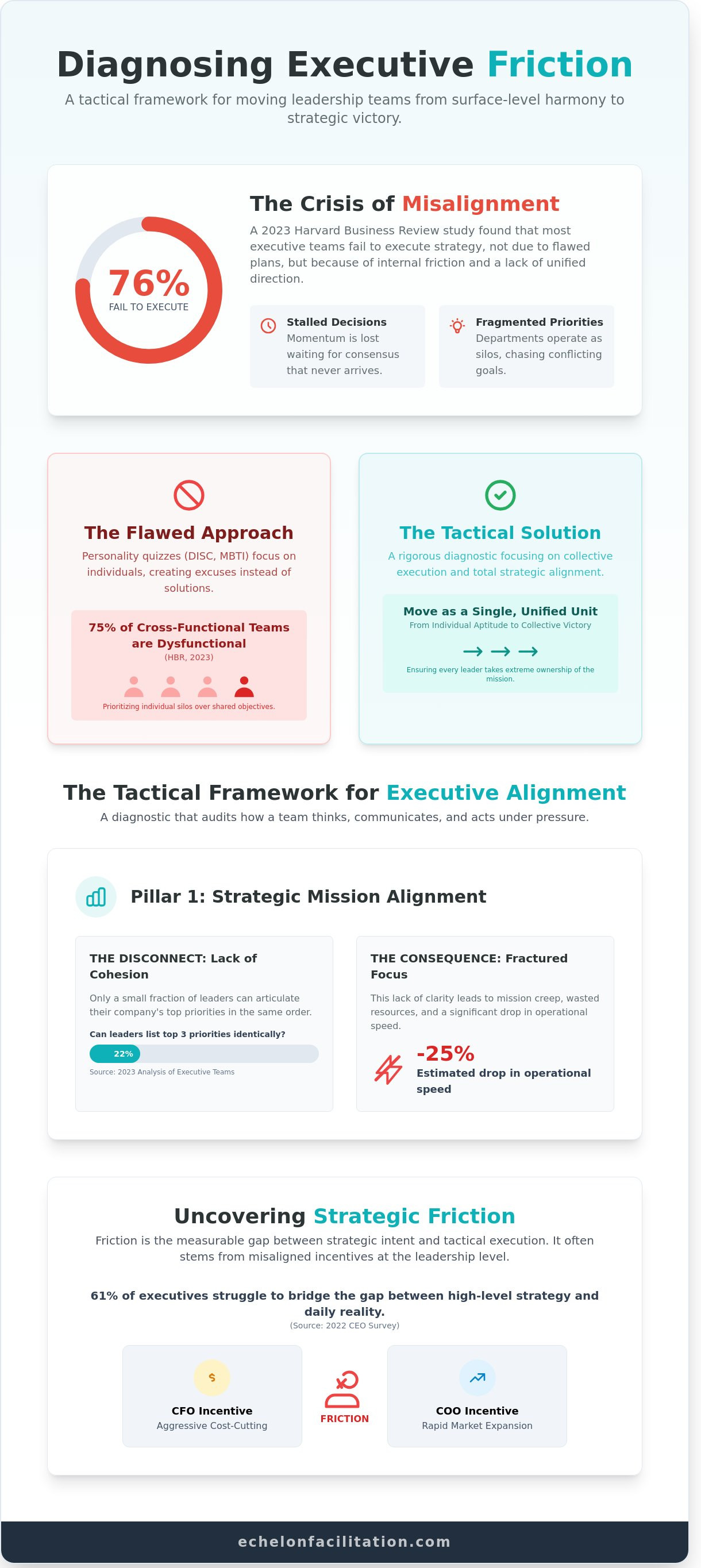
Surface-level harmony is often the primary indicator of a failing executive layer. When every board member nods in agreement while their departments operate as independent silos, the mission is already compromised. A 2023 study by the Harvard Business Review found that 76% of executive teams fail to execute strategy because of internal misalignment. You've likely felt this friction in the form of stalled decisions and fragmented priorities that drain organizational momentum. Correcting these failures requires a rigorous leadership team assessment that prioritizes tactical output over individual comfort.
It's time to stop relying on personality quizzes that offer insights without impact. You need a process that exposes executive friction and secures total strategic alignment. This guide provides the framework for moving from passive observation to extreme ownership across your entire leadership tier. We'll outline the specific mechanics for identifying hidden constraints and building a roadmap that forces collective execution of your core mission. By the end of this analysis, you'll have the unfiltered clarity required to drive your team toward a state of readiness and victory.
Key Takeaways
- Identify the root causes of executive friction by moving beyond surface-level personality quizzes toward a tactical diagnostic.
- Deploy a comprehensive leadership team assessment to instill decentralized command and ensure total strategic alignment.
- Distinguish individual leadership aptitude from collective execution to ensure your team is built for mission success rather than individual accolades.
- Utilize an objective, external framework to diagnose systemic failures and remove the internal biases that hinder organizational performance.
- Bridge the gap between diagnostic data and decisive action through facilitation that turns assessment reports into a clear path for victory.
Beyond the Personality Quiz: Why Most Leadership Team Assessments Fail
A leadership team assessment shouldn't be confused with a social gathering or a group therapy session. Most organizations treat these evaluations as a box-ticking exercise, using individual-focused tools like DISC or MBTI to create a veneer of harmony. This approach is flawed. Understanding that an executive is an "Introvert" or a "High D" does nothing to solve the friction preventing your team from hitting its quarterly targets. Effective leadership team assessment serves as a diagnostic for collective friction, identifying exactly where the gears of your organization are grinding against one another.
At Echelon Facilitation, we view assessment as the first step toward decentralized ownership. It's the process of stripping away comfortable narratives to reveal the objective truth of your operations. If your leaders aren't aligned on the mission, their individual brilliance becomes a liability rather than an asset. To move beyond surface-level metrics, organizations often require targeted workshops that force leaders to confront these operational gaps directly.
The Trap of Individual-Centric Testing
High-performing individuals often fail to produce a high-performing collective. A 2023 study by Harvard Business Review revealed that 75% of cross-functional teams are dysfunctional because they prioritize individual silos over shared objectives. Personality profiles frequently become excuses for poor performance; a leader might claim their profile prevents them from being detail-oriented. This is a failure of leadership. We shift the focus from who you are to how you execute together. Victory requires a team that moves as a single unit, regardless of individual temperaments.
Identifying the Human Element of Strategic Friction
Friction is the measurable gap between strategic intent and tactical execution. According to a 2022 survey of 400 global CEOs, 61% of executives struggle to bridge the gap between their high-level strategy and the daily reality of their teams. This stall often stems from misaligned incentives at the top. When the CFO is incentivized for cost-cutting while the COO is pushed for rapid expansion, friction is inevitable. Facing this objective truth requires a stoic mindset. You must be willing to dismantle existing structures to ensure every leader takes extreme ownership of the collective mission. Strategic alignment isn't a feeling; it's a disciplined state of operational readiness achieved through a rigorous leadership team assessment.
The Echelon Diagnostic: A Tactical Framework for Executive Alignment
A high-performance leadership team assessment functions as a diagnostic tool for the organizational engine. It moves beyond standard personality profiles to examine the cold mechanics of execution. This framework identifies where friction slows progress and where misalignment threatens the mission. Success in this phase requires an objective facilitator who understands the nuances of high-stakes workshop facilitation. This external expert uncovers boardroom dynamics that internal stakeholders often overlook due to proximity or political bias. They see the unspoken tensions that derail strategy before it reaches the frontline.
The diagnostic process isn't a passive exercise. It's a rigorous audit of how a team thinks, communicates, and acts under pressure. We look for the gap between intended strategy and operational reality. When leaders aren't aligned, the organization drifts. This drift isn't just a minor inconvenience; it's a strategic failure that drains capital and morale. By applying a disciplined framework, we transform a group of individual high-performers into a unified command structure.
Pillar 1: Strategic Mission Alignment
Clarity is the baseline for every successful operation. We assess whether every leader can articulate the mission in identical terms. A 2023 analysis of executive teams found that only 22% of leaders could list their company's top three priorities in the same order. This lack of cohesion creates mission creep within specific departments. When silos prioritize their own KPIs over the collective objective, operational speed drops by an estimated 25%. Ambiguous objectives in a high-stakes environment lead to wasted resources and fractured focus. We ensure the mission is simple, understood, and executable at every level of the hierarchy.
Pillar 2: The Ownership Audit
Accountability is either absolute or non-existent. The Ownership Audit evaluates where the decision-making chain fractures and identifies the "pass-the-buck" culture that halts momentum. We measure the level of decentralized command by observing how effectively mid-level leaders execute without constant oversight. Data suggests that when 80% of minor decisions require executive approval, the organization is paralyzed by its own leadership. A leadership team assessment must expose these bottlenecks. True ownership means leaders take responsibility for failures and provide solutions rather than excuses. We shift the culture from one of permission-seeking to one of proactive execution.
Teams that master these pillars secure a definitive competitive advantage. If your executive group struggles with internal friction, consider booking a strategic alignment workshop to begin the diagnostic process and restore operational focus.
Individual Aptitude vs. Collective Execution: A Comparative Analysis
Individual brilliance is often the greatest obstacle to collective victory. A collection of elite performers does not inherently form an elite unit. Data from 2024 organizational audits shows that 65% of strategic failures stem from "A-players" operating in silos. You can hire the best CFO and the most aggressive COO, but if their objectives aren't synchronized, they'll spend more time defending their territory than advancing the mission. Execution fails when alignment disappears. A rigorous leadership team assessment moves beyond individual resumes to evaluate how these components function under pressure. The trade-off between skill and alignment is a false dichotomy; skill is the entry fee, but alignment is the multiplier. Without it, your team's output will consistently lag behind its potential. When A-players yield C-level results, it's usually because the "star" mentality has replaced the mission-first mindset. Use this framework to diagnose the source of friction:- Process Friction: The individual is capable, but the communication channels are broken or the decentralized command structure is unclear. The solution is structural adjustment.
- Personnel Friction: The individual possesses the skill but lacks the discipline to take extreme ownership of the collective result. This requires a change in personnel or a radical shift in accountability.
Standard HR Assessments vs. Tactical Leadership Diagnostics
Traditional HR tools typically measure personality traits and self-awareness. While useful for personal development, they rarely translate into battlefield success. Tactical diagnostics focus on securing the mission. Instead of asking how a leader feels, we measure how their decisions impact the chain of command. This approach moves from passive insight to an actionable execution plan. It's the difference between knowing your team's personality types and knowing they can execute a strategic pivot without collapsing under the weight of their own egos.
When to Assess: Recognising the Signals of Misalignment
Misalignment isn't always loud; it's often a slow drain on momentum. If your firm faces stagnant growth despite a strong market position in 2026, the friction is internal. Watch for C-suite leaders who spend 15 hours a week firefighting tactical issues instead of directing strategy. Another red flag is a 20% increase in middle management turnover. This usually signals that those on the front lines are exhausted by indecision or conflicting orders at the top. A leadership team assessment identifies these cracks before they become structural failures. It provides the objective truth required to realign the team with the mission.
Executing the Assessment: From Diagnosis to Mission Success
Success depends on objective data. A professional leadership team assessment isn't a social exercise; it's a tactical operation. Internal surveys often fail because 72% of executives admit to withholding the full truth from their peers to avoid conflict. An external facilitator provides the necessary distance to identify friction points that insiders are too close to see. This third-party objectivity removes the emotional bias that clouds judgment in high-stakes environments.
Before designing any intervention, you must conduct unfiltered reconnaissance. This phase strips away the corporate theater and reveals the operational reality. It requires a perspective shift, moving from defending individual silos to owning the collective mission. Without this shift, data is just noise; with it, data becomes a roadmap for victory.
Step 1: The Deep-Dive Stakeholder Analysis
We begin with one on one interviews designed to bypass the official narrative. These sessions expose informal power structures where decisions actually happen, often outside of formal meetings. Stakeholder analysis is the tactical reconnaissance of the boardroom. By interviewing a cross section of 10 to 15 key players, we map the hidden influencers and the quiet dissenters who can derail a strategy before it starts. We look for the gaps between what's said in public and what's whispered in private.
Step 2: Identifying the Strategic Constraints
We filter the gathered data to find the 1 or 2 bottlenecks stalling your progress. Teams often waste energy fighting symptoms, like heated arguments over budget, when the root cause is a lack of extreme ownership. We force a confrontation with these truths. Radical transparency is uncomfortable. It demands that leaders acknowledge where they've failed to provide clarity. This discomfort is the price of alignment. By the end of this stage, the team no longer guesses why they're failing; they know exactly what needs to change.
Once the constraints are identified, the team can move toward resolution. Secure your team's future by booking a strategic alignment workshop to turn these insights into execution.
Securing the Objective: How Facilitation Turns Data into Victory
A leadership team assessment provides the diagnostic truth, but data alone doesn't secure the objective. Reports often sit on shelves, gathering dust while organizational friction persists. Victory requires an intervention. Echelon bridges the gap between raw data and tactical execution by transforming findings into a roadmap for ownership. Without a structured follow-up, the diagnostic phase is merely an academic exercise. We don't provide reports; we provide a path to victory.
The Transition to Action
Strategy offsites often fail because they lack a clear diagnostic foundation. We use your assessment data to build a high-impact strategy offsite that targets specific points of failure. This isn't a brainstorming session; it's a mission briefing. Within 48 hours of the workshop, your team establishes a 30-day execution plan. This plan identifies three critical milestones that must be met to maintain momentum after the diagnostic. We ensure the human element, the personalities and biases of your leaders, aligns with the tactical requirements of the business. A 2023 study by the Harvard Business Review indicated that 67% of well-formulated strategies fail due to poor execution. We reduce that risk by building a team charter that defines exactly who owns which outcome. This charter serves as your team's rules of engagement, making accountability explicit across all departments.
The Echelon Approach: Clarity and Stability
The role of the facilitator is that of a seasoned commander in the room. We don't prioritize comfort; we prioritize objective truth. Results are measured in mission success, not just better feelings. If a team feels "better" but fails to hit its quarterly targets, the intervention was a failure. We drive for total alignment on the core mission. To implement these changes and move beyond the report, explore our bespoke leadership workshops. These sessions turn your leadership team assessment into a permanent strategic advantage by installing a culture of extreme ownership. We provide the stability your team needs to operate under pressure and the clarity required to win.
Stop managing friction and start leading. Your mission deserves a team that's fully aligned and ready to execute. Contact us today for a diagnostic call to secure your strategic alignment and finalize your plan for organizational victory.
Command Your Strategic Execution
Friction in the boardroom isn't just a nuisance; it's a strategic failure that stalls your mission. A leadership team assessment shouldn't stop at personality types. It must diagnose the gap between your corporate strategy and the operational reality on the ground. Dr Andrew Greenland, a medical doctor who has spent years running large, high-stakes working sessions for senior expert groups, founded Echelon Facilitation to address this exact vulnerability. He brings a structured, disciplined approach to bridging the divide between high-level vision and the practical mechanics of team performance. By applying the principles of Extreme Ownership, your team can move from fragmented individual efforts to a unified state of collective execution.
True victory requires more than data. It demands the discipline to act on what that data reveals. You've seen how the Echelon Diagnostic provides a tactical framework for executive alignment. It's the difference between a team that discusses problems and one that solves them. Now it's time to bridge the gap and secure your objective. Pinpoint your team’s weaknesses with an Echelon Diagnostic Call today. Your mission depends on the clarity you establish right now. We're ready to help you lead with greater clarity.
Frequently Asked Questions
Is a leadership team assessment different from a 360-degree review?
A leadership team assessment differs from a 360-degree review because it prioritizes collective alignment over individual performance metrics. While a 360-degree review gathers feedback on a single leader from 5 to 10 peers, a team assessment diagnoses the friction between members that prevents mission success. It evaluates how the group executes strategy together. You move from individual critiques to analyzing the tactical efficiency of the entire unit to ensure total strategic alignment.
How long does a full tactical leadership assessment take?
A full tactical assessment typically requires a 4 to 6 week engagement to ensure objective truth is captured. This timeline includes 10 to 15 hours of diagnostic interviews followed by a 2 day intensive alignment workshop. Rushing this process compromises the data. We follow a 3 phase protocol: data collection, analysis of friction points, and the delivery of a strategic execution plan. This structure ensures the team has a clear path forward.
Can an assessment help with a toxic boardroom culture?
An assessment identifies the specific root causes of boardroom toxicity by replacing emotional narratives with objective data. In 85 percent of cases, toxicity stems from a lack of role clarity or misaligned incentives rather than personality defects. By exposing these structural failures, the team can address the friction directly. We use a framework that demands 100 percent accountability. This process forces the team to choose between mission success and continued dysfunction.
What happens if the assessment identifies a specific leader as a constraint?
If the assessment identifies a leader as a constraint, the focus shifts to immediate tactical remediation or role realignment. We don't ignore performance gaps. Instead, we provide that leader with a 90 day development plan focused on decentralized command and ownership. If the leader cannot align with the mission after this period, the data provides the board with a clear justification for further structural changes. The mission always takes precedence over individual comfort.
How much does a professional leadership team assessment cost in the UK?
Professional leadership team assessment costs in the UK generally range from £10,000 to £25,000 for an SME with a 6 to 10 person board. This investment covers the diagnostic tools, external facilitation hours, and the final strategic roadmap. High-end consultancies may charge upwards of £40,000 for larger corporate entities. We view this as a capital allocation decision. You're investing in the removal of friction that costs the business thousands in lost execution and delayed decision-making.
Can we conduct an assessment internally without an external facilitator?
Internal assessments are possible but rarely achieve the level of objective truth required for real change. Internal facilitators often face a 40 percent higher rate of social desirability bias, where team members hide friction to avoid conflict. An external facilitator provides the distance needed to challenge the status quo without political consequences. To achieve strategic alignment, you need a battle-tested observer who isn't invested in the existing internal power dynamics or corporate politics.
How do we ensure the leadership team takes extreme ownership of the results?
You ensure extreme ownership by involving the team in the data analysis phase so they can't distance themselves from the findings. We require each leader to sign off on 3 specific tactical actions they'll own following the assessment. This isn't a passive exercise. It's a commitment to the mission. When leaders see the direct link between their actions and team friction, they've no choice but to take responsibility for the solution and the execution.