
Your leadership team spends three days at a luxury estate, yet returns to the office with the same unresolved friction and vague objectives that existed before the departure. These sessions often devolve into expensive social gatherings rather than the rigorous strategic resets required for organisational growth.
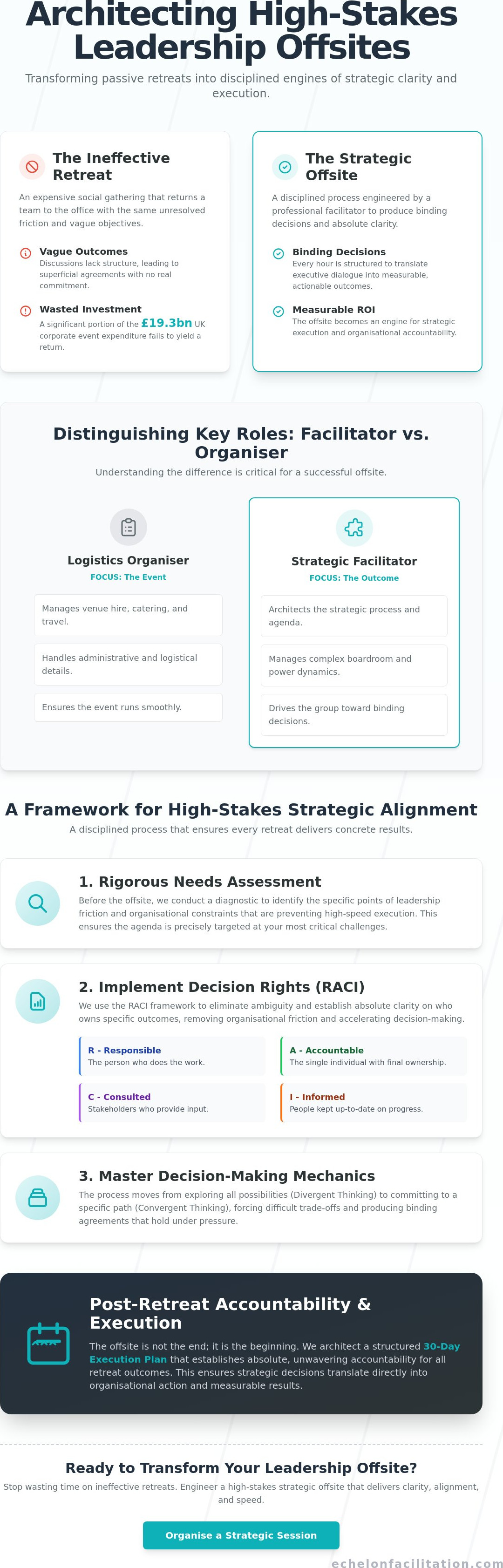
Passive retreats represent a significant drain on resources. Corporate events in the UK generate £19.3 billion in direct expenditure, yet much of this investment is squandered on activities that fail to address core leadership dysfunctions. When an executive team remains misaligned, the organisation loses speed and clarity. A professional corporate retreat facilitator london ensures that every hour spent offsite translates into a measurable return on investment, replacing generic team-building with disciplined strategic execution and absolute, unwavering organisational accountability for results.
You recognise that your leadership team's time is your most valuable asset. This guide demonstrates how expert facilitation transforms offsites from passive gatherings into engines of strategic clarity. We will examine the mechanics of decision rights and the frameworks necessary to build a high-performing executive team that executes with speed.
Key Takeaways
- Distinguish between logistical event planning and strategic facilitation to ensure leadership sessions focus on high-stakes boardroom dynamics rather than administrative details.
- Utilise a rigorous needs assessment to identify specific leadership constraints and organisational friction before the offsite begins.
- Replace generic team-building activities with shared strategic achievement to build authentic trust through collective results rather than social proximity.
- Engage a corporate retreat facilitator london to architect a structured 30-day execution plan that establishes absolute accountability for all retreat outcomes.
Defining the Role of a Corporate Retreat Facilitator in London
A corporate retreat facilitator london acts as the neutral authority tasked with architecting the strategic process of an offsite. Unlike a logistics organiser who focuses on venue hire and catering, a facilitator manages the complex interpersonal and strategic dynamics that occur within a senior leadership team. This role requires more than just timekeeping. It demands a sophisticated understanding of business facilitation as a tool for uncovering objective truth amidst competing executive priorities. Organisations in the City or Canary Wharf operate under intense scrutiny and rapid timelines. They cannot afford sessions that lack a clear, disciplined structure. The facilitator is a strategic partner who translates executive dialogue into binding decisions.
The Distinction Between Moderation and Strategic Facilitation
Moderation focuses on the flow of conversation, ensuring every voice is heard. Strategic facilitation goes further by driving the group toward a specific, pre-defined organisational objective. A corporate retreat facilitator london must navigate the intricate power dynamics of a senior leadership team, ensuring seniority doesn't stifle critical analysis or valid dissent. This neutral authority allows for the rigorous examination of the business's current state. It moves the team beyond comfortable narratives toward the friction necessary for growth.
Why Proximity to London Business Hubs Matters
London's corporate environment requires a specific pace and professional vocabulary. Whether facilitating for a FTSE 100 board or a high-growth tech firm in Shoreditch, the facilitator must mirror the urgency of these markets. Leaders in these hubs require a corporate retreat facilitator london who understands local pressures and the necessity of speed. Local expertise also provides a logistical advantage. It allows for more efficient coordination of sessions held in central London or the Home Counties, ensuring the transition from operational pressure to strategic reflection is immediate and effective. This deep understanding of regional dynamics informs how we work with senior teams to achieve alignment.
The Framework for High-Stakes Strategic Alignment
The Echelon approach to Strategy & Vision Offsites prioritises a disciplined process over the distractions of luxury venues. A successful retreat is built on the architecture of the agenda, not the amenities of the estate. Before the leadership team departs, a rigorous Needs Assessment serves as a diagnostic of current leadership constraints. This phase identifies the specific points of friction that prevent high-speed execution. McKinsey research indicates that 70% of large-scale change programmes fail to meet their objectives, often due to a lack of leadership alignment and commitment. A corporate retreat facilitator london mitigates this risk by ensuring the offsite addresses these structural misalignments directly.
Utilising the RACI Framework for Decision Rights
Ambiguity is the primary cause of executive inertia. A facilitator uses the RACI framework (Responsible, Accountable, Consulted, Informed) to eliminate confusion regarding who owns specific outcomes. Consider a London-based fintech leadership team struggling with delayed product launches because four different directors believe they hold final sign-off authority. In a Decision-Rights Reset, the team would map every critical milestone to a single Accountable individual. That clarity could remove months of organisational friction and let the team resume rapid scaling. If your team faces similar bottlenecks, consider how a structured Decision-Rights Reset can restore operational speed.
The Mechanics of Group Decision-Making
Moving a senior team from debate to decision requires a transition from divergent to convergent thinking. During the divergent phase, the corporate retreat facilitator london encourages the exploration of all strategic possibilities. The process then shifts to convergent thinking, where the team must commit to a specific path. This transition surfaces objective truth and forces the team to confront difficult trade-offs. It replaces superficial consensus with a binding agreement that holds under pressure. This mechanical approach ensures that the retreat produces concrete decisions rather than just another list of aspirations.
Eliminating the Pitfalls of Generic Team Building
Generic industry advice often suggests that activities like cooking classes or escape rooms are the primary drivers of team cohesion. This is a fallacy. High-performing executive teams build trust through shared strategic success, not social proximity. Professional reliability and the knowledge that a peer will deliver on a high-stakes commitment create more stability than shared leisure ever could. Social bonds are a byproduct of effective collaboration, not a prerequisite for it.
Selecting the right corporate retreat facilitator london is a strategic decision that impacts the organisation's trajectory. Leaders often make the mistake of prioritising a facilitator's personality over their ability to manage high-stakes boardroom dynamics. An effective corporate retreat facilitator london must be willing to challenge the CEO and senior directors to surface the friction necessary for growth. Without this healthy conflict, the retreat becomes an expensive social gathering rather than a strategic lever.
Use this checklist to select a partner who prioritises organisational output over entertainment:
- Does the facilitator demonstrate a deep understanding of leadership theory and tactical execution?
- Will they surface objective truth even when it creates temporary discomfort amongst the leadership team?
- Do they provide a structured framework for post-retreat accountability and execution?
- Is their approach focused on resolving specific business constraints rather than generic team bonding?
Why Shared Hardship Trumps Shared Leisure
Tackling a difficult business challenge together creates lasting cohesion. This shared hardship requires the team to navigate complex trade-offs and reach a resolution under pressure. It builds psychological safety by proving the team can handle intense strategic debate without fracturing professional relationships. Authentic trust is earned in the boardroom through the successful resolution of high-stakes problems, not at a social event.
Avoiding the Post-Offsite "Sugar Crash"
Many leadership teams experience a sugar crash where the energy of the offsite dissipates the moment they return to the office. This occurs when the retreat is treated as an isolated event rather than a step in a continuous strategic process. To prevent this, the session must be part of a broader framework that demands immediate action. We maintain this momentum by architecting a clear path from dialogue to execution. Review how we work to understand our commitment to long-term executive alignment and sustained organisational speed.
Ensure your next offsite delivers a measurable return by choosing a partner who values discipline and results. Contact us to discuss your facilitation needs.
Establishing Post-Retreat Accountability and Execution
Decisions reached during a retreat are only as valuable as the actions they trigger. A professional corporate retreat facilitator london acts as the architect of the 30-Day Execution Plan, ensuring the momentum generated offsite translates into operational reality. This phase demands absolute individual responsibility. Every objective must have a single owner who is accountable for its delivery. Without this clarity, the organisation risks reverting to the same misaligned behaviours that necessitated the retreat in the first place.
The facilitator leads the leadership team through a Transformation Alignment process. This involves a structured communication plan to cascade decisions throughout the organisation. It ensures the wider workforce understands the strategic shift and their role in its execution. Clear communication prevents the perception of an isolated executive "ivory tower" and builds collective commitment to the new direction. This process is essential for maintaining organisational speed during periods of significant change.
The 30-Day Execution Framework
Execution requires a practical mechanism for tracking progress. Use a rigorous template to maintain focus on the outcomes agreed during the session:
- Outcome: The specific result required.
- Owner: The single Accountable individual (using the RACI model).
- Deadline: A non-negotiable date for completion.
- Status: A binary indicator (On Track or At Risk).
A corporate retreat facilitator london conducts scheduled follow-ups at the 15 and 30-day marks. These sessions are not mere status updates. They are accountability checks designed to remove obstacles and ensure the team remains focused on its high-stakes objectives.
Measuring the ROI of Strategic Facilitation
Executive alignment has a direct impact on organisational performance. Research often highlighted in the Harvard Business Review suggests that organisations with highly aligned leadership teams achieve significantly higher profitability and growth than those where misalignment persists. Quantitative metrics for measuring the success of a retreat include the speed of decision-making and pre- versus post-retreat alignment scores. Qualitatively, the reduction in organisational friction and the clarity of individual decision rights serve as primary indicators of success.
If your leadership team currently struggles with persistent misalignment or a lack of accountability, a diagnostic call can identify the specific constraints holding you back. Contact us to schedule a strategic assessment.
Securing Long-Term Strategic Momentum
Strategic alignment isn't a static state but a continuous discipline. An offsite only succeeds when it moves beyond superficial consensus to establish clear decision rights and absolute accountability. By prioritising the architecture of the agenda over the amenities of the venue, leadership teams transform passive gatherings into engines of decisive action. High-performing teams recognise that trust is built through shared strategic success and the rigorous resolution of business constraints. Professional reliability creates more stability than social proximity ever could.
Echelon Facilitation was founded by Dr Andrew Greenland, a medical doctor who has spent years running large, high-stakes working sessions for senior expert groups. We specialise in high-stakes executive alignment and strategy sprints, offering a disciplined, results-driven approach tailored for the pace of London organisations. Engaging an expert corporate retreat facilitator london ensures that your leadership team returns to the office with a structured execution plan that maintains speed and clarity. This transition from dialogue to execution is the primary lever for sustained organisational growth.
Identify the specific friction points holding your leadership team back. Book a diagnostic call with Echelon Facilitation to begin architecting your next strategic reset. Your team's alignment is the foundation of your future success.
Frequently Asked Questions
What is the difference between a moderator and a corporate retreat facilitator?
A moderator manages the flow of conversation whilst a facilitator drives the group toward a specific strategic outcome. Whilst a moderator ensures everyone has a voice, a facilitator uses neutral authority to challenge assumptions and surface objective truths. This distinction is critical for organisations that require more than just a timekeeper. The facilitator acts as a strategic partner responsible for the quality of the decisions made during the session.
How much lead time is required to book a corporate retreat facilitator in London?
Organisations typically require four to eight weeks of lead time to book a corporate retreat facilitator london for a high-stakes offsite. This period allows for a rigorous needs assessment and the design of a bespoke strategic architecture. Whilst shorter timelines are possible for emergency sessions, the diagnostic phase is essential for identifying the specific leadership constraints that prevent organisational speed and alignment.
Should the CEO facilitate their own leadership team retreat?
A CEO should not facilitate their own leadership team retreat because they cannot remain a neutral participant in the strategic process. When the leader facilitates, the power dynamic often suppresses valid dissent and creates superficial consensus. An external facilitator allows the CEO to engage fully in the debate whilst ensuring the process remains objective and focused on collective organisational goals rather than individual biases.
What qualifications should I look for in a high-stakes facilitator?
Look for a facilitator with substantial board-level experience and a deep understanding of leadership theory and tactical execution. They must demonstrate proficiency in structured frameworks to manage complexity effectively. A high-stakes facilitator should possess the professional gravity to challenge senior directors and the composure to remain focused under pressure. Practical experience in London's corporate sectors is often a prerequisite for understanding the required pace.
How do you handle conflict between senior leaders during a retreat?
Conflict is handled by surfacing it as a strategic data point rather than an interpersonal issue. The facilitator uses a disciplined structure to move the team from emotional friction to objective truth. By refocusing the debate on shared strategic objectives and clear decision rights, the facilitator prevents personal biases from stalling the process. This approach ensures that conflict becomes a catalyst for clarity rather than a source of organisational inertia.