
A Chief Executive sits at the head of a boardroom table, watching their direct reports debate the same capital allocation strategy for the third consecutive month. No one takes ownership, no vote is called, and the meeting ends with a vague request for more data. A decision making workshop for leadership teams is the necessary intervention for this specific brand of organisational paralysis. It replaces comfortable narratives with the cold clarity of strategic execution and defined accountability.
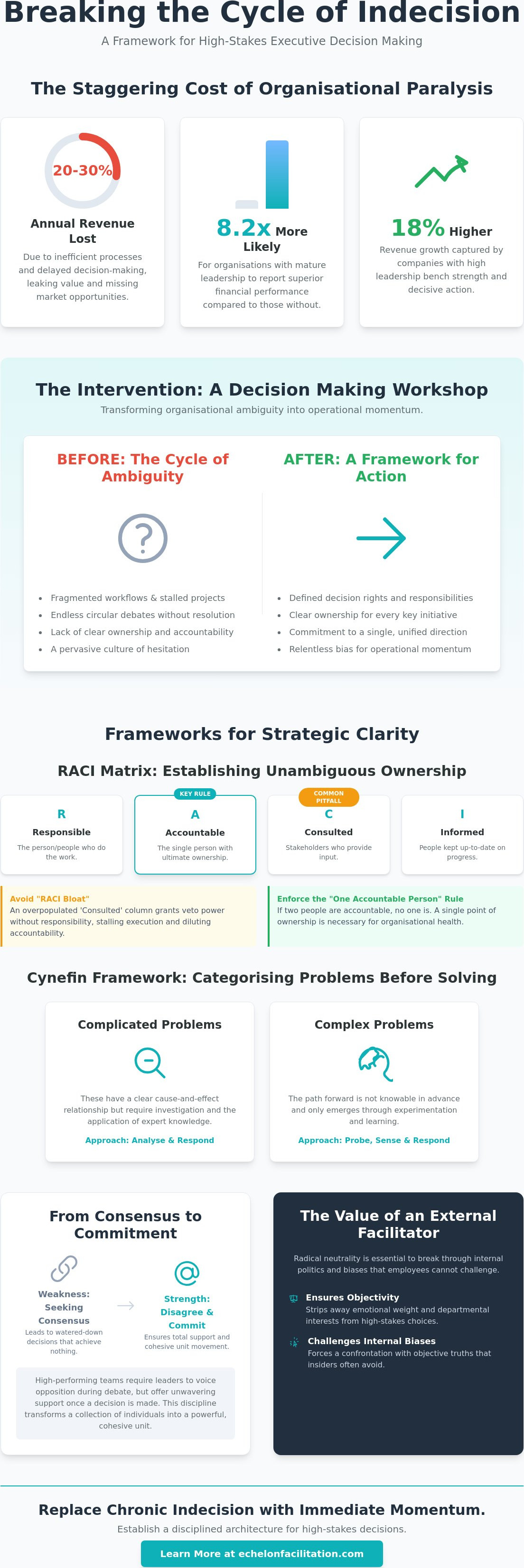
The cost of this executive hesitation is staggering. Industry data reveals that organisations with mature leadership programmes are 8.2 times more likely to report superior financial performance than those lacking disciplined decision frameworks. Stalled initiatives prevent firms from capturing the 18% higher revenue growth seen in companies with high leadership bench strength. Indecision acts as a corrosive force, strengthening departmental silos and ensuring that high-stakes objectives remain unfulfilled whilst competitors move with precision and speed; to maintain a competitive edge, you can learn more about Business With AI Strategist to see how AI consultancy can support your strategic implementation.
You understand that the current lack of clear ownership is an obstacle to your firm's growth. This article provides a roadmap to transform your executive team into a decisive unit capable of driving complex initiatives. Adopting a disciplined framework establishes clear decision rights and ensures every meeting results in operational momentum rather than further ambiguity.
Key Takeaways
- Identify the hidden costs of executive ambiguity and fragmented workflows that stall organisational progress and erode profit margins.
- Implement structured frameworks such as RACI and Cynefin to categorise decision types and assign unequivocal ownership across the leadership team.
- Utilise a decision making workshop for leadership teams to compress months of circular debate into a single day of focused strategic alignment.
- Recognise the value of radical neutrality from external facilitators to challenge internal biases and address uncomfortable organisational truths that employees cannot.
- Establish a disciplined architecture for high-stakes decisions that replaces chronic indecision with immediate operational momentum and accountability.
The Strategic Necessity of a Decision Making Workshop for Leadership Teams
A decision making workshop for leadership teams is not a training seminar. It is a high-stakes intervention designed to bridge the chasm between strategic intent and operational reality. Many executive groups mistake activity for progress, yet true velocity requires the structural removal of ambiguity. When leadership teams fail to define decision rights, they impose a "hidden tax" on the entire organisation. This tax manifests as fragmented workflows, stalled projects, and a culture of hesitation that erodes competitive advantage.
Utilising high-stakes workshop facilitation acts as a strategic lever to break this cycle. It forces a confrontation with objective truths and demands a shift from passive observation to active accountability. By examining internal decision-making processes, teams can identify where friction exists and install a disciplined framework for execution. The primary objective isn't to reach a comfortable consensus. It's to establish clear ownership and a relentless bias for action.
The Financial Cost of Executive Indecision
Indecision isn't just a leadership flaw; it's a balance sheet liability. Research from the International Data Corporation (IDC) suggests that organisations lose 20% to 30% of their annual revenue due to inefficient processes and delayed decision-making. This loss occurs because senior teams remain "busy" with endless circular debates without being "productive" in their outputs. Every day a critical choice remains unmade, the organisation leaks value and misses market opportunities that more decisive competitors will inevitably seize; for retail firms, you can learn more about EZ3PL Ltd to understand how professional fulfilment services can help capture these opportunities through operational efficiency.
Moving from Consensus to Commitment
The traditional pursuit of consensus is often the greatest barrier to strategic execution. Seeking universal agreement frequently results in watered-down decisions that satisfy everyone but achieve nothing. High-performing teams replace this obsession with the principle of "Disagree and Commit". This standard requires leaders to voice their opposition during the debate but offer total, unwavering support once a direction is set. A decision making workshop for leadership teams enforces this discipline, ensuring that the group moves forward as a single, cohesive unit rather than a collection of individual interests.
Frameworks for Clarity: Applying RACI and Cynefin in a Workshop Setting
Discipline in decision-making requires more than intent; it requires a structured language for responsibility. During a decision making workshop for leadership teams, frameworks act as the objective arbiter between competing departmental interests. These tools strip away the emotional weight of high-stakes choices and replace it with a logical process for execution. For organisations seeking to scale these efficiencies, leveraging enterprise AI and operations expertise from ethicrithm.com can help automate data flows and ensure strategic transparency. Without this structure, executive meetings often devolve into speculative debate rather than strategic commitment.
The RACI Matrix: Establishing Unambiguous Ownership
Ambiguity thrives where ownership is shared. A facilitator often uncovers "RACI bloat," a condition where the "Consulted" column is overpopulated by stakeholders seeking veto power without responsibility. This slows execution and dilutes accountability. The decision making workshop for leadership teams enforces the "One Accountable Person" rule. If two people are accountable for a result, then effectively, no one is. Establishing this single point of failure is uncomfortable but necessary for organisational health.
The Cynefin Framework for Strategic Navigation
Effective leaders categorise problems before attempting to solve them. The Cynefin framework allows teams to distinguish between "complicated" issues, which require expert analysis, and "complex" environments, where the path forward emerges only through experimentation. A study published in the Harvard Business Review highlights that failing to match leadership style to the decision environment is a primary cause of executive failure. In a Decision-Rights Reset, we use these categories to prevent analysis paralysis and ensure the decision making workshop for leadership teams delivers a concrete operational plan based on the correct level of rigour for every challenge.
The Mechanics of a High-Stakes Decision Making Workshop for Leadership Teams
Strategic execution fails when the process is loose. A decision making workshop for leadership teams must follow a rigid four-stage architecture: Diagnostic, Stress-Testing, Alignment, and Accountability Assignment. This structure ensures that decisions aren't just made but are vetted against operational reality. By integrating the Strategy Sprint methodology, months of circular board-level debate are compressed into a single day of high-velocity output.
Success relies on "Ground Truth." This requires stripping away departmental narratives and relying on objective data. In sectors where physical assets are central to the strategy, teams can explore Aerial Filming and Photography to gather high-fidelity information that bypasses anecdotal reporting. When senior stakeholders have conflicting incentives, the facilitator’s role is to enforce a focus on organisational objectives over individual kingdom-building. Every decision must be stress-tested against potential failure points before it is finalised. This rigour prevents the common mistake of choosing the most popular path rather than the most effective one.
Facilitating Through Resistance and Departmental Silos
In one concrete scenario, a CFO and COO reached a deadlock over a multi-million pound capital allocation project. The CFO prioritised liquidity whilst the COO demanded immediate operational expansion. We resolved this by applying disciplined authority to move the conversation from "who is right" to "which path satisfies our core strategic KPIs." This objective framing broke the siloed thinking and allowed for a unanimous commitment. If your team is stuck in similar cycles, consider a Problem-Solving & Innovation Workshop to reset your operational rhythm.
The Output: A 30-Day Execution Blueprint
A workshop without a specific action plan is merely an expensive conversation. The final stage of the session produces a 30-Day Execution Blueprint. This replaces traditional, vague meeting minutes with a Decision Ownership summary. It specifies the exact decision made, the single accountable individual, and the success metrics for the next month. This level of clarity ensures that momentum continues long after the session concludes. Accountability is not an abstract concept; it is a documented commitment with a deadline.
Why External Neutrality is Critical for Executive Decision Rights
Internal facilitation is often a false economy. Whilst it appears cost-effective on a balance sheet, it frequently costs more in lost time and biased outcomes. An internal manager cannot be truly neutral because they are embedded in the same political structures they seek to resolve. A decision making workshop for leadership teams requires a facilitator who operates entirely outside the organisational chart. This "Radical Neutrality" allows for the pursuit of objective truth over comfortable, departmental narratives; to complement this approach with empirical data on human factors, you can visit Ergoneers to explore their professional behavioural research solutions.
Echelon’s Facilitation Services act as a catalyst for a profound perspective shift. We do not just guide a conversation; we enforce a disciplined process that bypasses internal hierarchy. This ensures the most senior voice in the room does not automatically dictate the outcome. Instead, decisions are vetted against strategic merit and data. An external expert asks the uncomfortable questions that employees, fearing social or professional repercussions, simply cannot.
Bypassing Internal Politics for Objective Truth
Internal facilitators often prioritise psychological "safety" to maintain their long-term working relationships. This priority leads to soft questions and avoided conflicts, which are the enemies of strategic clarity. An external expert has a different mandate: clarity at all costs. By managing the process with disciplined authority, the outsider creates a space where leaders can focus entirely on the content of the decision. This separation of process and content is vital for reaching the truth of operational friction.
This principle of external objectivity is equally vital when validating organisational standards on a global scale. By partnering with International Associates Limited, leadership teams can secure independent assessment and certification, ensuring that their internal disciplines and management systems meet rigorous international benchmarks.
Securing Long-Term Operational Stability
A professional decision making workshop for leadership teams sets a new standard for organisational discipline. It provides a template for all future executive interactions, teaching the team how to debate vigorously and commit totally. This is not a temporary fix. It is a structural upgrade to your leadership capability that ensures long-term stability. Contact Echelon Facilitation to discuss your team’s decision-making constraints and begin your operational reset.
Establishing a Culture of Decisive Execution
Strategic momentum requires more than a shared vision; it demands a disciplined architecture for action. By replacing the pursuit of consensus with the standard of "Disagree and Commit", your leadership group transforms from a collection of silos into a cohesive unit. Applying frameworks like RACI ensures this transformation is permanent. A decision making workshop for leadership teams serves as the critical reset point where fragmented workflows are replaced by clear, documented ownership; additionally, corporate governance consultants UK can provide the ongoing advisory support needed to embed these disciplines into your firm's permanent structure. You cannot afford the hidden tax of ambiguity whilst your competitors move with precision.
Echelon Facilitation, led by high-stakes executive alignment specialist Richard Kasriel, provides the radical neutrality necessary to confront operational friction. Our approach is founded on disciplined authority and strategic clarity. We ensure that every session results in a concrete 30-day blueprint rather than a set of vague meeting minutes. We specialise in RACI and Decision-Rights frameworks to ensure that your organisation's most critical choices are made with speed. Book a Diagnostic Call to Optimise Your Leadership Team and begin your journey toward operational stability. Your team is ready to lead; give them the framework to do so effectively.
Frequently Asked Questions
What is the ideal duration for a decision making workshop for leadership teams?
The ideal duration for a decision making workshop for leadership teams is typically one full day of intensive facilitation. This timeframe provides sufficient space for the diagnostic and stress-testing phases without sacrificing the sense of urgency required for strategic alignment. Shorter sessions often fail to address deep-seated structural friction, whilst multi-day retreats risk losing focus and drifting into unproductive socialising rather than execution.
How does a decision-rights reset differ from standard team building?
A decision-rights reset is a structural intervention focused on operational mechanics rather than interpersonal rapport. Standard team building prioritises office atmosphere and social cohesion, which rarely resolves strategic paralysis. In contrast, a reset establishes clear ownership and accountability for organisational outcomes. It targets the specific ambiguity that prevents execution, ensuring the team functions as a disciplined decision-making body rather than a social group.
Which framework is most effective for executive alignment: RACI or Cynefin?
Neither framework is superior because they serve complementary functions within a high-stakes environment. Cynefin is used to categorise the complexity of a challenge to determine the required level of rigour. RACI then assigns unequivocal responsibility to ensure the chosen path is followed. Using both frameworks in tandem prevents the common error of applying simple solutions to complex problems or over-analysing simple, straightforward tasks.
Can an internal facilitator effectively challenge the Board of Directors?
Internal facilitators are rarely effective at challenging a Board of Directors because they are embedded in the organisation's power structure. Their long-term career safety often depends on maintaining comfortable relationships with senior stakeholders. An external facilitator operates with radical neutrality, allowing them to ask the uncomfortable questions that internal staff avoid. This outsider perspective is essential for bypassing corporate politics and identifying the true causes of operational friction.
How do we ensure that decisions made in the workshop are actually implemented?
Implementation is secured through a 30-Day Execution Blueprint that replaces vague meeting minutes with documented commitments. Every decision made during the decision making workshop for leadership teams must have a single accountable owner and a defined metric for success. By establishing this level of clarity, you ensure the group moves directly from the boardroom into operational execution with zero ambiguity and a relentless bias for action.

Article by
Andrew Greenland
Dr Andrew Greenland is the founder of Echelon Facilitation, a UK practice that designs and runs high-stakes leadership sessions for executive teams who need decisions, not more discussion. A medical doctor and medical educator, Andrew brings a clinician's discipline to the messy, political work of leadership alignment - surfacing the real disagreement, forcing the real choices, and ensuring every session produces a documented decision log with named owners and deadlines. He works with CEOs, executive teams, transformation leads, and boards across the UK and internationally. Based in Twickenham.