
You spent three months drafting a 30-page strategy, yet by the second quarter, your leadership team is still arguing over which department owns the growth targets. The document sits in a digital drawer whilst the organisation drifts back into reactive fire-fighting and departmental silos.
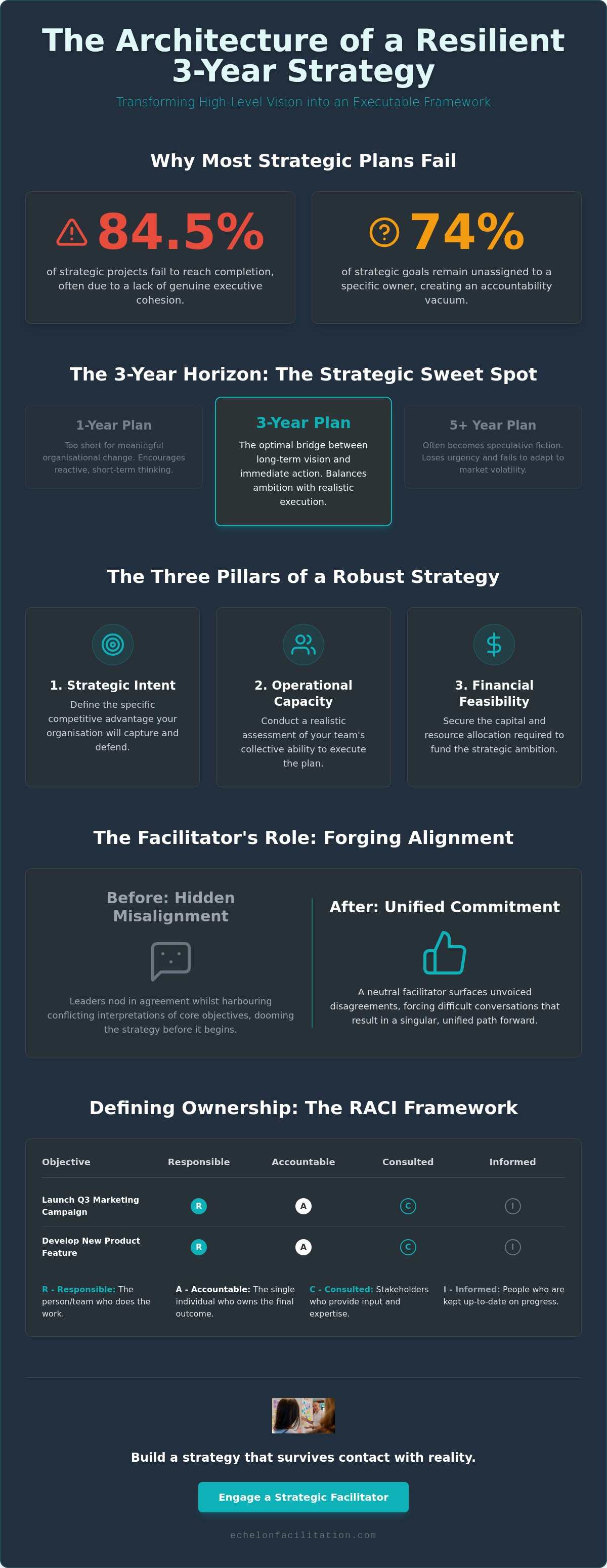
Research indicates that 84.5% of strategic projects fail to reach completion, largely because the initial planning phase prioritised financial data over executive cohesion. When 74% of strategic goals remain unassigned to a specific owner, accountability vanishes and the roadmap becomes obsolete. Utilising a strategic planning facilitator transforms your 2029 vision from a collection of milestones into a disciplined framework. This process ensures every leader understands their specific contribution to the collective objective and maintains focus under pressure.
Most leaders recognise that a plan without consensus is merely a wish list. Transitioning from static spreadsheets to a dynamic 3-year business plan requires a shift toward enforced ownership. Establishing executive alignment and clear decision rights ensures your strategy survives the first six months of execution and delivers a measurable 2029 vision.
Key Takeaways
- Establish the three-year business plan as the essential strategic bridge that connects annual budgets to your long-term organisational vision.
- Partner with a strategic planning facilitator to surface and resolve unvoiced disagreements amongst the leadership team before they undermine execution.
- Utilise the RACI matrix to assign clear ownership for every objective, ensuring that accountability remains the primary solution to organisational friction.
- Shift focus from document creation to momentum by prioritising a structured approach to the first 90 days of implementation.
The Architecture of a Strategic Planning Process
Strategic planning is the structural bridge between the immediate constraints of an annual budget and the aspirational reach of a long-term vision. Without this architecture, an organisation remains trapped in a cycle of short-termism, reacting to market fluctuations rather than shaping them. Defining The Architecture of a Strategic Planning Process requires a 3-year business plan to provide the necessary stability for complex transformations whilst remaining sufficiently agile to absorb external shocks.
Engaging a strategic planning facilitator ensures this architecture is built on objective truth rather than departmental bias. The presence of a neutral strategic planning facilitator allows the team to challenge assumptions that usually go unaddressed in internal meetings. Most traditional plans fail because they are treated as static financial projections for lenders. Echelon’s dynamic alignment philosophy treats strategy as a living framework supported by three core pillars:
- Strategic Intent: The specific competitive advantage you intend to capture.
- Operational Capacity: The realistic assessment of your team’s ability to execute.
- Financial Feasibility: The capital and resource allocation required to fund the ambition.
Why Traditional Planning Fails in Complex Organisations
Spreadsheets don't account for human behaviour. Harvard Business Review identifies a persistent Planning-Execution Gap where strategies fail because they ignore the social friction and misaligned incentives within leadership teams. A plan isn't finished when the document is printed. That is merely the point of departure. If the planning process doesn't address how leaders will behave when under pressure, the strategy will collapse within six months.
The Three-Year Horizon: Balancing Vision and Reality
Twelve months is too short for meaningful organisational change. Conversely, five-year plans often descend into speculative fiction. The three-year window allows for the setting of North Star objectives that survive market volatility whilst providing a clear roadmap for the immediate 1,000 days. It provides enough time to build new capabilities without losing the sense of urgency required for immediate progress. This timeframe forces a leadership team to confront the reality of their current constraints and optimise their resources accordingly.
Securing Boardroom Cohesion with a Strategic Planning Facilitator
Strategy is often mistaken for a solo writing exercise. In reality, it is a social contract between leaders. The primary failure point in planning is unvoiced disagreement amongst the leadership team. When directors nod in agreement whilst harbouring fundamental doubts about resource allocation, the strategy is doomed before it reaches the middle management layer. A professional strategic planning facilitator serves as the objective party who surfaces these conflicts early.
By creating a neutral environment, a facilitator forces the leadership team to confront uncomfortable truths rather than maintaining the facade of consensus. This process is documented in studies on how a strategic planning facilitator drives execution by ensuring that every voice is heard and every objection is categorised as either a risk to be mitigated or a decision to be made. To compress months of circular debate into a few days, organisations often utilise an Executive Alignment Sprint. This structured intervention forces rapid decision-making and ensures the leadership team leaves the room with a singular, unified narrative.
For boards struggling to find this level of focus, professional Facilitation Services provide the necessary external pressure to achieve genuine clarity.
Surfacing Hidden Misalignment in the Boardroom
Consider a scenario where a board agrees on a "digital-first" growth strategy. The CEO envisions market expansion, whilst the CFO focuses on cost reduction through automation. Without a facilitator to expose these divergent interpretations, the organisation will pull in two directions simultaneously. Achieving objective truth requires moving beyond comfortable narratives to define exactly what growth costs in terms of capital and culture. Professional guidance ensures these trade-offs are explicit and agreed upon by all stakeholders.
The Cost of Indecision During Strategic Shifts
Delayed decisions on a 3-year path lead to wasted capital and talent attrition. Top performers rarely stay in environments where the long-term objective is a moving target. High-performance teams require psychological safety to challenge business assumptions without fear of retribution. When leaders fail to decide, the organisation stagnates and the competitive advantage evaporates. A disciplined planning process eliminates this ambiguity by forcing a commitment to a specific, measurable path forward.
Using RACI to Optimise the Strategic Planning Process
Accountability is the primary solution to organisational friction. Without a clear owner, strategic objectives dissolve into polite suggestions that never leave the boardroom. The RACI matrix serves as the structural antidote to this ambiguity, ensuring that every element of the 3-year plan is anchored to a specific individual. A skilled strategic planning facilitator uses this framework to remove the hiding places that allow for collective inaction. This process is essential for Securing Boardroom Cohesion with a Strategic Planning Facilitator, as it forces a public commitment to results.
The RACI model defines four distinct roles for every strategic milestone:
- Responsible (R): The individual or team performing the work.
- Accountable (A): The single person answerable for the correct and thorough completion of the task.
- Consulted (C): Subject matter experts whose opinions are sought before decisions are finalised.
- Informed (I): Stakeholders kept up to date on progress.
Shared ownership usually results in zero progress. When a leadership team claims "we are all responsible" for a growth target, they are effectively ensuring that no one is accountable for the failure to achieve it. A strategic planning facilitator ensures that there is only one "A" for every objective, eliminating the confusion that typically stalls multi-year transformations.
The 4-Step RACI Mapping for 3-Year Objectives
Execution begins by mapping every strategic objective to a single Accountable executive. This person has the final decision rights and owns the success or failure of the initiative. Next, define the Responsible parties for the first 12 months of execution to ensure immediate momentum. Establish Consulted protocols early to prevent departmental siloing, ensuring that cross-functional dependencies are identified before they become bottlenecks. Finally, determine who must be Informed to maintain organisational transparency without slowing down the decision-making process.
Integrating RACI into Your Operational Rhythm
RACI assignments must not remain static. Review these roles during quarterly board reviews to ensure they still reflect the organisation's operational reality. Codifying these roles shifts the leadership team from passive observation to active ownership. When a director knows they are the single point of accountability for a 2029 vision milestone, their behaviour changes from reporting status to driving outcomes. To establish these decision rights within your own team, explore how we work to drive high-stakes alignment.
Beyond the Offsite: How a Strategic Planning Facilitator Drives Execution
Developing the strategic document represents only 20% of the total effort. The remaining 80% depends entirely on maintaining momentum once the leadership team returns to their daily operational duties. A strategic planning facilitator ensures that the transition from theory to action occurs immediately. Without this bridge, even the most robust 3-year plan will succumb to the inertia of business-as-usual. Success requires a disciplined shift from drafting a vision to enforcing the mechanics of delivery.
To kickstart the first 90 days, organisations should utilise a Strategy Sprint. This framework breaks down long-term objectives into high-velocity cycles of activity. It forces the team to focus on the most critical levers of growth whilst the energy from the offsite remains high. A 30-Day Execution Plan serves as the immediate roadmap, preventing the common post-offsite slump where priorities get buried under an accumulating inbox. Momentum is a perishable resource; it must be protected through structured accountability.
Validating 3-Year Assumptions with 90-Day Milestones
Strategic risks are rarely uniform. Using the Cynefin framework allows a leadership team to categorise plan risks as either Simple, Complicated, Complex, or Chaotic. Simple risks require standard operating procedures, whilst Complex risks require immediate experimentation. By setting 90-day milestones, you treat the first phase of the plan as a validation exercise for your long-term assumptions. This approach allows for disciplined adjustments before significant capital is committed to a flawed direction. A strategic planning facilitator helps the team identify which assumptions require the most urgent testing.
Maintaining Strategic Focus Amidst Operational Noise
Operational noise is the primary enemy of strategic execution. To counter this, establish a monthly Strategic Health Check for the executive team. This review should focus on three core areas:
- Alignment on the 2029 vision relative to current market shifts.
- The status of RACI assignments and identified bottlenecks.
- The necessity of a decision-rights reset for stalled initiatives.
Securing Your 2029 Vision Through Disciplined Alignment
A three-year plan provides the stability required for transformation whilst maintaining the agility to absorb market shocks. True strategic clarity originates from boardroom cohesion rather than financial projections. By enforcing individual accountability through the RACI matrix, you eliminate the ambiguity that typically stalls multi-year objectives. Engaging a strategic planning facilitator ensures that your leadership team confronts unvoiced disagreements and commits to a singular narrative.
Richard Kasriel utilises proven frameworks to secure board-level alignment, recently aligning a conflicted board in a single day through structured intervention. This disciplined approach moves the organisation beyond the initial offsite and into a rhythmic execution cycle. Establishing clear decision rights and 90-day milestones protects your 2029 vision from the erosion of operational noise. Your strategy is only as strong as the collective commitment to its execution.
Book a Strategy Sprint to align your leadership team for the next three years and transform your strategic intent into a measurable reality.
Frequently Asked Questions
What is the difference between a 1-year and a 3-year business plan?
A 1-year plan focuses on immediate operational targets and budgetary constraints, whilst a 3-year plan defines the strategic bridge to a long-term vision. The 12-month horizon is primarily concerned with hitting existing KPIs and managing current resources. In contrast, the 3-year horizon allows an organisation to build new capabilities and execute complex transformations that cannot be achieved within a single fiscal cycle.
How often should an organisation review its 3-year strategic plan?
Organisations should conduct a formal strategic health check every quarter to ensure alignment with market shifts. Whilst daily operations are managed through monthly reviews, the 3-year objectives require a quarterly cadence to validate assumptions and adjust resource allocation. This rhythm ensures the leadership team maintains focus on long-term goals without being consumed by short-term operational noise.
Who should be involved in developing a 3-year business plan?
The executive leadership team and the board must own the core strategic intent to ensure top-down commitment. Engaging a strategic planning facilitator ensures that these senior stakeholders reach genuine consensus and resolve hidden misalignments. Key department heads should also be involved during the operational capacity phase to verify that the roadmap is grounded in practical reality rather than boardroom speculation.
Can a 3-year business plan survive a major market disruption?
A robust 3-year plan survives disruption by prioritising strategic intent over rigid tactics. By using frameworks to categorise risks and implementing 90-day validation milestones, the leadership team can pivot their execution methods whilst maintaining their long-term objectives. This adaptability ensures that the plan remains a functional tool for decision-making even when external conditions shift unexpectedly.
What are the essential financial projections for a 3-year plan?
Essential projections include long-term revenue targets, capital expenditure requirements, and the resource costs associated with building new capabilities. The plan must also identify the break-even points for new strategic initiatives to ensure financial feasibility. A strategic planning facilitator helps the team balance these financial requirements against operational capacity to prevent the organisation from over-extending its resources.

Article by
Andrew Greenland
Dr Andrew Greenland is the founder of Echelon Facilitation, a UK practice that designs and runs high-stakes leadership sessions for executive teams who need decisions, not more discussion.
A medical doctor and medical educator, Andrew brings a clinician's discipline to the messy, political work of leadership alignment - surfacing the real disagreement, forcing the real choices, and ensuring every session produces a documented decision log with named owners and deadlines.
He works with CEOs, executive teams, transformation leads, and boards across the UK and internationally. Based in Twickenham.