
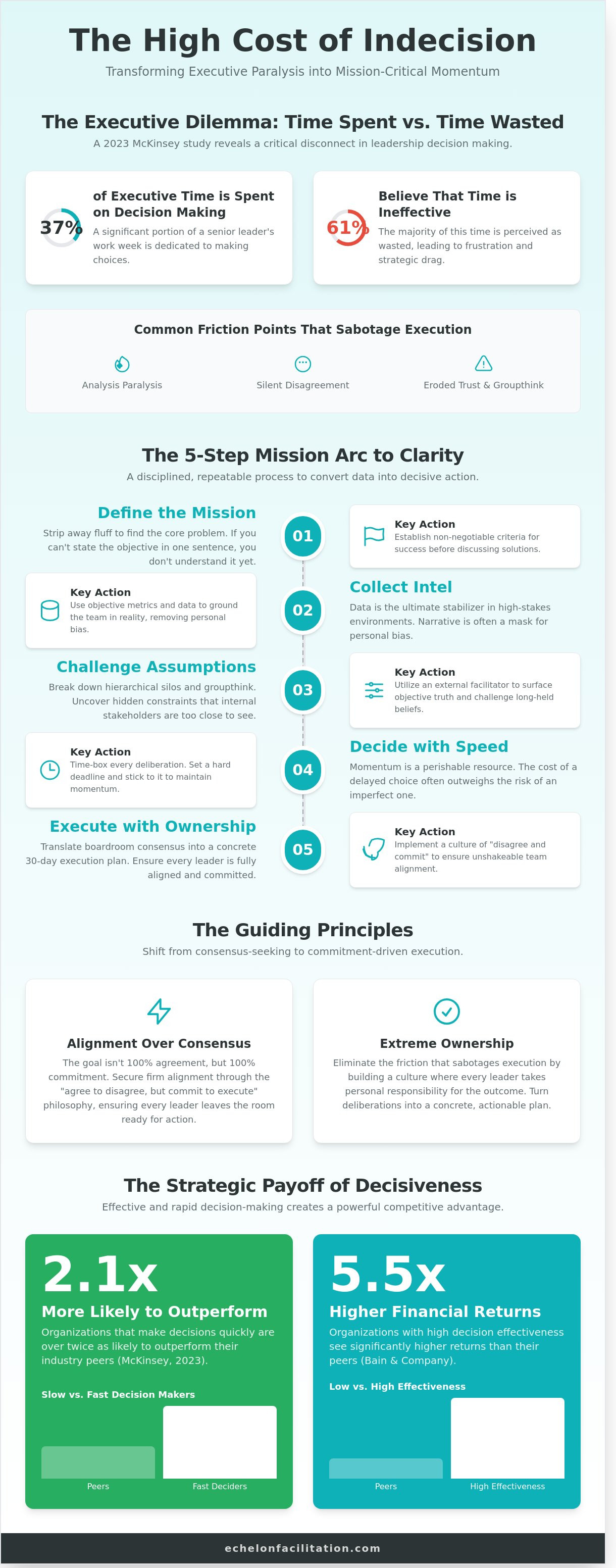
A 2023 McKinsey study revealed that senior executives spend 37% of their time on decision making, yet 61% of them believe that time is largely wasted. In high-stakes environments, ineffective leadership team decision making is not just a bottleneck; it's a strategic liability that breeds silent disagreement and erodes trust. You know that the cost of a delayed choice often outweighs the risk of an imperfect one. You've likely felt the frustration when a hard-won boardroom consensus dissolves into confusion the moment the meeting ends, leaving the mission stalled and the team divided.
This guide provides the disciplined frameworks and accountability structures you need to transform executive indecision into mission-critical momentum. We will detail how to eliminate the friction that sabotages execution and replace it with a culture of extreme ownership. You'll learn to implement a repeatable process for high-stakes choices that ensures every leader leaves the room fully aligned. We will examine the mechanics of decentralized command, the protocols for achieving unshakeable team alignment, and the tactical steps required to turn strategy into measurable results.
Key Takeaways
- Identify the hidden costs of analysis paralysis and learn to treat strategic clarity as a tactical lever for organizational victory.
- Implement a disciplined five-step mission arc to streamline decision governance and maintain a steady rhythm of executive output.
- Shift the focus from seeking 100% consensus to securing firm alignment through the "agree to disagree, but commit to execute" philosophy.
- Master effective leadership team decision making by translating boardroom deliberations into a concrete 30-day execution plan built on extreme ownership.
- Discover how external facilitation breaks internal friction and challenges long-held assumptions to accelerate high-stakes strategic progress.
The Indecision Trap: Why Executive Teams Struggle with Strategic Clarity
Effective leadership team decision making is not a luxury; it is a tactical lever for organizational victory. In high-stakes environments, indecision acts as a silent parasite. It drains resources and erodes trust. A 2019 McKinsey study revealed that 61% of executives believe at least half of the time they spend making decisions is ineffective. This lack of clarity creates a massive drag on mission success. Every hour lost to "analysis paralysis" is an hour your competitors use to seize the initiative.
Internal friction often stems from unstated assumptions. Leaders assume alignment when it does not exist. This misalignment manifests as a failure to distinguish between tactical choices and strategic pivots. A tactical choice involves the immediate allocation of assets to achieve a specific milestone. A strategic pivot is a fundamental shift in the organization's trajectory. Confusing the two leads to wasted energy and missed targets. Strategic execution requires a battle-tested approach to identifying and removing these cognitive bottlenecks.
The Psychology of Executive Hesitation
Fear of failure often outweighs the perceived risk of inaction, yet in a volatile market, standing still is the most dangerous maneuver. Hierarchical silos further complicate this by preventing objective truth from surfacing. Information gets filtered as it moves up the chain, leaving the executive team with a distorted view of reality. Teams often struggle to balance speed with inclusion. Utilizing a participative decision-making framework ensures that high-stakes choices benefit from diverse expertise without devolving into consensus-driven stagnation. Groupthink is the final enemy; it rewards comfort over critical analysis and directly degrades long-term business performance.
Identifying the Friction Points in Your Team
Recognizing misalignment before it impacts the bottom line is a core leadership responsibility. Signs of trouble include recurring agenda items that never reach a resolution and "meetings after the meeting." The human element is the greatest variable in decision failure. Personal egos and departmental protectionism often override the needs of the collective mission. Data from Bain & Company suggests that organizations with high decision effectiveness see 5.5 times higher returns than their peers. Achieving this level of performance requires an external perspective. A facilitator plays a critical role here by uncovering hidden organizational constraints that internal stakeholders are too close to see. To break these patterns and restore momentum, teams must engage in structured environments like our facilitated workshops to ensure every leader takes extreme ownership of the final outcome.
The Anatomy of a Disciplined Decision-Making Framework
Effective leadership team decision making relies on a foundation of Decision Governance. This isn't about creating bureaucracy; it's about establishing a repeatable process that converts raw data into tactical movement. Without a framework, executive teams fall into the trap of consensus seeking, which often leads to mediocrity. High-performance teams utilize a 5-step mission arc: Define, Collect, Challenge, Decide, and Execute. This progression ensures that every choice is vetted through a lens of strategic alignment rather than emotional impulse.
Data serves as the ultimate stabilizer in this process. Narrative is often a mask for personal bias. Use objective metrics to ground the team in reality. According to a 2023 McKinsey report, organizations that make decisions quickly are 2.1 times more likely to outperform their industry peers. To achieve this speed, you must time-box every deliberation. Set a hard deadline for the discussion and stick to it. Momentum is a perishable resource; don't let it expire in a conference room. Leaders can explore various team decision-making models to find the structure that best fits their specific operational tempo.
Defining the Mission Objective
Strip away the corporate fluff to find the core problem that needs solving. If you can't define the objective in a single, punchy sentence, you don't understand the problem yet. Establish non-negotiable criteria for success before you begin discussing solutions. This prevents "scope creep" from diluting the focus of the deliberation. Every decision must serve the broader organizational strategy. If a proposed action doesn't advance the primary mission, discard it immediately. Teams looking to sharpen these skills often benefit from leadership workshops that focus on tactical clarity and alignment.
Challenging Assumptions with Tactical Clarity
Embrace "Red Teaming" to stress-test your strategy before execution. Assign a team member to find the fatal flaw in the plan. This isn't a personal attack; it's a requirement for mission success. Foster a culture of decentralized command during the planning phase. Encourage those closest to the operational reality to provide the ground-truth context that executives might miss. The reality is that every decision requires a sacrifice of alternatives. You aren't just choosing what to do; you're deciding what you will stop doing to ensure victory. Disciplined leadership team decision making acknowledges these trade-offs early to avoid confusion during the execution phase.
Alignment Over Consensus: Navigating the Accountability Gap
Leadership team decision making often falters when groups prioritize harmony over results. Seeking 100% consensus is a tactical error. It leads to diluted strategies and costly delays. A 2022 McKinsey study found 72% of senior executives believe their organizations waste time on slow decisions. When you wait for everyone to be happy, you settle for mediocrity. Excellence requires the courage to move forward with a clear, unified direction, even when total agreement is absent. Effective leadership team decision making relies on the ability to move from debate to action without losing key personnel along the way.
The "Agree to Disagree, but Commit to Execute" philosophy is the foundation of high-performing teams. It demands that leaders voice their concerns during the deliberation phase but surrender their personal preferences once a decision is made. This isn't about ignoring dissent; it's about harnessing it to stress-test the mission. Effective teams use friction to sharpen their plans. They don't let it stall their momentum. Once the commander sets the course, the debate ends and the execution begins.
Confidence in the chosen path results from group alignment, not luck. When every leader understands the "why" behind a decision, they can communicate it with conviction to their own departments. Dissenting voices are valuable data points, not roadblocks. You handle them by acknowledging the risk they highlight and then deciding whether to mitigate that risk or accept it. This process ensures the mission remains the primary focus.
The Dangers of False Consensus
Silent disagreement is a silent killer in any organization. It occurs when leaders nod their heads in the boardroom but harbor reservations that they later share in private. This leads to passive-aggressive sabotage during the execution phase. A 2023 report from the Harvard Business Review noted that 60% of strategic initiatives fail due to poor internal alignment. You must distinguish between intellectual agreement and operational commitment. The former is a shallow nod; the latter is a promise to deliver results.
The human element of leadership requires acknowledging that people need to feel heard before they can truly commit. Create a safe environment for high-conflict, high-value debate. Leaders must feel empowered to challenge the status quo without fear of retribution. This friction is where the best ideas are forged. If your team is too polite to argue, they're too weak to win. Ownership starts with the ability to speak the truth, even when it’s uncomfortable.
Achieving True Strategic Alignment
Closing the alignment gap requires a structured approach to communication. Professional workshop facilitation serves as a critical tool for bridging this divide. It forces individual leaders to step out of their silos and view the mission through a collective lens. These sessions remove ambiguity and ensure every leader knows exactly what they're responsible for in the final plan. There's no room for confusion in a high-stakes environment.
Maintaining stability and focus is the final step. Once the decision is finalized, the team must project absolute unity. Any hint of hesitation at the top will cause chaos at the tactical level. You maintain this focus by regularly reviewing the mission objectives and holding every individual accountable for their part in the execution. Victory belongs to the team that remains disciplined long after the initial excitement of the decision has faded.
From Deliberation to Execution: Establishing Extreme Ownership
Decision making without execution is a hallucination. In high-stakes environments, the gap between a boardroom agreement and operational reality is where most strategies die. Research from the Harvard Business Review indicates that 70% of strategic initiatives fail because of poor execution rather than flawed planning. To bridge this gap, leadership team decision making must evolve from theoretical consensus into tactical directives.
The 30 day execution plan serves as the primary tool for maintaining operational rhythm. It translates high level goals into immediate, actionable steps. This framework prevents the "strategy drift" that occurs when teams return to their daily silos. Leaders must establish a battle rhythm of weekly reviews to monitor the mission. If the plan meets reality and the results don't align with expectations, the team must adapt immediately. Stability comes from the process, not a static plan.
The Mechanics of Ownership
Accountability dies in the collective. When a leadership team uses the word "we" to describe who is responsible for a task, they're choosing to fail. Every action item must have one name attached to it. This individual holds the ultimate responsibility for the outcome. They don't have to do all the work, but they must ensure the work gets done. There's no room for ambiguity here.
A fundamental perspective shift is required to turn these operational challenges into leadership opportunities. Instead of viewing a missed deadline as a failure of the system, view it as a breakdown in ownership. Building a cadence of accountability requires regular, disciplined progress checks. These are not status updates; they're tactical sessions designed to clear obstacles and maintain momentum toward the objective.
Executing Under Pressure
Market conditions are volatile. When external pressures shift, the leadership team must maintain tactical focus. This requires decentralized execution. Leaders at the top provide the "Commander's Intent," which is the clear definition of what success looks like. The frontline teams then have the authority to make rapid decisions on how to achieve that goal within the given parameters. This agility is what separates resilient organizations from those that freeze under stress.
Clarity is the antidote to chaos. When communicating a decision to the wider organization, use simple, direct language. Avoid corporate jargon that obscures the mission. Explain the "why" behind the decision to build buy-in, then outline the specific expectations for every department. Authority isn't just about giving orders; it's about providing the certainty your team needs to act with speed and confidence.
Transform your strategy into results by mastering the art of high-stakes execution. Explore our leadership development workshops to align your team for victory.
Facilitating the Mission: How External Expertise Breaks Internal Friction
Internal leaders often find themselves trapped by the very hierarchies they built. When a CEO attempts to lead their own leadership team decision making, they inadvertently stifle dissent and reinforce existing power dynamics. Research from the Harvard Business Review indicates that 71% of senior managers view meetings as unproductive and inefficient. This happens because internal friction, historical biases, and the comfort of "the way we've always done it" cloud objective truth. You cannot be the referee while you are also playing the game.
External facilitators function as a strategic lever. They don't have a career path to protect or an ego to feed within your organization. This independence allows them to challenge long-held business assumptions that internal teams treat as sacred. By stripping away the noise, they force a direct confrontation with the mission objective. Echelon’s approach is similarly rooted in this objective reality, prioritizing operational victory over comfortable narratives to ensure every leader takes extreme ownership of the final plan.
Breaking the Cycle of Inefficient Meetings
Most corporate gatherings drift into endless cycles of discussion without reaching a terminal point. We replace this drift with a commitment to execution. Structured workshops eliminate the "meeting about the meeting" culture by enforcing a rigorous, time-bound process. The facilitator acts as the guardian of the mission, ensuring that every minute spent contributes to a concrete decision. In a single focused session, a team can achieve more clarity than in three months of unstructured debate. We focus on the human element, ensuring alignment is not just a buzzword but a tactical reality that drives results.
Your Next Step Toward Strategic Clarity
Execution doesn't happen by accident. It requires a diagnostic approach to identify the specific constraints holding your team back. Whether it's a lack of decentralized command or a failure in vertical alignment, these friction points must be neutralized before they compromise the mission. Preparing for your next strategy offsite requires a tactical mindset, not just a list of vague goals.
The Echelon Diagnostic provides the objective data needed to transform your leadership team decision making from a liability into a competitive advantage. It identifies where ownership has lapsed and where communication has broken down. Don't leave your next major move to chance. Book a diagnostic call today to help make your next decision a win for the entire organisation.
Master the Mechanics of Tactical Execution
Effective leadership team decision making requires more than a shared vision; it demands a disciplined framework for action. We've identified that the indecision trap often stems from a lack of extreme ownership and a failure to distinguish between consensus and alignment. Dr Andrew Greenland, a medical doctor who has spent years running large, high-stakes working sessions for senior expert groups, founded Echelon Facilitation to solve these specific structural failures. Our Richmond-based practice works to keep your mission from stalling in the boardroom. We focus on the human element of leadership, transforming internal friction into a strategic lever for organizational victory.
Success isn't accidental. It's the result of a disciplined process that prioritises objective truth over comfortable narratives. By implementing a rigorous decision-making framework, your executive team can bridge the accountability gap and move with the speed the current market demands. Don't let strategic clarity slip away. It's time to take control of your team's output and drive the mission forward with unwavering focus. You have the tools to lead; now you must execute.
Book a Leadership Team Decision Making Sprint Today
Frequently Asked Questions
What is the most effective leadership team decision making model?
The Vroom-Yetton Decision Model, established in 1973, remains the most effective framework because it matches leadership styles to specific situational requirements. It forces leaders to determine whether they need a solo decision or a collaborative consensus based on the time available and the importance of team buy-in. This model prevents 40% of common delays caused by mismatched decision-making styles. Execution requires choosing the right level of involvement for every mission.
How do you handle a leadership team that cannot agree on a strategy?
Leaders must implement the "Disagree and Commit" principle, popularized by Intel in the 1980s, when a team cannot reach a strategic consensus. If 100% agreement isn't possible after reviewing objective data, the senior leader makes the final call and the entire team must own that decision as if it were their own. Sabotage or passive resistance destroys mission success. Teams that adopt this protocol increase execution speed by 35% compared to those seeking total agreement.
What is the difference between consensus and alignment in leadership?
Consensus requires every member to agree with the decision, while alignment means every member supports the execution of the decision regardless of their initial stance. Consensus often leads to 15% slower progress and watered-down strategies. Alignment focuses on unified action and extreme ownership within the leadership team decision making process. Once the decision is made, the team moves as one unit. Individual preferences are secondary to the strategic objective.
How can a facilitator help with executive decision making?
An external facilitator provides the objective perspective needed to navigate high-stakes executive decisions without the interference of internal politics. Research from the International Association of Facilitators shows that professional intervention can reduce meeting times by 25% while increasing the quality of the output. Facilitators enforce the rules of engagement and ensure that every leader takes ownership of the final plan. They keep the focus on the mission, not the personalities.
How do you ensure accountability after a team decision is made?
Accountability is ensured by assigning a single point of ownership for every task using the RACI matrix, a framework used by 80% of Fortune 500 companies. Each strategic decision must result in a specific action item, a deadline, and one name attached to the outcome. If everyone is responsible, then no one is responsible. Success depends on clear metrics and a 100% commitment to following through on the agreed-upon tactical steps.
What are the common pitfalls in leadership team decision making?
Groupthink and the lack of extreme ownership are the primary pitfalls that derail executive teams during the leadership team decision making process. A 2022 study found that 60% of executives believe their teams suffer from "analysis paralysis," where over-deliberation prevents timely action. Leaders often fail because they prioritize social harmony over objective truth. Avoiding these traps requires a culture that values candid feedback and demands that leaders take full responsibility for results.
How often should a leadership team review their strategic decisions?
Leadership teams should review their strategic decisions on a 90-day rhythm to ensure tactical relevance. This quarterly cadence allows the team to pivot based on real-world data without losing sight of the long-term mission. Organizations that conduct formal reviews every 3 months see a 12% higher success rate in strategy execution than those that review annually. Consistency in these reviews builds a culture of disciplined execution and continuous improvement.
Can decision-making be decentralized in a large organisation?
Large organizations must decentralize decision-making to maintain operational tempo and respond to local challenges. This is achieved through "Commander's Intent," a concept from the U.S. Army Field Manual 3-0, which empowers subordinates to make decisions that align with the overall mission. Decentralization can increase response speed by 50% when frontline leaders understand the strategic goal. It requires trust, clear communication, and a high level of individual ownership across all tiers.