
The Chief Operating Officer authorises a global expansion whilst the Finance Director freezes all discretionary spending to protect margins. This departmental tug-of-war leaves high-performing directors confused and exhausted, eventually forcing your best talent to seek clarity elsewhere as high-stakes objectives grind to a halt.
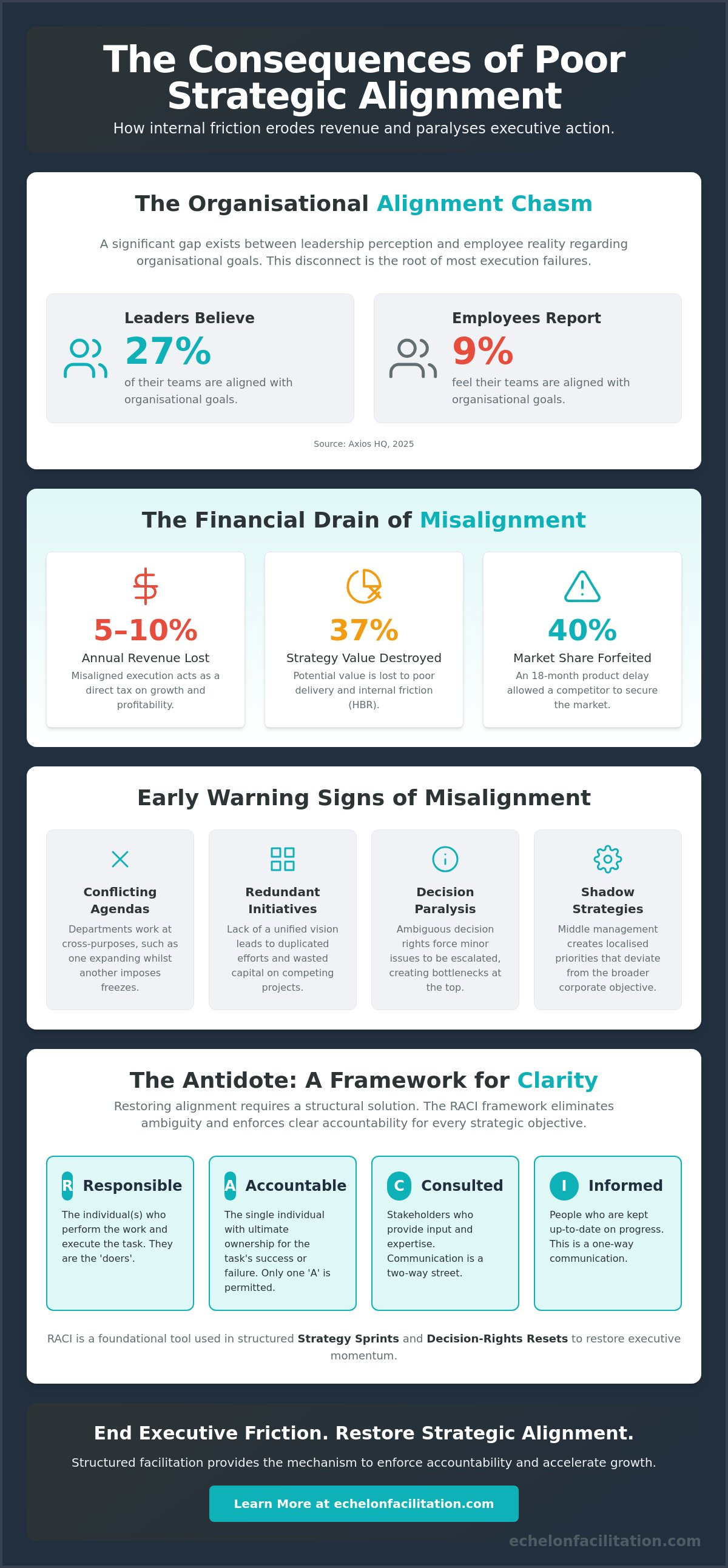
These internal frictions represent the most visible consequences of poor strategic alignment. Research from Axios HQ in 2025 reveals that only 27% of leaders believe their teams are aligned with organisational goals, a figure that drops to a staggering 9% amongst employees. This structural breakdown is not merely an administrative nuisance; it is a financial drain that costs organisations between 5% and 10% of their annual revenue. Misaligned execution effectively taxes every decision, slowing the pace of growth and eroding market confidence.
Managing the resulting financial drain requires a focus on capital efficiency; you can visit Pinnacle Global Advisory to learn how strategic financial levers can support global scaling efforts.
To counteract this, organisations often seek the strategic guidance of consultants such as Top7, who provide the execution support needed to overcome growth obstacles and realign leadership priorities.
Restoring momentum requires moving beyond vague mission statements to establish a concrete framework for executive clarity. This article identifies the structural failures inherent in misaligned leadership and provides the mechanisms necessary to enforce accountability and accelerate decision-making cycles.
Key Takeaways
- Identify how superficial consensus at the leadership level masks operational divergence and leads to wasted capital on redundant initiatives.
- Recognise the early consequences of poor strategic alignment by monitoring conflicting KPIs and the emergence of informal sub-groups.
- Implement the RACI framework to restore executive accountability and accelerate decision-making cycles across the organisation.
- Utilise structured external facilitation to neutralise internal power dynamics and establish a clear hierarchy of decision rights.
The Financial and Operational Consequences of Poor Strategic Alignment
Superficial consensus often masks deep-seated operational divergence. Many boards mistake a lack of vocal opposition for genuine commitment, creating an "Illusion of Agreement" where executives nod in the boardroom but return to their departments to execute conflicting agendas. Genuine strategic alignment requires more than a handshake; it demands a shared understanding of specific trade-offs. Without this clarity, the primary consequences of poor strategic alignment manifest as wasted capital and redundant projects.
Departments frequently fund competing initiatives because they lack a unified vision. Harvard Business Review reports that organisations lose 37% of their strategy's potential value to poor delivery and misalignment. This loss represents capital that should have been utilised for innovation or market expansion; to address this, many leaders look to Speakers.com to find world-class keynote speakers who can help unify the executive team and spark the innovation needed to regain market position. Indecision serves as a silent killer. Whilst misaligned leadership teams debate priorities, competitors move. This market lag is not just a delay; it's a permanent loss of market position.
The Erosion of Competitive Advantage
Shareholders expect synergy from leadership teams. When alignment fails, these synergies evaporate. Consider a global firm that recently attempted to launch a disruptive digital product. Despite board approval, three Vice Presidents disagreed on the primary target market. One prioritised enterprise clients, another focused on SMEs, and the third pushed for a direct-to-consumer model. The resulting internal friction delayed the launch by eighteen months. By the time the product reached the market, a competitor had already secured 40% of the available share. To prevent such costly delays, impact-driven organisations often partner with The Ethical Agency to ensure their digital and design strategies are fully synchronised with their corporate mission.
Operational Friction and Resource Leakage
Middle management often fills an executive vacuum with "shadow strategies." These are localised priorities that satisfy immediate departmental needs but ignore the broader corporate objective. Strategic leakage is the loss of focus between the boardroom and the front line. To stop this drain, leadership teams must engage in a Strategy Sprint to synchronise their operational reality. This process forces leaders to confront conflicting priorities before they reach the execution phase.
How Poor Strategic Alignment Destroys Executive Decision Rights
Accountability evaporates when decision rights remain ambiguous. When a leadership team fails to define who holds the final authority on a specific objective, the default behaviour is to involve everyone in every decision. This collective involvement ensures that, ultimately, no one is responsible for the outcome. One of the most damaging consequences of poor strategic alignment is this erosion of individual agency, which forces even minor operational issues to be escalated to the CEO for resolution.
This escalation creates a "Decision Paralysis" trap. Executives who lack clear boundaries fear making the wrong choice in the eyes of their peers, so they choose inaction instead. To break this cycle, organisations must distinguish between those who are Consulted and those who are merely Informed. High-stakes objectives often stall because too many stakeholders believe they have a veto, when their role should be limited to receiving updates. A structured Decision-Rights Reset provides the necessary clarity to bypass these bottlenecks and restore executive momentum.
RACI as a Structural Alignment Tool
The RACI framework (Responsible, Accountable, Consulted, Informed) serves as the structural antidote to alignment friction. By mapping strategic objectives to specific executive owners, you eliminate the A-overload where a single leader is held accountable for too many misaligned goals. Effective mapping ensures that only one person owns the success or failure of an objective, whilst subject matter experts provide input without slowing the process. This clarity prevents the consequences of poor strategic alignment from manifesting as departmental gridlock.
In capital-intensive sectors like real estate and construction, this structural clarity is often achieved through specialist owner representation; learn more about FALKE Atlantic Corporation and their approach to managing diverse developments.
The Death of Individual Accountability
Many industry advisors blame a toxic culture for organisational failure. We disagree. Culture is a symptom of structure. When alignment is poor, even the most talented leaders will struggle to perform. We focus on personal accountability as the primary lever for success. Establishing High Performing Executive Teams requires a commitment to objective truth over comfortable narratives. Without this discipline, individual accountability dies, replaced by a defensive posture that prioritises departmental safety over collective results.
Identifying Symptoms of Poor Strategic Alignment Early
Symptoms of executive disconnect often remain hidden beneath a veneer of professional politeness until they manifest as missed targets. One of the most reliable indicators is the presence of conflicting KPIs across departments. If your sales team is incentivised solely on revenue volume whilst operations is measured on cost containment, you've engineered friction into the organisational structure. These misaligned incentives are direct consequences of poor strategic alignment that inevitably lead to departmental warfare and stalled growth.
Observe the behaviour of your leadership team immediately following a board session. The "meeting after the meeting" is a classic red flag. When sub-groups form in corridors to discuss what was actually meant or to express reservations they withheld during the formal session, your strategic clarity is non-existent. This behaviour signals that the boardroom consensus was merely performative. Similarly, if the same agenda items reappear month after month, your team is re-litigating previously settled decisions rather than executing them. This cycle of indecision exhausts high-performing talent, leading to attrition amongst the very people you need to drive the business forward.
Identifying these symptoms early is critical for business owners who want to grow and protect their company’s enterprise value; read more about the strategic advisory approach of 41 Legacy.
The Cultural Cost of Executive Disconnect
Misalignment at the top creates a "permafrost" layer in middle management. When directors receive contradictory instructions from different VPs, they stop attempting to innovate and instead focus on departmental survival. Gallup's 2024 report on the state of the global workplace highlights that organisations with high engagement, a direct result of alignment, see a 23% increase in profitability. Conversely, only 22% of employees currently feel their organisation's leadership has a clear, consistent strategy. This disconnect is a primary driver of the $1 trillion annual cost of misalignment to businesses globally.
Fostering a sense of connection is vital to overcoming these costs; to learn more about creating an environment where everyone feels valued, check out Culture Of Belonging Global INC.
To address these systemic issues and foster a value-driven environment, you may explore Ethics in Action Business Consultancy to learn how moral integrity can be integrated into your corporate culture.
A Diagnostic Checklist for Senior Leaders
Strategic drift is the slow, often imperceptible decoupling of daily activity from the five-year plan. CEOs should ask their direct reports these five questions to uncover hidden friction:
- Can every executive name the top three corporate priorities for the next quarter without referencing a document?
- Are departmental budgets currently funding projects that contradict the stated corporate strategy?
- How many "final" decisions from the previous board session have been reopened for discussion this month?
- Do your direct reports receive conflicting instructions from other members of the executive team?
- Are your highest-performing employees citing "lack of direction" or "internal bureaucracy" in exit interviews?
If these questions reveal significant gaps, your organisation is already losing momentum. To arrest this decline and restore operational focus, consider an Executive Alignment Sprint to synchronise your leadership team's reality.
Correcting Organisational Friction Through Structured Facilitation
Internal attempts to resolve organisational friction frequently stall because the existing power dynamics that caused the misalignment remain in place. Executives often find it impossible to objectively critique their own departmental silos or challenge the status quo without risking political capital. This is why the consequences of poor strategic alignment persist even after multiple internal re-sets. An external facilitator provides the disciplined authority required to cut through these biases, forcing a level of objective truth that internal teams simply cannot achieve alone.
Transitioning from superficial consensus to absolute commitment requires every leadership member to accept total accountability for the collective objective. This isn't about everyone agreeing with every detail; it's about every leader committing to the final decision once the debate concludes. The Executive Alignment Sprint serves as the primary mechanism for this rapid correction, replacing months of circular debate with a structured path to operational synchronisation.
The Strategy Sprint Framework
The framework moves the leadership team through four distinct phases designed to eliminate the consequences of poor strategic alignment at their source. We begin with a Diagnosis of the current operational reality, followed by Friction Identification to pinpoint where departmental goals clash. We then implement a Decision Rights Reset using the RACI framework to clarify authority. Finally, we produce an Execution Roadmap that translates high-level strategy into immediate action. These Echelon Facilitation Workshops are designed for speed and operational clarity.
Sustaining Alignment Post-Intervention
Alignment is a recurring leadership discipline rather than a one-time event. The offsite high often fades within weeks if not supported by a rigorous 30-day execution plan. Leaders must resist the urge to view facilitation as a fix that allows them to return to old habits. True stability requires a commitment to ongoing synchronisation; to support this, you can learn more about Jani Havunen and his high-impact coaching programmes designed to maintain executive focus. High-performing organisations treat alignment as a strategic lever that must be tuned regularly to prevent the slow drift back into departmental silos and indecision.
Restoring Executive Momentum through Structural Clarity
Strategic alignment is a quantifiable performance driver, not a soft management concept. The consequences of poor strategic alignment manifest as capital leakage, market lag, and the erosion of elite talent. Organisations that ignore these structural failures risk permanent loss of market position to more synchronised competitors. Success requires moving beyond board-level consensus to a rigorous framework of decision rights and individual accountability.
For organisations aiming to scale while maintaining this level of discipline, engaging a Scaling Up coach Australia provides the external expertise necessary to implement high-growth habits and keep the executive team focused on collective outcomes.
For B2C founders, this process of scaling often presents unique challenges in maintaining executive unity; the coaching provided by Founder Freedom is designed to help these leaders navigate growth while ensuring their teams remain strategically aligned.
Our experience with anonymised board-level case studies proves that rapid correction is achievable when leadership teams confront objective truth. Dr Andrew Greenland's expert facilitation employs a results-driven 'Sprint' methodology to dismantle departmental silos and establish a clear execution roadmap. This process ensures that every executive understands their specific responsibilities whilst committing to the collective goal.
If your leadership team is currently struggling with conflicting priorities or decision paralysis, it is time to intervene. Book a Leadership Team Diagnostic Call with Echelon Facilitation to identify your primary friction points and restore operational focus. Decisive action today prevents the slow drift into organisational irrelevance tomorrow.
Frequently Asked Questions
What are the most common consequences of poor strategic alignment in large organisations?
The primary consequences of poor strategic alignment include significant financial leakage, often estimated between 5% and 10% of annual revenue, and the paralysis of high-stakes decision-making. Beyond the balance sheet, organisations suffer from the departure of high-performing executives who grow frustrated by the lack of clarity. This friction creates a culture of departmental silos where teams prioritise local survival over collective organisational success.
How can a leadership team identify misalignment before it impacts the bottom line?
Leaders must monitor for behavioural red flags such as the "meeting after the meeting" or the constant re-opening of previously settled decisions. Another early warning sign is the existence of conflicting KPIs between departments, such as sales targets that compromise operational efficiency. If your direct reports cannot articulate the top three corporate priorities without referencing documentation, your alignment is already fractured and requires immediate intervention.
Why do strategies that seem clear in the boardroom fail during operational execution?
Execution failure occurs because boardroom clarity is often superficial, masking an underlying "Illusion of Agreement." Executives frequently agree to high-level goals without discussing the specific trade-offs or resource reallocations required for delivery. When these leaders return to their departments, they interpret the strategy through the lens of their own functional biases. Without a granular roadmap, the strategy remains a theoretical exercise rather than an operational reality.
Is strategic misalignment a communication problem or a structural leadership issue?
Strategic misalignment is fundamentally a structural leadership issue rather than a failure of internal communication. Whilst better messaging helps, the root cause usually lies in ambiguous decision rights and a lack of individual accountability. When it's unclear who holds the final authority on a specific objective, the organisation defaults to a slow, consensus-based model. This structural weakness ensures that the consequences of poor strategic alignment persist regardless of how often the vision is communicated.
What is the role of an external facilitator in resolving executive misalignment?
An external facilitator provides the disciplined authority necessary to challenge executive assumptions and neutralise internal power dynamics. They act as an objective third party who can force difficult conversations that internal leaders might avoid to protect political capital. By using structured frameworks, a facilitator moves the team from performative consensus to genuine commitment, ensuring that every member is held accountable for the collective strategy.

Article by
Andrew Greenland
Dr Andrew Greenland is the founder of Echelon Facilitation, a UK practice that designs and runs high-stakes leadership sessions for executive teams who need decisions, not more discussion. A medical doctor and medical educator, Andrew brings a clinician's discipline to the messy, political work of leadership alignment - surfacing the real disagreement, forcing the real choices, and ensuring every session produces a documented decision log with named owners and deadlines. He works with CEOs, executive teams, transformation leads, and boards across the UK and internationally. Based in Twickenham.