
A group of talented individuals does not constitute a leadership unit; most executive boards are simply collections of functional experts protecting their own silos. Establishing high performing executive teams requires more than individual expertise; it demands a rigid structural framework that enforces collective ownership over the central strategy.
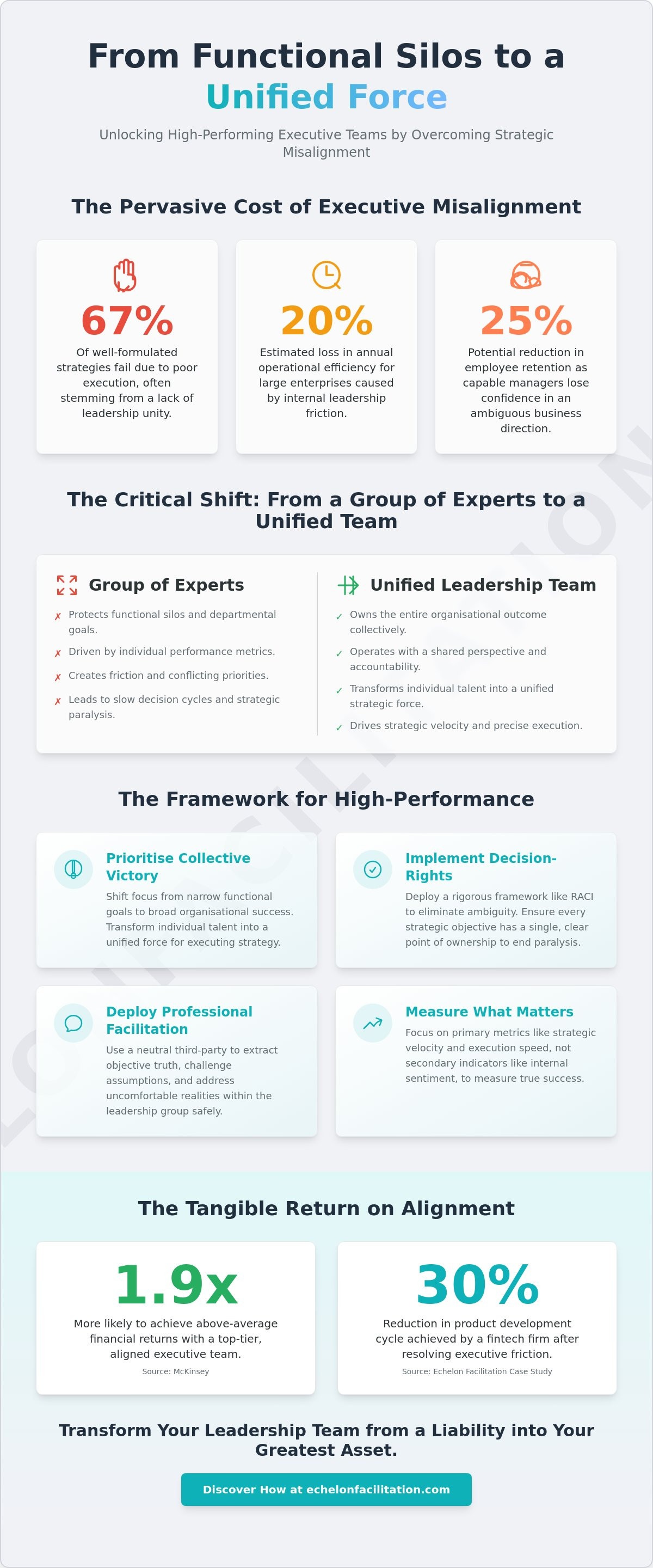
This lack of alignment creates functional silos that paralyse the organisation. According to research from the Harvard Business Review, 67% of well-formulated strategies fail due to poor execution, often because the leadership team is not unified. This internal friction costs large enterprises an estimated 20% in annual operational efficiency. Without a clear framework for alignment, your organisation remains trapped in slow decision cycles and ambiguous ownership that directly erodes your competitive advantage and market position whilst frustrating your most capable managers.
Discover the structural frameworks and facilitation techniques required to transform these talented individuals into high performing executive teams. We will examine how to establish clear decision rights and foster extreme ownership to ensure your strategy is executed with precision. This approach replaces vague aspirations with a disciplined model for operational success.
Key Takeaways
- Prioritise collective organisational victory over narrow functional goals to transform individual talent into a unified force.
- Implement a rigorous decision-rights framework to eliminate the ambiguity that often undermines high performing executive teams.
- Deploy professional facilitation as a strategic tool to extract objective truth and address uncomfortable realities within the leadership group.
- Measure success through strategic velocity and execution speed rather than secondary metrics like internal sentiment.
High Performing Executive Teams: Establishing Strategic Alignment
A global logistics firm loses 15% of its market share in twelve months because the Head of Operations and the Head of Sales cannot agree on a unified pricing structure. This friction at the summit prevents the organisation from responding to competitor shifts, leaving the frontline staff without clear direction.
Research from McKinsey indicates that companies with top-tier executive teams are 1.9 times more likely to achieve above-average financial returns. Conversely, misalignment at the top filters down, creating a culture of indecision that erodes shareholder value. A 2023 study indicated that executive friction can reduce employee retention rates by up to 25% as middle management loses confidence in the direction of the business. Failure to align costs more than just time; it costs equity.
This article examines the mechanics of building a unified leadership structure. It outlines how to move from a collection of high-achieving individuals to a team that prioritises collective results over departmental silos.
Defining High Performing Executive Teams Beyond the Talent Myth
Building high performing executive teams requires more than simply hiring the most expensive talent available. Most boards mistakenly believe that assembling a group of high-achieving individuals automatically creates a functional unit. This talent myth ignores the reality that unaligned experts often create more friction than value. A true high-performance team operates with a shared perspective where collective accountability supersedes individual performance metrics and functional departmental goals.
The distinction between a group of leaders and a unified executive team lies in ownership. In a group, leaders focus on their own silos; in a team, they own the entire organisational outcome. Without this shift, the CTO fights for technical perfection whilst the CFO demands immediate cost reduction, stalling every critical decision. These conflicting priorities create a bottleneck that prevents the business from executing its strategy effectively.
Consider a hypothetical London-based fintech firm where the CTO and CFO have been in constant conflict for eighteen months. The resulting friction delays a critical product launch and costs the firm projected revenue. A neutral facilitator might identify that neither leader understands the other's constraints. Once they establish a unified objective through a structured facilitation process, the firm can start to shorten its product development cycle. This scenario shows that individual excellence is a liability when it lacks a unified objective.
The Cost of Executive Misalignment
Misalignment often manifests as "nodding head" syndrome. Leaders offer verbal agreement in the boardroom but ignore those decisions once they return to their departments. This behaviour signals to the wider organisation that executive mandates are optional. Indecision at the top level directly impacts share price and employee retention. When high performing executive teams fail to provide a clear path, the resulting ambiguity forces high-potential employees to seek stability elsewhere.
High Performing Executive Teams and the Decision-Rights Framework
Ambiguity is the primary enemy of execution within a leadership group. It creates a vacuum where accountability disappears and resentment grows. High performing executive teams operate with a different standard; they replace vague assumptions with a rigid decision-rights framework. This structure ensures that every strategic objective has a single point of ownership, removing the friction of overlapping authorities. When three different executives believe they hold the final say on a capital expenditure, the result is paralysis. Clarity ends this cycle.
Utilising the RACI (Responsible, Accountable, Consulted, Informed) framework allows a team to categorise involvement with precision. Research highlighted in The Secrets of Great Teamwork suggests that a clear structure is one of the essential enabling conditions for success. Without it, teams default to consensus-seeking, which often leads to mediocrity and delayed timelines. High performance requires a shift from seeking total agreement to establishing clear ownership of specific outcomes. For a more detailed analysis of these mechanics, review our guide on leadership team decision making.
Implementing the RACI Model for Boards
The Accountable person must be a single individual. When two people are accountable, no one is. This individual owns the success or failure of the objective and holds the final authority to act. In contrast, the Consulted category should be strictly limited. Excessive consultation creates a veto culture that leads to decision-making paralysis. High performing executive teams use the following template during board meetings to map decision-rights for every major initiative:
- Strategic Decision: Define the specific action, such as a market entry or capital investment.
- Accountable: Assign the one individual who owns the final result.
- Responsible: Identify the parties who will execute the work.
- Consulted: List only those whose expertise is vital to the decision.
- Informed: List the stakeholders who require updates but do not influence the choice.
Establishing these boundaries during a strategy sprint prevents future organisational friction and ensures the team remains focused on objective results rather than internal politics.
Professional Facilitation as a Lever for High Performing Executive Teams
Internal leadership often fails to address the friction points that stall progress. Neutral facilitators bring the stoic confidence required to challenge uncomfortable truths that internal directors might ignore to maintain a false sense of harmony. This external perspective acts as a strategic tool to extract objective truth from a room often cluttered with competing department narratives. High performing executive teams understand that alignment is not the absence of disagreement; it's the presence of clarity after rigorous, honest debate.
A structured environment creates the safety needed for productive conflict. Research by McKinsey & Company indicates that organisations with high levels of leadership alignment are 1.9 times more likely to have above-average financial performance. Our methodology focuses on how we work to ensure that every voice contributes to the collective mission without the filter of internal politics. We replace vague consensus with concrete commitments and individual accountability.
Breaking Deadlocks in the Boardroom
Facilitators identify "groupthink" by questioning the underlying business assumptions that teams take for granted. A rigid, structured agenda prevents dominant personalities from overshadowing the room, ensuring that the collective intelligence of the board remains the primary driver of decision-making. This process requires a disciplined approach to time and topic management. By using the strategy sprint format, organisations can compress six months of circular, unproductive debate into a single day of decisive action and strategic clarity.
This process forces a shift from passive observation to extreme ownership. When leaders stop defending their silos and start focusing on the organisational mission, the path to execution becomes clear. High performing executive teams don't leave their alignment to chance; they use professional facilitation to remove the obstacles that hinder speed. If your leadership team is stuck in a cycle of indecision, you should contact Echelon to restore strategic focus.
Measuring the ROI of High Performing Executive Teams
Return on investment for senior leadership is often miscalculated. Organisations frequently rely on sentiment-based metrics like employee engagement or team cohesion to assess effectiveness. These metrics are secondary. The primary measure of high performing executive teams is strategic velocity: the speed at which a team converts a boardroom decision into operational reality. When alignment is absolute, the time between identifying a market shift and executing a counter-move narrows significantly.
Traditional team-building advice prioritises happiness, yet high-functioning groups understand that satisfaction follows success, not the other way around. Internal friction acts as a hidden tax on every project. Misalignment at the top creates a ripple effect of hesitation and redundancy that can cost an organisation up to 20% of its annual revenue through stalled initiatives. By contrast, a unified C-suite reduces this friction, allowing the business to respond to market volatility with a composure that competitors cannot replicate. Understanding the attributes of high performing teams is the first step toward reclaiming this lost efficiency.
The Long-Term Impact of a Perspective Shift
The most significant ROI comes from moving the C-suite from a functional mindset to one of total ownership. In this model, the Chief Technology Officer is just as responsible for sales targets as the Head of Sales. This shift eliminates departmental silos and ensures that every leader prioritises the collective mission over individual accolades. A Harvard Business Review study confirmed this correlation, noting that companies with highly aligned executive teams are 1.9 times more likely to achieve above-average financial performance and 2.3 times more likely to deliver superior shareholder value over a five-year period.
Leadership Confidence and Cultural Cascade
Unshakeable leadership confidence trickles down to every level of the organisation. When the executive team demonstrates clarity and discipline, middle management stops second-guessing strategic direction. This stability improves operational performance and builds a culture rooted in accountability rather than excuses. High performing executive teams don't just lead; they provide the strategic focus necessary for the entire workforce to execute with precision and objective truth.
Securing Strategic Alignment for Future Growth
Strategic clarity requires more than a collection of talented individuals; it demands a rigorous framework for decision-making and a commitment to objective truth. High performing executive teams succeed by resolving structural friction rather than relying on individual brilliance. Dr Andrew Greenland, a medical doctor who has spent years running large, high-stakes working sessions for senior expert groups, uses structured facilitation to remove the ambiguity that stalls progress.
By prioritising ownership and establishing clear decision rights, organisations transform from fragmented units into a cohesive force capable of executing complex objectives. This transition ensures that every leader operates with the stability and focus necessary for long-term success. Establishing this foundation today prepares your team for the challenges of tomorrow.
Book a complimentary diagnostic call to identify your team’s alignment constraints.
Frequently Asked Questions
What are the main characteristics of high performing executive teams?
High performing executive teams demonstrate extreme ownership, clear decision rights, and a shared commitment to the organisation's primary objective. A 2023 McKinsey report found these teams are 1.9 times more likely to achieve above-average financial performance. They prioritise collective enterprise results over individual departmental gains. This requires a culture of radical transparency where members challenge ideas without personal animosity.
How does professional facilitation improve executive team performance?
Professional facilitation improves performance by removing cognitive bias and enforcing a structured decision-making framework. An external expert ensures that the 20 percent of participants who typically dominate 80 percent of the conversation don't derail the strategic process. By using objective methodologies, facilitators help teams navigate complex problems without falling into the trap of groupthink or circular debate.
Why do talented executive teams often fail to align on strategy?
Talented high performing executive teams fail to align because they confuse individual competence with collective clarity. Research indicates that 65 percent of senior executives believe their leadership team isn't aligned on the organisation's top priorities. Friction often arises from misaligned incentives and a lack of defined decision rights. Without a central strategic anchor, high-achieving individuals naturally pull the organisation in divergent directions.
What is the difference between team building and executive alignment?
Team building focuses on interpersonal relationships and trust, whereas executive alignment focuses on strategic intent and operational execution. Whilst social cohesion is useful, it doesn't solve the problem of conflicting priorities. Alignment requires the team to agree on the specific path to victory and the trade-offs necessary to get there. It's a rigorous intellectual exercise rather than a social one.
How long does it take to build a high performing executive team?
Developing high performing executive teams typically requires six to twelve months of consistent, disciplined effort. This timeline accounts for the three to four quarterly cycles needed to embed new decision-making habits and refine strategic execution. Initial alignment can occur during a two-day intensive session, but sustained performance depends on the team's ability to maintain accountability through the subsequent 300 days of operation.