
Two senior directors refuse to concede on a shared budget, forcing a critical transformation project into a six-month stalemate. This friction is not a personality clash; it is a failure of organisational structure.
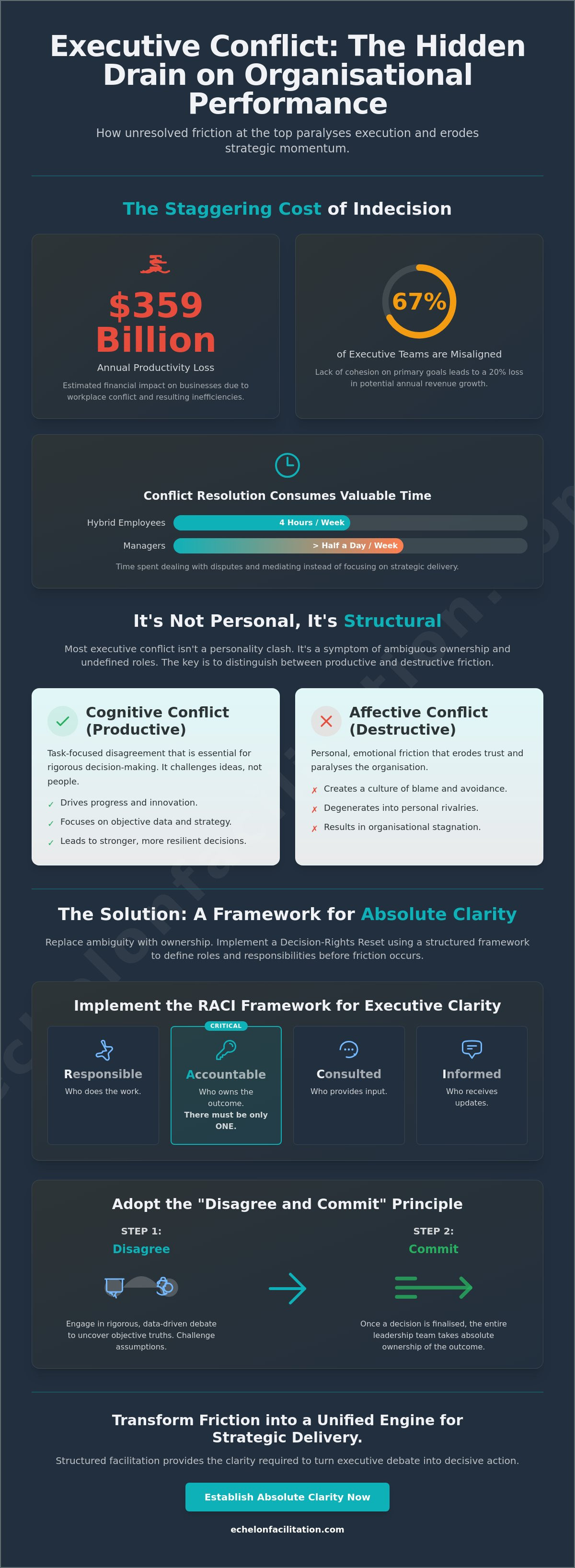
Indecision at the top level filters down, creating a culture of blame that paralyses execution. According to a March 2025 report, hybrid employees now spend an average of four hours per week dealing with disputes, whilst managers lose over half a day to mediation. This inefficiency contributes to an estimated $359 billion annual loss in productivity for businesses. When managing conflict within a leadership team is neglected, the cost is the erosion of strategic momentum and professional trust.
You recognise that executive disagreement is inevitable, yet you need it to be productive rather than polarising. Establish a decision-rights framework to replace ambiguity with absolute ownership when managing conflict within a leadership team. Structured facilitation provides the clarity required to transform friction into a unified engine for strategic delivery.
Key Takeaways
- Distinguish between task-based friction and personal rivalries to ensure disagreements drive progress rather than organisational destruction.
- Implement a Decision-Rights Reset to eliminate the boundary disputes that often masquerade as personality clashes when managing conflict within a leadership team.
- Utilise structured facilitation to shift executive debates from winning individual arguments to uncovering objective strategic truths based on data.
- Adopt the Disagree and Commit principle to ensure that once a decision is finalised, the entire leadership team takes absolute ownership of the outcome.
The Cost of Avoidance: Why Managing Conflict Within a Leadership Team is Non-Negotiable
Conflict within a leadership team is rarely about raised voices or personal animosity. It is the friction that occurs when misaligned objectives meet ambiguous ownership. Effective leaders understand that managing conflict within a leadership team is not about peacekeeping; it's about resolving structural contradictions that prevent execution. When roles are undefined, even the most capable executives will clash over territory and resources.
Distinguish between cognitive and affective friction. Cognitive conflict focuses on the task and is essential for rigorous decision-making. Affective conflict is personal, emotional, and destructive. When leaders fail to use established frameworks for team conflict, task-based disagreements often degenerate into personal rivalries. This transition marks the point where healthy debate becomes a liability to the organisation.
Senior leaders frequently prioritise harmony over alignment. Whilst harmony provides a comfortable environment, alignment is the only metric that drives strategic execution. Avoidance behaviours, such as silo-building or backchanneling, occur when executives fear direct confrontation. Managing conflict within a leadership team requires moving past these defensive postures to address the objective truth of the situation. Alignment demands a level of honesty that comfort cannot sustain.
The Quantifiable Price of Executive Stagnation
Executive friction trickles down, creating organisational paralysis. When directors cannot agree on a direction, middle management lacks the clarity needed to prioritise work. This indecision forces teams into a reactive state, where progress is sacrificed for political safety. Without a clear signal from the top, the entire workforce becomes hesitant, slowing the pace of innovation and delivery.
The financial impact is stark. Research published by the Harvard Business Review suggests that 67% of executive teams are misaligned on their organisation's primary goals. This lack of cohesion results in a 20% loss in potential revenue growth annually. Strategic drift is the inevitable result of these unresolved leadership stalemates. It is the gradual, often unnoticed departure from a defined strategy as misaligned leaders pull the organisation in conflicting directions.
Structural Alignment: Managing Conflict Within a Leadership Team Using Decision Rights
Structural failures often masquerade as personality clashes. When two executives fight over a project's direction, they are usually fighting over undefined territory. Managing conflict within a leadership team requires a shift from viewing disagreements as interpersonal issues to treating them as boundary disputes. By implementing a Decision-Rights Reset, an organisation can define who has the final authority on specific outcomes before friction occurs. This clarity is a core component of an Executive Alignment Sprint, which establishes the parameters of executive authority.
Decentralised command relies on absolute clarity. Every member of the leadership team must know who owns the mission and who provides support. When boundaries are blurred, execution slows as leaders wait for permission or engage in redundant oversight. Effective strategies for managing conflict focus on creating a structure where accountability is unavoidable. Managing conflict within a leadership team involves moving beyond soft skills to address the underlying power dynamics of executive roles.
Implementing the RACI Framework for Executive Clarity
The RACI framework provides a rigorous template for establishing this clarity. It categorises involvement into four distinct roles: Responsible (who does the work), Accountable (who owns the outcome), Consulted (who provides input), and Informed (who receives updates). A common failure in senior teams is assigning multiple people to the Accountable role. This leads to collective irresponsibility where no single individual feels the weight of the outcome. If you require immediate alignment on critical projects, consider a Strategy Sprint to codify these roles.
Contrast this approach with typical consensus-based decision-making. Consensus often results in watered-down strategies that satisfy every ego but achieve no significant results. High-performing teams prioritise clear ownership over comfortable agreement. By ensuring there is only one person accountable for every strategic outcome, you eliminate the ambiguity that fuels boardroom friction.
Facilitating Productive Disagreement: A Framework for Executive Debate
High-stakes debates often devolve into a battle of wills rather than a search for the best path forward. The objective when managing conflict within a leadership team must shift from winning an argument to uncovering the objective truth for the organisation. Facilitated disagreement introduces an external party who centres the conversation on data and strategic requirements rather than personal preferences. This neutral presence ensures that the debate remains focused on the mission, preventing the conversation from spiralling into affective friction.
A CEO cannot effectively facilitate a high-stakes debate whilst simultaneously being a primary participant. Their inherent authority biases the room, and their personal stake in the outcome prevents them from acting as an objective moderator. For a deeper analysis of this dynamic, refer to our guide on Leadership Team Decision Making. Professional facilitation allows the CEO to engage fully in the debate as a peer, ensuring their perspective is heard without stifling the contributions of the wider team.
Standard toolkits for managing workplace conflict often emphasise empathy over resolution. Whilst understanding perspective is useful, executive teams require a framework that forces a definitive conclusion. Managing conflict within a leadership team is a strategic lever that, when pulled correctly, accelerates decision cycles and eliminates the waste of circular meetings. If your leadership sessions are consistently unproductive, our Facilitation Services can provide the structure needed to restore momentum.
A 4-Step Process for Resolving High-Stakes Stalemates
Use this rigorous sequence to move from deadlock to decision:
- Isolate core strategic friction: Strip away emotive language and personal grievances to identify the underlying disagreement regarding resources, priorities, or outcomes.
- Map perspectives against the mission: Require every leader to justify how their proposed path contributes to the primary organisational objective.
- Force a decision: Use the established decision-rights framework to defer to the Accountable individual. Discussion must end when the owner makes the call.
- Secure ownership: Ensure every leader leaves the room committed to the chosen path. Private dissent after a public decision is a failure of leadership discipline.
Managing Conflict Within a Leadership Team: Establishing Ownership of Strategic Execution
In July 2024, a London-based logistics firm faced a six-month stalemate between the Operations Director and the Chief Commercial Officer over fleet electrification. This deadlock cost the firm an estimated £1.2 million in missed tender opportunities. By engaging in a Strategy Sprint, the board moved past circular arguments by re-centring on the organisational mission. They adopted the Disagree and Commit principle, a requirement for high-performing teams. This principle dictates that once a decision is made, every leader must provide unified, public support, regardless of their initial stance.
Managing conflict within a leadership team requires more than just an initial agreement; it necessitates rigorous monitoring to prevent backsliding. Leaders often revert to siloed behaviours or passive resistance when they return to their own departments. To counter this, set clear, measurable milestones immediately following the alignment session. If a leader fails to champion the collective decision to their team, it represents a breach of ownership that must be addressed directly. External facilitation acts as the circuit breaker in these scenarios, preventing healthy strategic friction from decaying into destructive personal rivalry.
The Role of the External Facilitator as a Strategic Lever
Internal politics often prevent the CEO or HR from being truly objective. An external facilitator provides the necessary distance to challenge senior assumptions without the risk of political fallout. They focus on the objective truth of the strategy rather than the comfort of the participants. A Transformation Alignment session resets team dynamics by removing the human element of ego and replacing it with a focus on execution. This process forces leaders to confront misalignment and accept the weight of their responsibilities.
Success in managing conflict within a leadership team is not a soft skill; it is a discipline of extreme ownership. It requires a relentless focus on the mission and the courage to hold peers accountable for their commitments. When you treat conflict as a structural challenge rather than a personality defect, you transform friction into a tool for strategic clarity. Success depends on the team's ability to move from debate to action with absolute alignment and unwavering focus on the objective.
Accelerating Execution through Executive Clarity
Executive friction is a structural failure requiring a structural response. Recognise that managing conflict within a leadership team is a discipline of clarity rather than personality. By applying frameworks such as RACI and Decision-Rights Resets, you replace ambiguity with absolute ownership. Echelon Facilitation, led by Richard Kasriel, provides the objective distance needed to challenge assumptions. As specialists in high-stakes executive alignment, we focus on the truth that drives execution. Book a complimentary diagnostic call to align your leadership team. Success depends on the clarity you establish today.
Frequently Asked Questions
How can I tell if our team conflict is healthy or destructive?
Healthy conflict focuses on the task and ends in a definitive decision. Destructive conflict focuses on the individual and results in 80% of meeting time being spent on grievances rather than execution. If your debates lead to a clear path forward, the friction is productive. If disagreements are re-litigated in private messages or through siloed resistance, the conflict is poisoning the organisation.
What is the most effective framework for managing conflict within a leadership team?
The most effective framework for managing conflict within a leadership team is the Decision-Rights Reset. This process identifies exactly who has the final authority on specific outcomes. By using a RACI matrix to codify these rights, you eliminate the boundary disputes that cause over 50% of workplace conflicts. Absolute clarity on ownership prevents friction from ever starting.
Should the CEO always be the one to resolve executive disagreements?
The CEO should not always mediate, particularly when they have a personal stake in the outcome. Their mediation can feel like a top-down directive rather than a genuine resolution, which breeds resentment. External facilitators provide the distance needed to challenge assumptions without political consequences. This allows the CEO to participate as a peer, ensuring the best strategic outcome for the organisation.
What happens if a senior leader refuses to align with a group decision?
Non-alignment after a decision is a breach of executive duty. High-performing teams operate on the principle of "Disagree and Commit". If a leader continues to undermine a decision, it creates strategic drift and confuses the wider workforce. Addressing this requires immediate, direct confrontation regarding their commitment to the mission. Continued resistance usually necessitates a change in personnel to protect the organisation's momentum.
When is it time to bring in an external facilitator for conflict resolution?
Engage an external facilitator when a strategic stalemate lasts longer than four weeks. If internal attempts to resolve the issue have failed, the friction is likely structural rather than personal. A neutral third party acts as a circuit breaker; they reset the team's focus on execution before the delay impacts annual revenue targets or damages the organisational culture beyond repair.

Article by
Andrew Greenland
Dr Andrew Greenland is the founder of Echelon Facilitation, a UK practice that designs and runs high-stakes leadership sessions for executive teams who need decisions, not more discussion. A medical doctor and medical educator, Andrew brings a clinician's discipline to the messy, political work of leadership alignment - surfacing the real disagreement, forcing the real choices, and ensuring every session produces a documented decision log with named owners and deadlines. He works with CEOs, executive teams, transformation leads, and boards across the UK and internationally. Based in Twickenham.