
A Chief Executive watches their senior leaders nod in unanimous agreement during a strategy session, only to discover three days later that the Head of Product has blocked a critical resource transfer. This silent dissent creates a vacuum where execution dies and functional silos thrive.
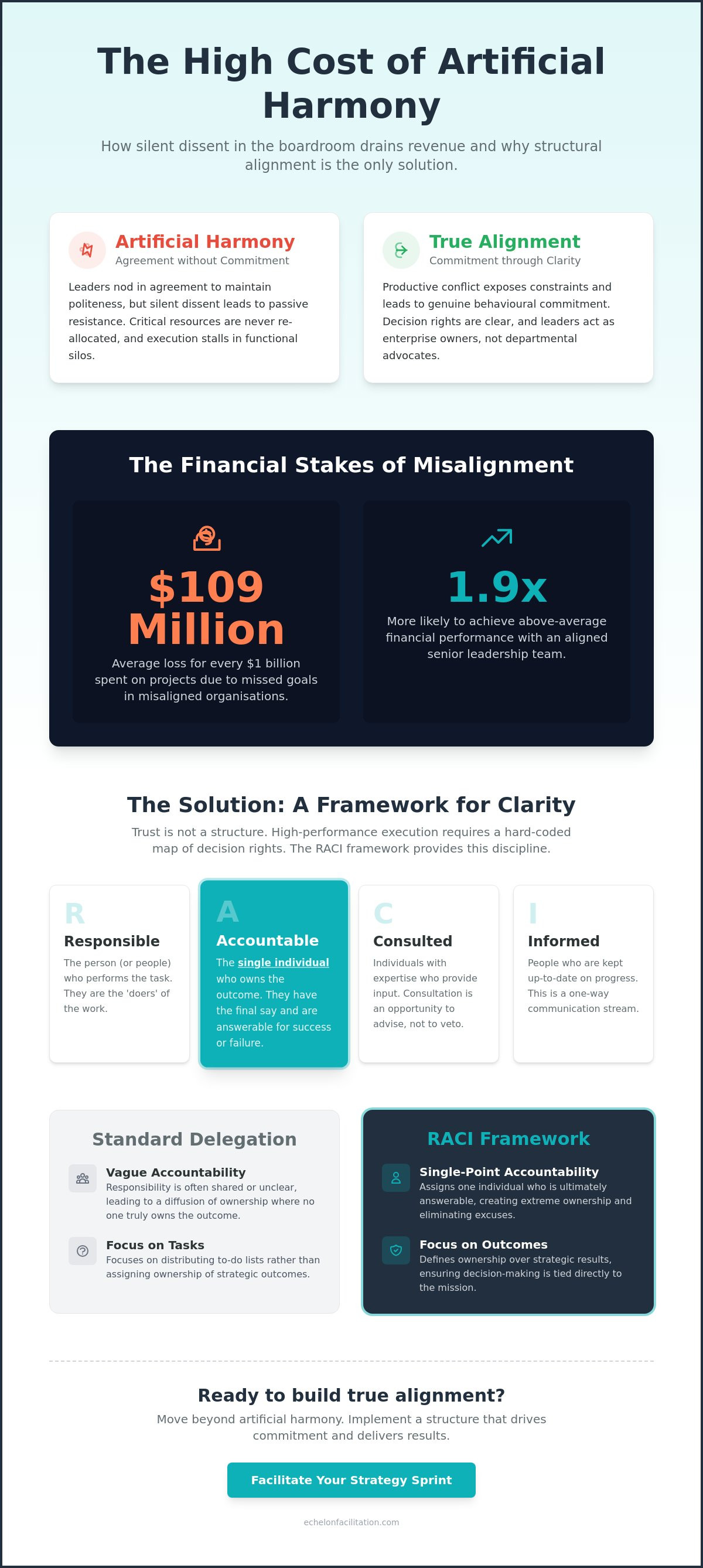
Misalignment isn't merely a cultural inconvenience; it is a direct drain on total revenue. Learning how to get executive team alignment is critical because misaligned organisations lose an average of $109 million for every $1 billion spent on projects due to missed goals. Research from a 2025 McKinsey report indicates that organisations with aligned senior leadership are 1.9 times more likely to achieve above-average financial performance. Establishing how to get executive team alignment ensures financial survival by moving beyond boardroom theory into structural discipline.
Boardroom agreement often lacks the friction necessary for true commitment. A disciplined framework replaces artificial harmony with extreme ownership and clear decision rights. These structural protocols ensure every leader prioritises the collective mission over their own department.
Key Takeaways
- Eliminate artificial harmony by fostering productive conflict to reach true behavioural commitment amongst the C-suite.
- Adopt the RACI framework to define clear decision rights and ensure a single individual holds accountability for each strategic outcome.
- Discover how to get executive team alignment by using external facilitation to break down functional silos during high-intensity Strategy Sprints.
- Shift the leadership perspective from departmental advocacy to collective ownership of the organisation's primary objectives.
- Validate strategic decisions through a 30-day execution plan that tests alignment against operational reality and resource availability.
Executive Team Alignment: Identifying the Hidden Costs of Artificial Harmony
Alignment is often mistaken for consensus. In many boardrooms, silence is interpreted as support, but true Strategic alignment requires a behavioural commitment to shared objectives with clearly defined owners. Without this, teams suffer from artificial harmony. This is a state where dissent remains hidden to maintain a facade of professional politeness, whilst functional heads quietly divert resources back to their departmental silos. Understanding how to get executive team alignment begins with acknowledging that productive conflict is the only route to clarity.
A London-based fintech firm experienced this friction during their 2024 expansion. The leadership team nodded through a pivot to a B2B model, yet the Product and Marketing heads never reconciled their conflicting KPIs. The result was a six-month delay in launch. The "polite" environment prevented the necessary friction that would have exposed their resource constraints. Leaders must stop acting as functional advocates and start acting as enterprise owners.
The Distinction Between Agreement and Alignment
Nodding in a meeting is a low-bar metric. It represents a lack of immediate objection rather than a commitment to action. True alignment is visible only when resource allocation shifts. Passive resistance occurs when a leader agrees to a plan in the boardroom but fails to deprioritise legacy projects in their own department. This gap between words and resource movement is where strategy fails.
How to Organise Decision Rights Using the RACI Framework
Psychological safety is insufficient for high-performance execution. Whilst trust is necessary, it cannot replace a rigid structure of accountability. Determining how to get executive team alignment requires more than just a shared vision; it demands a hard-coded map of who owns which decision. The RACI framework (Responsible, Accountable, Consulted, Informed) provides this map by clarifying roles and eliminating the ambiguity that leads to boardroom bottlenecks.
Accountability is the most critical component of this framework. In an effective C-suite, "Accountable" must be limited to a single individual. When two or more leaders share accountability, no one truly owns the outcome. This diffusion of responsibility is why strategic pivots often stall. By assigning a single owner, you ensure that someone is answerable for the success or failure of the objective, regardless of how many people are involved in the execution.
Eliminating Overlap in the C-Suite
Strategic friction often occurs because too many senior leaders believe they have veto power. A Decision-Rights Reset clarifies that being "Consulted" is an opportunity to provide expertise, not an invitation to block progress. Expertise is heard, but the Accountable lead retains the final word. This distinction allows the organisation to move at pace without ignoring critical risks. A Decision-Rights Reset can untangle these overlaps in a single session, restoring operational momentum.
RACI vs. Standard Delegation
Standard delegation focuses on tasks, whereas RACI focuses on outcomes. Within the 6 Pillars of Leadership and Team Alignment, extreme ownership is the primary driver of mission success. RACI enforces this ownership by moving beyond simple to-do lists into a structured protocol for decision-making and communication.
| Feature | Standard Delegation | RACI Framework |
|---|---|---|
| Accountability | Often shared or vague | Single point of failure |
| Expertise | Ad-hoc consultation | Structured "Consulted" role |
| Communication | Inconsistent updates | Clear "Informed" protocol |
| Ownership | Task-focused | Outcome-focused |
To implement this, start by listing every high-stakes decision required for your current strategy. Map these to specific executive roles using the RACI definitions. If you find multiple "A"s for one decision, you've identified a primary source of organisational friction.
Facilitating the Strategy Sprint for Immediate Clarity
Traditional two-day offsites often descend into comfortable narratives and passive consensus. A Strategy Sprint replaces this format with a high-intensity, structured process designed to force decisions. Central to this is the Cynefin framework, which categorises business challenges into simple, complicated, or complex domains. By identifying the nature of the problem, the executive team avoids applying simple solutions to complex systemic issues. This rigour is the foundation of how we work to ensure strategic clarity.
Achieving true consensus requires breaking the cycle of polite agreement. Understanding how to get executive team alignment involves moving through the friction of divergent ideas to reach a single, committed path. An external facilitator ensures this process remains objective, preventing the team from defaulting to the easiest or most politically safe option. This external pressure is necessary to transform a group of functional heads into a unified leadership team.
The Role of Neutral Facilitation
A CEO cannot effectively facilitate their own alignment session. Power dynamics naturally suppress dissent, as senior leaders often hesitate to challenge the person who determines their budget or career trajectory. Neutral facilitation removes this barrier. An external observer identifies blind spots and challenges hidden assumptions that internal teams frequently overlook. This objectivity is vital for surfacing the underlying tensions that otherwise derail execution.
Structuring the Strategy Sprint
The sprint follows a disciplined four-stage methodology: Discovery, Divergence, Convergence, and Commitment. During Divergence, the team explores multiple solutions without judgment. Convergence then narrows these options based on data and resource reality. The final stage, Commitment, ensures every leader leaves the room with a clear understanding of their individual ownership. For organisations requiring rapid results, the Strategy Sprint offers a path to clarity in a fraction of the usual time.
If your leadership team is stuck in a cycle of unproductive meetings, a structured intervention can break the deadlock. Book a Strategy Sprint to align your executive team around a single, actionable mission.
Executing the Perspective Shift: Sustaining Alignment Beyond the Boardroom
The boardroom agreement is a hypothesis. It remains unproven until it survives the first 30 days of operational execution. Sustaining how to get executive team alignment requires a 30-day execution plan designed to test resource assumptions and identify immediate friction points. This plan acts as a validation bridge between high-level strategy and ground-level reality. Without it, the clarity achieved during a sprint evaporates as soon as leaders return to their functional silos.
Alignment must cascade. If the C-suite is synchronised but middle management remains confused, execution fails. Companies with high executive alignment are 1.76 times more likely to outperform their competitors, according to a 2023 PwC survey. This performance gap is closed by ensuring every layer of the organisation understands the collective objective and their specific role in achieving it. Regular alignment check-ins replace annual reviews to maintain this synchronicity and address emerging obstacles in real time.
The Enterprise Leader Mindset
Senior professionals must transition from being a departmental advocate to an enterprise leader. An advocate prioritises their own budget and team; an enterprise leader prioritises the whole organisation. This shift is a core characteristic of High Performing Executive Teams. Ownership extends beyond the boundaries of one's own department to include the success of the collective mission. When a leader views the organisation through this enterprise lens, resource hoarding becomes an obsolete behaviour.
Measuring Alignment Success
Success is measurable through specific organisational behaviours. High alignment manifests as increased decision speed and resource fluidity. If a team can reallocate capital or personnel within 48 hours to meet a strategic pivot, they are aligned. Employee clarity is another key indicator. Currently, only 28% of managers can identify their company's top three strategic priorities. Improving this metric is a direct result of effective executive synchronisation.
For leadership teams seeking to eliminate strategic friction, a structured assessment provides the necessary starting point. Contact Echelon to schedule a diagnostic call and identify the specific bottlenecks stalling your execution.
Secure Your Strategic Objectives Through Structural Discipline
True clarity requires moving beyond the boardroom facade of agreement. Success is not found in a shared vision alone; it's forged through the rigorous application of frameworks like RACI and Cynefin. By defining a single point of accountability for every strategic outcome, organisations eliminate the resource hoarding that stalls progress. This structural discipline transforms a group of high-performing individuals into a unified executive team focused on the collective mission.
Mastering how to get executive team alignment is a continuous operational requirement rather than a one-off event. It demands a shift in perspective where every senior leader prioritises the enterprise over their specific department. When this alignment is sustained through 30-day execution plans and regular check-ins, the organisation gains the fluidity needed to outperform competitors by 1.76 times, as evidenced by 2023 PwC data.
If your executive team is struggling to translate strategy into action, book a complimentary diagnostic call with Echelon Facilitation. Led by Dr Andrew Greenland, an expert in strategic execution, we've facilitated high-stakes sessions for FTSE 100 companies and scaling tech firms. We're specialists in the RACI and Cynefin frameworks and can help you resolve the friction points currently stalling your execution. Start the process of synchronising your leadership team today.
Frequently Asked Questions
What is the difference between agreement and alignment?
Agreement is a verbal acknowledgement whilst alignment is a behavioural commitment. Nodding in a boardroom represents a lack of immediate objection; it does not guarantee that a leader will reallocate their department's budget. Alignment is only achieved when resources move in synchronicity with the shared objective. This distinction explains why many strategies fail despite unanimous boardroom approval.
How often should an executive team hold alignment workshops?
High-performing executive teams should hold alignment sessions every 90 days. This quarterly cadence matches the rhythm of modern business cycles and allows for strategic pivots before market conditions shift. Whilst an annual vision offsite sets the long-term direction, these shorter sessions ensure the team remains synchronised on immediate execution priorities and resource allocation. Frequent check-ins prevent the slow drift into functional silos.
Can we get executive team alignment without an external facilitator?
Internal facilitation often fails because existing power dynamics suppress honest dissent. A CEO cannot objectively challenge their direct reports without the risk of creating defensive behaviours or artificial harmony. When learning how to get executive team alignment, an external specialist provides the neutral pressure required to surface hidden friction points. This objectivity ensures the team reaches a state of true commitment rather than polite consensus.
How do we handle a dominant leader who prevents team alignment?
Structured decision-rights frameworks such as RACI neutralise the influence of dominant leaders. By assigning a single Accountable owner to each outcome, the team shifts the focus from the loudest voice to the person responsible for results. Facilitated sessions also use structured ideation and data-driven convergence to ensure every senior professional's expertise is heard without one individual hijacking the process or suppressing the views of others.
What are the first signs that my leadership team is misaligned?
The primary signs of misalignment are slow decision-making and functional resource hoarding. If departmental heads refuse to transfer personnel to high-priority projects, the team is misaligned. Another critical indicator is a lack of clarity in middle management. When fewer than 30% of managers can identify the organisation's top three priorities, it indicates that the executive team has failed to establish a unified and well-communicated path forward.

Article by
Andrew Greenland
Dr Andrew Greenland is the founder of Echelon Facilitation, a UK practice that designs and runs high-stakes leadership sessions for executive teams who need decisions, not more discussion. A medical doctor and medical educator, Andrew brings a clinician's discipline to the messy, political work of leadership alignment - surfacing the real disagreement, forcing the real choices, and ensuring every session produces a documented decision log with named owners and deadlines. He works with CEOs, executive teams, transformation leads, and boards across the UK and internationally. Based in Twickenham.