
Your executive team meets weekly to discuss strategy, yet the same unresolved conflicts stall progress every month. This persistent misalignment suggests that whilst your leaders are individually capable, they lack the structural cohesion required to execute under high-pressure scenarios.
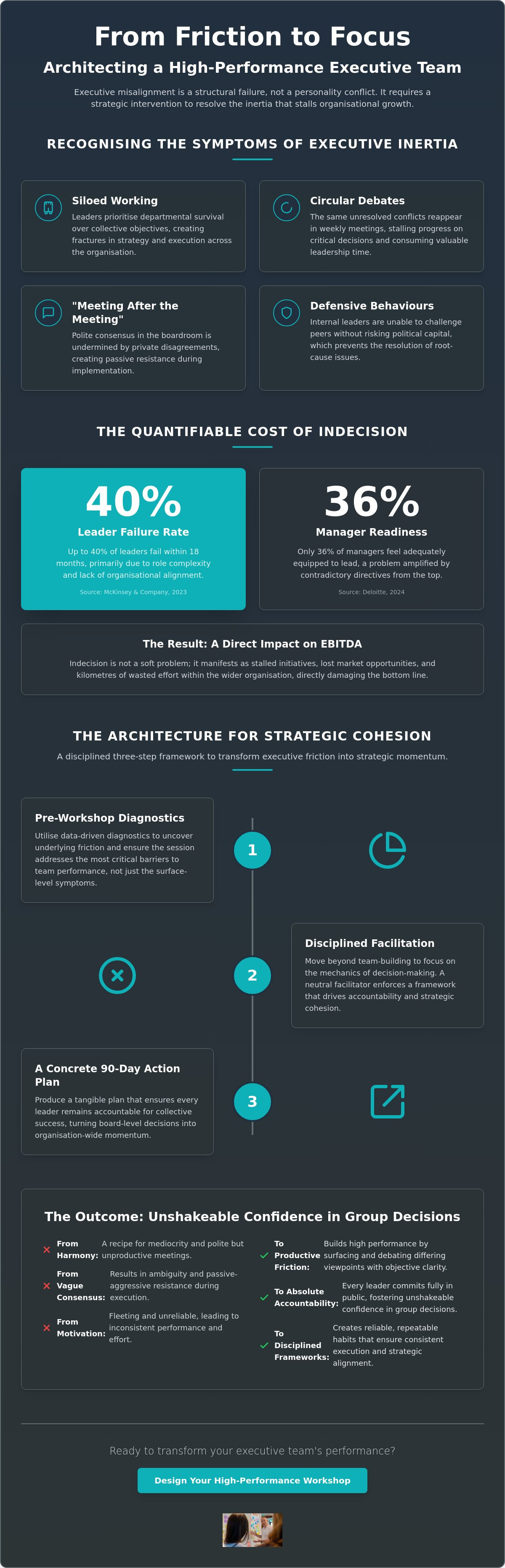
The cost of this friction is more than personal frustration. According to McKinsey & Company (2023), up to 40% of leaders fail within their first 18 months, primarily due to the complexity of their roles and a lack of alignment with the broader organisation. A high performance team workshop provides the necessary intervention to stop this decline by replacing vague consensus with absolute accountability and clear decision rights. When board-level decisions are delayed, the business loses the ability to respond to market shifts.
Traditional team-building exercises cannot fix these structural issues. A disciplined facilitation framework transforms executive friction into strategic momentum by defining roles and establishing clear decision rights. This approach produces a concrete 90-day action plan that ensures every leader remains accountable for the collective success of the organisation.
Key Takeaways
- Recognise that executive misalignment is a structural failure rather than a personality conflict, requiring a strategic intervention to resolve.
- Identify the symptoms of organisational inertia, such as siloed working and circular debates, that stall growth at the board level.
- Implement a three-step architecture within a high performance team workshop to move from initial diagnosis to concrete execution.
- Prioritise strategic cohesion over traditional team-building activities to ensure leaders can disagree in private whilst committing fully in public.
- Utilise pre-workshop diagnostics to uncover underlying friction and ensure the session addresses the most critical barriers to performance.
The Hidden Inertia of Misaligned Leadership Teams
Executive misalignment is rarely a matter of personality. It is a structural failure. A high performance team workshop acts as a strategic intervention designed to dismantle the inertia that stalls organisational growth. Unlike standard HR exercises that focus on interpersonal warmth, this process targets the mechanics of decision-making and accountability. It is a tool for the board, not a social event for the staff.
Symptoms of executive inertia are easy to identify but difficult to resolve internally. Circular debates, siloed working, and the "meeting after the meeting" culture are hallmarks of a team that has lost its strategic centre. In these environments, leaders prioritise departmental survival over collective objectives. A high-performance team operates with the understanding that healthy conflict is a prerequisite for clarity. Polite teams often mask deep-seated disagreements that resurface as passive-aggressive resistance during execution. This dysfunction at the top creates a multiplier effect. Every ounce of ambiguity at the board level translates into kilometres of wasted effort within the wider organisation.
The Cost of Executive Indecision
Indecision is an expensive luxury. When leadership teams fail to align on core priorities, the impact on EBITDA is direct. It manifests as stalled initiatives and lost market opportunities. Middle management often bears the brunt of this failure. With only 36% of managers feeling adequately equipped to lead their teams (Deloitte, 2024), adding the burden of contradictory directives from the top often leads to a total collapse of operational efficiency. Clear direction is the only way to protect the bottom line.
Why Internal Facilitation Often Fails High-Stakes Teams
Internal leaders frequently suffer from the "prophet in their own land" problem. They cannot challenge peers or superiors without risking significant political capital. This makes it impossible to address the root causes of friction. An external, neutral party is essential to navigate these complex power dynamics. Only an objective third party can surface the elephant in the room with the professional authority required to reset team dynamics and enforce a disciplined framework for progress.
Moving Beyond Team Building to Strategic Cohesion
Senior leadership teams frequently waste time on experiential away days that offer little more than temporary camaraderie. These events fail because they ignore the fundamental requirement of executive alignment: strategic cohesion. A high performance team workshop must move beyond social bonding to establish a culture where leaders are expected to disagree rigorously in private whilst maintaining absolute commitment in public. This transition requires a shift from an individual contributor mindset, where executives prioritise their specific departments, to one of collective leadership responsibility. When every member of the board takes ownership of the entire organisation's outcomes, decision-making becomes faster and more resilient.
The goal is to foster unshakeable confidence in group decisions. Once the workshop concludes, every leader must leave the room with total clarity on the path forward, ensuring no "meeting after the meeting" occurs to undermine the agreed strategy. This level of alignment is achieved through disciplined facilitation that prioritises objective truth over comfortable narratives.
The Difference Between Harmony and High Performance
Seeking harmony is often a recipe for mediocrity. It discourages the challenging of assumptions and results in "polite" meetings that leave critical issues unaddressed. High performance is built on productive friction, where differing viewpoints are surfaced and debated with objective clarity. Research on leadership and high-performance teams suggests that the effective use of power and influence within a group is what drives results, not the absence of conflict. A high performance team workshop must centre on this friction to reach the best possible strategic outcomes.
The Echelon Perspective: Discipline Over Motivation
Motivation is fleeting and unreliable. Successful leadership teams rely on disciplined habits and repeatable frameworks rather than emotional highs. This requires a significant perspective shift in how leaders perceive their roles within the group. By focusing on structural accountability, organisations can ensure that the momentum generated during a session survives the return to the office. For those ready to move past superficial team building, an Executive Alignment Sprint offers a structured path to operational clarity.
Designing a Workshop That Drives Accountability
A successful high performance team workshop follows a rigid three-step architecture: Diagnosis, Alignment, and Execution. This structure ensures that the session remains focused on strategic outcomes rather than interpersonal grievances. The process begins long before the leaders enter the room. A pre-workshop diagnostic is essential to identify the "elephant in the room" and surface the specific friction points that stall progress. Without this data, the workshop risks becoming a series of polite but unproductive conversations.
The agenda must move logically from high-level strategic vision to granular ownership. An outcome-first approach dictates that no session concludes without a named owner for every identified action. This methodology prevents the common pitfall where great ideas are discussed but never implemented. By hardwiring accountability into the schedule, the organisation ensures that the momentum generated during the workshop translates into operational reality.
Implementing the RACI Framework for Decision Rights
Role overlap is a primary driver of executive friction. Implementing the RACI framework (Responsible, Accountable, Consulted, Informed) during a session provides the clarity needed to eliminate this ambiguity. During a Decision-Rights Reset, leaders map out critical processes to ensure only one person is ultimately accountable for each outcome. This clarity prevents decision-making paralysis and empowers individuals to lead their departments with confidence, knowing exactly where their authority begins and ends.
From Offsite to Action: The 90-Day Execution Plan
The true value of a workshop is measured by what happens in the following quarter. Leaders must translate workshop notes into a rigorous 30-day or 90-day execution plan. This document serves as a contract between team members, outlining specific milestones and deadlines. Total accountability is the only way to ensure the strategy survives the return to the office. If you are ready to resolve executive friction and drive strategic momentum, book a Strategy Sprint to begin the process.
The Echelon Approach to High Performance Facilitation
Echelon operates on a philosophy of grounded authority and unwavering clarity. In high-stakes environments where the cost of failure is significant, leadership teams cannot afford the luxury of vague consensus. Our How We Work methodology is bespoke, intense, and focused exclusively on results. We do not act as tool technicians; we serve as strategic advisors who remain composed under pressure to guide teams toward objective truth.
A high performance team workshop facilitated by Echelon is not a passive experience. It is a rigorous process that demands total accountability from every participant. We move beyond the interpersonal dynamics of leadership to address the operational reality of leading a team. This commitment to discipline over fleeting motivation ensures that the strategic momentum generated during the session is sustainable and translates directly into organisational stability.
Anonymised Client Scenario: The Board Alignment
Consider a recent engagement where a board remained deadlocked over a £50m acquisition for several months. The impasse was not due to a lack of data, but rather a lack of alignment on risk appetite and decision rights. Through a single day of disciplined facilitation, we surfaced the underlying friction and established a clear framework for evaluation. By the end of the session, the board reached a unanimous decision based on objective truth rather than departmental bias. This outcome saved the organisation months of circular debate and prevented significant market displacement.
Selecting Your Facilitator: Why Expert Guidance Matters
Choosing the right facilitator is a strategic decision that impacts the long-term trajectory of your organisation. You require a partner with the experience to challenge senior leaders and the composure to navigate complex power dynamics without hesitation. The focus must remain on strategic clarity and the practical fulfilment of objectives. If your leadership team is stalling due to misalignment or decision-making paralysis, it is time to move from observation to action. Contact Echelon today to schedule a diagnostic call and begin the process of aligning your executive leadership through a high performance team workshop.
Establishing the Standard for Executive Alignment
Executive alignment is not a byproduct of time; it is the result of deliberate, disciplined intervention. High performance is achieved when leadership teams move beyond the superficiality of social bonding and embrace the rigour of defined decision rights. By implementing a high performance team workshop, organisations replace circular debates with a culture of strategic cohesion and absolute accountability. This structural shift ensures that every leader leaves the session with total clarity on their specific role in the organisation's collective success.
Founded by Richard Kasriel, a seasoned strategic advisor, Echelon specialises in high-stakes executive alignment. We utilise bespoke frameworks, such as RACI and Strategy Sprints, to transform friction into a concrete 90-day execution plan. This approach ensures that the momentum generated in the room survives the return to the operational environment. Organise your high performance team workshop with Echelon to resolve leadership inertia and secure your strategic objectives. Your team is capable of exceptional results once the structural barriers to execution are removed.
Frequently Asked Questions
What is the difference between team building and a high performance team workshop?
Team building focuses on interpersonal warmth and social cohesion whilst a high performance team workshop addresses structural alignment and decision rights. Traditional away days often fail because they prioritise fleeting motivation over disciplined execution. A workshop targets the mechanics of how a board functions, ensuring that every leader understands their specific accountability for collective organisational outcomes rather than just departmental success.
How long should an executive alignment workshop last to be effective?
An effective executive alignment session typically requires one to two days of intensive facilitation to achieve meaningful results. Half-day sessions are often insufficient for deep strategic re-alignment or resolving complex friction points. A full day allows for a rigorous diagnostic phase followed by the development of a concrete execution plan. High-stakes objectives demand a time investment that reflects the complexity of the challenges being addressed by the leadership team.
Can a workshop help resolve deep-seated conflict within a leadership team?
Workshops resolve deep-seated conflict by surfacing the underlying friction points through a neutral, third-party diagnostic. Internal leaders often lack the political capital to challenge peers, making external facilitation essential for navigating complex power dynamics. By focusing on objective truth rather than personal grievances, the session provides a structured framework for leaders to disagree in private but commit fully to the final group decision.
What are the most common outcomes of a successful strategy offsite?
The primary outcomes of a successful strategy offsite include absolute clarity on roles and a rigorous 90-day action plan. Leaders should leave the room with a resolved decision-rights framework, such as RACI, to eliminate departmental overlap and paralysis. These sessions move the team from vague consensus to a state of readiness where every action has a named owner and a specific deadline for completion.
How do you measure the ROI of high performance team facilitation?
ROI is measured by the speed of strategic execution and the reduction in circular debates that stall growth. Leadership failure rates can reach 40% within 18 months when alignment is lacking (McKinsey, 2023), so facilitation serves as a protective measure for the bottom line. Success is evidenced by the completion of 90-day plan milestones and the elimination of the "meeting after the meeting" culture that undermines board-level decisions.

Article by
Andrew Greenland
Dr Andrew Greenland is the founder of Echelon Facilitation, a UK practice that designs and runs high-stakes leadership sessions for executive teams who need decisions, not more discussion.
A medical doctor and medical educator, Andrew brings a clinician's discipline to the messy, political work of leadership alignment - surfacing the real disagreement, forcing the real choices, and ensuring every session produces a documented decision log with named owners and deadlines.
He works with CEOs, executive teams, transformation leads, and boards across the UK and internationally. Based in Twickenham.