
Imagine standing in a silent boardroom whilst the Chairman closes your presentation folder without asking a single question. This silence indicates a failure to understand how to present a business case to the board with the structural weight required for executive commitment.
According to PwC's 2025 Annual Corporate Directors Survey, a majority of directors believe at least one of their peers should be replaced, yet most feel their board's assessment processes fail to produce meaningful insights. This systemic inefficiency leads to chronic indecision and stalled strategic growth. When proposals lack a disciplined framework, they are frequently dismissed or deferred, costing organisations millions in lost revenue and unmitigated risk. A lack of clarity at this level ensures that critical projects remain unfunded and objectives remain unfulfilled.
Securing approval requires more than a polished slide deck; it demands a demonstration of strategic alignment and absolute accountability. This article provides a rigorous framework to convert complex proposals into sanctioned actions. You will learn the mechanics of board-level engagement to ensure your next critical project receives first-time approval and a clear mandate for execution.
Key Takeaways
- Identify the structural flaws that cause organisational delays and learn to replace exhaustive data with strategic clarity that drives board-level commitment.
- Discover how to present a business case to the board using a 5-question framework that prioritises urgency and defines precise resource allocation.
- Transition from a presenter to a facilitator by using pre-alignment strategies to address director behaviour and concerns before the formal session begins.
- Secure long-term project stability by applying the RACI framework and establishing a Single Point of Accountability for all strategic actions.
Why Most Business Cases Fail at the Board Level
Imagine a six-month project stalling because the board 'needs more information' despite a 50-page appendix. This scenario is common because many leaders haven't mastered how to present a business case to the board as a strategic lever. They treat the board pack as a technical manual rather than a tool for alignment. Success requires a shift in focus from data volume to decision clarity.
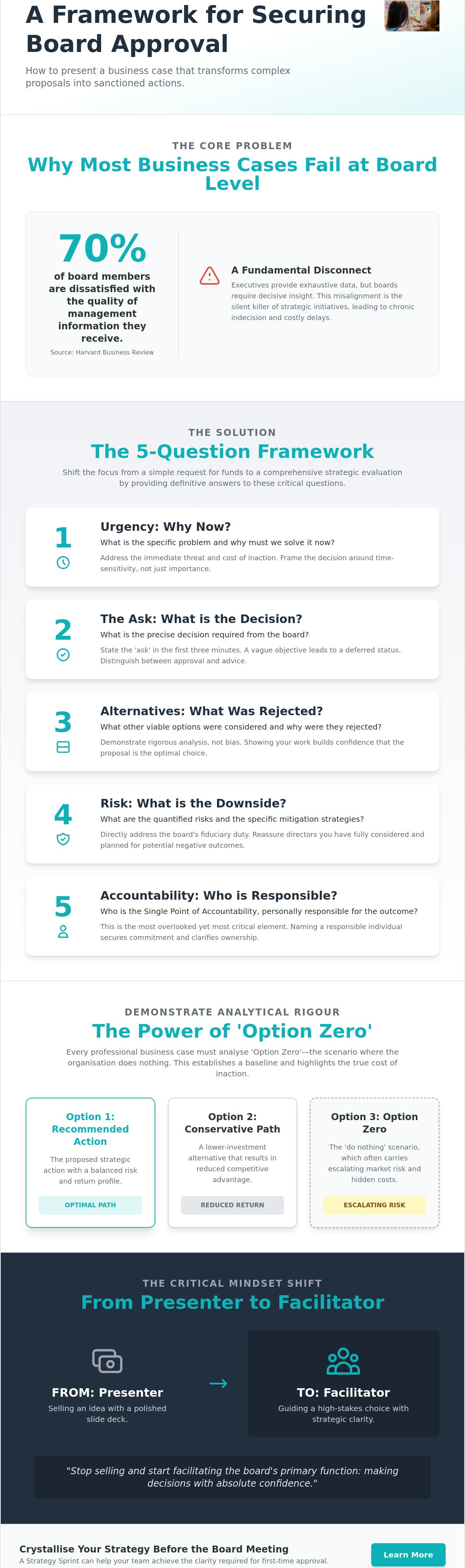
Harvard Business Review research indicates that 70% of board members are dissatisfied with the quality of management information they receive. This dissatisfaction stems from a fundamental disconnect: executives provide data, but boards require insight. A a well-structured business case must bridge this gap by outlining specific outcomes and risks. Without this, the board defaults to caution, leading to the expensive stagnation of critical initiatives.
The Hidden Cost of Executive Indecision
Delayed decisions do more than halt progress; they destroy momentum and demoralise high-performing teams. When the board hesitates, the organisation loses its competitive edge and market windows close permanently. Understanding The Hidden Cost of Indecision is vital for any leader seeking to maintain strategic velocity. Executive drag is an invisible tax on every project.
Misalignment: The Silent Boardroom Killer
Directors frequently offer surface-level agreement whilst harbouring conflicting views on risk tolerance and resource priority. This lack of true consensus ensures that even 'approved' projects struggle during implementation. Misalignment is the primary friction point in capital allocation.
Moving from a data-heavy pitch to a disciplined decision-making session is the only way to break this cycle. You must stop selling and start facilitating the board's primary function: making high-stakes choices with absolute confidence.
The 5-Question Framework for Securing Board Approval
Securing strategic approval requires a disciplined structure that addresses the board's unstated concerns. Whilst many executives rely on a persuasive pitch to win favour, seasoned leaders use objective rigour to drive decisions. Mastering how to present a business case to the board involves providing definitive answers to five critical questions. These questions shift the focus from a simple request for funds to a comprehensive strategic evaluation.
- Urgency: What is the specific problem and why must we solve it now? Importance is secondary to the immediate threat of inaction.
- The Ask: What is the precise decision required? Distinguish between binary approval and strategic advice.
- Alternatives: What options were rejected? Showing your work demonstrates that the proposal is the result of exhaustive analysis rather than bias.
- Risk: What are the quantified risks and mitigation strategies? Directly addressing fiduciary duty reassures directors that you have considered the downside.
- Accountability: Who is personally responsible for the outcome? This is the most overlooked element in corporate proposals.
Defining the 'Ask' with Precision
Confusion in the boardroom usually stems from a vague objective. You must clarify whether you are seeking a 'green light' for capital expenditure or seeking strategic guidance on a complex challenge. When learning how to present a business case to the board, you must recognise that a vague ask leads to a deferred status. Stating the 'ask' in the first three minutes ensures the subsequent discussion remains focussed on the desired outcome.
The Power of the 'Option Zero' Analysis
Professional business cases must include 'Option Zero', the scenario where the organisation does nothing. This highlights the cost of inaction and provides a baseline for comparing alternatives. Use a simple comparison template:
- Option 1: The recommended strategic action (balanced risk and return).
- Option 2: The conservative path (lower investment, reduced competitive advantage).
- Option 3: Option Zero (no investment, escalating market risk).
Managing Boardroom Dynamics and Interpersonal Friction
Expertise in how to present a business case to the board extends beyond the quality of the document. You must shift your mindset from delivering a performance to facilitating a high-stakes decision-making process. Boards are collections of individuals with diverse risk appetites and personal agendas. Friction is inevitable; managing it is a requirement of leadership.
The Facilitator’s Role in the Boardroom
In the boardroom, you are the architect of the discussion. Applying principles from High-Stakes Workshop Facilitation ensures that you remain in control of the room whilst allowing for productive dissent. Focus on active listening to identify the root of a director's concern. If a 'Detractor' emerges, neutralise protective behaviours by returning to objective truth and the overarching strategic vision. You aren't defending a paper; you're guiding a collective choice.
Pre-Alignment: The Work Before the Meeting
Never walk into a board meeting without knowing the individual concerns of key directors. High-performing executives socialise their proposals through 1-to-1 sessions weeks before the formal vote. This pre-alignment allows you to address objections whilst they can still be integrated into the final paper. It's during these sessions that you learn how to write a great business case that pre-emptively answers the hardest questions.
Consider a recent anonymised scenario where a £10m merger proposal faced significant internal resistance. By conducting a pre-alignment offsite, the leadership team identified a specific concern regarding cultural integration that had been overlooked. Addressing this early converted two vocal opponents into advocates, leading to unanimous approval during the formal session. If your board sessions consistently stall due to interpersonal friction, consider a Problem-Solving & Innovation Workshop to reset the dynamic and ensure collective focus remains on strategic objectives.
Driving Execution through Clear Decision Rights and Accountability
Securing board approval is a significant milestone, yet it is merely the beginning of the strategic process. The most common cause of project failure is the vacuum of accountability that follows a successful vote. When learning how to present a business case to the board, you must define exactly who will lead the execution and how progress will be measured. Without this clarity, the board’s commitment will dissipate as soon as the meeting concludes.
Boards require reassurance that the resources they allocate will be managed with disciplined authority. This transition from strategic debate to operational reality necessitates a clear definition of decision rights. Establishing these rights early prevents the board from drifting into tactical interference and ensures management remains focused on delivering the promised ROI.
Implementing the RACI Framework for Boards
The RACI framework (Responsible, Accountable, Consulted, Informed) provides a rigorous structure for post-approval governance. It clarifies the distinction between the board’s fiduciary oversight and the executive team’s operational responsibility. A well-defined RACI matrix prevents the 'accountability gap' where tasks are neglected because ownership was assumed rather than assigned.
| RACI Element | Board of Directors Role | Executive Team Role |
|---|---|---|
| Responsible | None. Tactical execution remains with management. | Project Lead and delivery teams. |
| Accountable | Final governance and fiduciary oversight. | The Single Point of Accountability (SPA). |
| Consulted | Strategic alignment and risk appetite. | Subject matter experts and stakeholders. |
| Informed | Milestone completion and risk updates. | The wider organisation and investors. |
Accountability must never be shared. If two individuals are held accountable for a single outcome, true responsibility evaporates. The board needs a Single Point of Accountability (SPA) to ensure that the project maintains its trajectory and that risks are mitigated before they escalate into failures.
Securing Commitment to the Next Steps
Close your session by presenting a concrete 30-day execution plan. This demonstrates that you are ready to move immediately from sanctioned action to tangible results. The plan should outline the first three critical milestones and name the individuals responsible for their completion. This level of detail confirms to the board that their decision has triggered a well-oiled operational machine.
If your leadership team requires assistance in defining these decision rights, professional Board & Leadership Sessions can provide the external perspective needed to resolve internal friction. Establishing clear ownership at the start is the only way to guarantee strategic success.
Mastering how to present a business case to the board requires a shift from performance to facilitation. Approval is not a personal victory; it is a collective commitment to organisational growth. By applying a disciplined framework that prioritises urgency, objective rigour, and clear accountability, you convert complex proposals into sanctioned strategic actions. True leadership is found in the transition from a compelling argument to a well-executed operation. When you provide the board with clarity and a Single Point of Accountability, you ensure that the organisation’s capital is deployed with precision and that strategic objectives are fulfilled without delay.
Converting Approval into Strategic Action
Mastering how to present a business case to the board is the definitive skill for any leader seeking to convert vision into reality. Success requires a shift from passive reporting to disciplined facilitation. You must answer the board's critical questions on urgency, manage interpersonal friction through pre-alignment, and establish a Single Point of Accountability. These elements ensure that a proposal doesn't just receive a 'green light' but becomes a sanctioned strategic action with clear ownership and defined ROI.
Echelon Facilitation provides the expert facilitation required for these high-stakes executive decisions. Based in London with a global reach, we utilise proven frameworks such as RACI and Cynefin to resolve organisational friction and drive results. Our sessions are designed for senior professionals who value objective truth and demand a high level of commitment from their leadership teams. We expect total accountability and deliver the stability required for strategic focus.
Take the next step in your leadership journey. Secure your next board approval with a professional Board & Leadership Session. Your organisation’s success depends on the clarity of your next move.
Frequently Asked Questions
What is the most common mistake when presenting a business case to the board?
The most common mistake is providing excessive technical data whilst failing to define a clear strategic 'ask'. Directors often receive 50-page appendices but lack the insight required for a binary decision. You must prioritise the 'so what' over the 'how'. Mastering how to present a business case to the board requires you to filter complexity into actionable intelligence that aligns with the organisation's long-term objectives.
How long should a business case presentation to the board be?
A board presentation should typically last between 10 and 15 minutes, followed by 30 to 45 minutes of facilitated discussion. The board pack serves as the detailed reference, so your verbal delivery must focus on the high-stakes trade-offs and risks. If you cannot articulate the value proposition and the required commitment within 15 minutes, the proposal likely lacks the necessary strategic clarity for approval.
How do I handle a board member who is openly hostile to my proposal?
Neutralise hostility by addressing individual concerns through pre-alignment sessions before the formal meeting occurs. If a director remains openly hostile during the session, remain composed and anchor the conversation in objective truth and risk mitigation. Avoid emotional hyperbole and ask the director to define the specific data or outcome they require to reach a state of readiness for a decision.
Should I include a full financial model in my board presentation?
You shouldn't include a full financial model in the main body of a board presentation. Provide a high-level summary of capital requirements, payback periods, and sensitivity analysis instead. Place the comprehensive model in the appendix for the Audit or Finance Committee to review if necessary. This approach keeps the boardroom focus on strategic alignment rather than line-item scrutiny.
How do I present a business case when the ROI is not purely financial?
Present non-financial ROI by linking the proposal to specific strategic pillars such as risk reduction, brand equity, or regulatory compliance. Use qualitative metrics that carry weight, such as employee retention rates or market share protection. When learning how to present a business case to the board for intangible benefits, you must quantify the cost of inaction to demonstrate the proposal's necessity.

Article by
Andrew Greenland
Dr Andrew Greenland is the founder of Echelon Facilitation, a UK practice that designs and runs high-stakes leadership sessions for executive teams who need decisions, not more discussion.
A medical doctor and medical educator, Andrew brings a clinician's discipline to the messy, political work of leadership alignment - surfacing the real disagreement, forcing the real choices, and ensuring every session produces a documented decision log with named owners and deadlines.
He works with CEOs, executive teams, transformation leads, and boards across the UK and internationally. Based in Twickenham.