
Leadership Team Design Sprint: How to Achieve Executive Alignment
Monday morning board meetings often dissolve into circular debates that postpone critical decisions by another fiscal quarter. This recurring pattern of executive indecision ensures that your most vital strategic initiatives remain trapped in a cycle of endless deliberation without a leadership team design sprint to break the deadlock.
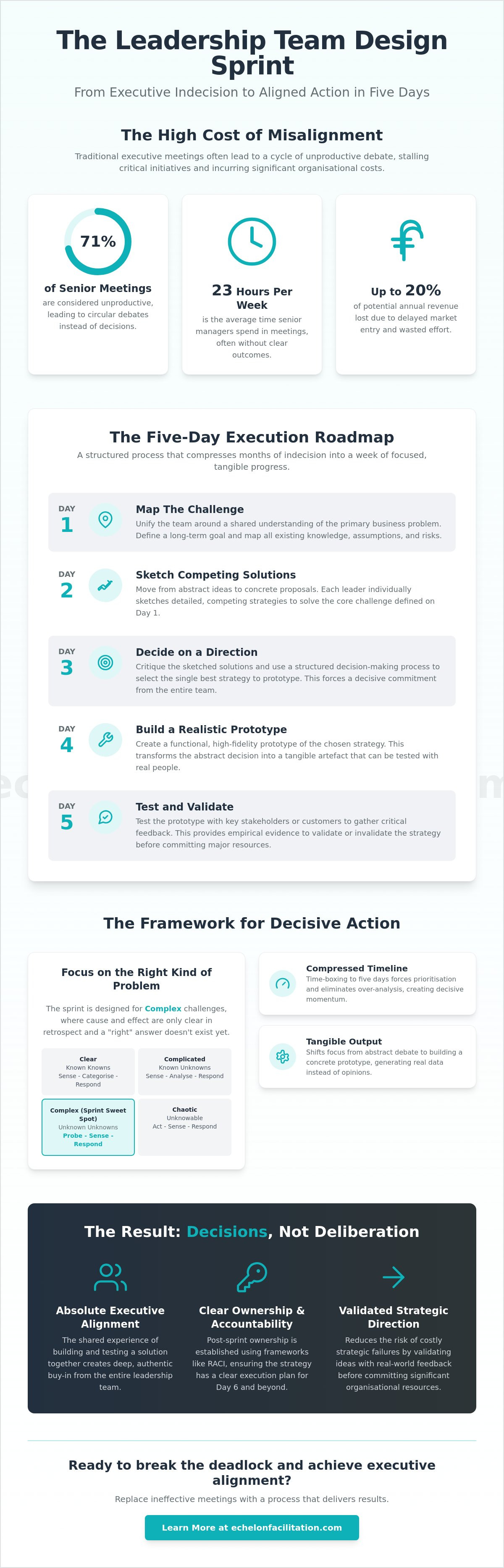
Research published by the Harvard Business Review suggests that senior managers spend an average of 23 hours per week in meetings, yet 71% of these sessions are considered unproductive. When leadership teams fail to reach consensus, the resulting misalignment can cost an organisation up to 20% of its potential annual revenue through delayed market entry and wasted operational effort. This friction creates a vacuum where high-stakes projects stall, ownership becomes blurred, and the primary organisational objectives are obscured by silos.
Traditional meeting structures are often insufficient for resolving complex strategic bottlenecks. Implementing a structured framework compresses months of indecision into five days of intensive, disciplined action. This process secures absolute executive alignment and defines clear ownership for your most vital organisational challenges.
Key Takeaways
- Replace ineffective executive offsites with a structured five-day process to resolve strategic indecision. A leadership team design sprint forces the transition from abstract debate to concrete organisational action.
- Categorise business challenges using the Cynefin framework to identify complex problems where traditional analysis fails. Focus senior energy on issues where cause and effect are only clear in retrospect.
- Execute a rigorous roadmap that maps the primary challenge and develops competing strategic solutions within 48 hours. Ensure the organisation solves the correct problem before committing significant resources to execution.
- Establish post-sprint ownership by applying the RACI framework to assign specific decision rights and accountability. Prevent strategic drift by securing a clear plan for what happens on Day 6 and beyond.
The Strategic Function of a Leadership Team Design Sprint
A leadership team design sprint is a rigorous five-day framework built to resolve complex organisational friction through rapid prototyping and testing. While traditional executive offsites often devolve into circular debates, this structured process forces a shift from theoretical discussion to concrete evidence. Research published in the Harvard Business Review indicates that 67% of senior managers view their meetings as unproductive; the sprint model corrects this by demanding a tangible output by the final day.
The Design Sprint Methodology replaces the standard management consulting cycle, which frequently lasts three months and generates external reports that lack internal buy-in. By contrast, a leadership team design sprint places the burden of creation on the C-suite. This creates immediate ownership of the solution. Instead of debating a strategy for the next quarter, the team builds a functional prototype of that strategy to validate it with stakeholders within 40 hours. This speed is essential, as a study by the Economist Intelligence Unit found that 90% of strategic initiatives fail due to poor execution and slow decision-making.
Why Executive Alignment Demands a Compressed Timeline
High-stakes decisions often suffer from over-analysis, leading to paralysis. Time-boxing the decision-making process to five days creates a psychological environment where leaders must prioritise the most critical variables. This intensity eliminates the "meeting after the meeting" culture, where dissenters wait until a session ends to undermine progress. Decisiveness becomes the only path forward when the clock is visible and the output is non-negotiable. For teams seeking to accelerate this process, a structured strategy sprint provides the necessary guardrails to maintain momentum.
Identifying the Right Challenges for a Sprint
A full leadership team design sprint requires a significant commitment of high-value time. It is not a tool for resolving minor operational friction or routine administrative tasks. Leaders should reserve this format for existential strategic threats or high-risk opportunities where the cost of a wrong decision is prohibitive. If the problem is how to fix expense reporting, a sprint is unnecessary. If the problem is how to pivot a core business model to survive a 20% market share loss, the sprint is the correct tool. Effective selection ensures that executive energy is focused on challenges that define the future of the organisation.
Navigating Strategic Complexity Using the Cynefin Framework
Executives often fail because they apply linear solutions to non-linear problems. The Cynefin Framework for Leaders provides a necessary lens for categorising these challenges into four domains: Clear, Complicated, Complex, and Chaotic. While "Complicated" problems require expert analysis, "Complex" problems exist where cause and effect are only identifiable in retrospect. A leadership team design sprint is the most effective tool for this complex domain because it replaces theoretical debate with empirical evidence.
Misalignment occurs when leaders treat complex organisational shifts as merely complicated tasks. They search for a "right" answer that does not exist yet, leading to analysis paralysis. The sprint adopts the "Probe-Sense-Respond" mechanic of the Cynefin model. By creating a prototype, the team probes the environment; by testing it, they sense the reaction; and by reviewing the results, they respond with a refined strategy. This iterative loop ensures the team moves forward based on reality rather than conjecture.
Moving from Chaos to Clarity
The sprint serves as a stabilising force during periods of market disruption. When an organisation enters the "Chaotic" domain, the facilitator maintains objective truth, preventing the team from retreating into silos. This structured environment allows leaders to organise their response with speed and precision, moving the challenge back into the manageable complex or complicated quadrants.
Challenging Executive Assumptions
Alignment requires the externalisation of mental models to identify hidden biases within the leadership cohort. This process prevents individual egos from dominating the strategic direction. The leadership team design sprint forces leaders to confront objective data over comfortable narratives.
The Five-Day Execution Roadmap for Senior Leaders
A leadership team design sprint follows a rigorous structure to force decisions that usually take months to resolve. Day 1 focuses on mapping the challenge to ensure the group is not solving the wrong problem. By the end of the first afternoon, the team selects a specific target. Day 2 moves from abstract discussions to concrete visuals as leaders sketch competing solutions. This shift reveals hidden disagreements that verbal debates often mask.
On Day 3, the team selects the final path. This stage requires a designated Decider to make a firm choice; this eliminates the democratic compromise that typically dilutes corporate strategy. Day 4 involves building a high-fidelity prototype. This is not a product mock-up but a tangible representation of a new operating model or market proposition. This process ensures Strategic Execution and Alignment are baked into the plan before the organisation commits significant capital to implementation.
Validating Strategy with Real-World Feedback
Day 5 provides the objective evidence required to move forward. The team tests the prototype with actual stakeholders or customers to gain unbiased feedback. This step identifies critical flaws that internal bias might overlook. Industry data from 2023 suggests that 70% of strategic initiatives fail due to poor execution or lack of market fit. This final day serves as a firewall against such expensive errors by validating the direction before full-scale execution begins.
Adapting the Sprint to Executive Calendars
C-suite schedules rarely allow for five consecutive days of isolation. We can organise a "compressed" leadership team design sprint schedule: two days of intensive mapping and sketching, followed by three days of asynchronous prototyping and a final feedback session. This structure respects existing obligations whilst protecting the integrity of the process. Spending 40 hours upfront saves the organisation hundreds of hours later by preventing the need for mid-course corrections or repetitive alignment meetings.
Review our strategy sprint framework to see how we condense these timelines for your board.
Securing Long-Term Ownership and Decision Rights
A leadership team design sprint provides the strategic blueprint, but Day 6 determines the survival of the initiative. Without a transition from ideation to ownership, the sprint becomes an expensive exercise in creative thinking rather than a driver of organisational change. High-performing teams avoid this by implementing the RACI framework immediately. By assigning specific individuals as Responsible, Accountable, Consulted, and Informed, the team eliminates the ambiguity that often leads to inertia once the facilitator leaves the room.
Execution relies on Decentralised Command. Leaders must trust their subordinates to make decisions within the framework established during the sprint. This approach ensures the strategy moves through the organisation without becoming bottlenecked at the executive level. Consider a hypothetical London-based FinTech firm facing a six-month deadlock between the CEO and the Board over a £12 million international expansion. By defining decision rights during a leadership team design sprint, they could clarify that the Board holds the 'Approve' right whilst the CEO holds the 'Execute' right, shortening project approval times.
Integrating the Sprint into the Strategy Sprints Framework
Sustainable progress requires a repeatable cadence. The Echelon Strategy Sprints framework provides the necessary structure for ongoing execution. This system ensures that the initial alignment doesn't decay over time. Teams should schedule quarterly follow-up sessions to review progress and adjust parameters based on real-world feedback. Integrating the leadership team design sprint outcomes into this broader framework prevents the strategy from becoming a static document stored on a shared drive.
Measuring the ROI of Leadership Alignment
Quantifiable results validate the investment. According to research by Harvard Business Review, organisations with aligned leadership teams are significantly more likely to achieve their strategic objectives. Success should be measured through specific metrics:
- Reduction in project lead times by at least 15% within six months.
- Increased employee engagement scores as a result of clearer top-down communication.
- Fewer redundant meetings as a direct result of clarified decision rights.
Secure Strategic Alignment and Accelerate Execution
Executive misalignment is a persistent friction point that most organisations tolerate for far too long. A leadership team design sprint replaces circular debates with a structured, evidence-based process that forces decisive action. By applying the Cynefin framework to separate operational tasks from complex strategic shifts, your team can move past political posturing and focus on objective evidence.
True alignment requires more than a simple consensus; it demands clear ownership and documented decision rights. This five-day roadmap ensures every leader leaves the room with a shared understanding of the path forward and their specific responsibilities in navigating it. When your executive team operates from a position of objective truth rather than personal narrative, the organisation gains the stability required to scale. Your team possesses the expertise to solve these challenges; they simply require the right framework to unlock it.
Book a complimentary diagnostic call to see if a design sprint is right for your team
Frequently Asked Questions
Is a leadership team design sprint different from a standard product design sprint?
Yes. A leadership team design sprint shifts the focus from product features to organisational strategy and decision-making frameworks. While a standard sprint produces a digital prototype, this version generates a strategic roadmap or a new operating model. Standard sprints often struggle at the leadership level because they ignore the complexities of internal politics and resource allocation.
How do we ensure the leadership team stays focused for the entire five days?
Maintaining focus requires a total ban on mobile devices and laptops during active sessions. Research by the University of London shows that multitasking during complex tasks drops effective IQ by 10 points. We use a 2+2+1 structure if a consecutive five-day block is impossible. This structure ensures the leadership team design sprint maintains high intensity whilst allowing executives to manage urgent operational requirements during scheduled breaks.
What happens if the leadership team cannot agree on a solution during the sprint?
The process utilises a designated Decider to bypass stalled negotiations and prevent strategic drift. This individual, typically the CEO or Managing Director, holds the final vote on all contested paths. Consensus-seeking is a common cause of organisational friction. We replace consensus with a "disagree and commit" protocol to ensure the team exits the room with a singular, clear direction.
Can a design sprint be conducted virtually for remote leadership teams?
Virtual delivery is effective when limited to four-hour synchronous blocks to prevent cognitive fatigue. Remote sprints require 20% more preparation time to configure digital whiteboards and ensure technical stability. We use tools like Miro or Mural to mirror the physical boardroom experience. This adaptation allows global teams to achieve alignment without the 48-hour travel requirement often associated with international strategy offsites.
Who should facilitate the leadership team design sprint to ensure objectivity?
An external facilitator must lead the session to neutralise internal power dynamics and historical biases. Internal moderators often struggle to challenge senior executives or manage dominant personalities effectively. Statistics from the International Association of Facilitators suggest that external neutral parties increase group productivity by 25%. A third-party expert keeps the group focused on the objective evidence rather than protecting individual departments or personal legacies.