
An executive team spends three days debating a strategy shift only to leave with a vague list of aspirations and no concrete owners. Measuring the roi of hiring a facilitator becomes a priority when you realise the cost of this inertia isn't the catering bill, but the six months of market share lost whilst competitors execute with clarity.
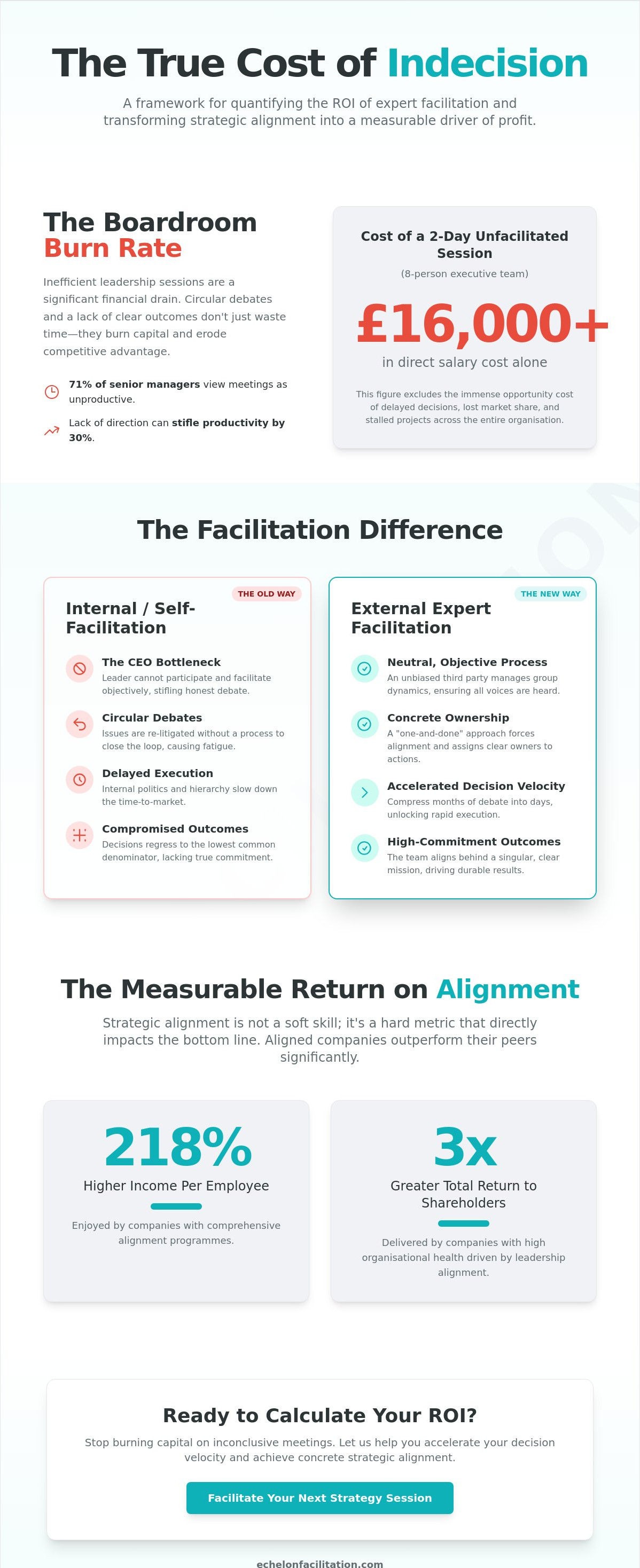
Inefficient leadership sessions represent a significant drain on corporate resources. Research suggests that companies with comprehensive alignment programmes see a 218% higher income per employee. When teams fail to reach decisive conclusions, the organisation suffers from a lack of direction that can stifle productivity by 30%. External facilitation rates for elite strategy sessions can reach £12,000 per day, but this investment is offset by the financial gains of accelerated execution and the elimination of organisational friction.
Senior leaders recognise that internal debates often circularise without an external arbiter to enforce discipline. This article provides a framework to quantify decision velocity and opportunity cost for your Board. You will learn how to transform alignment from a nebulous concept into a measurable driver of profit margin.
Key Takeaways
- Calculate the hourly burn rate of your leadership team to understand the financial drain of unguided sessions and circular debates.
- Accelerate execution by prioritising decision velocity and removing the bottleneck created when a CEO attempts to lead their own strategy sessions.
- Establish a robust framework for measuring the roi of hiring a facilitator based on compressed timelines and concrete strategic alignment.
- Mitigate the hidden costs of strategic drifting and talent attrition by ensuring leadership teams reach actionable conclusions without delay.
- Shift from subjective satisfaction metrics to objective KPIs such as action-item completion rates to track the long-term impact on operational efficiency.
Quantifying the Direct Cost of Executive Misalignment
Leadership teams often ignore the financial reality of their own presence in a room. Measuring the roi of hiring a facilitator requires a cold assessment of the hourly burn rate of your most expensive assets. Executive Friction is the measurable delay in mission execution caused by a lack of clarity. A recent case involved a UK technology board that spent 12 hours of collective time over three weeks whilst failing to resolve a single decision right. The direct salary cost was significant, but the resulting organisational paralysis cost the business a full quarter in product development lead time.
The Burn Rate of the Boardroom
Calculate the cost of an eight-person executive team spending two days in a room. With an average total compensation of £200,000 per leader, the raw salary cost alone exceeds £16,000. Harvard Business Review research indicates that 71% of senior managers view meetings as unproductive and inefficient. Professional business facilitation ensures this capital isn't wasted on administrative updates or aimless discussion. When companies focus on measuring the roi of hiring a facilitator, they must account for the recovery of these otherwise sunken costs.
The Price of Circular Debate
Circular debate occurs when teams re-litigate the same issues because they lack a process to close the loop. This creates psychological exhaustion and erodes trust in the leadership's ability to act. Decisions that are "settled" but never executed represent a failure of alignment. A structured Strategy Sprint replaces this fatigue with a "one-and-done" approach. This methodology forces alignment and establishes concrete ownership, preventing the financial bleed associated with repeated, inconclusive meetings.
Measuring ROI Through Decision Velocity and Execution Speed
Decision Velocity is the elapsed time between identifying a strategic challenge and committing to a definitive course of action. In high-stakes environments, speed is a competitive asset. When measuring the roi of hiring a facilitator, you must quantify the financial gain of compressing a six-month debate into a two-day alignment session. Every day an executive team spends in indecision creates a ripple effect that stalls operational progress for weeks.
| Metric | Internal Facilitation | External Expert Facilitation |
|---|---|---|
| Execution Speed | Delayed by internal politics and hierarchy. | Accelerated by disciplined process. |
| Objectivity | Clouded by existing bias and history. | Maintained by a neutral third party. |
| Outcome Quality | Often results in "lowest common denominator" compromise. | Drives commitment to a clear, singular mission. |
The CEO Bottleneck: Why Self-Facilitation Fails
A CEO who attempts to facilitate their own strategy session creates an immediate bottleneck. It's impossible to participate as a peer whilst simultaneously managing the group dynamics objectively. This dual role often stifles honest dissent and prevents the team from taking ownership of the final output. By stepping out of the process role, the leader allows the team to engage in the friction necessary for true alignment. This shift is a core component of how we work to ensure that decisions remain durable long after the session ends.
Accelerating the Time-to-Market
Clear decisions lead directly to faster product launches and more efficient strategic pivots. McKinsey research confirms that companies with high organisational health, driven by leadership alignment, deliver three times the total return to shareholders compared to those in the bottom quartile. Professional facilitators focus on measuring the value of meetings by tracking the speed of follow-through. When measuring the roi of hiring a facilitator, the most significant returns often appear in the operational efficiency gained from a team that moves in a single, unified direction without the need for constant re-clarification.
The Opportunity Cost of Delayed Strategic Clarity
Strategic drifting occurs when an organisation loses its competitive edge through incremental indecision. This drift erodes shareholder value more effectively than any competitor's product launch. Whilst direct savings are visible, measuring the roi of hiring a facilitator requires an analysis of the path not taken. The highest ROI of facilitation is often the avoidance of a catastrophic strategic error. When a board fails to align, the resulting ambiguity trickles down, causing projects to stall and resources to be misallocated across the entire organisation.
In industries such as property development or infrastructure, where strategic drift can lead to non-compliance with environmental regulations, you can discover Ekocentric to find out how specialist consulting in green building certifications protects asset value.
Talent Retention and Organisational Stability
Ambiguity is the primary driver of cultural rot. High-performing executives demand clarity to execute their roles effectively. When leadership teams exhibit persistent misalignment, these individuals often lose confidence and seek opportunities elsewhere. Replacing a senior leader costs significantly more than their annual salary when accounting for recruitment fees and lost momentum. Developing High Performing Executive Teams requires a commitment to resolving friction before it triggers a talent exodus. If you are struggling with leadership turnover, a Decision-Rights Reset can restore the stability necessary to retain your best people.
Risk Mitigation and the Cynefin Framework
Teams often fail because they apply simple solutions to complex problems. A professional facilitator uses frameworks like Cynefin to help leaders categorise challenges correctly. Complicated problems require expertise, whilst complex problems require experimentation and emergent practice. Forcing a rigid, simple solution onto a complex market shift can result in millions of pounds in failed implementation costs. Measuring the roi of hiring a facilitator involves quantifying the risk avoided by ensuring the strategy matches the reality of the environment. To ensure this clarity persists, we implement the RACI framework:
- Responsible: The individual performing the task.
- Accountable: The person with the ultimate decision authority.
- Consulted: Those providing essential input.
- Informed: Stakeholders updated on progress.
This structure prevents a return to the status quo once the facilitator departs. By establishing clear ownership, the organisation avoids the recurring costs of re-litigating previous decisions.
Establishing a Sustainable Return on Ownership
Measuring the roi of hiring a facilitator should never rely on post-session satisfaction surveys. Whilst it's pleasant if executives enjoyed the catering or the venue, subjective 'feelings' do not drive shareholder value. A high satisfaction score often masks a lack of real friction, suggesting the team avoided the difficult conversations necessary for true alignment. Instead, prioritising the Action-Item Completion Rate and Decision Adherence provides a cold, objective view of the session's impact. These KPIs track whether the leadership team actually executes the commitments made during the workshop.
Moving from Consensus to Commitment
Consensus is often a passive agreement that leads to hesitation in the field. Commitment is an active choice to own the result. Our approach ensures every session concludes with clear ownership and decentralised command. This allows teams to execute the strategy without constant oversight, which is the ultimate goal of any alignment exercise. You can learn more about our methodology in How We Work. When measuring the roi of hiring a facilitator, the shift from "agreeing in the room" to "owning the result" in the field is the most reliable indicator of success.
The 90-Day Audit of Strategic Value
A COO should track specific metrics three months after a Strategy Sprint to identify the Cost of Reversion. This is the financial loss incurred when a team slides back into old behaviours and circular debates. Use this Post-Offsite ROI Tracker to maintain momentum:
- 30 Days: 100% of action item owners confirmed and first-tier milestones met.
- 60 Days: Decision adherence rate above 90% with zero re-litigation of offsite conclusions.
- 90 Days: Measurable increase in decision velocity and tangible progress on primary objectives.
Measuring the roi of hiring a facilitator becomes clear when you compare the cost of the intervention against the value of the milestones achieved within the first quarter. If the team remains aligned and execution speed increases, the return on the investment is effectively infinite compared to the cost of continued strategic drift.
Accelerating Execution Through Strategic Alignment
Leadership alignment is a financial imperative rather than a cultural luxury. Measuring the roi of hiring a facilitator requires a cold assessment of executive time recovery and the compression of critical decision cycles. By moving from passive consensus to extreme ownership, organisations eliminate the friction that stalls operational progress. Echelon Facilitation, led by Richard Kasriel, specialises in these high-stakes sessions where clarity and execution speed are the only metrics that matter.
Our methodology replaces circular debate with a disciplined process that ensures every leader leaves with clear accountability. The true value of professional facilitation is found in the months of regained momentum and the avoidance of strategic drift. A unified executive team executes with a level of precision that fragmented leadership simply cannot match. It is time to treat your strategy sessions as the high-yield investments they are intended to be.
Book a complimentary diagnostic call with Echelon to assess your team’s alignment and determine the financial impact of your current decision-making process. Your mission requires a team that moves as a single, decisive unit.
Frequently Asked Questions
How much does a professional facilitator typically cost in the UK?
Professional facilitators in the UK typically charge between £3,000 and £9,000 per day for executive-level engagements. This fee covers the session itself along with preparation and follow-up reporting. Fees vary by scope. High-end enterprise sessions for board-level alignment often reach the upper end of this range. Whilst lower-end workshops might start at £1,500, they often lack the strategic depth required for complex organisational pivots.
Can we measure the ROI of facilitation if the outcomes are qualitative?
Senior teams measure qualitative outcomes by converting them into operational KPIs. Track the Action-Item Completion Rate or the reduction in time spent re-litigating previous decisions. Measuring the roi of hiring a facilitator involves looking at the delta between the pre-session state and the post-session execution speed. If a team moves from months of indecision to a 90-day execution cycle, the financial return is quantifiable. Results speak for themselves.
Is an external facilitator more cost-effective than an internal HR lead?
External facilitators provide greater cost-effectiveness by eliminating the CEO bottleneck. They bypass internal office politics. An internal HR lead often remains part of the hierarchy, which stifles honest dissent from senior leaders. A neutral third party enforces a disciplined process that an internal employee cannot replicate without risking their own standing. Neutrality is essential for reaching durable conclusions that the entire team owns.
What is the most common reason leadership offsites fail to deliver ROI?
Offsites fail to deliver value when they lack a mechanism for ownership and follow-through. Most sessions focus on discussion without assigning specific, time-bound accountability. When a team returns to the office without a RACI framework, they slide back into old behaviours. This reversion negates the initial investment. It leads to strategic drift across the organisation. Clarity requires commitment.
How do you calculate the "cost of delay" for a strategic decision?
Calculate the cost of delay by aggregating the total compensation of the leadership team and the potential revenue lost during the period of indecision. If a product launch stalls for one month due to lack of alignment, the cost equals the monthly revenue target plus the executive burn rate. Measuring the roi of hiring a facilitator reveals that the cost of the intervention represents a small fraction of the cost of one week of strategic delay. Speed is a financial asset.

Article by
Andrew Greenland
Dr Andrew Greenland is the founder of Echelon Facilitation, a UK practice that designs and runs high-stakes leadership sessions for executive teams who need decisions, not more discussion. A medical doctor and medical educator, Andrew brings a clinician's discipline to the messy, political work of leadership alignment - surfacing the real disagreement, forcing the real choices, and ensuring every session produces a documented decision log with named owners and deadlines. He works with CEOs, executive teams, transformation leads, and boards across the UK and internationally. Based in Twickenham.