
Your board chair spends forty minutes debating the annual report font whilst the strategic plan remains untouched. You know that poorly managed offsites often yield nothing more than exhausted leaders and ignored flipchart notes. Engaging a professional non-profit board retreat facilitator ensures these sessions move beyond performative discussion and into the territory of rigorous strategic decision-making.
Ineffective governance carries a heavy price for the third sector. Research from the University of North Carolina indicates that a professional facilitator requires one day of preparation for every day of on-site delivery. Organisations that bypass this preparation to reduce costs often face strategic drift. This failure to address role confusion between executive teams and directors results in wasted resources and stalled impact. You cannot afford to spend your limited annual budget on circular arguments that fail to produce actionable outcomes.
Disciplined guidance ensures the board moves beyond comfortable narratives and into the territory of objective truth. High-performing organisations use these sessions to optimise governance, define decision rights, and restore total accountability to the leadership team.
Key Takeaways
- Neutralise unhelpful group dynamics, including founder syndrome, to ensure every board member contributes to high-level strategy.
- Engage a professional non-profit board retreat facilitator to transform circular debates into rigorous strategic decisions and clear organisational accountability.
- Implement the RACI framework to assign definitive ownership and eliminate role confusion between the board and the executive team.
- Confront the cost of indecision and eliminate strategic drift through structured sessions that force hard choices about resource allocation.
- Prioritise governance expertise over interpersonal warmth when selecting external facilitators to ensure the retreat delivers a clear strategic roadmap.
Defining the Role of a Non-Profit Board Retreat Facilitator
A non-profit board retreat facilitator acts as a strategic advisor who ensures governance objectives are met through disciplined process management. Unlike a chairperson who holds a vested interest in specific outcomes, the facilitator manages the process to ensure the board fulfils its core obligations. This external presence provides a neutral perspective, allowing the Chair and CEO to step away from the burden of room management and contribute as equal participants.
Professional facilitators identify and neutralise unhelpful group dynamics that often paralyse non-profit leadership. These include "founder syndrome," where legacy influence stifles innovation, or dominant personalities who derail agendas with minor operational concerns. By structuring an environment for objective truth rather than comfortable narratives, the non-profit board retreat facilitator forces the board to confront the practical reality of their organisational performance.
Neutrality as a Strategic Lever
Internal facilitation frequently leads to biased outcomes or the suppression of dissent. When a board member leads the session, others often hesitate to challenge long-held assumptions for fear of damaging interpersonal relationships. Neutrality acts as a strategic lever, enabling a third party to ask difficult questions about the duties of boards of directors and their alignment with the mission. This objective distance is essential for uncovering the friction points that impede progress.
Beyond Meeting Management
Effective facilitation differs fundamentally from meeting chairing. Whilst a chair manages an agenda, a facilitator manages an outcome-oriented structure designed to achieve high-stakes alignment. This process requires a deep understanding of how we work to bridge the gap between high-level strategy and operational reality. The focus remains on the organisation’s core purpose, ensuring that every debate moves the board closer to a definitive strategic roadmap rather than a list of vague intentions.
Eliminating Strategic Drift Through Rigorous Governance
Strategic drift occurs when a board fails to make hard choices about resource allocation and priority. Instead of decisive action, boards often default to incrementalism or endless data collection. A professional non-profit board retreat facilitator breaks this cycle by forcing the board to confront the cost of indecision in a structured environment. This is not about building camaraderie; it's about ensuring the organisation remains viable and focused on its core purpose.
Consider a hypothetical national charity facing a critical merger decision. If the board avoids the final vote for eighteen months, citing a need for more stakeholder consultation, the organisation could lose 15% of its reserve fund through operational inefficiencies and duplicated overheads during that period of inertia. A facilitated Strategy Sprint would identify the decision rights early, preventing such a significant erosion of charitable assets.
The High Cost of Board Inertia
Delayed strategic decisions create a vacuum that executive teams cannot fill without overstepping their authority. This paralysis often stems from a misunderstanding of The Board's Role in Non-Profit Governance, which requires active oversight rather than passive observation. Research by McKinsey suggests that top-tier boards spend 20% more time on strategy than their lower-performing peers. This time is not spent on minor operational updates but on the rigorous evaluation of long-term objectives and the risks of inaction.
Frameworks for Strategic Clarity
To eliminate friction, boards must adopt clear Decision Rights frameworks. This process clarifies who makes the final call on specific issues, such as capital expenditure or executive appointments. Without this clarity, the board and executive team often enter a state of role confusion that stalls execution. For a deeper analysis of these dynamics, refer to this guide on leadership team decision making. Engaging a non-profit board retreat facilitator ensures that every debate ends with a documented decision or a clear, time-bound path to one.
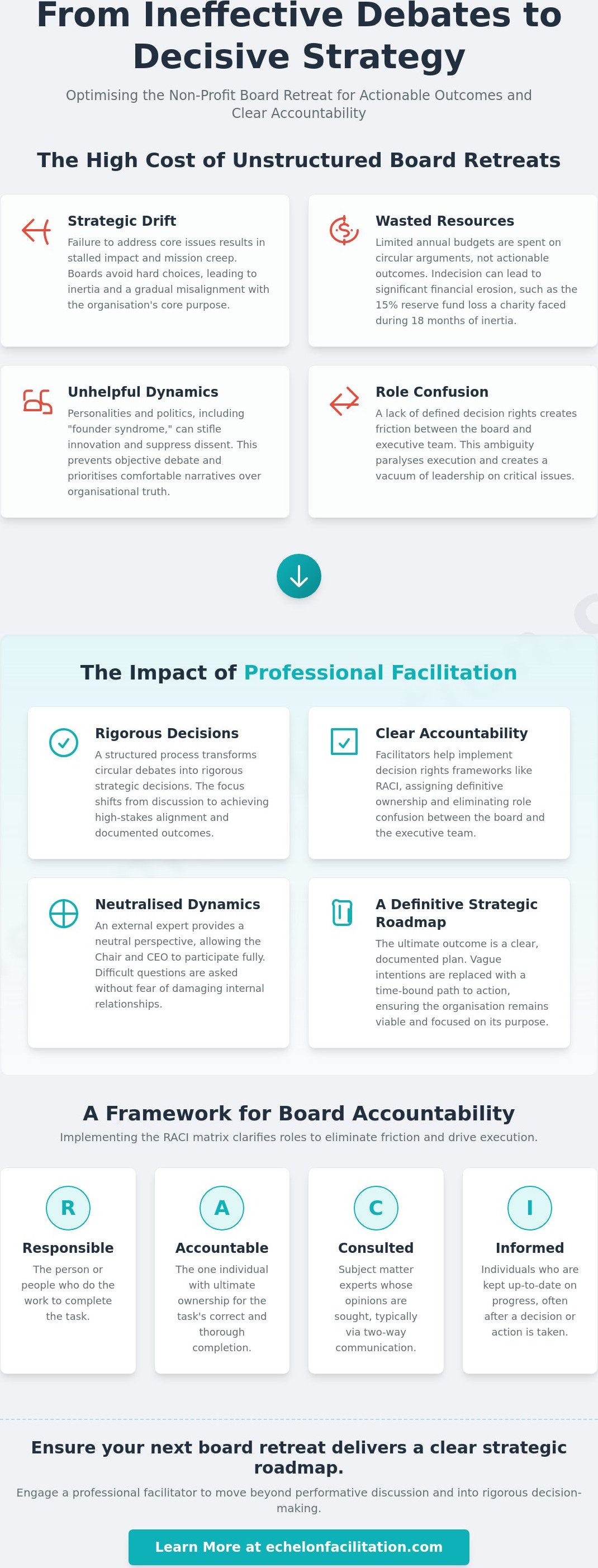
Implementing the RACI Framework for Board Accountability
Boards often confuse consensus with commitment. A list of "good ideas" generated during a retreat without assigned ownership is merely a wish list. To ensure strategic execution, a non-profit board retreat facilitator introduces the RACI framework. This system eliminates the ambiguity that typically follows high-stakes meetings by defining exactly who owns each outcome. Without this structure, the energy generated during the session dissipates the moment the directors return to their daily responsibilities.
The RACI framework consists of four distinct roles:
- Responsible: The individual or team performing the work.
- Accountable: The single person who owns the result and has the final "yes" or "no" authority.
- Consulted: Those whose expertise is required before a decision is finalised.
- Informed: Stakeholders who must be notified of the outcome after the decision is made.
A critical rule in board governance is that the "Accountable" role must be assigned to only one individual. When accountability is shared amongst a committee, it is effectively non-existent. This individual ensures the objective moves forward, providing a single point of contact for the board and executive team.
Mapping Decision Ownership
Mapping decision ownership requires the board to move beyond generalisations. For example, if the retreat objective is to "increase donor retention by 10%," the RACI matrix must identify the specific executive responsible for the programme and the board member accountable for oversight. This process forces the board to distinguish between being "Responsible" (doing the work) and "Accountable" (owning the strategic result). This clarity prevents the board from micro-managing operational tasks whilst ensuring they maintain their fiduciary duties.
Transitioning from Offsite to Action
Maintaining momentum requires a "30-Day Execution Plan" that begins the morning after the retreat. This plan outlines the immediate steps necessary to validate the decisions made during the session. It serves as a bridge between the high-level strategy discussed and the operational reality of the organisation. Our approach to follow-through is detailed in how we work, ensuring that the retreat leads to measurable organisational change rather than stagnant documents. To secure this level of clarity for your next session, contact us to discuss a Decision-Rights Reset.
Securing External Expertise for High-Stakes Alignment
Selecting a non-profit board retreat facilitator requires a focus on governance expertise rather than interpersonal warmth. Whilst "energy" is often cited as a requirement, it is a poor substitute for the ability to manage complex organisational dynamics. A professional facilitator acts as a partner in maintaining stability; they ensure the session remains focused on objective truth rather than comfortable but unproductive narratives. This individual must possess the strategic weight to challenge the CEO and Chair whilst maintaining a calm, professional demeanour.
Before engagement, request a diagnostic call to verify the facilitator's understanding of the UK non-profit sector. Governance constraints in the UK require a specific familiarity with regulatory expectations and the practical realities of charitable funding. Follow these four steps to ensure a successful selection:
- Step 1: Define the primary objective for the retreat, such as a strategy pivot or a decision-rights reset.
- Step 2: Audit existing board dynamics to identify specific friction points or dominant personalities.
- Step 3: Select a facilitator with the professional authority to enforce disciplined process management.
- Step 4: Co-create a structured agenda that prioritises definitive decision-making over open-ended discussion.
The False Economy of Internal Facilitation
Some organisations attempt to reduce expenditure by using a board member to facilitate their own session. This is a false economy. An internal facilitator cannot remain neutral whilst simultaneously fulfilling their fiduciary duties as a participant. This approach inevitably leads to groupthink or the suppression of critical dissenting views. Without a neutral arbiter, the same group dynamics that cause strategic drift will persist, leaving the organisation trapped in the circular debates that necessitated the retreat in the first place.
Booking a Results-Driven Session
High-performing boards recognise that a retreat is a strategic investment in the organisation’s future, not a social expense. The cost of professional facilitation is negligible compared to the financial and operational impact of board inertia. To ensure your next session delivers clear decision rights and a definitive roadmap, Contact Echelon Facilitation to discuss your board governance requirements.
Transforming Board Debate into Strategic Action
Effective governance relies on the transition from open debate to definitive strategic execution. High-performing boards recognise that neutrality and the application of rigorous frameworks, such as RACI, are essential for eliminating strategic drift. By assigning single-point accountability, organisations ensure that retreat outcomes translate into measurable operational impact rather than stagnant documents. Action replaces observation. This shift in focus ensures that the collective expertise of the board is directed toward the organisation's most critical objectives.
Selecting a professional non-profit board retreat facilitator allows the Chair and CEO to contribute fully whilst a neutral arbiter manages complex group dynamics. Echelon Facilitation, led by founder Dr Andrew Greenland, a medical doctor who has spent years running large, high-stakes working sessions for senior expert groups, specialises in high-stakes strategic execution for organisations that cannot afford the cost of board inertia. This disciplined approach provides the stability necessary to lead through complex sector challenges with confidence.
Book a diagnostic call to align your board and secure the strategic roadmap your mission requires. Your organisation deserves the clarity that professional facilitation provides.
Frequently Asked Questions
Why should a non-profit hire an external board retreat facilitator rather than using the Chair?
An external facilitator provides the neutrality required for the Chair and CEO to participate as equal contributors rather than room managers. This separation of powers ensures that the individual leading the discussion has no vested interest in specific strategic outcomes. It allows for the rigorous challenging of organisational assumptions that an internal leader might avoid to maintain social harmony amongst the group.
How much does a professional non-profit board retreat facilitator typically cost?
Investment in a non-profit board retreat facilitator varies based on the scope of pre-retreat diagnostic work and the duration of the session. Professional fees typically encompass stakeholder interviews, custom agenda design, and post-retreat deliverables such as a decision-rights matrix. High-performing boards view this as a strategic investment because the cost of a failed offsite often exceeds the professional fee through wasted leadership time and continued strategic drift.
What is the ideal duration for a high-stakes board strategy retreat?
High-stakes strategy retreats typically require one to two full days of focused engagement to move from diagnostic review to definitive decision-making. Shorter sessions often fail to move past surface-level updates, whilst longer offsites risk diminishing returns through mental fatigue. A structured two-day session provides the necessary time for deep work required to resolve complex governance friction and align the leadership team on a clear strategic roadmap.
How do you handle a "difficult" board member during a facilitated session?
Facilitators manage dominant or derailment-prone personalities by establishing clear ground rules and redirecting the conversation toward objective organisational data. By focusing on the mission rather than individual opinions, the facilitator neutralises personal agendas and ensures the collective board remains productive. This process management prevents a single individual from hijacking the agenda, ensuring every director's expertise is utilised for the organisation's benefit.
What specific outcomes should we expect from a facilitated board retreat?
A successful retreat produces a documented strategic roadmap and a clear framework for decision rights. Boards should expect a completed RACI matrix that assigns definitive ownership to every key objective discussed during the session. This ensures the organisation leaves the retreat with a re-energised commitment to the mission and a practical plan for execution that eliminates role confusion between the board and executive team.