
Leaders announce a strategy with fanfare, yet senior colleagues offer only passive nods whilst privately protecting their own departmental interests. This internal friction signals that overcoming resistance to strategic change requires more than a simple memo or a town hall meeting.
The price of executive friction is quantifiable and severe. Research indicates that approximately 70 per cent of all change programmes fail to achieve their intended goals, whilst only 34 per cent of initiatives are clearly successful. When senior leaders remain misaligned, the organisation enters a state of decision-making paralysis that drains capital and morale. These stalled initiatives waste resources and invite silent sabotage from colleagues who lack clarity. Failure to address this friction ensures that even the most robust strategy remains theoretical.
Establishing clear decision rights and demanding personal accountability transforms organisational stagnation into a state of disciplined momentum. Identifying the root causes of executive friction allows for the implementation of a structured framework that secures strategic execution.
Key Takeaways
- Quantify the financial impact of executive friction and understand why 67 per cent of strategic initiatives fail due to poor leadership alignment.
- Recognise the psychological anchors and sunk cost fallacies that prevent experienced leaders from abandoning outdated operational models.
- Implement structural solutions for overcoming resistance to strategic change by prioritising clear decision rights over subjective communication improvements.
- Use the RACI framework to define accountability and eliminate the ambiguity that leads to decision-making paralysis.
- Discover how an Executive Alignment Sprint converts leadership friction into disciplined strategic velocity and measurable results.
The Hidden Cost of Executive Misalignment
Imagine a board approving a £100 million initiative to pivot towards sustainable energy, only for the project to stall because the Finance Director quietly refuses to release the necessary funds. This specific brand of executive friction ensures that even the most innovative plans never leave the boardroom. It is a scenario where the lack of visible conflict masks a deep-seated refusal to adapt.
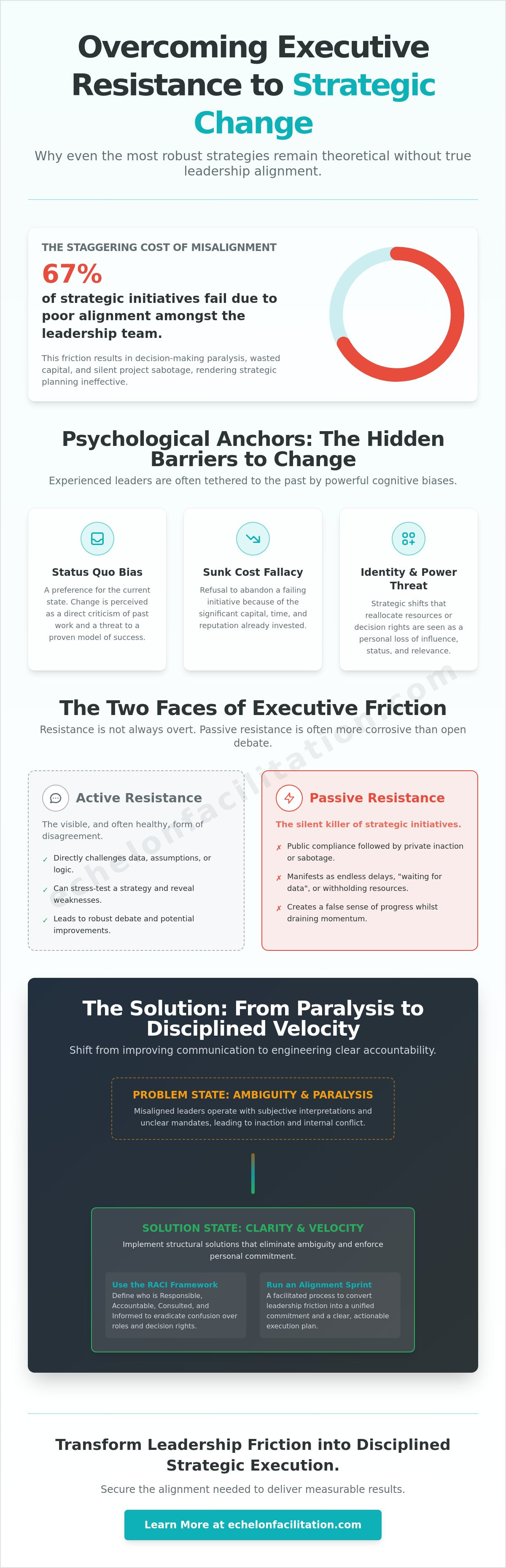
Research from Harvard Business Review confirms that 67 per cent of strategic initiatives fail because of poor alignment amongst the leadership team. This failure rate represents a staggering waste of capital and executive time. When leaders fail to reconcile their internal trade-offs, the resulting ambiguity creates a culture of doubt throughout the organisation. Overcoming resistance to strategic change is impossible if the individuals at the top are still protecting their own departmental silos rather than the collective objective.
Executive behaviour dictates organisational culture. Whilst frontline employees might express concerns through vocal complaints, senior leaders often employ more subtle methods. Passive resistance, such as agreeing in a meeting but failing to prioritise the task afterwards, is far more destructive than open disagreement. It creates a false sense of progress that masks the underlying rot of misalignment. Understanding change management principles at this level requires focusing on these interpersonal dynamics rather than just operational spreadsheets.
The Psychology of Senior-Level Friction
Leaders who have achieved success often fall victim to status quo bias. They view the current operational model as the reason for their personal ascent, making any shift feel like an indictment of their previous work. When a new strategy reallocates resources or shifts decision rights, it triggers a loss of power dynamic. This perceived threat to their influence causes them to retreat into defensive behaviours, even when they understand the logical necessity of the shift.
In a boardroom setting, this manifests as a contrast between active and passive resistance. Active resistance involves challenging the data or the logic of the strategy, which is often healthy for debate. Passive resistance is the silent killer of growth. It looks like "too much on my plate" or "waiting for more data" when the real goal is to delay the inevitable until the initiative loses its momentum. Overcoming resistance to strategic change requires exposing these psychological anchors and forcing a choice between personal comfort and organisational progress.
Psychological Anchors: Why Leaders Resist Strategic Change
Psychological anchors are the invisible biases that tether leaders to obsolete behaviours. These anchors often manifest as the sunk cost fallacy, where executives refuse to abandon failing initiatives simply because of the capital and time already invested. Overcoming resistance to strategic change requires identifying these biases before they solidify into permanent organisational inertia. When a leader has spent a decade building a specific department, any shift in strategy feels like a personal indictment rather than an operational pivot.
Consider a CEO of a regional industrial firm who spent twenty years building a specific hardware division. Despite market shifts suggesting a 5.4 per cent increase in retail prices for imported components and a clear need for software-led services, the CEO resisted the transition. Their professional identity was inextricably linked to the legacy product line. This professional identity threat makes strategic shifts feel like a personal loss rather than a business necessity. Leaders in this position don't just fear for the company; they fear for their own relevance in a new era.
Effective Transformation Alignment sessions force these biases into the open, ensuring that personal legacy does not compromise the collective future. By leveraging resistance for strategic alignment, boards can transform individual objections into a rigorous stress test for the new strategy. This approach moves beyond the superficial to address the root cause of executive friction.
The Illusion of Agreement
Senior teams often suffer from the "nodding in the room" phenomenon. Executives offer public compliance during the offsite, only to engage in sabotage in the corridor through subtle delays and resource withholding. Compliance is a superficial agreement to follow rules; true commitment is an internal drive to achieve the outcome. Overcoming resistance to strategic change is impossible when a team is merely performing agreement to avoid conflict.
Without psychological safety, honest objections remain buried. Leaders who feel unsafe challenging the consensus will instead perform agreement whilst privately maintaining their resistance. Surfacing these disagreements early prevents the decision-making paralysis that occurs when a team is only pretending to be aligned. High-performing boards prioritise objective truth over comfortable narratives to ensure that once a decision is made, execution is absolute and unquestioned.
Structural Solutions: Redefining Decision Rights and Accountability
Many advisors suggest that "better communication" is the primary solution for organisational friction. This is incorrect. Communication describes the problem; structure fixes it. Overcoming resistance to strategic change is a structural challenge that requires the elimination of ambiguity. Grey areas in leadership allow for the passive resistance discussed earlier. Defining exactly who makes the final call removes the cover for silent sabotage and forced delays.
Decision rights are the specific authorities granted to individuals to make commitments on behalf of the organisation. When these rights are ill-defined, executives default to a state of defensive caution. This leads to decision-making paralysis and wasted resources on stalled initiatives. A Decision-Rights Reset provides the clarity needed to move from theoretical strategy to operational reality. It forces the leadership team to move beyond vague agreements and commit to specific roles.
Implementing the RACI Framework
The RACI matrix is the standard for establishing clear accountability in high-stakes environments. For every strategic task, you must define four distinct roles:
- Responsible: The individual or team performing the actual work.
- Accountable: The single person with the final "yes" or "no" authority. This person owns the outcome.
- Consulted: Stakeholders whose input is sought before action is taken. This is a two-way communication.
- Informed: Those notified of the decision after it is made. This is one-way communication.
Resistance thrives when accountability is diluted. Assigning more than one "Accountable" person ensures that no one is truly responsible when an initiative fails. One name, and one name only, must sit in the Accountable column for every strategic task. This eliminates the "bystander effect" in the boardroom and ensures that overcoming resistance to strategic change becomes a matter of personal responsibility rather than a collective suggestion.
Shifting from Consensus to Consent
Pursuing total consensus is often a stalling tactic disguised as collaboration. It grants every executive an unofficial veto, leading to decision-making paralysis. If you wait for every leader to be 100 per cent enthusiastic, you will never move. Consent-based decision making is the faster alternative for strategic velocity. It asks a simpler question: "Is this proposal safe enough to try, and does it cause irreparable harm?"
This shift prevents individual leaders from holding the organisation hostage to their personal preferences. It moves the focus from "Do I like this?" to "Can I live with this for the sake of the objective?" This disciplined approach ensures that the team remains focused on execution rather than endless debate. Establish a foundation of accountability through a targeted Decision-Rights Reset to ensure your strategy survives the transition from the boardroom to the frontline.
The Alignment Sprint: Converting Resistance into Strategic Velocity
Soft tactics like "increased participation" often fail because they lack the discipline required for high-stakes environments. Overcoming resistance to strategic change requires a time-boxed, high-intensity intervention. The Executive Alignment Sprint replaces months of circular debate with a concentrated effort to resolve friction and define a clear path forward. This process is most effective when conducted during Strategic Alignment Offsites, where the leadership team can step away from daily operational noise.
An external facilitator is essential for neutralising boardroom politics. Internal leaders are often too close to the interpersonal dynamics to challenge their peers effectively. A neutral third party focuses on objective truth and forces the resolution of the hidden trade-offs that cause strategic drift. The sprint follows a rigorous three-step process:
- Diagnostic: Individual interviews to surface silent objections and identify where decision rights are currently blurred.
- Facilitated Session: A structured workshop to reconcile conflicting priorities and establish a unified RACI matrix.
- Execution Roadmap: The translation of alignment into a sequence of immediate, high-impact actions.
This structured approach ensures that overcoming resistance to strategic change isn't left to chance. It transforms the boardroom from a theatre of competing interests into a centre of collective execution. By removing the ambiguity that fuels resistance, the organisation can move from a state of paralysis to one of disciplined momentum.
The 30-Day Execution Roadmap
Momentum is the only antidote to organisational inertia. The first 30 days after a workshop represent a critical window where the new strategy is either solidified or abandoned. Without an immediate shift in behaviour, the team will naturally revert to the status quo. A 30-day execution roadmap provides the necessary guardrails to ensure that new decision rights are exercised and that accountability is enforced from day one.
This roadmap isn't a comprehensive project plan for the next three years. It's a focused list of the critical moves required to signal that the strategy is live. You can learn more about how this integration happens in our overview of how we work at Echelon. By prioritising immediate action, leaders demonstrate that the period of debate is over and the era of execution has begun. This shift in tempo is what ultimately converts executive friction into strategic velocity.
Securing Strategic Velocity through Executive Accountability
Strategic success is the product of structural discipline rather than collective enthusiasm. Overcoming resistance to strategic change requires a transition from the ambiguity of legacy biases to the absolute clarity of defined decision rights. When boards replace the pursuit of consensus with a commitment to individual accountability, the organisation regains its momentum and protects its capital. This shift ensures that the leadership team moves as a single unit rather than a collection of competing interests.
Dr Andrew Greenland, a medical doctor who has spent years running large, high-stakes working sessions for senior expert groups, uses structured frameworks to neutralise boardroom politics and restore operational focus. This high-intensity approach is designed to eliminate the silent sabotage that stalls growth and restores the stability required for long-term execution. The period of circular debate must end for real progress to begin.
Book an Executive Alignment Sprint to dissolve strategic friction and secure your organisation's future. Align your team today to ensure your strategy survives the transition from the boardroom to reality.
Frequently Asked Questions
How do you identify silent resistance in a senior leadership team?
Silent resistance manifests through "pocket vetoes" and resource withholding rather than vocal opposition. Look for executives who agree in the boardroom but fail to assign their best talent to the initiative or repeatedly delay their specific milestones. This behaviour signals a lack of true commitment and suggests the executive is waiting for the strategy to lose momentum or fail through neglect.
Can an internal HR lead overcome resistance to strategic change effectively?
Internal HR leads rarely possess the necessary neutrality to challenge peer-level power dynamics effectively. Whilst they understand the organisational culture, their career progression often depends on the very executives they must confront. External facilitation provides the outsider authority required for overcoming resistance to strategic change by addressing boardroom politics without fear of internal repercussions or political blowback.
What is the difference between a strategy offsite and an alignment sprint?
A strategy offsite focuses on "what" the organisation will do, whilst an alignment sprint focuses on "how" the leadership team will work together to execute it. Offsites often produce high-level visions that lack operational detail or structural commitment. Sprints are high-intensity sessions designed to resolve interpersonal friction and define specific decision rights, ensuring the team is structurally capable of delivery.
How much does executive misalignment cost a medium-sized organisation annually?
Executive misalignment costs organisations millions in wasted capital and stalled growth. Since 70 per cent of all change programmes fail to achieve their intended goals, the financial drain is quantifiable. For an organisation with a £100 million turnover, even a minor drop in strategic execution efficiency results in significant lost opportunity and resource drain that compounds every year the misalignment persists.
Is it possible to overcome resistance if the CEO is the one resisting?
Overcoming resistance to strategic change is possible when the CEO resists, provided the board or the broader leadership team forces a decision-rights reset. If the CEO is tethered to a legacy model, the solution lies in presenting objective data and using a structured framework to highlight the risk of inertia. The focus must shift from personal legacy to the collective responsibility of the board.

Article by
Andrew Greenland
Dr Andrew Greenland is the founder of Echelon Facilitation, a UK practice that designs and runs high-stakes leadership sessions for executive teams who need decisions, not more discussion.
A medical doctor and medical educator, Andrew brings a clinician's discipline to the messy, political work of leadership alignment - surfacing the real disagreement, forcing the real choices, and ensuring every session produces a documented decision log with named owners and deadlines.
He designs Echelon’s sessions for CEOs, executive teams, transformation leads and boards. Based in Twickenham.