
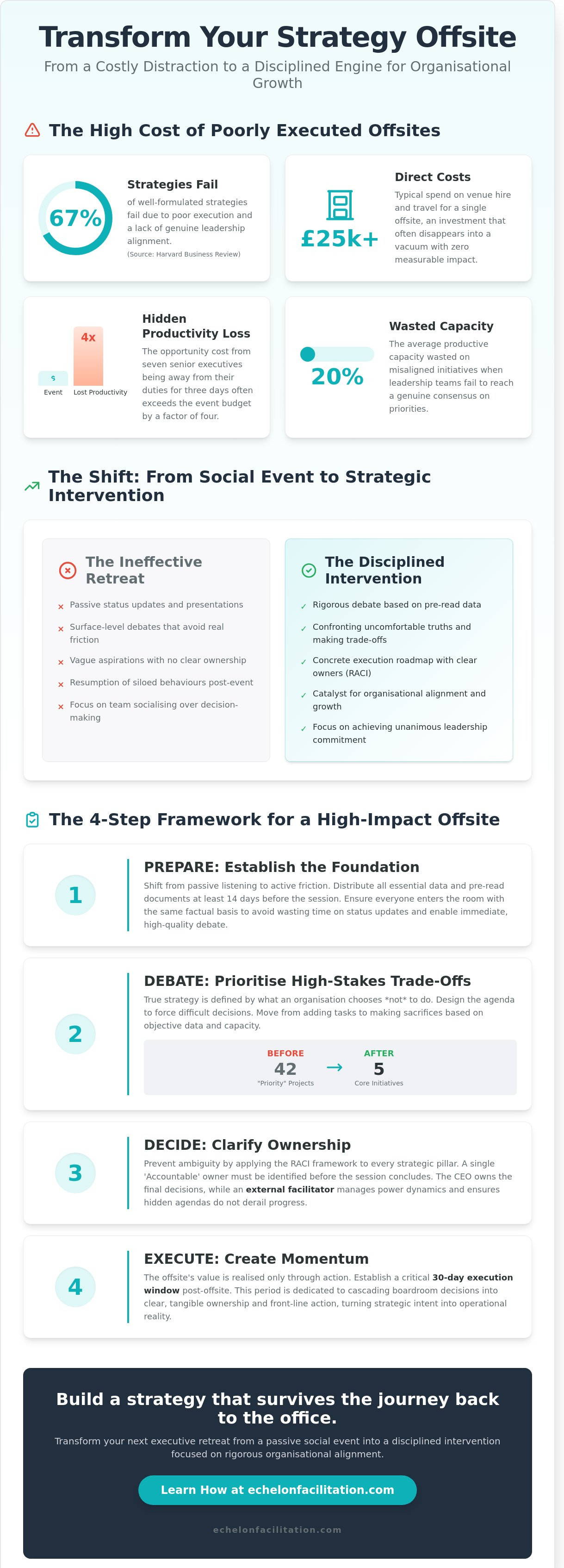
Most executive teams spend upwards of £25,000 on venue hire and travel for a strategy offsite only to return to the office and resume the exact same siloed behaviours they intended to fix. This investment disappears into a vacuum when the session lacks a rigorous structure for decision-making and accountability.
Research by Harvard Business Review indicates that 67% of well-formulated strategies fail due to poor execution and a lack of genuine leadership alignment. When seven senior executives spend three days away from their desks, the hidden cost in lost productivity often exceeds the event budget by a factor of four. These sessions frequently devolve into surface-level debates that fail to address underlying friction, resulting in a high-cost retreat with zero measurable impact on the organisational mission.
Recognise that a retreat must be the catalyst for the next phase of growth rather than a costly distraction. Use this framework to transform a vague strategy offsite into a disciplined engine of organisational alignment and clear ownership. This process establishes the mechanics for rigorous sessions that move beyond boardroom pleasantries to produce a concrete execution roadmap and unanimous leadership commitment.
Key Takeaways
- Transform executive retreats from passive social events into disciplined interventions focused on rigorous organisational alignment.
- Design a strategy offsite agenda that prioritises evidence-based debate and uses the RACI framework to clarify decision rights.
- Employ an external facilitator to manage complex power dynamics and ensure hidden agendas do not derail strategic progress.
- Establish a critical 30-day execution window to cascade boardroom decisions into clear ownership and front-line action.
Executive teams frequently mistake a social gathering for a planning session. The result is a list of vague aspirations that fail to survive the first week of operational reality.
According to research from the Harvard Business Review, 67% of well-formulated strategies fail due to poor execution and lack of alignment. When leadership teams fail to reach consensus on priorities, the organisation wastes an average of 20% of its productive capacity on misaligned initiatives. This friction costs mid-sized firms millions in lost opportunity and creates a culture of cynicism. Without a rigorous strategic planning process, the executive team remains a group of individuals protecting their silos rather than a unified force.
This guide defines the framework for a high-impact strategy offsite. It establishes the distinction between planning and execution whilst outlining the necessity of CEO ownership.
Strategy Offsite Definition: Moving Beyond the Annual Retreat
A strategy offsite is a high-stakes intervention designed for executive alignment. It's not a corporate retreat or a social reward for hitting quarterly targets. Whilst team-building activities focus on interpersonal rapport, a strategy session focuses on the cold, hard reality of decision-making. The primary goal is to isolate the leadership team from operational noise to establish an objective truth about the business.
Effective sessions require the team to confront uncomfortable data without the distraction of daily emails or "urgent" fires. This physical removal provides the psychological space to evaluate the organisation's current position against its intended target. By the end of the session, the team must move from a collection of functional heads to a unified leadership body. This transition is only possible when the group prioritises collective goals over departmental agendas.
The Distinction Between Planning and Execution
Strategy is frequently conflated with a simple to-do list. This is a fundamental error. A list of tasks describes execution, not strategy. A successful strategy offsite identifies the organisational constraints that prevent progress. For example, imagine a mid-sized fintech that discovers it has 42 'priority' projects for a team of 15 developers. By applying a clear decision framework during the session, it could reduce this to five core initiatives. This requires a shift from adding tasks to making difficult trade-offs based on objective capacity.
The CEO Ownership Model
The business leader must own the outcomes of the session. Even when using professional facilitators to manage the process, the CEO remains responsible for the final decisions. This requires a psychological shift from being a functional expert to becoming an organisational leader. Every participant must take extreme ownership of the collective mission rather than just their department's performance. This discipline ensures that the strategy offsite produces a plan that survives the transition back to the office.
Designing a Strategy Offsite Agenda for Executive Alignment
A productive strategy offsite demands a shift from passive listening to active friction. Most executive teams waste 60% of their time on status updates that belong in a pre-read document. High-impact agendas prioritise debate over presentations; they force leaders to confront uncomfortable truths rather than nodding through slides. This requires a rigorous pre-work phase where data is collected and distributed at least 14 days before the session. When everyone enters the room with the same factual foundation, the group avoids the surface-level discussions that typically derail strategic progress.
Applying the RACI framework during the session prevents the ambiguity that often follows large-scale meetings. Every strategic pillar must have a single Accountable owner identified before the group departs. Without clear decision rights, the momentum generated during the event evaporates within a week. For a detailed breakdown of session timing, refer to this strategy offsite agenda template designed for maximum output.
Prioritising High-Stakes Trade-Offs
Strategy is defined by what an organisation chooses not to do. An effective agenda focuses on trade-offs that involve real sacrifice. A standard 48-hour session flow allocates Day 1 to reality-testing current assumptions and Day 2 to committing to specific resource reallocations. This structure forces the team to move beyond growth as a vague concept and into the specifics of which products or markets will lose funding to support the primary objective. Teams that fail to make these hard choices end up with a to-do list rather than a strategy.
The Role of Data in Reducing Friction
Objective metrics are the only effective antidote to personality-driven arguments. When leadership teams rely on anecdotes, the loudest voice usually wins. This preparation ensures that discussions centre on market realities rather than internal politics. If you need to pressure-test your current data against industry benchmarks, consider a strategy sprint to sharpen your focus before the main event.
The Role of an External Strategy Offsite Facilitator
Internal facilitation frequently collapses under the weight of existing hierarchy. Senior leaders often hesitate to voice dissenting opinions when a colleague or subordinate leads the session. This dynamic preserves the status quo and stifles the objective truth required for a successful strategy offsite. An external partner introduces a neutral perspective, allowing them to challenge executive assumptions that internal staff might find too politically sensitive to address.
External experts manage power dynamics by identifying hidden agendas before they derail the agenda. They ensure that the loudest voice does not dictate the outcome. Research suggests that effective offsite leadership meetings require a clear focus on trust and vision, which is difficult to maintain when the facilitator is personally invested in the office politics of the organisation. Selecting a professional strategy offsite facilitator uk ensures that these dynamics are handled with professional distance and objective rigour.
Managing Executive Group Dynamics
Consider a London-based insurance firm facing a board-level deadlock. Functional silos between the underwriting and claims departments have effectively halted the development of a new digital product. Disciplined inquiry can strip away the personal grievances that have built up over 18 months. By focusing the group on data-backed evidence rather than departmental protectionism, a team in this position can reach a consensus on the product roadmap within a single session. This shift from defensive posturing to collective ownership is the primary benefit of external intervention.
Echelon Facilitation Methodology
Our approach centres on disciplined authority. We follow a specific framework for how we work to ensure stability and focus throughout the session. We don't act as passive observers; we actively steer the group away from low-value tangents. This methodology forces senior teams to confront uncomfortable realities and maintain the pace required for a high-impact strategy offsite. Success depends on this level of external rigour and the refusal to accept vague compromises that mask underlying misalignment.
Turning High-Level Discussions into Concrete Ownership
The success of a strategy offsite is determined not by the quality of the slides, but by the momentum generated in the subsequent 30-day execution window. This period represents the critical threshold where strategic intent either transforms into operational reality or dissolves into the friction of daily business. Harvard Business Review research suggests that 67% of well-formulated strategies fail because of poor execution. Leaders must move beyond conceptual agreement and establish radical ownership before the team leaves the room.
Translating boardroom decisions to the front line requires a structured Strategy Sprint. This mechanism bypasses traditional, slow-moving implementation cycles by focusing on 14-day bursts of activity. It ensures that the high-level objectives discussed during the strategy offsite become tangible tasks for every department, preventing the gap between planning and operations that stalls growth.
The 24-Hour Debrief Rule
Documentation must be completed before the team returns to their standard operating environment. Within 24 hours, leaders should issue a definitive "Record of Decisions" that strips away narrative and focuses on outcomes. Every strategic pillar requires a single, named owner. Using a RACI framework ensures there is no ambiguity regarding who is Responsible, Accountable, Consulted, or Informed. Ownership cannot be shared; shared responsibility is a functional vacuum that leads to inaction.
Measuring the ROI of Alignment
To truly validate the investment in a strategy offsite, organisations must establish clear metrics for alignment ROI. This goes beyond attendance figures; it involves tracking the progress of those defined Strategy Sprints, monitoring key performance indicators directly linked to the offsite's objectives, and assessing the reduction in cross-departmental friction. Regular reviews of these metrics provide tangible evidence of strategic execution and reinforce accountability across the business.
Operationalising Your Strategic Vision
A productive strategy offsite functions as a catalyst for clarity rather than a passive retreat from daily operations. Success depends on moving beyond superficial agreement to achieve deep executive alignment. This transition requires a structured agenda that prioritises objective truth and assigns clear ownership for every strategic pillar. Dr Andrew Greenland, a medical doctor who has spent years running large, high-stakes working sessions for senior expert groups, brings the disciplined authority necessary to navigate these high-stakes discussions.
Data from McKinsey indicates that organisations with highly aligned leadership teams are 1.9 times more likely to achieve above-average financial performance. Richmond-based Echelon Facilitation works with leadership teams by removing internal bias and focusing on the hard work of execution. The aim is for you to leave the room with a defined path forward and the accountability needed to deliver results. True leadership is found in the transition from discussion to action.
Book a Strategy Alignment Diagnostic with Echelon Facilitation and ensure your leadership team is prepared for the challenges ahead.
Frequently Asked Questions
What is the ideal duration for a strategy offsite?
The ideal duration for a strategy offsite is two consecutive days. Research published in the Journal of Business Research indicates that leadership teams require approximately six hours of focused interaction before they successfully transition from operational fire-fighting to long-term strategic synthesis. A two-day window provides the necessary time to move past immediate concerns and achieve genuine alignment on the organisation's 12-month objectives.
How many participants should attend an executive strategy offsite?
Limit attendance to between six and twelve key decision-makers to maintain high levels of engagement and accountability. Data from Bain & Company suggests that for every individual added to a group over seven, decision-making effectiveness decreases by 10%. Keeping the group lean ensures that every participant maintains extreme ownership over the outcomes and prevents the session from devolving into a series of passive presentations.
Should we include team-building activities in a strategy offsite?
Integrate activities only if they directly resolve organisational friction or clarify decision-making protocols. Avoid generic social exercises that lack professional utility, as 65% of senior managers view traditional team-building as a distraction from the core mission. An effective strategy offsite prioritises structured workshops that improve how the team executes together, rather than forced socialisation that fails to produce measurable business results.
What is the difference between a strategy offsite and a board meeting?
A strategy offsite focuses on long-term direction and the mechanics of execution, whilst a board meeting prioritises governance and fiduciary oversight. Board meetings typically centre on reviewing past performance and ensuring regulatory compliance within a rigid legal framework. In contrast, the offsite provides a dedicated environment for leaders to challenge existing assumptions and build a future roadmap without the constraints of a standard quarterly agenda.
How much does a professional strategy offsite facilitator cost in the UK?
Professional facilitation fees in the United Kingdom reflect the complexity of the engagement and the facilitator's expertise. Industry benchmarks from the Association of Facilitators in 2023 show that daily rates for senior executive facilitators typically range from £2,500 to £5,000. This investment generally includes the pre-session diagnostic phase, the design of the strategic framework, and the production of a post-event report to ensure the team remains focused on execution.