
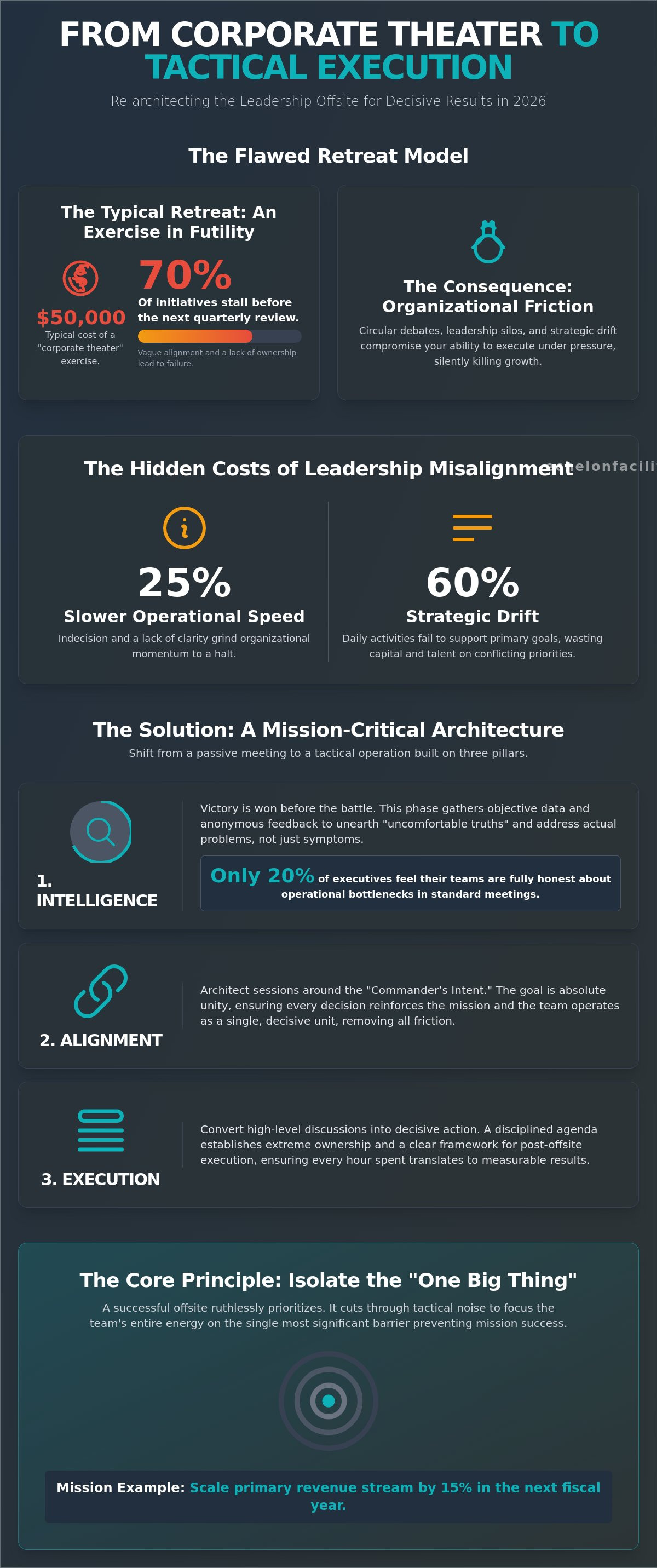
Most leadership retreats are $50,000 exercises in corporate theater that fail to produce a single actionable result. You've likely experienced the frustration of a three day session ending in vague alignment, only to watch 70% of those initiatives stall before the next quarterly review. Circular debates and leadership silos don't just waste time; they compromise your organization's ability to execute under pressure. A disciplined strategy offsite agenda is the only tool capable of breaking this cycle of wasted potential and organizational friction.
You need more than a change of scenery to drive results in 2026. This mission-critical template transforms your next retreat from a passive meeting into a tactical execution framework. By following this structure, you'll secure absolute team alignment and establish defined ownership for every strategic objective in your 12 month mission plan. We'll outline the exact mechanics required to eliminate friction and ensure your leadership team operates as a single, decisive unit.
Key Takeaways
- Redefine the leadership retreat as a high-stakes tactical reset designed to navigate the agile demands and strategic complexities of 2026.
- Architect your sessions around the pillars of Intelligence and Alignment to ensure every decision reinforces the Commander’s Intent.
- Deploy a battle-tested strategy offsite agenda that prioritizes objective truth and context before moving into tactical mapping.
- Force critical perspective shifts to challenge legacy business assumptions and identify the friction points hindering your organizational momentum.
- Convert high-level discussions into decisive action by establishing extreme ownership and a clear framework for post-offsite execution.
The Strategy Offsite as a Mission-Critical Objective
A strategy offsite is not a corporate holiday. It's a tactical reset designed to strip away operational noise and refocus the leadership team on the objective. In 2026, market volatility and rapid technological shifts leave no room for passive observation. Leaders who treat these sessions as social gatherings risk total organizational failure. Success requires a strategy offsite agenda built for decisiveness and speed. We define this process through the lens of strategic planning, ensuring every hour spent away from the office translates into measurable frontline results. The goal is absolute alignment. We remove friction so the team can move as a single, lethal unit.
The Hidden Cost of Leadership Team Misalignment
Misalignment is a silent killer of growth. When a core team lacks clarity, indecision slows operational speed by as much as 25% according to recent performance benchmarks. Silos form instantly when the mission isn't articulated with precision. This leads to strategic drift, a state where 60% of daily activities fail to support the primary goal. This drift erodes culture faster than any market downturn. It creates a vacuum where hesitation replaces action and doubt replaces discipline. Without a unified front, the organization fragments into competing interests, wasting capital and talent on conflicting priorities.
Shifting from Meeting to Mission
We demand a stoic approach to the offsite environment. This isn't a meeting; it's a mission. The agenda serves as the primary tool for maintaining focus under pressure. Every item on the list must drive toward a specific outcome. Ownership is the central theme. If a task lacks a clear owner, it doesn't belong on the schedule. Leadership teams must adopt a mindset of extreme accountability to survive the 2026 fiscal landscape. You can explore how we implement these standards in our workshops. Discipline in the boardroom ensures victory in the market. We trade comfortable narratives for objective truths. We value results over excuses.
Designing the Architecture of a High-Stakes Agenda
A successful strategy offsite agenda rests on three structural pillars: Intelligence, Alignment, and Execution. These pillars ensure the session transcends a mere meeting and becomes a tactical operation. Leaders must apply the "Commander’s Intent" to the agenda design, defining the desired end state clearly so the team understands the mission even when the situation changes. A rigid schedule isn't a cage. It's the framework that grants the team creative and strategic freedom. Without strict time boxes, discussions drift into unproductive territory, wasting the 48 hours allocated for high-level thinking.
Complex team dynamics can derail even the most meticulously planned sessions. Professional workshop facilitation is critical to navigate these frictions. A facilitator maintains the pace and ensures that the loudest voices don't drown out the most strategic ones, keeping the focus on objective outcomes rather than personal agendas.
The Pre-Offsite Intelligence Phase
Victory is won before the battle begins. The intelligence phase involves gathering objective data and anonymous feedback from the entire leadership tier. This process unearths "uncomfortable truths" that teams often avoid in daily operations. A 2024 survey of 500 executives revealed that only 20% felt their teams were fully honest about operational bottlenecks during standard meetings. The facilitator must remain an objective observer during this phase, filtering out personal bias to ensure the strategy offsite agenda addresses the actual problems, not just the symptoms.
Identifying the Strategic Constraints
Apply the Theory of Constraints to determine where the team’s energy belongs. Most agendas fail because they're cluttered with tactical noise, like quarterly budget tweaks or minor HR updates. These are distractions. Focus on strategic signals that impact the 2026 mission. A disciplined strategy offsite agenda prioritizes the single point of failure within the organization's current trajectory.
The "One Big Thing" is the single most significant barrier preventing the organization from scaling its primary revenue stream by 15% in the next fiscal year. To ensure your team is prepared for these high-stakes decisions, consider the structure of our strategic leadership workshops.
Core Components of a Results-Driven Strategy Agenda
A mission-critical strategy offsite agenda rests on three non-negotiable blocks: Context Setting, Strategic Horizon, and Tactical Mapping. Context Setting provides a 15-minute objective briefing on the current operational baseline. The Strategic Horizon defines the objective for 2027 and beyond. Tactical Mapping bridges the gap between high-level vision and the "boots-on-the-ground" reality. Without these pillars, an offsite is merely an expensive conversation.
We utilize Perspective Shifts to dismantle legacy business assumptions. These sessions force leaders to view the organization through the lens of a competitor or a disruptive newcomer. It's about objective truth, not comfort. Strategy fails when it ignores operational friction. We solve this through Decentralised Command. Senior leaders define the "commander's intent," while department heads build the tactical plan. This ensures ownership at every level and prevents the bottlenecks common in top-down mandates.
Strategic Horizon Scanning
Effective scanning requires looking at the 2027 market landscape with brutal honesty. We facilitate these sessions using a "Pre-Mortem" framework. Leaders must explain why the company failed two years from now. This technique bypasses defensiveness because it treats failure as a hypothetical data point rather than a personal critique. A 2023 Harvard Business Review study indicates that teams using pre-mortems increase their ability to identify project risks by 30%. Identifying external threats now prevents tactical paralysis later.
Tactical Execution Frameworks
Execution is where most offsites fail. We move from "what we want to do" to "who is accountable for the result." Every decision made during the strategy offsite agenda must have a single, named owner. There's no such thing as "shared responsibility" in a high-stakes mission. Each owner develops a 30-day execution plan within 48 hours of the session. These plans include clear KPIs and weekly milestones. This level of disciplined alignment ensures strategy translates into immediate, measurable action rather than gathering dust in a digital folder.
The Master Strategy Offsite Agenda Template for 2026
A successful strategy offsite agenda follows a linear, logical progression: Truth, Strategy, and then Action. You can't build a roadmap on a foundation of false assumptions or comfortable narratives. For 2026, leaders must allocate exactly 20% of the schedule as "white space." This isn't downtime for rest. It's a tactical reserve. It allows the team to dive deeper into unexpected friction points or pursue breakthroughs that emerge during the session. This structured strategy offsite agenda ensures the team doesn't leave with vague promises, but with a battle-tested plan.
Day 1: Alignment and The Objective Truth
The first day focuses on stripping away corporate ego to find the objective reality of the organization. You must confront the gaps before you can bridge them.
- Morning: Review the current mission and audit alignment. Recent data from 2024 leadership surveys indicates that 82% of teams report significant gaps between executive vision and frontline reality. Use this block to close those gaps.
- Afternoon: Execute facilitated sprints to tackle core strategic challenges. These sprints, modeled after Echelon’s professional workshops, force teams to reach high-stakes conclusions under intentional time pressure.
- Evening: Conduct purposeful social interaction. The goal is to reinforce the mission through shared experience. Avoid standard "bonding" exercises. Instead, focus on peer-to-peer accountability in a relaxed setting.
Day 2: Ownership and The Execution Roadmap
Day two shifts from analysis to decisive action. A 2023 Harvard Business Review study found 67% of well-formulated strategies fail due to poor execution. This day prevents that failure.
- Morning: Finalize strategic priorities by making hard trade-offs. You cannot have ten priorities. You must narrow them to three to five mission-critical objectives. Discipline is required here.
- Afternoon: Assign extreme ownership. Every objective needs a single point of accountability. Build a 90-day tactical roadmap with clear milestones and specific resource allocations.
- Closing: Deliver the "Commander’s Summary." This final 15-minute briefing ensures every attendee leaves with 100% clarity on their specific role in the mission.
Execution is the only metric that matters. Book a professional facilitator to help your next strategy session translate into organizational victory.
Facilitating the Pivot from Discussion to Decisive Action
A strategy offsite agenda often generates intense energy that vanishes the moment the team returns to their daily emails. This "offsite high" is a leadership failure. It happens when discussion isn't anchored to hard accountability. Facilitators prevent this decay by forcing the team to move from abstract concepts to tactical commitments. When friction occurs, we don't ignore it. We resolve it. Conflict is a tool for clarity. A disciplined facilitator identifies roadblocks in real-time and ensures they don't stall the mission. We prioritize objective truth over comfortable narratives to ensure the strategy remains grounded in reality.
The Advantage of External Facilitation
Internal leaders cannot effectively facilitate their own strategy offsite. It's impossible to be both a participant and an objective referee. Data suggests that 67% of internal strategy sessions fail due to power dynamics and groupthink. An external advisor maintains the discipline and pace of the agenda without fear of internal politics. Echelon sessions are led by Dr Andrew Greenland, who has the authority to challenge the CEO when they drift off-course. We maintain the tempo of the session, ensuring that no single voice dominates and every strategic risk is identified.
Ensuring Extreme Ownership Post-Offsite
The mission succeeds or fails based on the 30-day execution plan. This framework establishes immediate momentum through specific, measurable milestones. Accountability isn't optional; it's the standard. We implement a rigid follow-up loop to ensure every leader maintains extreme ownership of their deliverables. Communicating these outcomes is the next critical step. Leaders must brief 100% of the organization within 48 hours to maintain transparency and alignment across every department. This prevents the "strategy drift" that often occurs when information is siloed.
- Establish a 30-day execution roadmap with weekly progress checks.
- Assign a single point of contact for every strategic objective to ensure decentralized command.
- Conduct a post-mission debrief 90 days after the offsite to analyze execution gaps.
Strategic alignment at the offsite is the catalyst that transforms abstract vision into a sequence of operational victories.
Echelon Facilitation is the partner for leaders who value results over excuses. We don't offer fluff or feel-good sessions. We provide the strategic focus required for organizational victory. If your team is ready to stop discussing and start executing, explore our leadership workshops today. We don't just plan; we prepare your team for the realities of the 2026 market.
Command Your Mission with a Disciplined Strategy Offsite Agenda
A successful strategy offsite agenda isn't a suggestion; it's a blueprint for organizational survival. You've identified that the pivot from high-level discussion to decentralized ownership is the only way to secure a competitive edge by 2026. This process requires more than a casual meeting. It demands a rigorous architecture that forces executive alignment and eliminates the friction that stalls progress. At Echelon Facilitation, this approach draws on years of running large, high-stakes working sessions for senior expert groups.
Founded by Dr Andrew Greenland, a medical doctor who has spent years running large, high-stakes working sessions for senior expert groups, Echelon Facilitation specializes in aligning executive teams through disciplined facilitation. Based in Richmond, London, we provide the professional leadership workshops your team needs to transform intent into execution. Don't leave your mission to chance. Give your next session the structure it needs to produce measurable results and clear decisions across your leadership tier.
Book a Strategic Diagnostic Call with Echelon Facilitation to harden your plan and lead your team to victory.
Frequently Asked Questions
How long should a strategy offsite agenda be?
A high-impact strategy offsite agenda requires exactly 2 full days to move from alignment to execution. This 16 hour window provides enough time to dissect the current mission without succumbing to the fatigue that sets in by day 3.
Who should be included in the leadership offsite?
Limit the primary group to the 6 to 10 individuals who hold direct accountability for the mission's success. Including more than 12 participants often degrades the quality of debate and slows the decision-making process. Focus on those with the authority to commit resources and the ownership to see the strategy through to its tactical end. You don't want spectators in a high-stakes environment.
What is the best location for a strategy offsite in the UK?
Select a secluded location that forces a mental break from daily operations, such as Heckfield Place in Hampshire or The Grove in Hertfordshire. These venues provide the physical distance needed for objective thinking. Avoid city-center hotels where 30 percent of attendees typically get distracted by local office emergencies. Physical environment dictates the level of strategic focus your team can achieve.
How do you handle conflict during a strategy session?
Address conflict immediately by refocusing the team on the objective mission rather than personal grievances. Use a "disagree and commit" framework to ensure 100 percent alignment once a decision is reached. Research indicates that teams that engage in healthy, fact-based dissent are 2.5 times more likely to execute their strategy successfully compared to those who avoid confrontation. Conflict is a tool for clarity.
What are the most common strategy offsite pitfalls to avoid?
The most common pitfall is failing to define clear owners for the 5 to 7 key objectives identified during the session. Another failure point is the "post-offsite slump" where 60 percent of strategic plans are abandoned within 30 days due to lack of tactical integration. Avoid these by documenting every decision and assigning a specific deadline for the first milestone before the session ends.
How often should a leadership team hold a strategy offsite?
Schedule one comprehensive strategy offsite every 12 months, supplemented by 1-day quarterly alignment sessions. This 90-day rhythm ensures that the team remains agile enough to pivot when market conditions change. Organizations that review their strategic progress at 4 distinct points throughout the year report a 40 percent higher success rate in hitting their annual targets. Consistency builds the discipline required for victory.
Should we use an internal or external facilitator for our offsite?
Utilize an external facilitator to maintain total objectivity and allow the CEO to participate as a peer. Internal facilitators often struggle with existing power dynamics, which can suppress 45 percent of dissenting but necessary viewpoints. A professional facilitator enforces the discipline required to keep the strategy offsite agenda on track while ensuring every leader takes extreme ownership of the outcomes. It's about mission success.
How do we ensure the decisions made at the offsite are actually implemented?
Ensure implementation by creating an "Execution Roadmap" that lists specific actions, owners, and deadlines for the next 30, 60, and 90 days. Assign one person to track these deliverables through a centralized dashboard. Without this tactical layer, 70 percent of strategic initiatives fail to move past the conceptual stage. Success depends on the transition from high-level vision to the reality of daily execution.