
Last Tuesday, a chief executive watched a three-hour board meeting dissolve into circular debate without a single action item being assigned. This paralysis forces internal teams to wait whilst competitors move faster, increasing the cost of indecision and eroding trust amongst the most capable staff members.
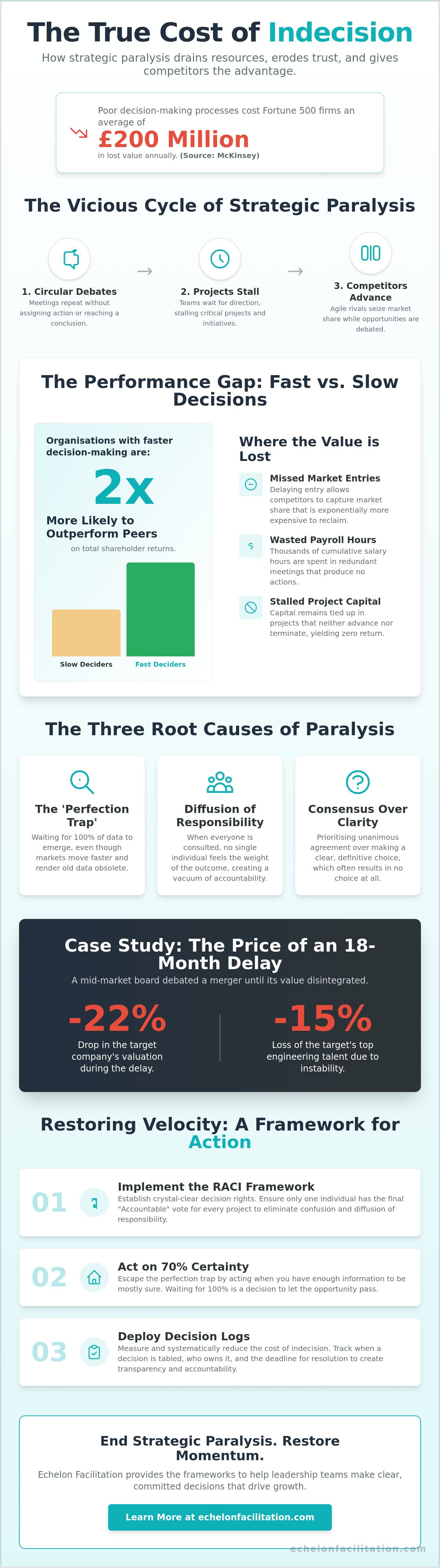
When a board chooses to wait for perfect information rather than act on 70% certainty, the organisation enters a state of strategic paralysis. This inertia carries a measurable cost of indecision that erodes bottom-line performance through missed market entries and thousands of wasted payroll hours spent in redundant committees. Research by McKinsey indicates that organisations with faster decision-making processes are twice as likely to outperform their peers on total shareholder returns. Stalled leadership causes high-performing staff to disengage whilst competitors seize the initiative.
You likely recognise the frustration of watching critical projects stall amongst endless debate and circular reasoning that never reaches a conclusion. Restoring strategic velocity requires a shift from consensus-seeking to clear accountability and ownership. Implementing a repeatable framework for assigning decision rights ensures that your organisation maintains momentum and protects its financial health.
Key Takeaways
- Quantify the hidden capital stalled in circular meetings to protect your organisation's competitive advantage and bottom line.
- Recognise the "perfection trap" and identify the precise moment where excessive data collection stalls progress whilst the window of opportunity remains open.
- Implement the RACI framework to establish clear decision rights and ensure only one individual owns the final outcome for every project.
- Deploy decision logs and mandatory pause limits to measure and systematically reduce the cost of indecision across the executive team.
Strategic Momentum: How to Mitigate the Cost of Indecision
A leadership team sits in a boardroom for the third consecutive month, debating the same market entry strategy whilst more agile competitors secure the prime contracts. This hesitation is not a neutral act; it is a choice that actively drains resources and destroys competitive advantage.
Research from McKinsey reveals that poor decision-making processes cost Fortune 500 firms an average of £200 million in lost value annually. This figure represents more than just missed revenue; it encompasses the hidden capital trapped in stalled projects and the cumulative salary hours spent in redundant meetings. When leadership teams fail to commit, they don't just delay progress; they actively incinerate shareholder value and erode the strategic advantages that previously defined their market position in a crowded global landscape.
This section examines the financial and cultural impact of hesitation. It provides a framework for identifying decision bottlenecks and establishing clear ownership to restore strategic momentum.
Quantifying the Financial Impact: The Real Cost of Indecision
Stagnation is a balance sheet liability. The cost of indecision often hides within circular meetings where teams review the same data sets without producing a resulting action. This analysis paralysis keeps capital tied up in projects that neither advance nor terminate. Delaying a market entry by a single quarter allows competitors to capture market share that becomes exponentially more expensive to reclaim later. Speed is a primary component of investment return. When a firm pauses, its competitors do not.
The McKinsey study regarding the £200 million annual loss for Fortune 500 firms highlights a systemic failure. This loss is the result of cumulative friction rather than a single catastrophic event. Every hour spent debating settled facts is an hour stolen from execution. Organisations that fail to quantify these losses treat time as an infinite resource. This is a fundamental strategic error that leads to bloated operational costs and diminished market relevance.
The Erosion of Organisational Trust
Hesitation at the executive level creates a "wait and see" culture amongst middle management. When leaders fail to choose a path, psychological safety breaks down. High-performing staff rarely tolerate prolonged stagnation. They leave organisations where their work is constantly stalled by leadership paralysis, seeking environments that value execution and clear direction. This churn removes the very talent required to drive future growth and innovation.
Direct vs. Indirect Costs
Direct costs are easily measured through wasted salary hours and consultant fees for redundant sessions. Indirect costs are more insidious. The "energy drain" caused by the cost of indecision reduces the quality of future execution. Teams lose the discipline required for high-level performance when they expect their efforts to be shelved or revisited indefinitely. Ownership requires a definitive "yes" or "no" to maintain operational integrity and collective momentum.
Root Causes: Why Executive Teams Struggle with Decision Ownership
Decision ownership fails when accountability is spread so thin that it becomes invisible. In many boardrooms, a diffusion of responsibility ensures that whilst everyone is consulted, no single individual feels the weight of the outcome. This collective hesitation creates a vacuum where the cost of indecision begins to compound. When leadership teams prioritise consensus over clarity, they often fall into the "Perfection Trap." This involves waiting for a mythical 100% of data to emerge, even though markets move at a pace that renders old data obsolete before the ink dries. Waiting for total certainty is a choice to lose the window of opportunity.
Consider a mid-market manufacturing board that debated a strategic merger for 18 months. During this period of prolonged evaluation, the target company's valuation plummeted by 22% due to market shifts. During this delay, 15% of the target's top engineering talent fled to competitors, citing the instability of the pending deal. The board didn't lose the deal because of a "no" vote; they lost the value of the deal because they refused to vote at all. This lack of direction often stems from 5 signs your leadership team is critically misaligned, which prevents the decisive action required to capture market share.
The Role of Misalignment in Stalled Decisions
Conflicting KPIs amongst executives create a natural state of paralysis. If the Chief Revenue Officer is incentivised for aggressive expansion whilst the Chief Financial Officer is measured on strict cost-containment, every major strategic choice becomes a tug-of-war. This tension is rarely addressed directly. Instead, a culture of boardroom "politeness" often masks deep-seated strategic disagreement. Executives avoid direct confrontation, opting for endless "clarification" meetings that lead nowhere. This social friction contributes to the high, hidden cost of inconsistent decision making within the organisation, where the lack of a unified front stalls progress.
Data Paralysis vs. Strategic Clarity
Leadership teams must distinguish between a genuine need for information and a defensive avoidance of risk. Analysis paralysis is a defence mechanism against accountability where leaders hide behind spreadsheets to avoid the personal risk of a wrong choice. This behaviour often masks a fear of being held responsible for a sub-optimal outcome. True strategic clarity requires accepting that most decisions are reversible and that 70% of the data is usually sufficient for action. If you find your team trapped in a cycle of "one more report," you are likely experiencing a failure of ownership rather than a lack of insight. To break this cycle, organisations often require a structured strategy sprint to reset their decision-making rhythm and restore momentum.
Structural Solutions: Reducing the Cost of Indecision with RACI
Structural friction often stems from a lack of clarity regarding who owns the final choice. The RACI framework provides the necessary architecture to resolve this by categorising stakeholders as Responsible, Accountable, Consulted, or Informed. This clarity eliminates the ambiguity that fuels the cost of indecision within senior teams. Without these defined boundaries, meetings devolve into consensus-seeking exercises that drain resources without producing results.
The "Accountable" rule is the most critical component of this framework. Only one individual can own the final decision. This person has the authority to break deadlocks and move the project forward. When accountability is shared, it is diluted; this leads to circular debates where no one feels empowered to commit. An external facilitator enforces these roles during high-stakes sessions, ensuring that those in "Consulted" roles provide input without overstepping into decision-making authority. Data from McKinsey suggests that the cost of ineffective decision making translates to approximately 530,000 days of lost management time annually for a typical large organisation. Mapping RACI to a stalled project forces a breakthrough by identifying exactly where the bottleneck exists.
Implementing a Decision-Rights Reset
Redefining authority requires a disciplined three-step process. First, identify every stakeholder who currently has the power to say "no" and evaluate if that power is justified. Second, reassign the "Accountable" tag to a single individual who is closest to the execution. Third, communicate that "Consulted" parties are there for advice, not approval. You can accelerate this transition by booking a Decision-Rights Reset workshop to realign your leadership team.
The Cynefin Framework for Contextual Decision-Making
Context determines the appropriate response. The Cynefin framework categorises decisions into Simple, Complicated, Complex, or Chaotic domains. Leaders often trigger a high cost of indecision by applying "Simple" logic—relying on best practices—to "Complex" problems that require experimentation and pattern recognition. Applying the wrong logic leads to inevitable failure because it ignores the inherent uncertainty of the environment. Recognising the domain allows a team to choose a decision-making style that matches the reality of the challenge.
Restoring Velocity: Steps to End the Cost of Indecision
To eliminate the cost of indecision, leadership teams must implement a Decision Log. This tool tracks every strategic choice from the moment of identification to the point of final execution. It exposes the hidden friction where momentum stalls. Statistics from the Project Management Institute suggest that organisations lose 12% of their investment due to poor execution and delayed starts. A Decision Log makes these delays visible, forcing accountability on those responsible for the next step.
Leaders must also establish strict Pause Limits. A pause for assessment is a tool, not a destination. If a decision remains unmade after 14 days of deliberation, the process has failed. At this point, the team must either commit to a path or escalate the issue to a higher authority. This prevents assessment from becoming a mask for permanent hesitation.
The 30-day execution plan bridges the gap between boardroom consensus and operational reality. Within the first 72 hours, clear ownership must be assigned. By day 15, resource allocation must be finalised. By day 30, the first measurable milestone must be achieved. This rhythm prevents the strategy from decaying into a mere suggestion and ensures that the cost of indecision does not compound over time.
A Template for Decision Readiness
Teams often wait for perfect information that never arrives. Instead, identify the Minimum Viable Data (MVD) required to act. 60% certainty is often sufficient for a reversible decision. You must also identify the Single Point of Failure in your current decision-making chain. Often, a single executive's preference for total consensus acts as a bottleneck that halts progress for the entire organisation. Removing this requirement for unanimity restores velocity.
When to Seek Professional Facilitation
Internal bias frequently blinds senior peers to the objective truth. When deadlocks occur amongst equals, a neutral third party provides the necessary friction to force a resolution. High-Stakes Workshop Facilitation offers a structured path forward when the internal culture cannot break its own cycles of hesitation. Professional facilitators remove the emotional weight from the room, allowing the team to focus on the objective outcome. This intervention is essential when the stakes are high and the window for action is closing.
Restore Executive Velocity and Strategic Focus
Executive teams often mistake prolonged caution for diligence; however, the financial reality reveals a different truth. Stagnation erodes competitive advantage and drains capital that should be funding growth. By implementing clear frameworks like RACI and shifting toward decentralised ownership, organisations transform static boards into high-velocity engines. Dr Andrew Greenland, a medical doctor who has spent years running large, high-stakes working sessions for senior expert groups, brings that same discipline to leadership teams facing entrenched deadlocks.
Eliminating the cost of indecision requires more than a shift in mindset; it demands a structural reset of how your team functions. High-stakes leadership is about the courage to choose a path and the discipline to follow it. When accountability is clear, momentum becomes the natural state of the business. You have the tools to reclaim your organisation's trajectory and ensure every hour spent in the boardroom yields a concrete result. Decisive action is the only path to strategic victory.
Book a Leadership Team Decision-Rights Reset
Frequently Asked Questions
What is the most common cause of the cost of indecision?
The most common cause of the cost of indecision is a culture of risk aversion. Fear of making a wrong choice often outweighs the potential benefits of action. A 2022 survey by McKinsey and Company found that 72% of senior executives believe their organisations waste time on ineffective decision-making processes. This hesitation stems from a lack of clear decision rights, causing leaders to wait for consensus that rarely arrives.
How can I calculate the cost of indecision for my specific team?
You calculate the cost of indecision by summing the daily salary costs of involved personnel during the delay period and adding the projected revenue lost from a missed market window. If a project worth £1,000,000 is delayed by three months, the cost includes the 25% annualised opportunity cost plus the idle resource hours. This objective calculation removes emotion from the discussion. It highlights the fiscal impact of organisational paralysis on the bottom line.
Can an external facilitator help reduce the cost of indecision?
External facilitators reduce the cost of indecision by acting as an objective third party that enforces a structured decision-making framework. They identify cognitive biases and social friction that internal leaders often ignore to maintain politeness. By setting a hard deadline, a facilitator helps the whole executive team reach alignment. This intervention prevents the circular debates that typically drain resources and delay execution.
Is there a difference between a "slow decision" and indecision?
A slow decision is a deliberate, time-bound process used for high-stakes choices. Conversely, indecision is a chronic state of inaction without a clear timeline. Jeff Bezos’s 2016 Letter to Shareholders notes that Type 1 decisions require deliberation, but Type 2 decisions should be made with 70% of the information. Indecision occurs when a team treats every choice as a Type 1 decision. This leads to a total loss of momentum and wasted operational capacity.
How does the RACI framework help in executive decision-making?
The RACI framework eliminates ambiguity by assigning a single Accountable person for every decision. This structure prevents the decision by committee trap, which accounts for up to 50% of delays in corporate environments. When one individual owns the final outcome, the process moves faster. Lines of authority become clear. This ensures that stakeholders provide input without the power to veto, maintaining the pace of execution and preventing the cost of indecision from mounting.