
Your leadership team nods in agreement during the offsite, yet months later, the same silos remain and the strategy document sits unopened. Finding a disciplined strategic planning facilitator UK is the difference between a wasted weekend and a leadership team that actually executes. This polite consensus is a quiet failure of leadership that wastes your most expensive resource: executive time.
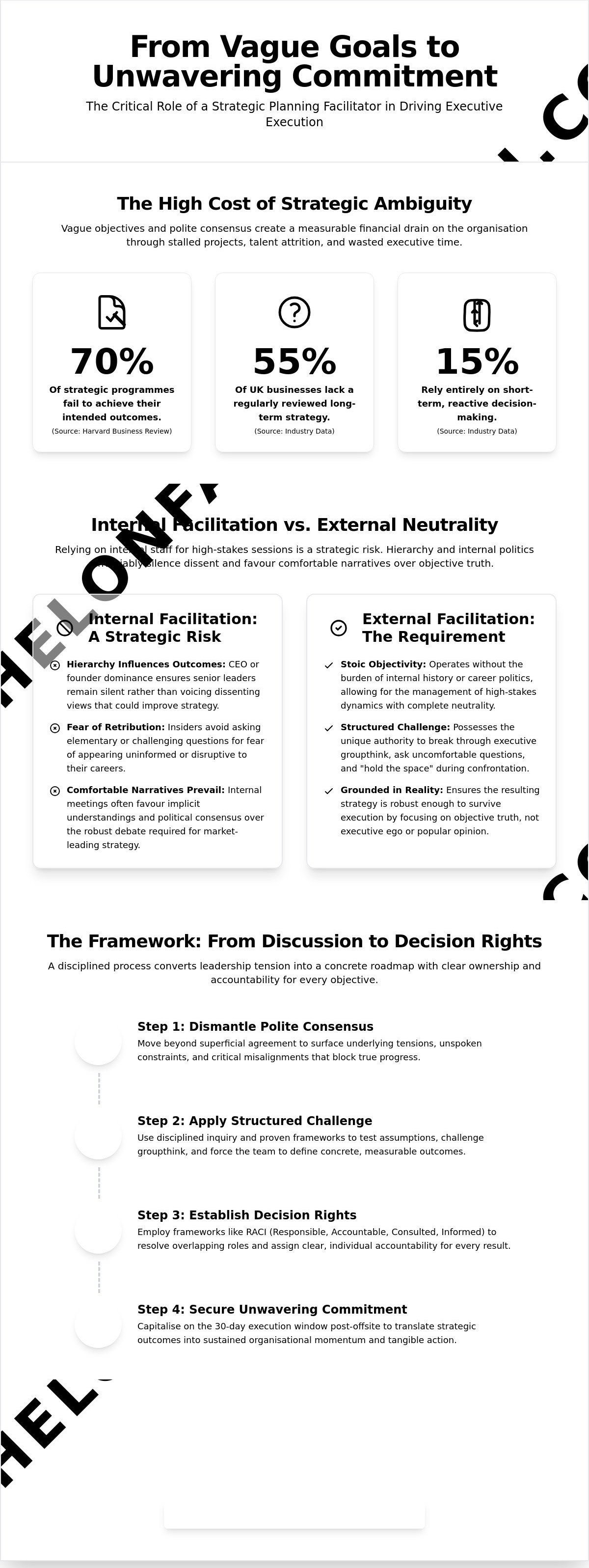
Recent data indicates that 55% of UK businesses lack a long-term strategy that is regularly reviewed, whilst 15% rely entirely on short-term reactions. According to research by McKinsey, this lack of direction creates measurable friction. When senior leaders fail to align, the organisation absorbs the cost through stalled projects and talent attrition. This absence of clarity ensures that discussions never move beyond superficial agreement into the territory of high-stakes commitment and individual accountability for every objective.
You likely recognise that vague goals lead to mediocre execution. This article outlines how a disciplined facilitation process converts leadership tension into a concrete roadmap with clear ownership. You will discover the mechanisms required to reduce organisational friction and secure unwavering commitment from your full executive team.
Key Takeaways
- Distinguish between superficial consensus and explicit alignment to eliminate the financial drain of strategic ambiguity.
- Secure a strategic planning facilitator UK to navigate high-stakes interpersonal dynamics and ask the uncomfortable questions that insiders often overlook.
- Use frameworks like RACI or Cynefin to resolve overlapping decision rights and establish clear individual accountability for every result.
- Capitalise on the 30-day execution window to ensure that strategy offsite outcomes translate into sustained organisational momentum.
The Financial Weight of Strategic Ambiguity
A strategic planning facilitator UK serves as a neutral arbiter of objective organisational truth. Their primary function is not to mediate minor disputes, but to dismantle the polite consensus that often masks deep executive misalignment. Internal meetings frequently rely on implicit understandings and favour-trading amongst leaders. This lack of clarity is expensive. True market dominance requires explicit alignment, where every member of the leadership team understands exactly what they are committing to and what they are choosing to abandon. Professional strategic planning requires a partner who values results over comfortable narratives. A facilitator is not there to make people feel good; they are there to make the strategy work.
Quantifying the Cost of Misalignment
Strategic initiatives fail at an alarming rate. Harvard Business Review research indicates that approximately 70% of these programmes do not achieve their intended outcomes. These failures are rarely the result of poor data; they are the result of strategic ambiguity. Vague objectives lead to several critical failures:
- Resource Misallocation: Departments pull in competing directions whilst claiming to follow the same roadmap.
- Employee Burnout: Teams lose confidence when leadership cannot articulate a clear, actionable path forward.
- Execution Lag: Indecision at the top creates a hidden tax that slows every subsequent operational level.
When a strategic planning facilitator UK forces a team to define concrete outcomes, they are effectively removing the financial drain of indecision that stalls organisational momentum and wastes executive capital.
Why Internal Facilitation is a Strategic Risk
Relying on internal staff to facilitate high-stakes sessions is a strategic risk because hierarchy always influences the room. The "Founder’s Trap" or CEO dominance often ensures that senior leaders remain silent rather than voicing a dissenting view that might improve the outcome. An external perspective is essential to surface unspoken organisational constraints and challenge the status quo without fear of political retribution. Neutrality allows for the identification of objective truth, ensuring that the resulting strategy is robust enough to survive the reality of execution rather than merely surviving the meeting.
Why an External Strategic Planning Facilitator UK is Essential for Neutrality
Neutrality is not merely a preference; it is a functional requirement for strategic success. An external strategic planning facilitator UK operates without the burden of internal history or the distraction of future career politics. This independence allows them to manage high-stakes interpersonal dynamics with stoic objectivity. They possess the unique authority to ask the elementary questions that insiders often avoid for fear of appearing uninformed or disruptive. By framing the ongoing organizational process through a lens of objective truth, the facilitator ensures the strategy remains grounded in operational reality rather than executive ego.
Understanding the specific UK corporate landscape is equally vital. A facilitator familiar with British regulatory standards and corporate governance provides a layer of stability that an international generalist might lack. This expertise ensures that the strategic planning process aligns with local market pressures and reporting requirements. Their role is to act as a steady hand, maintaining focus on the objective whilst others may be swayed by temporary emotional or political shifts in the room.
The Mechanism of Structured Challenge
Disciplined inquiry is the primary tool used to break through executive groupthink. When a conversation becomes confrontational or uncomfortable, the facilitator "holds the space." This prevents the group from retreating into safe, non-committal language or abandoning a difficult topic prematurely. They maintain a calm, professional focus on the objective until the team reaches a definitive resolution. This process converts friction into a strategic lever, ensuring that every dissenting voice is heard and addressed before a final commitment is made.
Navigating UK Boardroom Dynamics
British boardroom behaviour often involves understated disagreement. A subtle pause or a carefully hedged comment can signal deep-seated opposition that an internal moderator might ignore to maintain a veneer of peace. A strategic planning facilitator UK ensures that silence is never mistaken for consent. During a strategy sprint, every leader must explicitly state their position and ownership of specific outcomes. This rigour prevents the "polite consensus" from undermining execution once the meeting concludes. If your team struggles with ambiguous accountability, a Decision-Rights Reset can provide the necessary structural clarity.
The Echelon Framework: From Discussion to Decision Rights
The facilitator’s role is to develop an effective process that moves beyond mere conversation. High-level strategy often collapses because the leadership team fails to define who actually makes the final call. We utilize the RACI framework (Responsible, Accountable, Consulted, Informed) to eliminate this ambiguity. This structured approach ensures that every strategic pillar is supported by a clear hierarchy of action rather than a vague hope for cooperation.
Consider the scenario of a London-based fintech firm. They possessed a clear strategic roadmap on paper, yet execution had stalled for two consecutive quarters. The issue was not a lack of talent or market opportunity. It was overlapping decision rights where three different executives felt they had final authority over product development. This created a culture of perpetual deliberation where no one felt empowered to act. A strategic planning facilitator UK intervenes in these situations by forcing a reset of these rights, ensuring that every objective has one single, undisputed owner.
We reject the common industry advice that prioritises seeking total buy-in from every stakeholder. Chasing universal consensus leads to diluted decisions and catastrophic delays. Instead, we champion a "disagree and commit" model. This ensures that whilst every perspective is heard, the team moves forward with speed once a decision is finalised. Securing a Decision-Rights Reset is the most efficient way to convert leadership friction into organisational momentum.
The Decision-Rights Reset
Shared accountability is a failure of leadership. When responsibility is spread across a committee, individual ownership evaporates and progress slows. A strategic planning facilitator UK maps individual responsibility to high-level strategic pillars. This process ensures that when friction arises, there is a clear, pre-defined path to resolution. It replaces the polite consensus of the boardroom with a rigid structure of personal responsibility and measurable outcomes.
Moving from Vision to Operational Execution
A three-year vision is useless without a mechanism for immediate action. We translate high-level aspirations into 90-day execution sprints that demand measurable progress and total accountability. Strategic execution is the relentless pursuit of objective-led outcomes. This rhythmic approach ensures that the energy generated during a strategy session does not dissipate but remains focused on the practical fulfilment of the collective plan.
Establishing Momentum After Your UK Strategic Planning Session
The ultimate success of a strategy is determined within the 30-day execution window following the session. If the leadership team reverts to previous behaviours within this month, the plan becomes shelfware. A disciplined strategic planning facilitator UK ensures that the transition from the offsite back to the boardroom is marked by a structural shift in how decisions are made and tracked. Follow-through diagnostics are essential to identify early signs of reversion and to reinforce the new accountability standards. This period requires a relentless focus on the new decision rights to ensure they take root within the organisation’s culture.
CEOs should maintain momentum using this checklist:
- Confirm all RACI assignments are documented and accepted by every owner.
- Integrate 90-day sprint targets into existing executive board reporting.
- Schedule the first monthly progress review before the offsite concludes.
- Communicate the core strategic pillars to the wider organisation within 48 hours.
The Post-Offsite Accountability Loop
Strategic drift occurs when daily operations begin to crowd out long-term objectives. Establishing a cadence of accountability through regular progress reviews prevents this erosion. These sessions must focus exclusively on the strategic roadmap rather than operational minutiae. This discipline ensures that the leadership team remains focused on the high-stakes results defined during the session, whilst ignoring the noise of low-priority tasks that do not advance the primary objective.
Selecting the Right UK Facilitator
Effective facilitation requires more than just a neutral presence. Look for a strategic planning facilitator UK with industrial experience and a focus on outcomes over activities. Professional chemistry is less important than the facilitator’s ability to challenge the CEO and surface objective truths that may be uncomfortable. This ability to navigate the specific nuances of UK corporate governance ensures that the strategy survives the scrutiny of the board and the reality of the market. To assess your team's readiness for a high-stakes reset, contact Echelon for a diagnostic call.
Converting Executive Alignment into Organisational Momentum
Leadership teams often mistake polite consensus for actual commitment. This distinction is the catalyst for either market dominance or expensive strategic failure. By introducing a disciplined strategic planning facilitator UK, you move beyond superficial agreement and into the territory of explicit accountability. You've seen how frameworks like RACI and the 30-day execution window provide the structural integrity required to sustain progress long after the session concludes. True alignment isn't a soft outcome; it's a hard-won structural state that demands individual responsibility for every strategic pillar.
Echelon Facilitation, founded by Dr Andrew Greenland, a medical doctor who has spent years running large, high-stakes working sessions for senior expert groups, focuses on this exact disciplined execution. We specialise in high-stakes executive alignment and decision-rights resets, using a structured framework to transform boardroom friction into strategic clarity. Don't allow your next strategy session to become another exercise in administrative box-ticking. Book a Complimentary Diagnostic Call with Echelon Facilitation to assess your team's readiness for a high-stakes reset and help your organisation move forward with unwavering focus. Your leadership team is capable of exceptional results when the path is clear and the ownership is undisputed.
Frequently Asked Questions
What does a strategic planning facilitator UK actually do during a session?
A strategic planning facilitator UK manages the decision-making architecture and interpersonal dynamics of the leadership team. They don't provide the strategic answers; they provide the rigour required for the team to reach them. This involves using structured inquiry to dismantle groupthink, managing confrontational discussions, and ensuring that every objective is assigned a single, accountable owner through frameworks like RACI.
How much does a professional strategic planning facilitator cost in the UK?
Fees for professional facilitation are typically determined by the complexity of the organisation and the scope of the alignment required. Costs usually reflect the depth of the pre-session diagnostic work and the level of post-session execution support. Professional facilitators prioritise the long-term value of strategic clarity and the reduction of organisational friction over simple time-based billing. You should expect a structure that reflects the high-stakes nature of executive alignment.
How long should a strategic planning workshop last for a senior leadership team?
Effective workshops for senior teams generally require one to two days of intensive focus. This duration provides sufficient time to move beyond superficial agreement and address the difficult territory of resource trade-offs and decision rights. Attempting to compress this process into a few hours often results in a vague plan that lacks the necessary executive commitment for sustained execution.
What is the difference between a strategy consultant and a strategic planning facilitator?
A strategy consultant typically provides external expertise and specific recommendations on what an organisation should do. A facilitator focuses on the process of alignment and the mechanics of execution. The facilitator ensures the leadership team owns the resulting strategy. This internal ownership is the only way to overcome the high failure rates associated with strategic initiatives that lack executive commitment.
Can we facilitate our own strategic planning offsite effectively?
Internal facilitation is rarely successful for high-stakes sessions because existing power dynamics inevitably influence the room. When a CEO or senior leader facilitates, other executives often default to polite consensus rather than voicing dissenting views. An external partner provides the neutrality required to surface objective truths and hold every leader accountable without the distraction of internal political repercussions.