
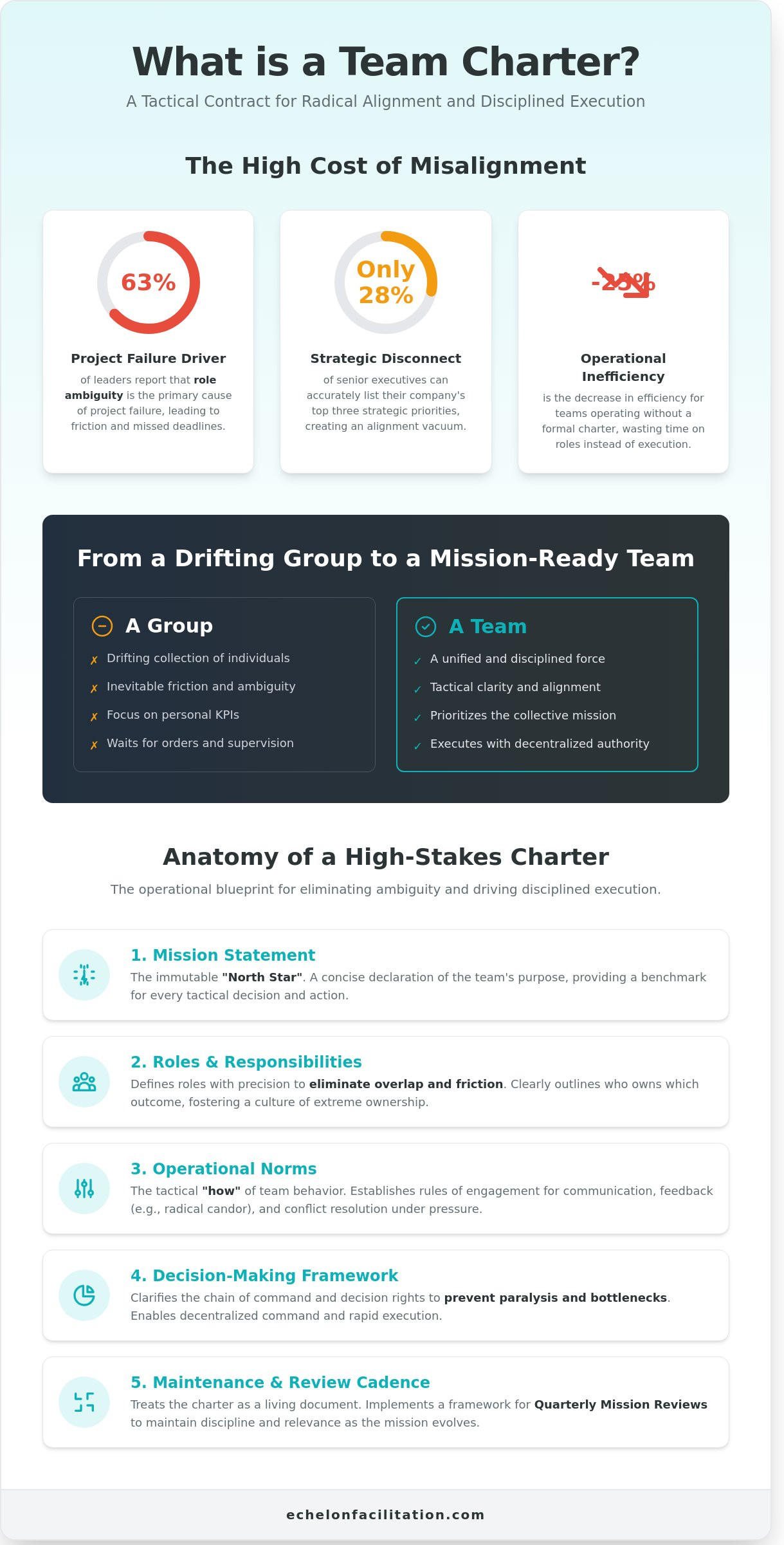
A team without a governing document isn't a team; it's a collection of individuals drifting toward inevitable friction. When 63% of leaders report that role ambiguity is the primary driver of project failure, the cost of "winging it" becomes too high to ignore. Understanding what is a team charter acts as the tactical foundation for every successful operation. It's the difference between a group that waits for orders and a unit that executes with decentralized authority and disciplined focus.
You likely see the symptoms of poor alignment every day in circular meetings and missed deadlines that erode trust. You want a culture where every member understands the mission and takes extreme ownership of the outcome without constant supervision. This guide provides the battle-tested framework you need to achieve radical alignment and reclaim your team's momentum. We'll break down the specific components of a high-performance charter, examine the mechanics of decentralized decision-making, and provide a roadmap for immediate operational implementation.
Key Takeaways
- Define your team's operational standards by understanding what is a team charter—a living tactical contract designed for high-stakes leadership and radical alignment.
- Deconstruct the anatomy of a battle-tested charter to establish a Mission Statement that serves as the immutable North Star for all collective actions.
- Clarify the strategic distinction between your operational "software" and your project "hardware" to eliminate friction and improve execution.
- Execute a structured facilitation process that builds extreme ownership and ensures the team is fully invested in their working agreement.
- Implement a framework for Quarterly Mission Reviews to maintain discipline and ensure your charter remains relevant to the evolving mission.
Defining the Team Charter as a Tactical Contract for Alignment
Leadership is a high-stakes discipline where the margin for error is thin. When execution fails, leaders often blame strategy or resource scarcity, but the root cause is usually structural friction. To resolve this, you must understand the fundamentals of a Project charter and how those principles apply to human capital. A team charter isn't a static document buried in a digital archive. It's a living contract that dictates how an executive unit operates under pressure. It transforms vague expectations into a tactical agreement that binds every member to a shared standard of performance.
Misalignment remains the primary friction point for leadership teams. Research from the MIT Sloan Management Review indicates that only 28% of senior executives can accurately list their company’s top three strategic priorities. This gap creates a vacuum where individual agendas replace collective mission success. By establishing what is a team charter in a tactical sense, you eliminate ambiguity and replace it with Extreme Ownership. This framework ensures that every leader owns the outcome of the mission, not just their specific department or silo.
The Difference Between a Group and a Mission-Ready Team
Proximity doesn't equal alignment. Many corporate environments house groups of high-performing individuals who operate in total isolation from one another. These individuals focus on personal KPIs while the collective mission suffers. A mission-ready team undergoes a psychological shift; they prioritize the objective over the individual. Operating without a formal agreement on team norms results in a 25% decrease in operational efficiency according to industry benchmarks, as teams waste time litigating roles rather than executing strategy. A formal charter bridges this gap by codifying the transition from individual contributors to a unified force.
To accelerate this psychological shift, some leaders use high-stakes team-building exercises where trust and clear communication are paramount.
Why 'Nice-to-Have' Documents Fail at the Executive Level
Generic mission statements are useless in a crisis. Board-level teams don't need "good intentions" or vague aspirational language. They require tactical clarity. Most organizational documents fail because they lack the mechanics of execution. When we facilitate workshops, we focus on the practical application of decentralized command. Understanding what is a team charter requires looking past the surface to see the underlying architecture of accountability. A team charter is the operational blueprint for team victory.
- Eliminate Ambiguity: Define roles with precision to prevent overlap and friction.
- Establish Norms: Dictate how the team communicates and resolves conflict during high-stress operations.
- Drive Accountability: Create a culture where every member is responsible for the final result.
The Anatomy of a High-Stakes Charter: Mapping the Mission
A battle-tested charter is more than a document. It's a strategic framework designed to eliminate ambiguity. When leaders ask what is a team charter, they aren't looking for a list of vague aspirations. They're seeking a mechanism for disciplined execution. The foundation of this document is the Mission Statement. This serves as the North Star for every tactical decision. Without a defined mission, teams drift into busy work that lacks impact. The mission must be a concise declaration of the team's reason for existence, providing a benchmark against which every action is measured.
Bottlenecks occur when decision-making rights remain opaque. A high-stakes charter defines exactly who owns which outcome. This clarity prevents the paralysis that often kills momentum in high-pressure environments. By addressing these vital considerations for your team charter, you ensure that the chain of command remains functional even when the leader isn't in the room. Ownership is the primary solution to organizational friction. When every member knows their boundaries and their authority, execution happens at pace.
Core Values vs. Operational Norms
Values are the why, but norms are the how. Aspirational values like integrity mean little without tactical norms that drive daily behavior. Effective teams implement norms such as radical candor or disagree and commit. These rules of engagement act as a self-correcting mechanism for team dynamics. When friction arises, the team relies on established norms to resolve conflict without emotional hyperbole. This approach turns potential friction into a catalyst for better results, ensuring the collective mission remains the priority over individual ego.
Defining Roles and Decentralised Command
Job descriptions are often too broad for high-stakes execution. Leaders must focus on mission-critical responsibilities. This is where the RACI matrix becomes essential. It maps out who is Responsible, Accountable, Consulted, and Informed with surgical precision. Clear roles enable decentralized command. This allows individual members to take initiative within their scope, accelerating the pace of execution. Teams that master this level of clarity often see a 25% increase in project delivery speed. If your team is struggling with ownership, exploring specialized facilitation workshops can bridge the gap between theory and tactical application. Alignment is a choice, and it starts with defining exactly who is doing what.
Team Charter vs. Project Plan: Understanding the Strategic Distinction
Leaders often confuse tactical output with operational alignment. A project plan defines the mission's "what" and "when". It lists milestones, resource allocations, and deadlines. It functions as the hardware of your operation. However, understanding what is a team charter requires looking at the software. The charter dictates how the team interacts, makes decisions, and resolves friction. Even a perfect project plan will fail if the human operating system is corrupted by ambiguity.
A 2023 report from the Project Management Institute suggests that 12% of investment is wasted due to poor project performance. Much of this loss stems from social friction rather than technical failure. When you prioritize the plan over the people, you ignore The Core Attributes of High Performing Teams. Radical alignment isn't found in a Gantt chart; it's forged in the shared commitments of a charter. Execution requires both the map and the will to move together.
The Human Element vs. The Technical Milestone
Technical expertise cannot compensate for poor team architecture. A project plan manages deadlines, but the charter manages conflict. When a crisis occurs, the plan tells you which deadline you missed. The charter tells you how the team will regroup and take ownership of the solution. This distinction is critical for maintaining momentum. Without a charter, a single missed milestone can trigger a cascade of blame. With one, the team falls back on established protocols for decentralized command and accountability. You don't need more meetings; you need better rules of engagement.
When to Deploy a Charter for Maximum Impact
Timing is a strategic variable. You must deploy a charter when the stakes change or the team composition shifts. Don't wait for performance to dip before taking action. Key triggers include:
- New Leadership: Establish the commander's intent immediately to prevent cultural drift.
- Strategic Pivots: Realign the team when the mission objective changes by more than 20% to ensure everyone understands the new direction.
- Post-Merger Integration: Use the charter to synthesize two distinct cultures into a single, high-functioning unit focused on a common goal.
Existing teams stuck in a stalemate can also use a charter as a tactical reset. It clears the slate of past grievances and replaces them with objective standards for execution. The best time to draft a charter is before the first obstacle appears. If you wait for the crisis to arrive, you're already behind the curve. Success requires proactive alignment, not reactive damage control. Disciplined teams win because they've decided how to fight before the battle begins.
The Facilitation Process: Drafting a Living Document for Execution
Building a charter requires more than a casual afternoon meeting. It demands a structured, tactical process that forces teams to confront reality. Most internal attempts at defining what is a team charter fail because they lack objectivity. An external perspective is essential to challenge stagnant assumptions and expose the polite silences that mask systemic friction. Without a neutral party to drive the conversation, teams often default to comfortable narratives rather than addressing the root causes of misalignment.
Step 1: The Diagnostic and Discovery Phase
Effective facilitation begins long before the team enters the room. Pre-work is non-negotiable. We conduct individual interviews to uncover hidden misalignments that people rarely voice in group settings. Research indicates that 65% of team performance issues are tied to unexpressed role confusion. By gathering these insights early, we build an objective truth that prevents the session from devolving into a debate over definitions. This phase sets the stage for a disciplined, fluff-free execution where every participant knows the stakes.
Step 2: The Alignment Workshop
The workshop is the engine of the process. We structure the agenda for maximum output, focusing on high-stakes decision-making rather than passive listening. Echelon's high-stakes workshops are designed for this level of intensity. We facilitate the difficult conversations regarding ownership and accountability. The goal is to move the team from circular debate to Radical Alignment in a single session. We don't leave the room until every leader accepts their specific mission parameters and understands what is a team charter in the context of their daily operations.
Step 3: Finalisation and Socialisation
A charter that sits in a digital folder is a failure. We convert workshop notes into a crisp, authoritative tactical contract. This document serves as the single source of truth for the team. Every member must undergo a formal ratification process; they sign off on the mission and the standards of conduct. To ensure longevity, the charter must be integrated into daily stand-ups and monthly board reviews.
Beyond the Paper: Maintaining Radical Alignment and Operational Victory
The most frequent objection to defining what is a team charter is the fear of irrelevance. Leaders often worry the document will become "shelf-ware" that teams ignore after 30 days. This failure occurs when the charter is treated as a creative exercise rather than a tactical contract. To maintain radical alignment, you must integrate the charter into your operational rhythm. It's the baseline for every decision, not a decorative mission statement.
Establish a Quarterly Mission Review (QMR) to ensure the document remains a functional tool. Every 90 days, set aside 60 minutes to audit your team's execution against the agreed-upon standards. Use this framework:
- Norm Audit: Identify which behavioral norms were violated in the last quarter and why.
- Resource Check: Determine if the team still possesses the authority and tools listed in the original document.
- Recognition: Call out specific instances where a team member demonstrated extreme ownership of the charter's values.
This disciplined review process builds confidence in leadership by proving that standards are enforced, not just suggested. Use the charter as your primary onboarding mechanism. New hires should receive the charter on day one as their operational manual. It removes the guesswork from culture and sets immediate expectations for performance and accountability.
The Charter as a Tool for Conflict Resolution
Conflict is inevitable in high-stakes environments. When friction arises, the charter acts as an objective mediator. Instead of addressing personal grievances, refer back to the agreed-upon norms. If a strategic stalemate occurs, invoke the "Mission First" clause. This forces the team to pivot from individual preferences to the primary objective. The leader's role is to enforce these boundaries with disciplined authority. You don't need to be the judge; you only need to be the steward of the contract the team already signed.
Evolution of the Mission
A team charter isn't a static monument. As your business scales, your original framework may become a bottleneck. According to data from the 2023 Organizational Health Index, 72% of high-growth companies update their operational norms at least once every 18 months to stay agile. Recognize when your team has outgrown its original constraints. Tactical re-alignment is necessary when the mission scope changes or the team size doubles. If your current structure feels restrictive, it's time to rewrite the contract. To ensure your next phase is built on a foundation of absolute clarity, book a facilitation session to build your team's tactical contract.
Translate Strategic Intent Into Operational Victory
Understanding what is a team charter represents the first step toward eliminating organizational friction. This document functions as a tactical contract that demands extreme ownership from every member of the leadership team. It transforms vague objectives into a clear mission, ensuring that every action taken serves the collective goal. Without this level of radical alignment, teams often succumb to decentralized priorities and wasted effort. High-stakes environments leave no room for such inefficiencies.
Echelon Facilitation, founded by Dr Andrew Greenland, a medical doctor who has spent years running large, high-stakes working sessions for senior expert groups, specializes in high-stakes executive alignment. Our disciplined, results-driven facilitation process removes the guesswork from team dynamics. We focus on objective truth and tactical clarity, helping you draft a living document designed for consistent execution. This isn't about fleeting motivation; it's about building a foundation for long-term stability and strategic focus. When you prioritize alignment, you secure the success of your entire operation.
Don't leave your team's performance to chance. Secure your team's alignment with an Echelon Facilitation Workshop today. Your mission depends on the clarity you establish now.
Frequently Asked Questions
What is the difference between a team charter and a mission statement?
A mission statement defines the organization's purpose, while a team charter serves as a tactical operating agreement for a specific group. The mission provides the 30,000 foot view of the objective. In contrast, the charter outlines the protocols, decision making rights, and communication standards necessary for execution. It's the difference between knowing the destination and having the map to navigate the terrain.
Who should be involved in creating the team charter?
Every member of the team must participate in the creation of the charter to ensure decentralized ownership. Alignment fails when a leader dictates terms from the top down. By involving 100% of the stakeholders, you secure commitment to the standards established. This collaborative process identifies friction points before they compromise the mission, ensuring the entire unit operates from a single source of truth.
How long should a team charter be for an executive team?
An executive team charter should be restricted to 2 pages of high impact directives. Brevity ensures clarity and facilitates rapid recall during high pressure scenarios. If a document exceeds 1,000 words, it becomes a bureaucratic burden rather than a tactical tool. Focus on the 5 core pillars: mission purpose, member roles, decision authorities, communication cadences, and conflict resolution protocols.
Can a team charter be changed once it's signed?
A team charter is a living document that must evolve as the operational environment shifts. It's not a static contract but a strategic framework for alignment. When a team undergoes a 20% change in personnel or a major shift in mission scope, the charter requires immediate revision. This ensures the protocols remain relevant to the current tactical reality rather than anchored to obsolete assumptions.
Does a small team of 3-4 people really need a charter?
Small teams of 3 or 4 people require a charter to prevent the ambiguity that often plagues tight knit groups. Understanding what is a team charter for a small group clarifies individual accountability and prevents the bystander effect. Defining rules early ensures limited resources focus on execution.
How do you handle a team member who refuses to follow the charter?
Address non compliance through immediate, direct feedback based on the agreed upon standards. The charter provides the objective benchmark for performance, removing personal bias from the conversation. If a member fails to meet the standard 3 times, it becomes a leadership challenge regarding their fit for the mission. You must prioritize the integrity of the team's alignment over the comfort of a single individual.
Is a team charter legally binding in a corporate setting?
A team charter isn't a legally binding document in a court of law, but it's a professional covenant that governs internal conduct. It functions as a social contract within the corporate structure to enforce accountability and discipline. While it won't be used in 2024 litigation proceedings, it serves as the primary evidence for performance reviews and internal disciplinary actions when standards aren't met.
How often should a leadership team review their charter?
Leadership teams should conduct a formal review of their charter every 90 days. This quarterly cadence ensures the document reflects the current strategic priorities and team dynamics. Additionally, a review must occur within 10 days of a major project completion or a leadership change. Regular maintenance prevents operational drift and keeps the team's tactical execution sharp and focused on the primary mission.