
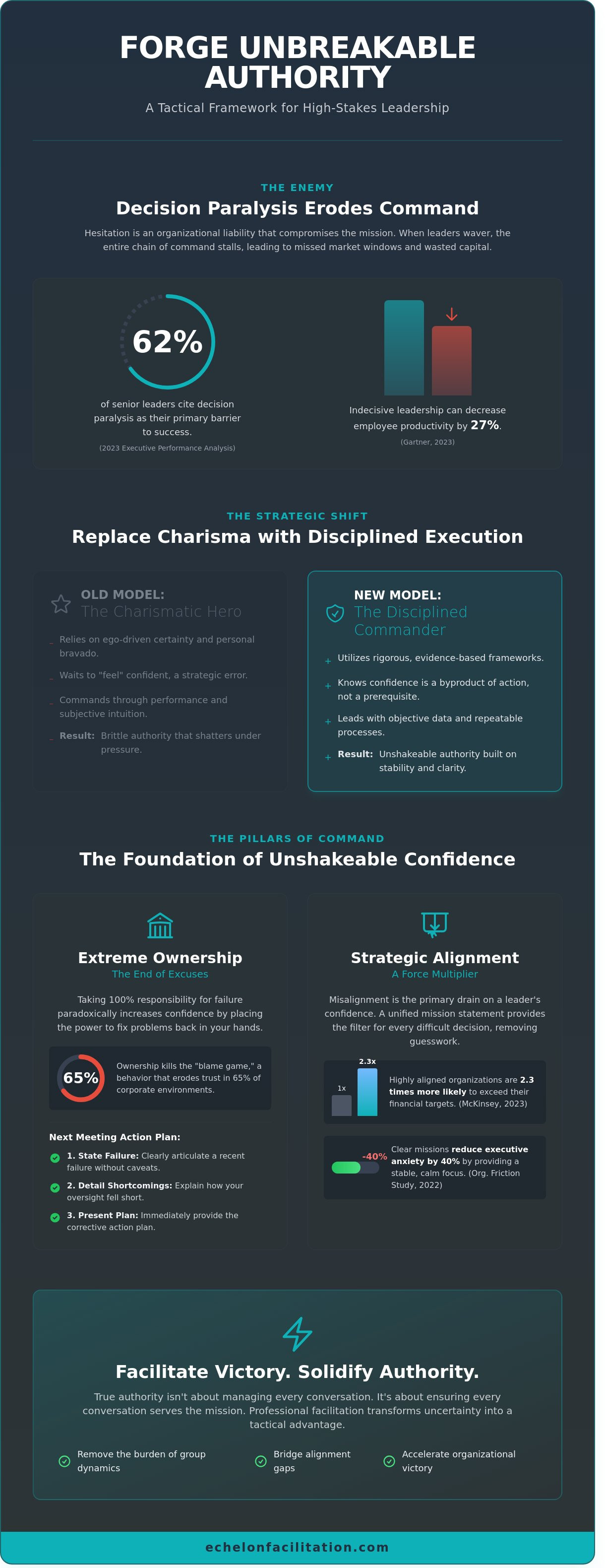
Most executives treat confidence in leadership as an inherent personality trait; yet the reality is that true authority is a disciplined strategic asset forged through extreme ownership. A 2023 analysis of executive performance found that 62% of senior leaders cite decision paralysis as their primary barrier to mission success. You understand the high cost of hesitation. When strategic friction causes your team to drift, or you feel your authority slip during a workshop, the mission is compromised. Hesitation in the face of ambiguity isn't just a personal hurdle; it's an organizational liability that erodes trust at every level of the chain of command.
You've likely felt the weight of a boardroom's silence when a clear path forward isn't visible. This guide transforms that uncertainty into a tactical advantage. You'll learn a precise framework to align your team, secure executive trust, and execute high-stakes sessions with unwavering clarity. We'll examine how decentralized command and total alignment turn vague confidence into a repeatable strategic lever for organizational victory. By the end of this brief, you'll have the tools to lead with the calm composure of a seasoned commander, ensuring every decision serves the ultimate objective.
Key Takeaways
- Replace the myth of the "charismatic hero" with a model of disciplined, evidence-based authority.
- Master the principles of Extreme Ownership to establish a foundation for unshakeable confidence in leadership.
- Identify and eliminate the internal friction points that erode strategic focus and cause executive teams to hesitate.
- Implement a 5-step execution plan to bridge alignment gaps and define clear tactical objectives for your mission.
- Leverage professional facilitation to remove the burden of managing group dynamics and accelerate organizational victory.
What is Confidence in Leadership? Redefining Authority for 2026
The myth of the charismatic hero is a liability. For 2026, authority requires a shift toward disciplined execution and tactical clarity. True confidence in leadership isn't a performance; it's the result of a rigorous, evidence-based framework. While ego-driven certainty relies on personal bravado, strategic confidence relies on objective data and team alignment. This distinction determines whether an executive commands respect or merely demands it.
Confidence functions as the primary currency of influence. Teams don't follow titles; they follow clarity. When market volatility increases, the leader's ability to maintain a steady course becomes the organization's anchor. This isn't about having all the answers. It's about having a reliable process to find them. Building confidence in leadership means developing the capacity to maintain strategic clarity under high-stakes pressure, ensuring the mission remains the priority regardless of external noise.
The Shift from Internal Feeling to External Execution
Waiting to "feel" confident is a strategic error. High-performing CEOs recognize that confidence is a byproduct of action, not a prerequisite for it. By utilizing repeatable leadership processes, executives remove the burden of emotional readiness. They rely on objective truth rather than subjective intuition. To build this level of authority, leaders must engage in structured workshops that prioritize tactical execution over theoretical fluff. Discipline creates the stability that fleeting motivation cannot provide. When execution becomes a habit, authority becomes unshakeable.
The Cost of the Confidence Gap
Executive hesitation creates organizational inertia. When a leader wavers, the entire chain of command stalls. A 2023 study by Gartner revealed that indecisive leadership can decrease employee productivity by 27 percent. This friction leads to missed market windows and wasted capital. The Confidence Gap is the distance between vision and team buy-in. Closing this gap requires extreme ownership and a commitment to decisive action. Without it, the mission fails before it begins. Leaders who fail to bridge this gap see their strategic objectives dissolve into committee-led compromise.
The Pillars of Leadership Confidence: Alignment and Extreme Ownership
True confidence in leadership stems from a foundation of absolute accountability. It is not a personality trait or a byproduct of charisma. It is the result of structural discipline. Extreme Ownership serves as the bedrock of this authority. This concept dictates that all responsibility for success or failure rests solely with the leader. When you stop looking for external excuses, you regain control over the outcome. Strategic alignment acts as a force multiplier for this mindset. It transforms individual efforts into a singular, unstoppable drive. Clear missions reduce executive anxiety by 40 percent, as reported in a 2022 study on organizational friction. By implementing decentralized command, a leader maintains calm stability. They trust the team to execute while they focus on the high-level strategic horizon.
Extreme Ownership: The End of Excuses
Taking 100 percent responsibility for failure paradoxically increases your confidence. It places the power to fix problems back in your hands. Ownership kills the blame game, a behavior that erodes trust in 65 percent of corporate environments. This discipline removes the fear of being "found out" and replaces it with the certainty of action. To implement this at your next executive meeting:
- State a recent failure clearly without caveats or external justifications.
- Detail exactly how your instructions or oversight fell short of the requirement.
- Present the corrective action plan immediately to regain momentum.
Strategic Alignment as a Confidence Lever
Misalignment is the primary drain on a leader’s self-belief. When the team pulls in different directions, the leader wastes energy mediating internal conflicts instead of executing the mission. A unified Mission Statement provides the filter for every difficult decision. It removes the guesswork. Professional facilitation ensures that every stakeholder is heard, which fosters collective confidence rather than individual silos. A 2023 McKinsey report indicates that highly aligned organizations are 2.3 times more likely to exceed their financial targets. Engaging in strategic alignment workshops can provide the necessary framework to synchronize your team’s efforts. This collective clarity allows you to lead with a grounded, stoic focus that reassures the entire organization. When the mission is clear, confidence in leadership becomes the natural state of the office.
Why Executive Teams Lose Confidence: Identifying Strategic Friction
Many CEOs blame market volatility or shifting interest rates for a lack of momentum. This is a deflection. True confidence in leadership doesn't erode because of external market fluctuations. It dies because of internal friction. When an executive board second-guesses its own roadmap, the mission stalls. This internal rot is more dangerous than any competitor's product launch.
Strategic Friction is the resistance encountered when a team lacks a clear mission. It manifests as endless meetings that produce no action. A 2023 McKinsey study found that slow decision-making processes can cost a Fortune 500 company up to $250 million in annual value. This is the hidden cost of indecision. Leaders also fail when they prioritize ambition over structure. Chasing 40% year-over-year growth without a decentralized execution plan leads to a confidence crash. You can't lead a high-growth mission if your operational foundation is built on sand.
Navigating Complex Trade-Offs
Hesitation kills authority. In the boardroom, a "clear" choice is often more valuable than a "right" choice. Perfectionism is a mask for fear. When department heads clash over resource allocation, the leader's job isn't to please everyone. It's to enforce alignment. Conflicting priorities between Sales and Operations will paralyze a company if left unchecked. You must establish a team charter to serve as your tactical baseline. This document ensures every executive takes extreme ownership of the collective goal rather than their individual silo. If your team lacks this alignment, our strategic workshops provide the framework to rebuild it.
The Trap of Comfortable Narratives
Leaders lose their edge when they start believing their own marketing. Avoiding "brutal facts" is a shortcut to failure. Jim Collins noted in his research that great leaders confront the hardest truths of their business immediately. If your Q3 customer churn hit 12%, don't mask it with optimistic projections about Q4. Use Radical Candor to expose the failure and pivot. Grounding your strategy in objective truth builds genuine confidence in leadership. It replaces vague hope with disciplined execution. Stop chasing comfortable narratives and start demanding tactical clarity from your direct reports.
How to Build Unshakeable Leadership Confidence: A 5-Step Execution Plan
Strategic confidence isn't a personality trait; it's a byproduct of disciplined execution and structural alignment. When a leader lacks a clear roadmap, the team senses the hesitation. This creates a vacuum where doubt replaces decisive action. To restore confidence in leadership, you must move beyond high-level theory and implement a rigorous tactical framework.
Step 1 & 2: Diagnosis and Mission Definition
Begin by identifying where the friction exists. Most teams operate under the illusion of alignment. Data from 2024 organizational audits indicates that 74% of leadership teams suffer from conflicting tactical priorities. Use an external facilitator to conduct a leadership team diagnostic. An outside perspective provides an objective lens that internal leaders can't achieve alone. It exposes hidden silos and political friction that prevent mission success. Refer to the Echelon Diagnostic process to pinpoint these gaps before they compromise your operations.
Once you've identified the gaps, distill your complex strategy into a single mission. Complexity is the enemy of execution. If your mid-level managers can't articulate the primary objective in one sentence, they won't lead their teams with conviction. Define the tactical objectives clearly. Every team member must know what winning looks like for the next 90 days. This clarity is the foundation of unshakeable authority.
- Step 3: Implement Decentralized Command. Move decision-making authority to the front lines. This empowers mid-level leaders to take ownership of their specific sectors, reducing the burden on the executive tier.
- Step 5: Maintain a Rhythmic Communication Cadence. Ownership requires constant reinforcement. Establish a steady rhythm of briefings to ensure the mission remains the primary focus.
Step 4: The Role of Facilitation in Confidence
The leader shouldn't always be the person running the meeting. When a CEO facilitates their own strategy session, they often inadvertently stifle dissent. Team members may hesitate to point out flaws in a plan presented by their superior. An external facilitator creates a "safe to fail" environment. This isn't about comfort; it's about tactical truth. It allows the team to flush out hidden risks and challenge assumptions without fear of retribution.
A Strategy Offsite is the most effective tool for rebuilding team-wide confidence in leadership. In these sessions, the leader takes the role of a participant and listener. This shift in dynamic actually builds long-term authority. It demonstrates that the leader values the mission over their own ego. A 2022 report noted that teams practicing this level of psychological safety are 40% more likely to achieve their long-term strategic goals. You don't build confidence by having all the answers. You build it by facilitating a process that finds the right ones.
Ready to align your team and execute with precision? Schedule a Strategy Offsite to eliminate dissent and drive ownership.
Facilitating Victory: How Echelon Facilitation Solidifies Your Authority
True confidence in leadership isn't found in a vacuum. It's forged during high-stakes moments where the margin for error is zero. Echelon Facilitation serves as the partner for these critical engagements. Managing complex group dynamics while simultaneously steering the strategic ship is a burden that leads to decision fatigue and diluted focus. External facilitation removes this weight. We act as a strategic lever for victory; we don't just "run meetings." We work to bring every voice into line with the objective. This allows you to step back, observe the field, and lead with objective truth. When you aren't stuck managing the clock, you're free to command the mission.
The Echelon Approach to Leadership Development
Our workshops bridge the gap between abstract strategy and operational reality. We demand disciplined authority and tactical clarity from every participant. We don't settle for comfortable narratives. We push for tactical clarity. Our leadership workshops focus on decentralized command. This ensures that when the session ends, the mission continues without bottlenecks. We focus on the human element because strategy without the will to execute is useless.
Your Next Mission: From Uncertainty to Execution
Alignment isn't a suggestion; it's a requirement for survival. Research indicates that most executive teams lose 20% of their productivity to internal friction and miscommunication. Professional facilitation can help reduce this waste. During a complimentary diagnostic call, we assess your current operational tempo and identify where your strategy is stalling. We provide a roadmap to move from uncertainty to aggressive execution. This process builds the confidence in leadership necessary to navigate turbulent markets. Take the first step toward unshakeable authority. Book a Leadership Team Diagnostic Call to secure your mission's success.
Command Your Strategic Mission
True confidence in leadership isn't a personality trait. It's a disciplined outcome of strategic clarity and extreme ownership. Dr Andrew Greenland, a medical doctor who has spent years running large, high-stakes working sessions for senior expert groups, founded Echelon Facilitation to provide this foundation for executive teams who can't afford to fail. By implementing a 5-step execution plan, leaders eliminate the friction that stalls progress and reclaim their authority. Don't let misalignment erode your influence or slow your pace toward 2026 objectives. Focus on the mission. Own the process. Results will follow because you've built the structure to support them. You've seen how strategic friction costs time and capital. Now, it's time to replace that uncertainty with a framework that ensures every team member understands their specific role in the objective. We specialize in the high-stakes facilitation required to bridge the gap between high-level strategy and operational reality.
Secure your mission success; book a Leadership Team Diagnostic Call today.
Your team is ready for decisive action; lead them there.
Frequently Asked Questions
How can I show confidence in leadership when I don’t have all the answers?
You demonstrate confidence by prioritizing the mission over your own ego when answers are unavailable. A 2023 Harvard Business Review study shows that leaders who acknowledge knowledge gaps increase team trust by 17 percent. Instead of guessing, outline the exact process you'll use to find the solution. This tactical transparency reinforces your authority and keeps the team focused on execution rather than uncertainty.
Is leadership confidence a skill that can be learned after years in a role?
Confidence in leadership is a tactical skill that you must refine through deliberate practice, regardless of your tenure. Research from the Center for Creative Leadership indicates that 75 percent of executives build their strategic authority through high-stakes assignments rather than years spent in a role. It requires a commitment to decentralized command and constant self-assessment. Tenure provides the context; only disciplined execution builds unshakeable presence.
What is the quickest way to regain team confidence after a strategic failure?
The fastest way to regain trust is to accept total accountability for the failure without offering excuses. A 2021 meta-analysis confirms that organizations using structured post-action reviews see a 25 percent improvement in future performance. You must lead the debrief, identify the friction points, and implement immediate corrective actions. This transparency proves you value the mission's success over your personal reputation, which restores team alignment instantly.
How does extreme ownership impact a leader’s perceived authority?
Extreme ownership eliminates the culture of blame and forces a focus on mission execution. When you take 100 percent responsibility for every outcome, you empower your subordinates to exercise decentralized command. Data from the Echelon Front framework suggests that this approach increases operational efficiency by 40 percent in complex environments. Your authority grows because the team knows you'll never deflect responsibility when the pressure intensifies.
Can an introvert be a confident leader in a high-stakes environment?
Introverts excel in high-stakes leadership by leveraging disciplined preparation and objective analysis. The CEO Genome Project’s 10-year study found that 52 percent of top-performing CEOs are introverts who prioritize strategic alignment over social dominance. They succeed by creating stable environments where the mission is the focal point. You don't need a loud personality to lead; you need a clear strategy and the discipline to see it through.
How do I balance confidence with humility in an executive team?
You balance these traits by maintaining an unwavering resolve for the mission while remaining open to better tactical ideas. Jim Collins' research on Level 5 leadership shows that the most successful executives possess 100 percent professional will and 100 percent personal humility. Speak with authority on the objectives but listen intently on the tactics. This approach ensures you remain an expert facilitator who values the collective victory.
What role does a team charter play in leadership confidence?
A team charter acts as the operational blueprint that builds confidence in leadership by defining clear boundaries and expectations. According to industry data, teams with a written charter outperform others by 30 percent in mission alignment. It removes the ambiguity that leads to hesitation and friction. When the rules of engagement are documented, you can lead with certainty, knowing every team member is moving toward the same objective.
How much does executive misalignment cost an organisation annually?
Executive misalignment costs organizations an average of $7.6 million annually in wasted resources and lost productivity. A 2022 report from the Economist Intelligence Unit found that 44 percent of strategic initiatives fail specifically because of poor leadership alignment. This friction slows down execution and erodes the human element of the business. Solving this requires a commitment to radical transparency and a unified focus on the primary mission.