
Most executive strategies fail not because of poor vision, but because the transition from the boardroom to the office floor lacks a concrete 30-day execution plan. This gap between intent and action is where momentum vanishes and initiatives stall.
Data from the Harvard Business Review indicates that 67% of well-formulated strategies fail due to poor execution. This failure creates a vacuum where ownership becomes diluted and confusion regarding immediate tasks takes hold. When an organisation cannot bridge the divide between high-level goals and daily operations, the result is a significant loss of capital and a decline in team morale. Without immediate, measurable milestones, the initial investment in strategic planning becomes a sunk cost that erodes leadership authority.
This framework provides a disciplined approach to the first month of implementation, ensuring every objective has a clear owner and a defined path forward. You will learn how to establish a roadmap that transforms strategic theory into operational reality with absolute clarity.
Key Takeaways
- Identify the primary causes of operational inertia to prevent strategic failure during the high-risk initial phase of a new initiative.
- Define clear decision rights and ownership frameworks to remove ambiguity and eliminate friction within the leadership team.
- Implement a structured 30-day execution plan that prioritises immediate resource alignment and the systematic removal of operational constraints.
- Transition to a model of decentralised ownership that emphasises measurable outcomes over mere activity to sustain momentum.
The Critical Gap: Why Strategy Fails in the First 30 Days
Leadership teams often leave strategy offsites with a sense of triumph only to watch those ideas dissolve within weeks. This immediate stall occurs because high-level vision lacks a concrete bridge to daily activity, creating a vacuum where momentum dies.
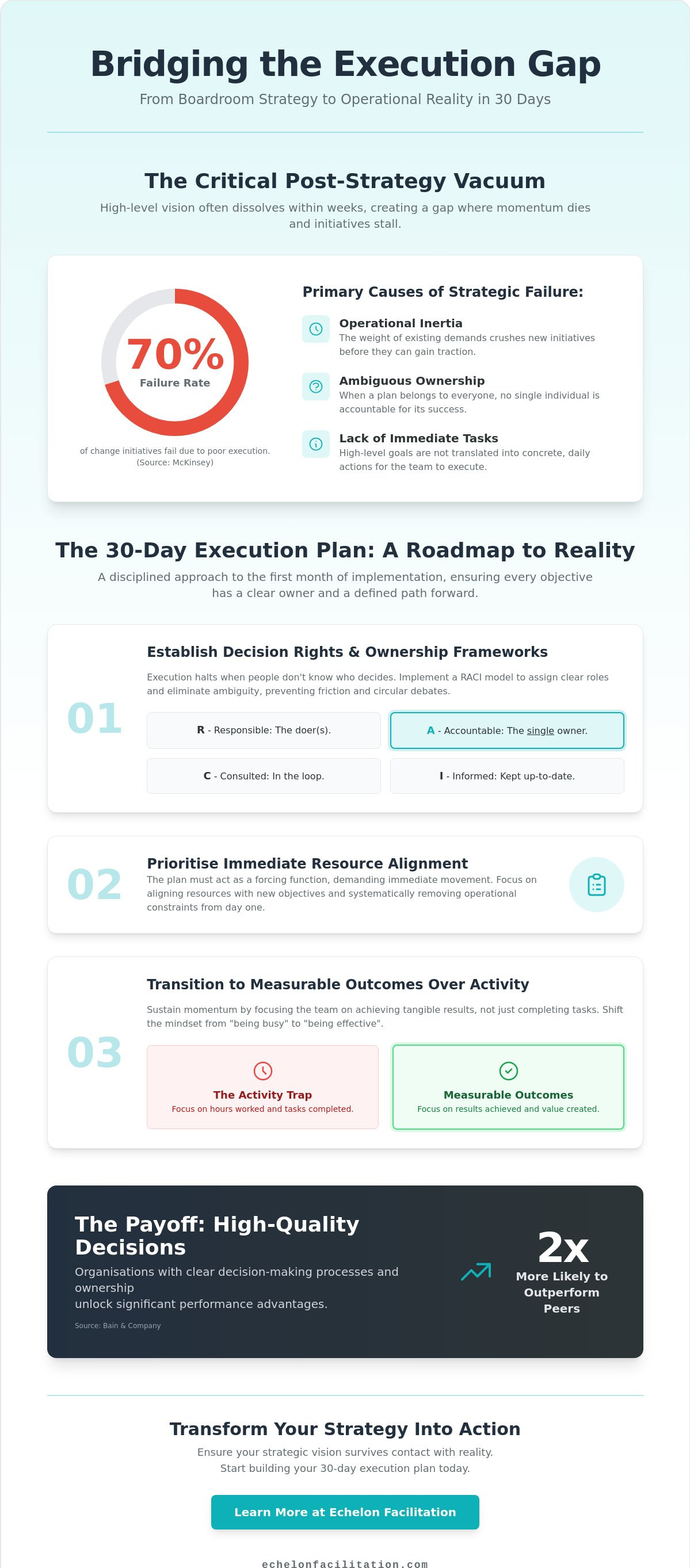
According to McKinsey research, 70% of change initiatives fail due to a lack of management support and employee resistance. This failure typically crystallises during the first four weeks after a strategy is announced. When leaders return to their desks, the weight of existing operational demands crushes new initiatives. Organisations lose significant capital and potential revenue when they allow strategic momentum to evaporate during this critical window. This inertia creates a permanent disconnect between the boardroom and the front line.
A structured 30-day execution plan prevents this drift by turning abstract goals into immediate requirements. This section explores why the first thirty days determine the long-term viability of your strategy and how to establish ownership from day one.
The "execution gap" represents the period where strategic intent meets operational inertia. It is the space between what the board envisions and what the staff actually produces on Monday morning. Strategy fails when it remains a static document rather than a set of evolving behaviours. Without an integrated operational planning framework, the organisation defaults to its previous state. The 30-day execution plan acts as a forcing function, requiring leaders to justify their time against new objectives immediately rather than delaying action for the next quarterly review.
Ownership is the primary casualty of strategic drift. When a plan belongs to the company at large, no single individual is accountable for its success. True progress requires decentralised ownership, where specific leaders hold the mandate for specific outcomes. Unlike annual plans or quarterly OKRs, which allow for slow starts and mid-course corrections, this short-term framework demands immediate movement. It prioritises the present over the eventual, ensuring that the strategy sprint outcomes are converted into tangible tasks before the initial enthusiasm fades.
The Cost of the Post-Offsite Vacuum
Offsite meetings generate a psychological high that rarely survives the first inbox check. The execution gap is the period where strategic intent meets operational inertia, often resulting in the 70% failure rate for change initiatives cited by McKinsey. This vacuum forms when the intensity of the offsite is not matched by a structured return to the office. Without immediate, visible changes in leadership behaviour, the wider team assumes the new strategy is optional.
Distinguishing Execution from Onboarding
A 30-day execution plan is not a training schedule for new hires. It is a tool for established leadership teams to shift organisational momentum. Whilst onboarding focuses on individual learning curves, this plan focuses on collective output and the removal of bottlenecks. It ensures that the existing team is not just busy, but is actively contributing to the new strategic direction through defined, time-bound objectives.
Establishing Decision Rights and Ownership Frameworks
Execution stops when people don't know who decides. A 30-day execution plan requires immediate clarity on authority. Ambiguity creates friction; it slows momentum and forces decisions back up the chain. According to a 2023 study by Bain & Company, organisations with high-quality decision-making processes are twice as likely to outperform their peers financially. Without defined rights, your plan is merely a list of suggestions rather than a mandate for progress.
The RACI model provides the necessary structure for rapid progress. It separates those doing the work (Responsible) from the one person whose neck is on the line (Accountable). For high-stakes choices where multiple stakeholders have veto power, the RAPID framework offers more precision. It identifies the 'D' (Decider) clearly, preventing the circular debates that ruin short-term initiatives. Leaders should consult this 30-60-90 day plan guide to see how these frameworks fit into broader timelines.
Implementing RACI for Immediate Action
Assign exactly one Accountable individual for every strategic pillar within the 30-day execution plan. When two people are accountable, no one is. This clarity allows the team to bypass the consensus trap. Effective Leadership Team Decision Making relies on this decentralised authority to maintain speed. If the Accountable person cannot make a final call without a committee, the framework has failed and the timeline will slip.
Eliminating Group Ownership Fallacies
The phrase "the whole team owns the goal" is a recipe for inaction. In a high-pressure 30-day window, collective ownership often masks individual avoidance. Success depends on specific names attached to specific outcomes. Research suggests that 70% of change initiatives fail due to a lack of clear ownership. Moving from "we" to "he" or "she" ensures that tasks don't fall between the gaps. It's the only way to transform strategy into a functional reality. If your team struggles to define these roles, reviewing our operational framework can provide the necessary structure.
Constructing the 30-Day Execution Plan: A Roadmap for Leaders
The 30-day execution plan serves as the bridge between high-level intent and operational reality. Leaders often mistake a strategy document for a finished action plan; however, without a structured timeline, momentum dissipates within days. This four-week cycle demands relentless focus on specific outcomes and the immediate removal of institutional friction. It's a period of high-intensity alignment that sets the trajectory for the entire fiscal quarter.
Week 1: The 72-Hour Alignment Window
Speed is the primary variable in successful deployment. Leaders must communicate strategic decisions to the entire organisation within a 72-hour alignment window. Delaying this communication creates an information vacuum that staff fill with speculation and anxiety. Utilising a strategy sprint allows teams to compress months of planning into days, ensuring that resource allocation matches the immediate requirements of the 30-day execution plan. During these first seven days, every team member must understand their specific contribution to the objective.
The Weekly Execution Review
The weekly execution review is a 15-minute stand-up designed for the executive team. It is not a general status update or a forum for lengthy debate. The agenda focuses exclusively on "red-light" issues: blockers that prevent a task from moving forward. Each leader provides a binary update on their objectives. If a task is on track, it requires no discussion. If it's stalled, the team identifies the owner responsible for clearing the path. This discipline ensures that small frictions don't evolve into systemic failures.
Week 2 prioritises the removal of operational constraints. Leaders identify the three primary bottlenecks that emerged during the first week and reallocate resources to clear them. This phase requires direct intervention rather than committee-based decision making. By Week 3, the team conducts first-pass reviews based on early performance data. Research from the Harvard Business Review suggests that 67% of well-formulated strategies fail due to poor execution. Week 3 serves as the critical junction where leaders use objective data to course-correct before deviations become permanent.
Week 4 involves a synthesis of results. The executive team evaluates the initial 30-day execution plan against established benchmarks and prepares the transition to the 60-day horizon. Success in this final week is defined by the team's ability to maintain velocity whilst scaling the programme to broader departments. The focus shifts from survival and alignment to sustainability and growth.
Execute your 30-day plan with a strategy sprint.
Sustaining Momentum through Decentralised Ownership
Execution fails when ownership remains centralised at the top of the hierarchy. High-performing organisations distribute authority to those closest to the operational reality. This concept of decentralised ownership ensures that the 30-day execution plan does not become a static document. Instead, it becomes a dynamic framework where individual leaders take full responsibility for specific outcomes. According to research from the Harvard Business Review, 67% of well-crafted strategies fail due to poor execution; decentralising ownership is the primary hedge against this failure. It shifts the internal culture from one of "permission-seeking" to one of "informed action."
To maintain this momentum, the team must utilise a progress report that prioritises outcomes over mere activity. A 30-day progress report should follow this structure to ensure objective clarity:
- Defined Outcome: State the specific result achieved (e.g., "Onboarded 50% of the new regional sales team" rather than "Conducted interviews").
- Ownership: A single name responsible for the result.
- Status: A binary assessment of on-track or off-track.
- Friction Points: Identification of specific barriers that require executive intervention.
This reporting style forces a focus on the results established during the strategy offsite pillar and prevents the team from hiding behind busywork.
The Facilitator as an Execution Partner
Internal accountability often suffers from social friction or political bias. An external facilitator acts as an objective partner who maintains the integrity of the 30-day execution plan without the baggage of internal hierarchies. This role is not about "policing" the team. It involves providing professional accountability support that keeps the focus on the agreed objectives. A facilitator asks the difficult questions that internal staff may avoid, ensuring that the truth of the operation is always visible to the leadership team.
Transitioning to the 90-Day Horizon
The first 30 days are designed to build the operational muscle required for long-term success. Once a team proves it can execute on a short-term horizon, it gains the confidence to manage a 90-day strategic cycle. This transition turns sporadic bursts of energy into a sustainable cadence of delivery. If your leadership team is struggling to translate high-level ideas into concrete results, contact Echelon for a diagnostic call to identify the specific friction points in your current process.
Converting Strategic Intent into Operational Results
Strategy remains a theoretical exercise until it's anchored in specific, time-bound actions. The first month determines whether an organisation builds momentum or reverts to previous habits. By establishing clear decision rights through frameworks like RACI and RAPID, leaders eliminate the ambiguity that stalls progress. High-stakes UK leadership teams recognise that decentralised ownership is the only way to scale execution without creating bottlenecks at the executive level. A robust 30-day execution plan serves as the bridge between intent and reality; it replaces vague aspirations with concrete accountability.
Echelon Facilitation is led by Dr Andrew Greenland, a medical doctor who has spent years running large, high-stakes working sessions for senior expert groups. We help your team move beyond alignment and into measurable output. This process requires discipline and a refusal to accept comfortable narratives over objective truths. When your leadership team operates with total clarity on ownership, the organisation moves with greater precision. It's time to stop discussing what might happen and start directing what will happen.
Begin your 30-day execution journey with a Strategy Sprint
Frequently Asked Questions
What is the difference between a 30-day execution plan and a project schedule?
A 30-day execution plan prioritises strategic alignment and immediate momentum, whereas a project schedule tracks granular tasks and deadlines. The plan focuses on the 3 to 5 critical levers that move the organisation toward its objective. Project schedules often contain hundreds of line items; the execution plan distils these into high-impact milestones that require direct executive ownership and objective performance measurement.
How do I deal with team members who resist the new execution plan?
Resistance usually stems from a lack of clarity or a perceived increase in workload. Address this by enforcing ownership and clarifying decision rights using the RAPID model. When leaders understand their specific role in the 30-day execution plan, 85% of resistance dissipates as ambiguity is replaced by structured accountability. This approach ensures every team member knows exactly how their output contributes to the broader organisational goal.
Can a 30-day execution plan work for a remote leadership team?
This framework is highly effective for remote teams as it's a centralised source of truth for objectives. Digital decentralisation requires more rigorous alignment than in-person environments. By using shared dashboards and weekly synchronisation calls, remote leaders maintain 100% visibility on progress. This structure prevents the silos that often form in distributed environments, ensuring that 10 in 10 team members remain aligned on the primary mission.
What happens if we fail to meet our 30-day targets?
Missing targets provides objective data regarding operational bottlenecks or unrealistic resource allocation. If a team misses 20% of its targets, the leader must conduct a root-cause analysis rather than assigning blame. This process identifies whether the failure resulted from poor execution or a flawed strategic assumption. It allows the organisation to recalibrate the next cycle with greater precision based on 30 days of actual performance data.
How often should the 30-day execution plan be reviewed?
Review the progress through a 15-minute daily stand-up and a substantive weekly progress assessment. The daily rhythm ensures immediate course correction for minor deviations before they compound. The weekly review allows the leadership team to evaluate performance against the 4 key metrics defined at the start of the month. This cadence ensures the organisation remains focused on the mission without becoming bogged down in administrative trivia or unnecessary meetings.