
Most project kick-offs are administrative theatre that masks deep-seated executive disagreement. You recognise the friction caused when roles remain undefined and meetings yield no decisive action. This article demonstrates how to structure an agenda for project kick-off meeting that eliminates ambiguity and establishes definitive ownership from day one.
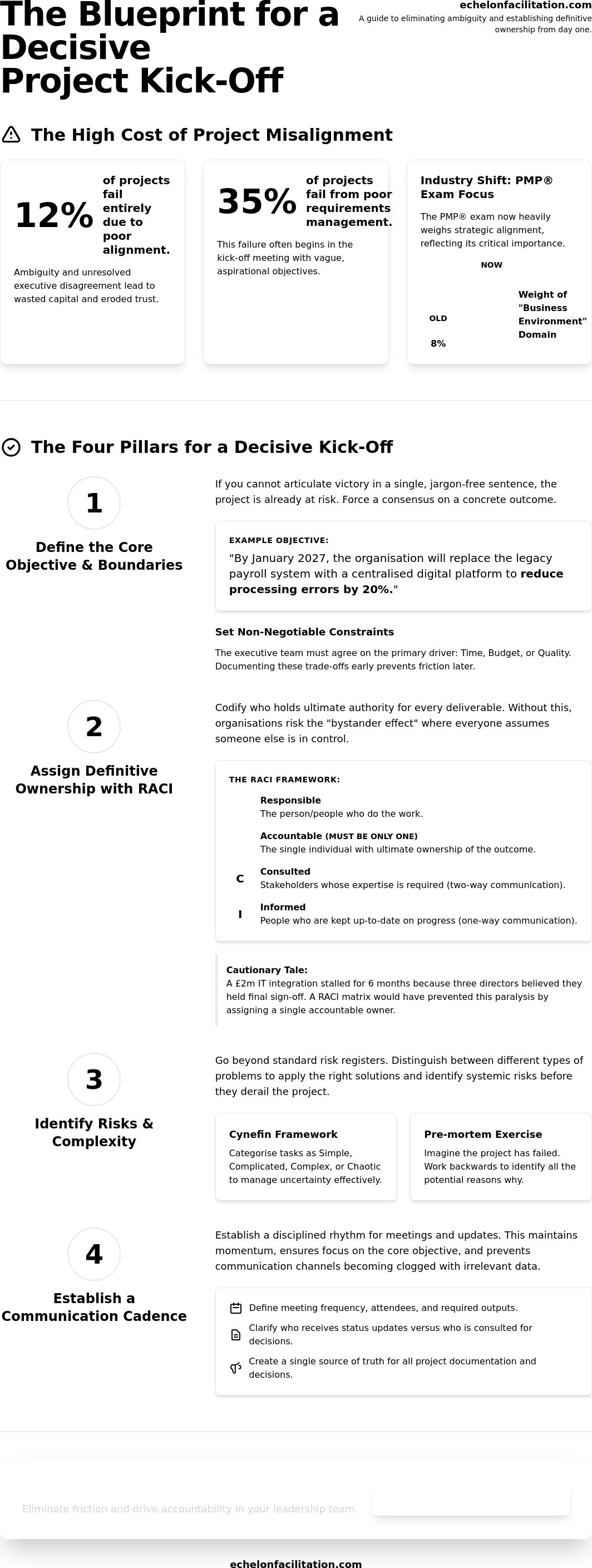
Misalignment is a systemic failure that consumes capital and erodes trust. The Project Management Institute’s 2026 update to the PMP exam reflects this shift, increasing the weight of the "Business Environment" domain from 8% to 26% to address these strategic gaps. Without a rigorous agenda for project kick-off meeting, organisations risk joining the 12% of projects that fail entirely due to poor alignment. This waste of executive time is avoidable through disciplined facilitation and the establishment of clear decision rights from the outset.
We examine the transition to outcome-oriented tracking and the frameworks required to ensure your leadership team remains aligned. You will gain a definitive structure that drives accountability and secures a clear path to project victory.
Key Takeaways
- Define the primary strategic objective and rigid boundaries to prevent scope creep from the outset.
- Structure an agenda for project kick-off meeting that prioritises executive alignment and establishes accountability for outcomes.
- Utilise the RACI framework to eliminate role ambiguity and clarify decision rights amongst the leadership team.
- Categorise project tasks using the Cynefin framework and execute a pre-mortem to identify systemic risks early.
- Establish a disciplined communication cadence to maintain momentum and ensure every participant remains focused on the core objective.
Defining the core objective and project boundaries
Establishing a definitive objective is the first requirement of any agenda for project kick-off meeting. If the leadership team cannot articulate victory in a single, jargon-free sentence, the project is already at risk. Ambiguity at this stage invites scope creep and ensures that resources are misallocated from the outset. Clarity is the primary requirement for executive alignment.
According to the Project Management Institute (PMI), 35% of projects fail specifically due to poor requirements management. This failure often begins in the initial meeting where objectives are discussed in vague, aspirational terms rather than concrete outcomes. To avoid this, your agenda for project kick-off meeting must force a consensus on a single objective, such as: "By January 2027, the organisation will replace the legacy payroll system with a centralised digital platform to reduce processing errors by 20%."
Aligning on the strategic "Why"
Participants must understand how the project serves the broader organisational strategy. This isn't a theoretical exercise; it's a practical step to ensure the project solves a verified business problem. When leaders agree on the strategic purpose, they are better equipped to use a RACI framework to assign ownership in later stages. If the strategic link is weak, the project will likely be deprioritised when the first obstacle appears.
Setting the non-negotiable constraints
Every project operates within the constraints of budget, time, and quality. A successful kick-off requires the executive team to agree on which of these is the primary driver. If a deadline is immovable, the team must accept that scope or budget will be the variables. Documenting these trade-offs early prevents friction during the execution phase. For organisations struggling to define these parameters, a Strategy Sprint can provide the necessary focus before the wider team is engaged.
Assigning definitive ownership through the RACI framework
The transition from a strategic objective to execution requires a rigid structure for decision rights. An effective agenda for project kick-off meeting must go beyond listing names and titles; it must codify who holds the ultimate authority for every deliverable. Without this, the organisation risks the "bystander effect," where everyone assumes someone else is in control. High-performing executive teams recognise that establishing strategic alignment starts with individual accountability.
In 2024, a £2m IT integration for a mid-market manufacturing firm stalled for six months because three directors believed they held final sign-off on the vendor selection. This overlap created a paralysis of analysis. By applying a RACI matrix (Responsible, Accountable, Consulted, Informed), the firm identified the conflict. We designate one person as "Accountable" (the owner of the outcome) and others as "Responsible" (the executors of the task). If your agenda for project kick-off meeting lacks this distinction, you are planning for friction.
Establishing the single point of accountability
Accountability is binary. It cannot be shared. Every workstream within the project must have exactly one accountable individual. Accountability by committee is a common failure point; it leads to diluted responsibility and slow decision-making. In high-stakes environments, a single person must be empowered to make the final call, even if they choose to delegate the underlying tasks. A rigorous agenda for project kick-off meeting ensures that these roles are not just discussed but formally recorded. For teams struggling with overlapping jurisdictions, a Decision-Rights Reset can clarify these boundaries before they derail the project.
Defining consultation and information loops
Productive projects distinguish between those whose expertise is required (Consulted) and those who simply need to know the status (Informed). Over-consultation leads to decision fatigue. Your kick-off must set expectations for these loops to prevent communication channels from becoming clogged with irrelevant data. Clarify which stakeholders have a voice in the process and which will receive only the final output. This discipline preserves executive bandwidth for high-value interventions.
Managing complexity and identifying operational constraints
Standard risk registers often fail because they treat every threat as a linear problem. An effective agenda for project kick-off meeting must distinguish between technical complications and systemic complexity. Identifying "unknown unknowns" requires a move beyond simple spreadsheets. We examine how different components of the project interact and where dependencies might create unforeseen friction. This level of scrutiny is often difficult for internal teams to achieve alone due to existing organisational biases.
Applying the Cynefin framework to project risks
The Cynefin framework allows the leadership team to categorise tasks as Simple, Complicated, Complex, or Chaotic. Most executive projects sit in the Complicated or Complex domains. Complicated tasks require expert analysis and detailed planning. Complex tasks, however, require a "probe, sense, respond" approach because the relationship between cause and effect is only clear in hindsight. Including this categorisation in your agenda for project kick-off meeting ensures the team doesn't try to solve a complex cultural shift with a simple technical fix. This clarity prevents the misapplication of resources and sets realistic expectations for delivery across departments.
The Pre-mortem: Identifying failure points
A pre-mortem is a prospective hindsight exercise that forces the team to imagine the project has failed one year from today. Working backwards from this hypothetical disaster reveals hidden hurdles and flawed assumptions. This process uncovers specific behaviours or operational constraints that a standard SWOT analysis misses. It shifts the focus from optimism to objective reality. If you want to identify these constraints with professional precision, see how we work to facilitate these critical sessions. By surfacing these risks early, the team can build mitigation strategies into the project plan before the first pound is spent. This exercise ensures that alignment is not just a sentiment, but a fortified strategic position.
Establishing a communication cadence for sustained alignment
Alignment is not a static state achieved once and forgotten. It's a dynamic condition that requires continuous recalibration. The final phase of your agenda for project kick-off meeting must define the communication cadence that will sustain the project through its lifecycle. Without a structured rhythm, executive teams often default to reactive micromanagement or, worse, complete disengagement. Momentum relies on a predictable flow of high-quality information.
Effective communication distinguishes between strategic dialogue and operational updates. Dashboards and asynchronous channels should handle the latter, whilst scheduled sessions focus on the former. This discipline ensures that meeting time is used for resolving friction rather than reciting status reports. For leadership teams looking beyond immediate execution, strategic alignment provides the framework for long-term organisational stability. Transparency amongst the executive team is non-negotiable; bad news must travel faster than good news to allow for timely intervention.
Designing the meeting architecture
A rigorous meeting architecture prevents the "meeting about meetings" culture. Your agenda for project kick-off meeting should formalise the following tiers:
- Weekly Progress Reviews: 30-minute sessions focused on removing immediate blockers and verifying workstream progress.
- Monthly Steering Committees: 90-minute sessions for high-level resource allocation and strategic adjustments.
- Quarterly Alignment Checks: Half-day sessions to ensure the project still serves the evolving organisational strategy.
Each session must have a specific objective and a mandatory attendee list to protect executive bandwidth.
Formalising the decision-making process
Decision-making paralysis is a primary cause of project failure. The executive team must agree on a deadlock-breaking mechanism before conflict arises. If consensus isn't reached within a defined timeframe, the "Accountable" individual identified in the RACI matrix makes the final call. Documenting the escalation path to the board or steering group ensures that critical issues don't linger. This process removes the emotional weight from difficult decisions and maintains the focus on the primary objective.
Securing the path to project victory
Strategic alignment is a deliberate choice made during the initial hours of a project's lifecycle. A rigorous agenda for project kick-off meeting serves as the foundation for this discipline, transforming vague intentions into concrete accountability. By defining victory through jargon-free objectives and enforcing ownership via the RACI framework, you eliminate the ambiguity that stalls 35% of requirements-heavy projects. Recognising complexity through the Cynefin model ensures your team applies the correct response to every hurdle, whilst a disciplined communication cadence maintains momentum long after the initial session concludes.
Execution requires more than a checklist; it demands the objective perspective of an expert facilitator. Dr Andrew Greenland provides the high-stakes executive alignment necessary to navigate these organisational shifts. Utilising proven frameworks such as RACI and the Cynefin model, we ensure your leadership team remains focused on the core objective. Organise a professional facilitation session for your next project kick-off to establish definitive ownership from day one. Your project's success is determined by the clarity you establish today.
Frequently Asked Questions
What is the primary goal of an agenda for project kick-off meeting?
The primary goal of an agenda for project kick-off meeting is to secure total executive alignment and establish definitive ownership of outcomes. It isn't a social introduction; it's a strategic exercise to eliminate role ambiguity from day one. By the end of the session, every participant must understand the definition of victory and their specific decision rights. This clarity prevents the friction that typically derails 12% of high-value projects.
How long should a high-stakes project kick-off meeting last?
A high-stakes kick-off session typically requires 4 to 8 hours of focused dialogue. Complex organisational shifts cannot be resolved in a 60-minute status update. This duration allows sufficient time for a rigorous pre-mortem exercise and the application of the RACI framework. Shorter meetings often skip the critical strategic discussions, leading to systemic failure during the execution phase when roles haven't been clearly defined.
Who should be responsible for facilitating the project kick-off?
An objective external facilitator should lead the session to ensure neutrality and challenge existing organisational biases. Internal leaders often struggle to navigate the power dynamics and hidden hurdles that reside within their own teams. A professional facilitator ensures the agenda for project kick-off meeting remains focused on strategic objectives rather than individual accolades. This approach maintains a disciplined environment where objective truth is prioritised over comfortable narratives.
Can a project kick-off meeting be held virtually whilst maintaining alignment?
Virtual kick-offs maintain alignment only if the facilitator employs a more rigid structure and smaller breakout groups to ensure active participation. Maintaining engagement in a digital environment requires shorter segments and a strict adherence to the communication cadence. Whilst in-person sessions are preferred for building trust in 100% of cases, virtual platforms can succeed if the agenda prioritises interactive decision-making over passive observation.
What is the most common mistake in a project kick-off agenda?
The most frequent error is focusing on a checklist of tasks rather than establishing definitive ownership and strategic objectives. Many agendas fail because they don't address the decision-rights framework, leaving roles ambiguous. This mistake often results in a bystander effect where 70% of team members wait for others to act. Ensuring the agenda addresses the strategic purpose and the RACI matrix is essential for project victory.

Article by
Andrew Greenland
Dr Andrew Greenland is the founder of Echelon Facilitation, a UK practice that designs and runs high-stakes leadership sessions for executive teams who need decisions, not more discussion. A medical doctor and medical educator, Andrew brings a clinician's discipline to the messy, political work of leadership alignment - surfacing the real disagreement, forcing the real choices, and ensuring every session produces a documented decision log with named owners and deadlines. He works with CEOs, executive teams, transformation leads, and boards across the UK and internationally. Based in Twickenham.