
Decision Ownership: How to Resolve Leadership Friction and Drive Execution
An executive team leaves a three-hour strategy session believing they've reached a consensus, only to discover forty-eight hours later that three different departments are pursuing conflicting versions of the same objective. This breakdown occurs when decision ownership is treated as a collective suggestion rather than a specific individual assignment.
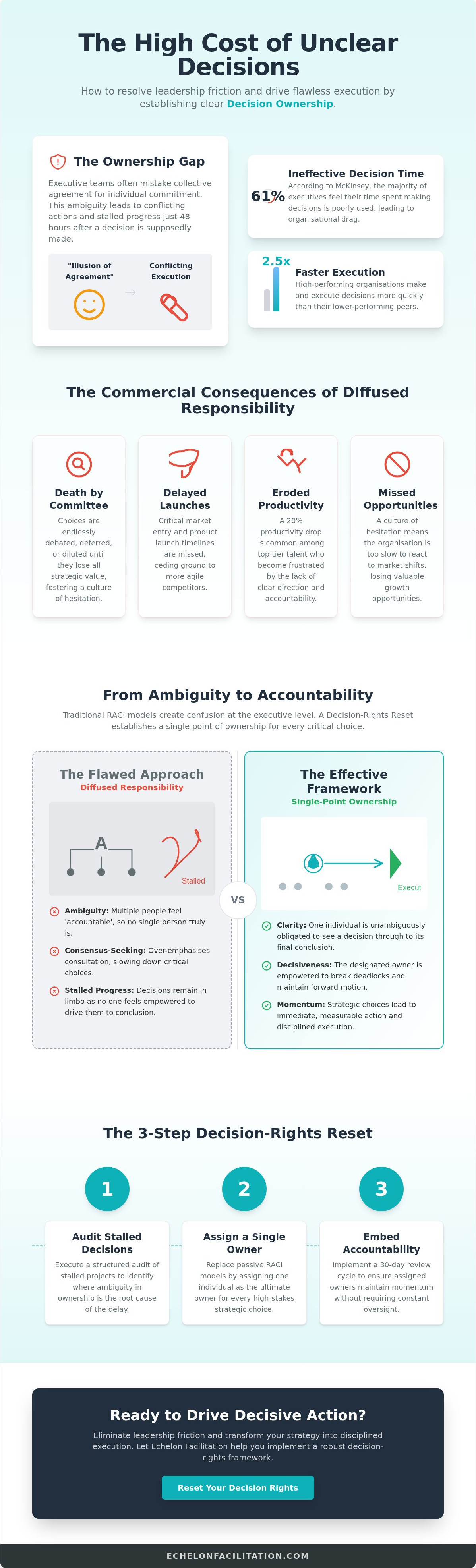
This misalignment stems from a failure to define who holds the final authority. When accountability remains diffused, the organisation pays a measurable price in momentum. Research published in Harvard Business Review indicates that high-performing organisations are 2.5 times more likely to make and execute decisions quickly than their peers. Without clear rights, leadership teams default to consensus-seeking, which creates a drag on performance. This friction delays product launches, inflates operational costs, and ultimately erodes the authority of the executive suite.
You likely recognise that a lack of clarity in the boardroom leads to paralysis on the front line. This article provides a structured framework to reset decision rights and establish firm decision ownership to eliminate the ambiguity that stalls your organisation's progress. You'll learn to assign individual accountability that ensures every strategic choice leads to immediate, measurable action.
Key Takeaways
- Distinguish between strategic agreement and execution commitment to identify exactly where leadership friction originates within the organisation.
- Replace passive RACI models with a rigorous framework that establishes a single point of accountability for every high-stakes choice.
- Define decision ownership as the specific obligation of one individual to drive a choice through to its conclusion, eliminating the ambiguity that stalls progress.
- Execute a structured audit of stalled decisions to reorganise how the executive team handles complex strategic choices.
- Implement a 30-day review cycle to embed accountability and ensure assigned owners maintain momentum without requiring constant oversight.
Recognising the Decision Ownership Gap in Executive Teams
Executive teams frequently mistake a collective nod of the head for a commitment to act. Decision ownership is the unambiguous obligation of one specific individual to drive a choice to its final conclusion. It differs fundamentally from strategic agreement. Whilst a leadership team might reach a consensus on the general direction, ownership ensures the objective does not stall once the meeting ends. Without this clarity, the most brilliant strategies remain nothing more than expensive ink on paper.
Ambiguity carries a heavy commercial price. Research from McKinsey indicates that 61% of executives feel their decision-making time is ineffective. This inefficiency manifests as "death by committee," where choices are deferred or diluted until they lose their strategic value. Circular debates become the standard operating procedure; this results in initiative proliferation where too many projects compete for the same pool of limited resources. Decision ownership acts as the corrective force, pinning responsibility to a single leader who is empowered to break the deadlock and maintain momentum.
Why Consensus Often Masks Misalignment
Collegial norms often stifle progress within senior teams. Leaders frequently avoid challenging vague responsibilities to maintain a facade of harmony, creating an "illusion of agreement" where silence is misinterpreted as commitment. Consider a London-based fintech firm that spends six months debating a market entry strategy because the CEO never appoints a single lead. Every executive agrees the move is necessary, yet no one feels personally responsible for the outcome. Without a clear Responsibility assignment matrix, individual leaders assume a colleague will handle the execution, leaving critical choices in a state of permanent limbo. True alignment requires the discomfort of naming one person as the ultimate owner.
The Commercial Consequences of Diffused Responsibility
Diffused responsibility erodes operational speed and poisons organisational culture. High-performing employees grow frustrated when leadership fails to provide clear direction, often resulting in a 20% drop in productivity amongst top-tier talent who refuse to operate in a vacuum of accountability. When decision ownership remains unclear, competing priorities dilute focus and stall growth. This lack of individual commitment creates a culture of hesitation where urgency is replaced by bureaucracy. Ultimately, this impacts the bottom line through missed market opportunities and delayed product launches. Resolving the decision ownership gap is the first step toward transforming a stagnant executive group into a high-performance team capable of disciplined execution.
Implementing a Decision-Rights Framework Beyond the RACI Matrix
The RACI matrix often fails at the executive level because it encourages a culture of consensus by default. Whilst useful for project management, it creates ambiguity in the boardroom by over-emphasising consultation. High-performing teams require a Decision-Rights Reset that isolates the Accountable individual as the sole owner. This clarity ensures that clear decision roles replace the blurred lines of collective responsibility. When the "A" is diluted amongst a group, speed and quality of execution inevitably suffer.
Effective decision ownership also requires a process known as Decision Stacking. This involves identifying the hierarchy of choices and determining which must be finalised before others can proceed. For example, a leadership team cannot settle on a 2025 marketing budget until it has reached a firm conclusion on its target market positioning. Addressing these dependencies in the wrong order leads to circular debates and wasted executive hours. By stacking decisions logically, leaders maintain forward momentum and prevent the need for constant backtracking.
The Problem with "Too Many Cooks"
Shared ownership is a fallacy. When more than one person owns a decision, nobody does. This structure triggers social loafing, a psychological phenomenon where individuals in a group setting exert less effort because they assume others will fill the gap. In executive committees, this manifests as a lack of rigour during the evaluation of risks. True decision ownership demands a single point of failure. One person must carry the weight of the choice, whilst others provide the necessary data and support to ensure that choice is informed.
Defining the Scope of Authority
Organisations must distinguish between input rights and decision rights to avoid gridlock. Input rights allow stakeholders to provide data and perspectives, but they do not carry a vote. Picture a technology firm where a major product launch slips by nine months because four different department heads believe they hold a veto over the final design. That overlapping authority paralyses the project and costs the company market share. To prevent such outcomes, leaders must document exactly who makes the final call and who is merely being consulted. Establishing these boundaries is a core component of Leadership Team Decision Making and ensures that internal friction does not halt progress.
If your team struggles to move past the consultation phase, a structured strategy sprint can help clarify these roles and restore operational velocity.
Facilitating a Decision-Rights Reset: A Step-by-Step Approach
Resolving leadership friction requires a deliberate pause in operations to recalibrate the organisation’s mechanics. A decision-rights reset is not a casual discussion; it is a structured intervention designed to eliminate the ambiguity that breeds resentment. To establish true decision ownership, leaders must follow a precise sequence that moves from objective analysis to personal accountability.
- Step 1: Audit high-stakes decisions. Review every major decision from the last 180 days. Identify those that stalled, required constant re-litigation, or caused friction between departments. Focus on the 20% of decisions that drive 80% of the organisation's results.
- Step 2: Convene a dedicated session. Remove the leadership team from the weekly operational cycle. This session must focus exclusively on governance and structure. Do not allow the meeting to descend into a discussion about current projects or tactical fires.
- Step 3: Force the Public Commitment. Every leader must explicitly accept ownership of their assigned areas. Ambiguity is often a shield against accountability. Publicly stating "I own this" ensures that every member of the team knows exactly where the buck stops.
- Step 4: Codify the output. Document the results in a living charter that governs future boardroom behaviour. This document serves as the objective truth when future disputes arise.
Research from Harvard Business School suggests that a clear framework for decision rights is essential for performance, as it prevents the 'decision gap' where no one feels empowered to act. Without this structure, decision ownership remains a theoretical concept rather than an operational reality.
The Role of the Neutral Facilitator
Internal leaders cannot easily facilitate their own decision-rights reset. Inherent biases and historical power dynamics inevitably skew the conversation. A Chief Executive who facilitates the session often inadvertently suppresses dissent or reinforces existing silos. An external facilitator provides the objective distance necessary to challenge assumptions and ensure that the reset is based on strategic logic rather than internal politics. Professional Facilitation Services provide the neutral ground required to reach a genuine consensus that holds under pressure.
Managing Resistance During the Reset
Resistance often manifests as a concern about "siloed working." Leaders may argue that clear ownership prevents collaboration. This is a fallacy. Clarity does not prevent collaboration; it defines the terms of it. Collaboration without ownership is simply a committee, and committees rarely drive execution. To manage this resistance, introduce a practical "Decision Log" to track progress. A standard template should include:
- Decision Area: The specific category of choice (e.g., Capital Expenditure).
- Decision Owner: The single individual with the final "yes" or "no."
- Consulted Parties: Those who provide expertise but do not have a veto.
- Execution Lead: The person responsible for implementation after the choice is made.
This level of detail transforms decision ownership from a vague leadership principle into a functional tool for daily operations. It removes the emotional weight of decision-making and replaces it with a predictable, repeatable process.
Secure the clarity your leadership team needs to execute without friction. Contact Echelon Facilitation to schedule a decision-rights reset for your board.
Embedding Accountability to Sustain Strategic Momentum
Execution fails when decision rights remain theoretical. Leaders must move from the facilitated environment to the operational reality without falling back into the trap of micromanagement. Effective decision ownership requires a structured transition. We implement a "30-Day Review" cycle to ensure that assigned owners are actually exercising their rights. This checkpoint isn't a performance appraisal; it's a diagnostic tool. If a decision hasn't been made, the review identifies whether the barrier is a lack of information or a lack of authority. This disciplined approach is central to How We Work at Echelon.
Sustaining momentum demands a cultural pivot. Organisations must value the individual who owns a mistake over the executive who hides in a committee. Committee-based decision-making often serves as a shield against personal risk, which inevitably slows execution. When a single owner is accountable, the path to resolution is shorter. Data from recent organisational audits suggests that teams with clear accountability structures experience 20% fewer project delays compared to those relying on consensus-heavy models. Accountability isn't a burden; it's the engine of speed.
The Link Between Ownership and Executive Alignment
Ambiguity breeds political posturing. When decision boundaries are blurred, leaders compete for influence rather than outcomes. Clear decision ownership eliminates this friction by defining exactly where one leader's authority ends and another's begins. This clarity builds trust amongst the leadership team, as it removes the fear of being undermined. Understanding Decision Making Trade-offs ensures that alignment remains robust even when stakes are high and resources are limited.
Measuring Success in Decision Rights
Success in this framework is measured through objective KPIs rather than subjective sentiment. Leaders should track three primary metrics:
- Meeting Efficiency: A reduction in total meeting hours by at least 15% as unnecessary "consulted" parties are removed from the room.
- Velocity: A measurable decrease in the time elapsed between identifying a problem and implementing a solution.
- Confidence: Increased scores in internal leadership surveys regarding role clarity and autonomy.
Facilitation turns strategic intent into disciplined action. By formalising who decides, who contributes, and who executes, an organisation moves from a state of friction to one of flow. This transformation requires more than a workshop; it requires a commitment to the objective truth of results. When ownership is absolute, execution becomes inevitable.
Secure Strategic Momentum Through Execution
Leadership friction is rarely a result of poor intent; it's the inevitable outcome of structural ambiguity. Moving beyond the limitations of the RACI matrix requires a commitment to absolute decision ownership. Facilitation by Dr Andrew Greenland, a medical doctor who has spent years running large, high-stakes working sessions for senior expert groups, grounds every session in your team's real decisions rather than theory. This approach focuses on disciplined execution, ensuring that every member of the executive team understands their specific role in the decision-making process.
Clarity is the primary driver of execution. By implementing a formal reset, leadership teams move from a state of reactive friction to one of proactive momentum. The result is an organisation that makes better choices, faster, and stays focused on its core objectives without the drag of internal misalignment. It's time to replace the noise of debate with the precision of clear accountability. Your team has the talent to succeed; they simply require the framework to act with certainty.
Book a Decision-Rights Reset for your leadership team to transform your strategic execution today.
Frequently Asked Questions
How does decision ownership differ from accountability?
Decision ownership is the proactive commitment to drive a choice to its conclusion, whilst accountability is the retrospective obligation to answer for the result. Ownership requires an individual to possess the authority and the will to navigate obstacles during execution. In a 2021 McKinsey study, organisations with clear decision ownership were 2.5 times more likely to outperform peers on total shareholder returns. Accountability often exists on paper; ownership exists in the actions taken before the deadline.
What is the most common reason for decision ownership failure?
Ambiguity regarding who holds the final authority is the primary driver of failure. When leadership teams rely on consensus rather than designated decision ownership, execution slows by an average of 20 percent according to industry benchmarks. This lack of clarity creates a vacuum where multiple stakeholders believe they have a veto, leading to stalled progress. Without a single individual named as the owner, the initiative loses momentum as soon as it encounters cross-departmental friction.
Can decision ownership be shared between two departments?
Decision ownership cannot be shared without diluting responsibility and creating operational friction. Whilst multiple departments contribute data or execute tasks, one specific leader must hold the final authority to break deadlocks. Attempting to split ownership between two heads of department leads to a 30 percent increase in project delays due to conflicting priorities. Effective organisations ensure that whilst many are consulted, only one individual owns the decision-making process for a specific outcome.
How often should a leadership team review its decision-rights framework?
Leadership teams must review their decision-rights framework at least once every 12 months or immediately following a significant organisational change. Structural shifts such as mergers or a 15 percent change in headcount require an audit of who holds authority. Regular reviews prevent the authority creep that occurs when legacy processes no longer align with current strategic objectives. These audits ensure that decision ownership remains with the individuals closest to the operational reality.
What should we do if an executive refuses to take ownership of a critical area?
Address the refusal as a structural or performance issue rather than a personal preference. If an executive declines ownership, it often signals a 40 percent misalignment between their key performance indicators and the required outcome. Facilitate a direct conversation to identify if the refusal stems from a lack of resources or a misunderstanding of the objective. If the executive continues to abdicate responsibility, the chief executive must reassign the portfolio to a leader who demonstrates the discipline required for execution.