
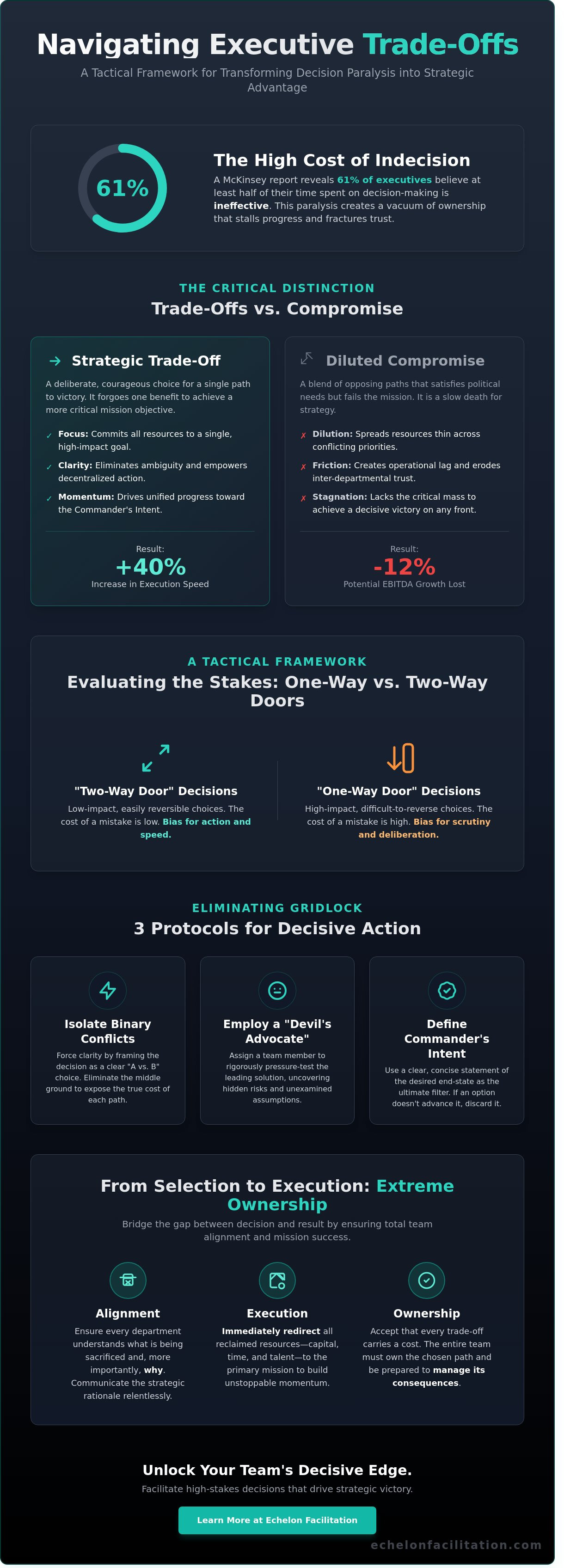
A 2023 McKinsey report reveals that 61% of executives believe at least half of their time spent on decision-making is ineffective. Leadership isn't about finding the perfect path; it's about the disciplined execution of decision making trade-offs that others are too paralyzed to make. You've likely felt the friction of a team stuck in analysis, where the fear of alienating a department outweighs the necessity of the mission. This hesitation creates a vacuum of ownership that stalls progress and breeds resentment across your ranks. When leaders fail to choose, the organization pays the price in lost momentum and fractured trust.
You recognize that every strategic choice carries a cost, yet the pressure to please every stakeholder often leads to compromise that serves no one. This article provides a tactical framework to navigate complex executive trade-offs with stoic confidence and ensure your team takes extreme ownership of the final choice. We will examine the mechanics of priority evaluation and the specific protocols required to transform a difficult compromise into a unified strategic victory for 2026. By the end of this guide, you'll have the tools to convert decision paralysis into a decisive operational advantage.
Key Takeaways
- Define trade-offs as the currency of executive leadership to gain strategic clarity on your most critical mission objectives.
- Analyze the economic reality of decision making trade-offs to calculate the true opportunity cost of every strategic path not taken.
- Utilize a tactical framework to distinguish between reversible choices and high-impact "one-way door" decisions that require maximum scrutiny.
- Eliminate organizational gridlock by isolating binary conflicts and employing a "Devil’s Advocate" to pressure-test competing solutions.
- Bridge the gap between selection and execution by implementing Extreme Ownership to ensure total team alignment and mission success.
Understanding Decision Making Trade-offs in High-Stakes Leadership
Trade-offs represent the conscious choice to forgo one benefit to achieve a more critical mission objective. In the high-stakes environment of executive leadership, these choices serve as the primary currency of strategic clarity. You cannot lead effectively if you refuse to choose. Attempting to "do it all" results in organizational dilution, where resources are scattered and impact is neutralized. Research from the MIT Sloan School of Management suggests that only 28% of executives can list their company’s top three strategic priorities. This lack of focus stems from an inability to navigate Understanding Decision-Making_Trade-offs. When teams lack a shared evaluation framework, they encounter "Trade-off Friction." This friction creates operational lag, erodes trust, and prevents decentralized units from taking decisive action. Mastering decision making trade-offs isn't about finding a perfect balance; it's about making a hard choice and owning the consequences.
The Psychology of Choice: Why Trade-offs Feel Like Loss
Loss aversion often paralyzes leadership teams. They view the rejection of a viable alternative as a permanent defeat rather than a tactical pivot. This psychological barrier leads to "compromise" decisions that satisfy political needs but fail the mission. Leaders must also navigate the intertemporal challenge. This requires sacrificing short-term stability, such as immediate quarterly margins, to fund long-term growth initiatives targeted for 2026. Success depends on the Commander's Intent. Use this clear, concise statement of the desired end-state as the ultimate filter for every difficult choice. If an option doesn't directly advance the Commander's Intent, it's a distraction that you must discard. Discipline in this area ensures that the team’s energy remains focused on the primary objective.
Trade-offs vs. Compromise: A Critical Distinction
Compromise is often a slow death for strategy. It attempts to blend two opposing paths, resulting in a diluted solution that lacks the resources to succeed in either direction. You'll identify a weak compromise when a project has multiple, conflicting KPIs or a budget spread thin across twelve "top priorities." According to a 2022 survey of 1,500 executives, organizations that prioritized aggressive trade-offs over compromise saw a 40% increase in execution speed. In contrast, a trade-off empowers a single objective by stripping away secondary concerns. It demands extreme ownership of the chosen path and the courage to leave other opportunities behind. A successful trade-off is a deliberate commitment to a single path of victory. Use decision making trade-offs to eliminate the middle ground and force your organization into a position of strength.
- Alignment: Ensure every department understands what is being sacrificed and why.
- Execution: Redirect all reclaimed resources to the primary mission immediately.
- Ownership: Accept that every trade-off carries a cost and prepare to manage it.
The Economic Reality: Opportunity Cost and Strategic Alignment
Economics is often called the dismal science because it demands an uncompromising acknowledgment of limits. For an executive, capital and time are the primary currencies. Every decision making trade-off you finalize defines the perimeter of your strategy. Tradeoffs: The Currency of Decision Making represent the actual price of the path not taken. If you commit $2 million to a legacy product line, that capital is effectively dead to your 2026 innovation pipeline. This reality forms the core of effective leadership team decision making. Indecision isn't a neutral state; it's a hidden tax that compounds. A 2024 analysis of enterprise agility found that delayed strategic pivots cost mid-market firms an average of 12% in potential EBITDA growth over a single fiscal year.
Resource Scarcity as a Strategic Constraint
Budgetary limits and talent shortages aren't obstacles to overcome. They are force multipliers for focus. When resources are finite, leaders are forced to prioritize high-impact missions over low-value noise. The greatest threat to this focus is the "zombie project." These initiatives persist because no one has the tactical courage to make a trade-off. In 2025, industry data suggested that 18% of corporate resources are wasted on projects that no longer align with market reality. Adding more resources rarely solves the problem. It often masks a lack of discipline. Strategic clarity comes from what you stop doing, not just what you start. Precision in resource allocation is the hallmark of a battle-tested leader.
Alignment as the Ultimate Trade-off Filter
Complex choices become simple when measured against a single North Star metric. This metric serves as the final filter for every resource allocation. Leaders must execute a Perspective Shift to view these decision making trade-offs from the market's point of view rather than internal politics. Every choice made today must serve as a bridge to your 2027 strategic plan. If a trade-off provides short-term relief but compromises long-term positioning, it's a failure of ownership. To refine these high-stakes choices, teams often benefit from external strategic facilitation that forces objective analysis. Alignment ensures that when a trade-off is made, the entire organization moves in one direction without friction.
Evaluating the Stakes: A Tactical Framework for Solution Comparison
Effective leadership demands a framework that strips away bias and focuses on mission success. You cannot compare competing strategic paths based on gut feeling or internal politics. You must apply a criteria-based matrix that weighs mission alignment against resource depletion. This is where you confront decision making trade-offs with clinical precision. Every choice carries a cost; your task is to ensure that cost is an investment, not a liability.
Categorize every choice as a one-way or two-way door. One-way doors are irreversible and high-impact. They require slow, deliberate analysis and high-level approval. Two-way doors are reversible. If the outcome is suboptimal, you pivot and recover. Leaders often stall on two-way doors, wasting 40% of their operational tempo on reversible outcomes. This is a failure of decentralized command. Speed is a tactical advantage that you should not surrender to unnecessary bureaucracy.
Intellectual honesty is the final filter. Force your team to argue against their own preferences. If you cannot identify three critical failure points in your preferred path, you haven't looked hard enough. Identifying these weaknesses isn't about fostering doubt; it's about building a resilient execution plan. The mission survives because you prepared for the flaws in your own design.
The Speed vs. Quality Trade-off
Speed is often the primary requirement for survival. In a 2024 survey of UK tech leaders, 62% cited "delayed market entry" as a greater risk than initial technical debt. "Perfect" becomes the enemy of the mission when it results in a missed window. During an executive workshop, we facilitate this specific debate by forcing teams to quantify the cost of delay versus the cost of remediation. If the projected cost of delay exceeds the remediation budget by a 3:1 ratio, the command decision is to move immediately.
Short-term Revenue vs. Long-term Brand Equity
The UK corporate landscape is littered with brands that traded integrity for quarterly targets. A 10% revenue spike today can lead to a 30% drop in customer lifetime value over the next 24 months if it compromises trust. Establish a Red Line. This is your non-negotiable boundary for brand integrity. If a proposal crosses this line, the option is discarded without further debate. Ownership means protecting the brand's long-term viability over temporary financial metrics. You don't trade your reputation for a better balance sheet in Q3; the long-term cost is too high to justify the short-term gain.
How to Facilitate Trade-off Decisions without Organisational Gridlock
Gridlock occurs when leaders prioritize departmental comfort over strategic clarity. To master decision making trade-offs, you must apply a tactical process that removes ambiguity and enforces accountability. This five-step framework ensures momentum remains high even when choices are difficult.
- Step 1: Isolate the core conflict. Strip away the fluff and secondary concerns to find the binary choice. If you can't state the trade-off in one sentence, you don't understand the problem yet.
- Step 2: Assign a Devil’s Advocate to each path. This ensures objective scrutiny. Each advocate must build the strongest possible case for their assigned route, regardless of their personal preference.
- Step 3: Conduct a Pre-Mortem for both options. A 2019 study published in Harvard Business Review demonstrated that prospective hindsight increases the ability to identify reasons for future outcomes by 30 percent. Ask your team: "It is one year from now and this path failed. Why?"
- Step 4: Execute a Decentralised Command vote. Leaders must choose based on the collective mission rather than individual silos. This requires extreme ownership of the final outcome by every person in the room.
- Step 5: Document the rationale. Record the data, assumptions, and risks identified during the process. This prevents decision regret and second-guessing in the following quarters.
Managing the Human Element of Friction
Friction is inevitable during high-stakes decision making trade-offs. You must handle the losing side of a trade-off conversation with professional transparency. Ensure every voice is heard without allowing every voice to have a veto. This distinction maintains speed and prevents consensus-seeking from diluting the strategy. McKinsey data from 2023 indicates that 72 percent of senior executives see internal politics as a primary driver of poor decision quality. An external facilitator breaks these executive deadlocks by focusing on objective truth rather than internal hierarchies.
The Echelon Approach to High-Stakes Sprints
Lengthy debates waste resources and kill morale. Use a leadership design sprint to compress months of circular discussion into 48 to 72 hours of intense execution. A neutral environment is vital for challenging business assumptions that have become "sacred cows." Neutral facilitation is the antidote to internal political bias. This approach forces alignment and ensures the team leaves with a clear mission and defined ownership of the next steps.
Stop the cycle of indecision and align your leadership team for 2026. Book a high-stakes facilitation workshop to master your strategic execution.
From Selection to Execution: Ensuring Extreme Ownership
Execution is the graveyard of strategy. A trade-off serves no purpose if the leadership team remains divided after the meeting ends. Mastering decision making trade-offs requires more than analytical rigor; it demands relentless execution and total alignment. In this context, Extreme Ownership means that every leader, regardless of their initial stance, owns the final decision as if it were their own. There is no room for passive-aggressive compliance. If the mission fails because a leader didn't fully back the chosen trade-off, that leader is responsible for the failure.
Communicating these choices to the wider organization requires a shift in posture. Stop apologizing for what you are not doing. Leaders often dilute the message by focusing on the "unfortunate" necessity of cutting projects. This creates uncertainty. Instead, state the trade-off with clarity. Explain the strategic "why" behind the sacrifice and emphasize the resources now available for the primary objective. Clarity provides the stability your team needs to move fast. Without this commitment, the decision making trade-offs identified in the planning phase remain nothing more than ink on a page.
Monitoring the execution gap is your primary tactical duty after the decision. A 2017 study by the Harvard Business Review found that 67 percent of well-formulated strategies fail due to poor execution. This gap usually appears when middle management receives conflicting signals from a divided leadership team. Measure progress daily. If the trade-off isn't yielding the expected resource velocity, adjust the tactics, not the commitment.
Eliminating the "I Told You So" Culture
Internal friction destroys momentum faster than market shifts. Build a team charter that explicitly forbids undermining a collective trade-off. This document must state that once a path is chosen, the debate is over. If the data shows the trade-off was incorrect, the team pivots as a single unit. The commander’s role is to maintain stability during this transition. You must ensure that the pivot is viewed as a tactical adjustment based on new intelligence, not a failure of the original decision maker. Blame is a luxury your mission cannot afford.
Tactical Next Steps for Your Leadership Team
Move from theory to action immediately. Use these steps to pressure-test your current strategy:
- Audit your Q2 and Q3 priorities: Look for hidden compromises where you've tried to "do it all" instead of making a hard choice.
- Identify constraints: Schedule a 30 minute diagnostic call to isolate the primary bottleneck preventing your team from committing to a single path.
- Force the issue: Book a High-Stakes Facilitation Session to resolve your most pressing trade-offs and align your leadership team for the 2026 fiscal year.
Victory belongs to the team that chooses a path and pursues it with absolute discipline. Discipline is the difference between a strategy and a wish.
Command the Strategic Horizon
The 2026 landscape demands a high level of tactical discipline. Leaders can't afford to hesitate when navigating complex decision making trade-offs that define their organization's future. You've seen how a structured framework for solution comparison eliminates gridlock and ensures every resource aligns with the mission. High-stakes leadership requires you to account for opportunity costs while maintaining extreme ownership over the final execution. This process isn't just about choosing a path; it's about securing a decisive victory through clarity and unwavering commitment.
Echelon Facilitation provides the stability your board needs to move forward. Echelon is a UK facilitation practice led by Dr Andrew Greenland, a medical doctor who has spent years running large, high-stakes working sessions for senior expert groups. We apply a disciplined, mission-focused approach to facilitation that cuts through noise and focuses on objective truth rather than comfortable narratives. Stop allowing organizational friction to dictate your results. Master your team’s decision making with a professional Echelon Facilitator. You have the tools to lead your team toward a successful 2026. Take the first step toward superior execution today.
Frequently Asked Questions
What is the most common trade-off in business decision making?
The most frequent trade-off involves the tension between execution speed and product quality. Leaders often face a 40 percent reduction in market share if they delay a product launch, yet a 15 percent error rate in production can destroy brand reputation. You must decide which risk aligns with the current mission. Achieving a balance requires decentralized command where teams understand the acceptable tolerance for error in high-velocity environments.
How do you handle a trade-off when the team is split 50/50?
When a team is split equally, the leader must exercise extreme ownership and make the final call. Data from the Harvard Business Review indicates that stalled decisions cost organizations up to 20 percent in annual productivity. You don't wait for total agreement; you seek alignment. Once the decision is made, every team member must commit to the execution of the chosen path to ensure mission success.
Can all business decisions be framed as trade-offs?
Every business decision involves trade-offs because resources like time, capital, and personnel are finite. Even a decision to maintain the status quo trades potential growth for perceived stability. According to basic economic principles, choosing one path automatically excludes others. Mastering decision making trade-offs ensures that these sacrifices are intentional rather than accidental. Leaders who recognize this reality maintain a tactical advantage over those who ignore hidden costs.
How much data do I need before making a high-stakes trade-off?
You need approximately 70 percent of the available information before making a high-stakes trade-off. Waiting for 100 percent certainty leads to paralysis and missed windows of opportunity. General Colin Powell’s 40/70 rule suggests that if you have less than 40 percent of the data, you're guessing; more than 70 percent means you've waited too long. Use the data you have to form a logical framework, then execute with discipline.
What happens if we refuse to make a trade-off?
Refusing to make a trade-off results in strategic drift, where a company attempts to be everything to everyone and fails at both. This lack of focus often leads to a 30 percent increase in operational overhead as resources are spread too thin. You cannot optimize for two conflicting goals simultaneously. Failure to choose is a choice in itself, usually one that results in mediocrity and wasted capital.
Is a trade-off the same as an opportunity cost?
A trade-off is the tactical act of choosing one option over another, while opportunity cost is the specific value of the path not taken. If you invest 1,000,000 dollars in R&D instead of marketing, the trade-off is the immediate visibility you lose. The opportunity cost is the calculated 12 percent return that marketing spend would have generated by the end of the fiscal year. Understanding both allows for clearer strategic execution and better resource alignment.
How do I communicate a difficult trade-off to my employees?
Communicate difficult trade-offs by providing the logic behind the decision and outlining the impact on the mission. Use clear, declarative language to explain the objective and the expected outcome. Avoid sugarcoating the reality of the sacrifice. When employees understand the strategic necessity, they are more likely to take ownership of the new direction. Transparency builds the trust required for high-stakes execution.
How often should a leadership team review their strategic trade-offs?
Leadership teams should review their strategic decision making trade-offs every 90 days. This quarterly rhythm allows for adjustments based on shifting market conditions or internal performance metrics. A study by McKinsey shows that companies that reallocate resources at least once a year achieve 30 percent higher total returns to shareholders. Regular reviews ensure that your tactical framework remains aligned with the evolving objectives of the organization.