
You watch your executive team nod in agreement during the board meeting, only to discover by Friday that three departments are actively working against the agreed strategy. This disconnect is rarely a matter of personality; it is a structural failure of alignment that halts organisational momentum. Identifying the subtle signs of a dysfunctional leadership team is the first step toward reclaiming executive control and ensuring that strategic initiatives do not stall in the final mile.
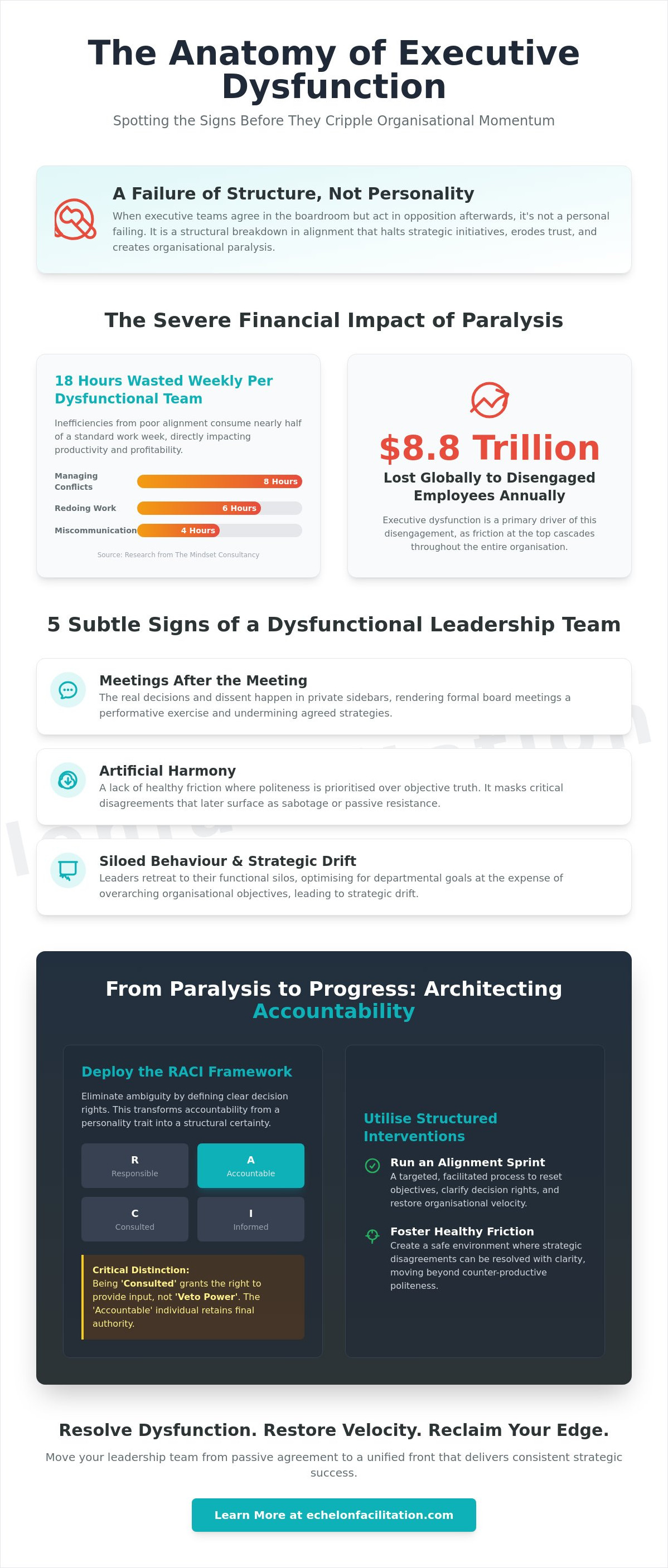
The financial impact of executive paralysis is measurable and severe. In dysfunctional teams, miscommunication consumes an average of 4 hours per week, whilst redoing work takes 6 hours and managing conflicts requires 8 hours, according to research from The Mindset Consultancy. These inefficiencies contribute to the estimated $8.8 trillion lost globally to disengaged employees annually. When senior leaders fail to model accountability, the friction cascades down the hierarchy, stalling strategic initiatives and eroding the organisation's competitive edge.
You likely recognise that your current pace of execution is unsustainable and requires immediate intervention to protect your market position. Restoring organisational velocity requires a transition from passive-aggressive "meetings after the meeting" to a unified front that delivers clear decision rights at the board level. Adopting specific structural frameworks allows you to resolve the signs of a dysfunctional leadership team and re-establish the accountability required for consistent strategic success.
Key Takeaways
- Identify "meetings after the meeting" as a critical indicator of hidden misalignment that undermines formal board decisions.
- Recognise the signs of a dysfunctional leadership team through the presence of strategic drift and department goals that supersede organisational priorities.
- Deploy the RACI framework to establish clear decision rights and eliminate the accountability gaps that cause executive paralysis.
- Foster healthy friction within the boardroom to ensure strategic disagreements are resolved with clarity rather than masked by politeness.
- Utilise structured interventions like an Alignment Sprint to reset objectives and restore organisational velocity.
Subtle Signs of a Dysfunctional Leadership Team in High-Stakes Environments
Executive dysfunction rarely announces itself with shouting matches. It manifests as a quiet, corrosive erosion of commitment. You see it when the "meeting after the meeting" becomes the primary venue for decision-making. In these sidebars, senior leaders re-litigate board decisions or express the dissent they were too guarded to voice in the room. This behaviour signals a total breakdown in team effectiveness, as the formal governance structure becomes a performance rather than a process.
Artificial harmony is another of the critical signs of a dysfunctional leadership team. When a board lacks healthy friction, it usually indicates that members have prioritised politeness over objective truth. Consider an anonymised scenario involving a mid-sized financial services firm. The executive committee unanimously approved a 12% shift in capital toward digital transformation. However, in the following 30 days, execution stalled entirely. The Head of Operations privately instructed teams to ignore the directive, whilst the CFO delayed funding releases. They agreed in public but sabotaged in private, a classic case of executive paralysis.
The Cost of Executive Misalignment
Misalignment at the summit creates organisational whiplash for middle management. When the executive layer is fractured, department heads receive conflicting priorities, leading to wasted effort and paralysis at the operational level. The financial impact is significant; the annual cost of a single difficult mid-level leader ranges from 175% to over 1000% of their compensation, according to 2025 data on the total cost of difficult leaders. This friction directly impacts capital allocation efficiency and speed-to-market. Recognising the signs of a dysfunctional leadership team is essential to stop this value leakage before it impacts the bottom line.
Identifying Shadow-Steering and Siloed Behaviours
When trust evaporates, senior leaders often retreat into functional silos. They focus exclusively on their own department's performance, viewing other executives as competitors for resources rather than partners in a shared objective. This siloed behaviour leads to strategic drift, where individual department goals begin to supersede the primary objectives of the organisation. Establishing high-performing executive teams requires breaking these silos through radical transparency and clear decision rights.
The Structural Root: Why Decision Rights and Accountability Fail
Many organisations treat accountability as a personality trait, hoping senior leaders will simply "step up". This approach is flawed. Accountability cannot be encouraged through motivational speeches; it must be architected into the system. When you observe subtle signs of team dysfunction, the cause is often a lack of clear decision rights rather than a lack of character.
Decision paralysis frequently occurs when a team prioritises consensus over ownership. Seeking total agreement often serves as a mask for a lack of clear ownership, as no one wants to be the sole individual responsible for a high-stakes outcome. This "consensus trap" is one of the most persistent signs of a dysfunctional leadership team. It slows execution and dilutes the quality of strategic decisions by reducing them to the lowest common denominator.
Implementing the RACI Matrix at the Executive Level
To eliminate ambiguity, teams must adopt a rigorous Strategy Sprint methodology that incorporates the RACI framework. Defining who is Responsible, Accountable, Consulted, and Informed prevents the overlap that leads to friction. Crucially, executives must distinguish between being 'Consulted' and having 'Veto Power'. A 'Consulted' party provides input, but the 'Accountable' individual retains the final authority to move forward without further permission.
The Cynefin Framework for Complex Problem Solving
Misidentifying the nature of a problem causes unnecessary executive friction. The Cynefin framework helps teams categorise challenges as Simple, Complicated, Complex, or Chaotic. If a team treats a 'Complex' strategic shift as a 'Simple' operational task, they will likely fail to account for emerging variables. This miscategorisation leads to failed execution and mutual blaming. A formal Decision-Rights Reset can help re-distribute authority and accelerate organisational velocity by aligning decision-making styles with the actual complexity of the task.
Why Conflict Avoidance is a Primary Indicator of Team Failure
High-performing teams do not suffer from a lack of conflict; they utilise it. Toxic dysfunction occurs when disagreement is suppressed, leading to the patterns of leadership dysfunction often described as 'Petting Zoos', where politeness masks deep-seated strategic disagreements. If your executive meetings are always comfortable, your leadership team is likely failing to address its biggest constraints. This artificial harmony is one of the most deceptive signs of a dysfunctional leadership team, as it creates an illusion of alignment whilst critical risks remain unvoiced.
Psychological safety is the prerequisite for this healthy friction. It allows senior peers to challenge the status quo without fear of retribution. Without it, silence becomes the default response to flawed strategy. Identifying these silent signs of a dysfunctional leadership team early prevents the rot of complacency from setting in. True leadership requires the discipline to confront uncomfortable truths in the boardroom to prevent them from becoming organisational disasters in the field.
Facilitating Productive Disagreement
Surfacing the unspoken requires a neutral environment where power dynamics are balanced. During a Board & Leadership Session, an external facilitator uses structured techniques to extract dissenting views that executives might otherwise withhold. This process neutralises the influence of dominant voices and ensures that the 'meeting after the meeting' is brought into the light of the formal session.
Moving from Friction to Strategic Clarity
The objective of conflict is not debate for its own sake, but the synthesis of opposing views into a single, unified executive direction. Once all perspectives are aired, the team must commit to a decided path with total accountability. You can find specific mechanics for this transition in our Leadership Team Decision Making guide. To resolve these underlying tensions and restore strategic focus, contact us to discuss an Alignment Sprint.
Resolving Dysfunction through High-Stakes Executive Alignment
Resolving the signs of a dysfunctional leadership team requires more than a series of training courses or team-building exercises. It demands a high-stakes, structural intervention that addresses the root causes of executive paralysis. The process begins with a Diagnostic Call to identify the specific constraints and "elephants in the room" that prevent the board from achieving its objectives. Once the friction points are identified, the team enters an Alignment Sprint. This time-boxed, intensive session resets decision rights and strategy, moving the group from a state of hesitation to one of disciplined velocity.
Long-term stability relies on the creation of a Team Charter. This document establishes the non-negotiable behaviours for executive conduct, ensuring that personal accountability becomes the standard for every member. Finally, Post-Sprint Execution ensures the intervention leads to measurable 30-day outcomes. Without a clear path to immediate results, alignment remains a theoretical exercise. This structured approach replaces the "meeting after the meeting" with a unified front that executes board decisions with precision.
The Role of Professional Facilitation
Internal leaders cannot facilitate their own alignment sessions effectively. The inherent power dynamics and existing interpersonal biases make it impossible for a CEO or HR Director to remain neutral whilst also participating in the strategic debate. Professional facilitation provides the objective distance required to challenge senior peers and surface unspoken dissent. Our How We Work methodology ensures that the session remains focused on strategic focus rather than internal politics or comfortable narratives.
Measuring the ROI of Alignment
Investing in executive alignment produces quantifiable returns that impact the entire organisation. You should measure success through a reduced "time to decision" and increased employee engagement scores, as the clarity established at the summit filters down to the operational level. When you resolve the signs of a dysfunctional leadership team, you reclaim the capacity previously lost to conflict management and miscommunication. Contact Echelon Facilitation to discuss a diagnostic for your leadership team and begin the process of restoring strategic alignment.
Restoring Strategic Velocity through Executive Alignment
Executive paralysis is a choice, often made by default when structural clarity is absent. The "meeting after the meeting" and artificial harmony are not just cultural quirks; they are critical signs of a dysfunctional leadership team that indicate a breakdown in the structural architecture of the board. Transitioning from a group of talented individuals to a high-performing executive unit requires the discipline of defined decision rights and the courage to engage in productive friction. This shift ensures that consensus never becomes a mask for a lack of ownership.
Echelon Facilitation, led by Richard Kasriel, specialises in high-stakes facilitation designed to break cycles of dysfunction and restore momentum. Our results-driven 'Sprint' methodology moves beyond generic team-building to provide the tactical clarity your organisation requires for rapid execution. By resetting decision rights and establishing a clear team charter, you ensure that strategic objectives are met with collective accountability. Book a Complimentary Diagnostic Call with Echelon Facilitation to identify the specific constraints holding your board back. You can transform your leadership team into a unified engine of growth.
Frequently Asked Questions
How can I tell if my leadership team is misaligned or just having a bad month?
Persistent inability to execute board-level decisions indicates systemic misalignment rather than a temporary dip in performance. A bad month is typically caused by external market factors or a single project delay. Chronic signs of a dysfunctional leadership team include recurring side-bar conversations and the consistent failure to meet 30-day execution milestones. If the friction remains after the immediate pressure subsides, the issue is structural and requires intervention.
What is the difference between a dysfunctional team and a toxic leader?
Dysfunction is a systemic failure of processes and decision rights, whilst toxicity is a behavioural issue rooted in a single individual. A dysfunctional team often consists of capable professionals who lack a clear framework for collaboration. A toxic leader actively undermines psychological safety through manipulation or exclusion. Whilst structural resets fix signs of a dysfunctional leadership team, toxic individuals often require direct performance management or removal to protect the organisational culture.
Can a dysfunctional leadership team be fixed without replacing members?
Structural alignment often resolves dysfunction without the need for recruitment or termination. Many teams struggle because decision rights are ambiguous or healthy conflict is avoided. Just as Dating Explained focuses on finding the right interpersonal fit through professional matchmaking, executive leaders must ensure their team members are correctly aligned with the organisation's culture and goals. Implementing a rigorous framework like RACI clarifies individual accountability and removes the friction caused by overlapping roles, ensuring that the 'match' between team members remains productive. If members are committed to the organisation's objectives and willing to adhere to a new Team Charter, professional facilitation can restore organisational velocity.
How much does a professional executive alignment workshop cost in the UK?
Fees for high-stakes executive facilitation vary based on the complexity of the organisation and the duration of the engagement. Most professional facilitators structure their pricing around the specific outcomes delivered rather than a simple daily rate. Because these interventions address high-value strategic risks, the investment is usually weighed against the cost of continued executive paralysis. You should request a tailored quote to understand the specific investment required for your board.
What happens if the CEO is the source of the leadership team's dysfunction?
Dysfunction originating from the CEO requires an external facilitator to neutralise the power imbalance and provide objective feedback. A CEO might unintentionally cause paralysis by micromanaging or by failing to provide clear strategic boundaries. In these scenarios, the facilitator establishes a framework that protects the team's decision rights whilst ensuring the CEO's vision is translated into actionable objectives. This process requires the CEO's total commitment to personal accountability and structural change.

Article by
Andrew Greenland
Dr Andrew Greenland is the founder of Echelon Facilitation, a UK practice that designs and runs high-stakes leadership sessions for executive teams who need decisions, not more discussion. A medical doctor and medical educator, Andrew brings a clinician's discipline to the messy, political work of leadership alignment - surfacing the real disagreement, forcing the real choices, and ensuring every session produces a documented decision log with named owners and deadlines. He works with CEOs, executive teams, transformation leads, and boards across the UK and internationally. Based in Twickenham.