
Executive alignment: Why hiring an independent meeting facilitator in the UK is essential
Last Tuesday, a FTSE 250 leadership team spent four hours debating a single market entry point without the guidance of an independent meeting facilitator uk, leaving the room with no clear owner or timeline.
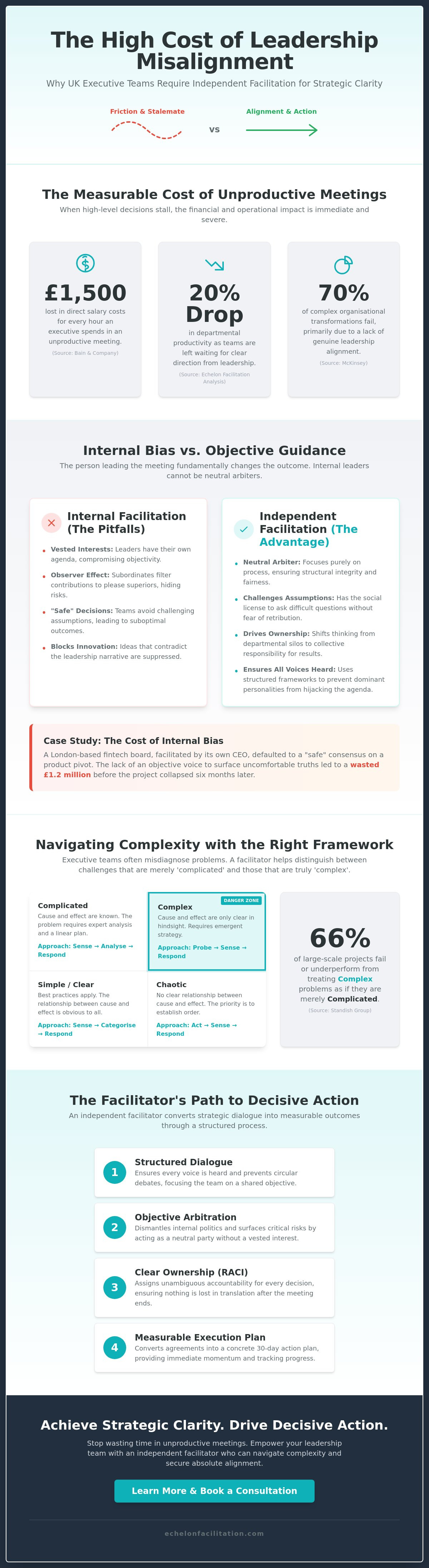
Leadership inertia carries a heavy price. Research by Bain & Company indicates that for every hour an executive spends in an unproductive meeting, the organisation loses approximately £1,500 in direct salary costs alone. When high-level decisions stall, the resulting friction trickles down, causing a 20% drop in departmental productivity as teams wait for direction. Objective distance dismantles these circular debates and refocuses the room on definitive outcomes. It's about securing the collective team's absolute long-term strategic success and stability.
You recognise that internal dynamics often prevent the most qualified voices from being heard, allowing dominant personalities to overshadow critical data. Disciplined, external guidance resolves executive friction to drive strategic clarity. Objective facilitation provides the frameworks necessary to assign clear ownership for every decision made, ensuring the organisation moves forward with absolute certainty.
Key Takeaways
- Recognise the limitations of internal facilitation and how the observer effect prevents leaders from objectively arbitrating their own team's disputes.
- Utilise the Cynefin framework to distinguish between complicated and complex challenges that require emergent strategy rather than standard solutions.
- Select an independent meeting facilitator uk based on their ability to command authority whilst navigating the specific nuances of British boardroom culture.
- Convert strategic dialogue into measurable outcomes using a structured 30-day execution plan and the RACI framework for clear ownership.
The limitations of internal leadership in high-stakes UK boardrooms
High-stakes strategy sessions require a level of objectivity that internal leaders cannot provide. When a CEO or Chairperson attempts to lead a critical debate, they inevitably compromise the outcome because they are participants with a vested interest. An independent meeting facilitator uk removes this conflict by acting as a neutral arbiter of process. This role ensures that the structural integrity of the discussion remains intact, allowing senior leaders to contribute their expertise without the dual burden of managing the room. Internal facilitation often falls victim to the observer effect, where the presence of a superior fundamentally alters the behaviour and honesty of the team.
The cost of internal bias is measurable in both strategic momentum and financial loss. According to research by McKinsey, 70% of complex organisational transformations fail, primarily due to a lack of genuine alignment amongst the leadership team. When internal politics dictate the flow of a meeting, critical risks remain unvoiced. In 2022, a London-based fintech board attempted to pivot its core service while the CEO facilitated the session. Because the CEO held the power of budget and promotion, the board defaulted to a "safe" consensus rather than challenging his assumptions. Six months later, the firm collapsed the project after wasting £1.2 million on a product the market did not want. This failure resulted directly from the absence of an objective voice to surface uncomfortable truths.
Why internal facilitation often breeds resentment
Senior leaders frequently mistake chairing for facilitating. When the individual who sets annual KPIs also manages the strategy discussion, subordinates naturally filter their contributions to align with perceived expectations. This dynamic creates a culture of polite compliance. Internal politics often lead teams to choose the path of least resistance, resulting in "safe" decisions that protect individual department silos rather than optimal choices that serve the collective mission. The perceived lack of neutrality creates a barrier to entry for innovative ideas that might contradict the current leadership narrative.
The objective advantage of an independent meeting facilitator in the UK
An external partner possesses the social license to challenge assumptions without fear of political retribution. This neutrality is the foundation of effective business facilitation. By hiring an independent meeting facilitator uk, an organisation ensures the focus remains on the strategic objective rather than individual egos. These professionals use structured frameworks to prevent any single voice from dominating the room. This approach forces a shift from defensive department-centric thinking to a state of total ownership over the collective result. It allows the team to navigate friction constructively, ensuring that the final strategy is robust enough to survive the realities of execution.
Applying the Cynefin framework to complex organisational challenges
The Cynefin framework, explored in A Leader's Framework for Decision Making, categorises business problems into four domains: simple, complicated, complex, and chaotic. Most executive teams treat every challenge as "complicated," assuming that expert analysis and a linear plan will yield a predictable result. This approach fails when faced with "complex" problems where cause and effect are only clear in hindsight. Data from the Standish Group indicates that 66% of large-scale projects fail or underperform, largely due to a lack of structured alignment in these unpredictable environments.
An independent meeting facilitator uk manages these dynamics by shifting the group from "sensing and responding" to "probing, sensing, and responding." Traditional chairing focuses on order and timekeeping; strategic facilitation identifies emergent patterns that internal teams often overlook. This external perspective is vital for identifying when a problem has moved beyond the reach of standard technical expertise and requires a different cognitive approach.
Moving from complicated to complex decision-making
Executives often mistake systemic issues for technical ones. They seek expert analysis when they actually require a systemic perspective shift. An independent meeting facilitator uk prevents the team from defaulting to "simple" solutions for "complex" issues. This ensures the group does not waste resources on linear fixes for non-linear problems. Success requires the team to acknowledge that no single individual holds the complete solution, necessitating a move toward collective sense-making.
The facilitator as a guardian of the process
Innovative paths require time to emerge. UK executive teams often rush to premature consensus to avoid the discomfort of ambiguity. The facilitator acts as a guardian, keeping the group within the complex domain long enough to find genuine breakthroughs. They prevent "groupthink" and ensure the alignment process remains focused on objective truth rather than comfortable narratives. This disciplined approach forces the team to confront reality before committing to a course of action.
Criteria for selecting an independent meeting facilitator in the UK
Selecting an independent meeting facilitator uk requires a professional who possesses discipline, authority, and clarity. High-stakes environments do not benefit from "soft" moderation. They require a lead who can challenge a CEO or Chairperson without hesitation. In the UK boardroom, communication is frequently indirect. A facilitator must decode the "understated critique," where a polite phrase like "I have some minor reservations" often signals a fundamental objection to the strategy. A professional independent meeting facilitator uk ensures that these subtle cues are addressed directly to prevent unspoken resentment from stalling execution. Effective facilitators adhere to established guidelines for facilitating effective meetings to ensure every voice is heard without compromising the agenda. They maintain a stoic focus on the objective truth, even when it creates temporary discomfort for the team. This discipline ensures the session results in concrete outcomes rather than vague intentions.External expertise vs. industry-specific knowledge
Industry jargon often masks flawed logic and protects outdated habits. A facilitator who lacks technical "insider" knowledge is a strategic asset. Their "ignorance" allows them to ask the fundamental questions that internal teams avoid. They focus on the structural integrity of the argument and the behaviour of the group. This objective distance is central to how we work at Echelon. By prioritising logic over technical minutiae, they force the leadership team to explain their strategy in plain English, often revealing gaps in alignment that were previously hidden behind corporate buzzwords.Evaluating the facilitator's primary focus
Executives must distinguish between facilitators who offer "team building" and those who provide "strategic alignment." Experiential activities and trust falls have no place in a high-performing boardroom. Alignment is built through rigorous debate and the clear assignment of decision rights using frameworks like RACI (Responsible, Accountable, Consulted, Informed). Our approach focuses on building High Performing Executive Teams by addressing the human element of leadership through the lens of results. Use this checklist when interviewing potential facilitators:- Can they demonstrate a track record of managing high-status egos without retreating?
- Do they prioritise logical consistency over industry-specific jargon?
- How do they handle "the quietest person in the room" when that person holds critical data?
- What specific framework do they use to ensure ownership of tasks post-meeting?
Driving strategic execution through structured alignment
Alignment without execution is merely a hallucination. The transition from a facilitated session to operational reality requires a disciplined 30-day execution plan. Research from the Harvard Business Review indicates that 67% of well-formulated strategies fail because of poor execution. An independent meeting facilitator uk prevents this by forcing the group to translate abstract goals into concrete deliverables before the session concludes. This ensures that the energy generated during the workshop is immediately directed towards specific organisational objectives.
We utilise the RACI framework to establish clear boundaries of ownership. This framework identifies who is Responsible, Accountable, Consulted, and Informed for every strategic pillar. By removing the collective "we" from action items and replacing it with a single name, the facilitator ensures that accountability is personal. Collective accountability is often no accountability at all. A structured Strategy Sprint can rapidly condense this alignment process, moving a team from ambiguity to a prioritised task list in a fraction of the usual time.
Engaging an independent meeting facilitator uk provides the external pressure needed to maintain momentum. The facilitator acts as a bridge between high-level strategy and the practical reality of the boardroom, insisting on a documented output that assigns specific tasks to specific individuals with firm deadlines. This removes the "implementation gap" that typically occurs when executives return to their daily operational demands.
Establishing unshakeable ownership
The facilitator's primary duty is to demand clarity on the "What" and the "By When". They act as a neutral arbiter who documents dissent whilst securing a firm commitment to the final decision. This process prevents the "meeting after the meeting" where decisions are quietly undermined. A 2023 McKinsey report found that teams with high alignment are 1.9 times more likely to have above-average financial performance. The facilitator ensures this alignment is documented and signed off by all parties.
The Echelon approach to strategic planning
Echelon integrates Leadership Team Decision Making into a structured process that moves from initial diagnosis to rapid execution. This approach prioritises objective truth over comfortable narratives. If your executive team is stuck in a cycle of indecision or lacks a clear path forward, reach out to Echelon Facilitation for a diagnostic call to identify the friction points in your alignment process.
True alignment is not found in a shared vision statement but in the disciplined execution of shared decisions. The cost of misalignment is measured in wasted capital and lost market share. By introducing an external perspective and a structured framework for accountability, organisations can bridge the gap between strategy and results. The role of the facilitator is to provide the friction necessary to test ideas and the structure necessary to implement them. Success is the product of clarity, ownership, and the courage to hold the team to its commitments.
Drive Strategic Clarity Through Disciplined Alignment
Internal leadership often falters when personal agendas or cognitive biases cloud high-stakes decisions. Relying on an independent meeting facilitator uk removes these barriers; it replaces circular debate with objective clarity. Since 2019, Echelon Facilitation, founded by Richard Kasriel, has addressed these frictions through Executive Alignment Sprints. These sessions move beyond the fluff of traditional workshops to focus on disciplined execution. By applying frameworks like Cynefin, leadership teams categorise challenges accurately and assign clear ownership. A study by McKinsey highlights that organisations with aligned executive teams are 1.9 times more likely to achieve above-average financial performance. Strategic victory is not a product of chance; it is the result of structured alignment and the refusal to accept comfortable narratives. Your team's ability to execute depends on the clarity established in the boardroom today. Professional facilitation ensures that every voice is heard without allowing the loudest to dominate the agenda. This disciplined approach transforms fragmented ideas into a singular, actionable path forward.
Book a diagnostic call to align your leadership team
Frequently Asked Questions
What exactly does an independent meeting facilitator in the UK do during a session?
An independent meeting facilitator in the UK manages the group dynamics and decision-making architecture to ensure the session achieves its stated objectives. They enforce pre-agreed ground rules, manage the agenda timing, and utilise frameworks like the Cynefin model to categorise complex challenges. By remaining neutral, the facilitator identifies circular arguments and redirects the group toward actionable outcomes. This allows the CEO to participate fully as a peer rather than managing the room.
How does an external facilitator handle strong personalities or difficult board members?
External facilitators neutralise dominant personalities by shifting the focus from individual opinions to objective data and shared ownership. If a board member monopolises the discussion, the facilitator uses structured techniques such as timed contributions or the Nominal Group Technique to equalise the power balance. Research from the Harvard Business Review indicates that neutral intervention reduces defensive behaviours in 70% of high-stakes executive sessions. This process ensures that the loudest voice does not dictate the organisation's strategy.
Is an independent facilitator necessary for every meeting or just strategy offsites?
Professional facilitation is reserved for meetings where the complexity of the problem or the risk of misalignment is high. Routine operational updates don't require external oversight. However, for strategy offsites, mergers, or restructuring, an independent meeting facilitator in the UK provides the necessary distance to challenge internal assumptions. Organisations should deploy external facilitators when the internal hierarchy prevents honest dissent or when the team must reach a definitive consensus on a 12-month roadmap.
How much does a professional independent meeting facilitator in the UK cost?
Fees for professional facilitators vary based on the duration of the engagement and the seniority of the group. Industry data from professional bodies suggest that day rates for experienced executive facilitators often range between £1,500 and £5,000. These figures typically exclude pre-session diagnostic interviews and post-meeting documentation. Companies should view this expenditure as an investment in execution speed, as poor alignment often results in months of wasted operational effort.
What is the difference between a facilitator and a management consultant?
A management consultant provides the answer, whereas a facilitator extracts the solution from the leadership team to ensure maximum ownership. Consultants typically deliver a report with specific recommendations based on external benchmarks. In contrast, a facilitator designs the process that allows the executive team to reach their own conclusions. This distinction is vital because teams are 40% more likely to execute a strategy they built themselves than one delivered by an external party.

Article by
Andrew Greenland
Dr Andrew Greenland is the founder of Echelon Facilitation, a UK practice that designs and runs high-stakes leadership sessions for executive teams who need decisions, not more discussion.
A medical doctor and medical educator, Andrew brings a clinician's discipline to the messy, political work of leadership alignment - surfacing the real disagreement, forcing the real choices, and ensuring every session produces a documented decision log with named owners and deadlines.
He works with CEOs, executive teams, transformation leads, and boards across the UK and internationally. Based in Twickenham.