
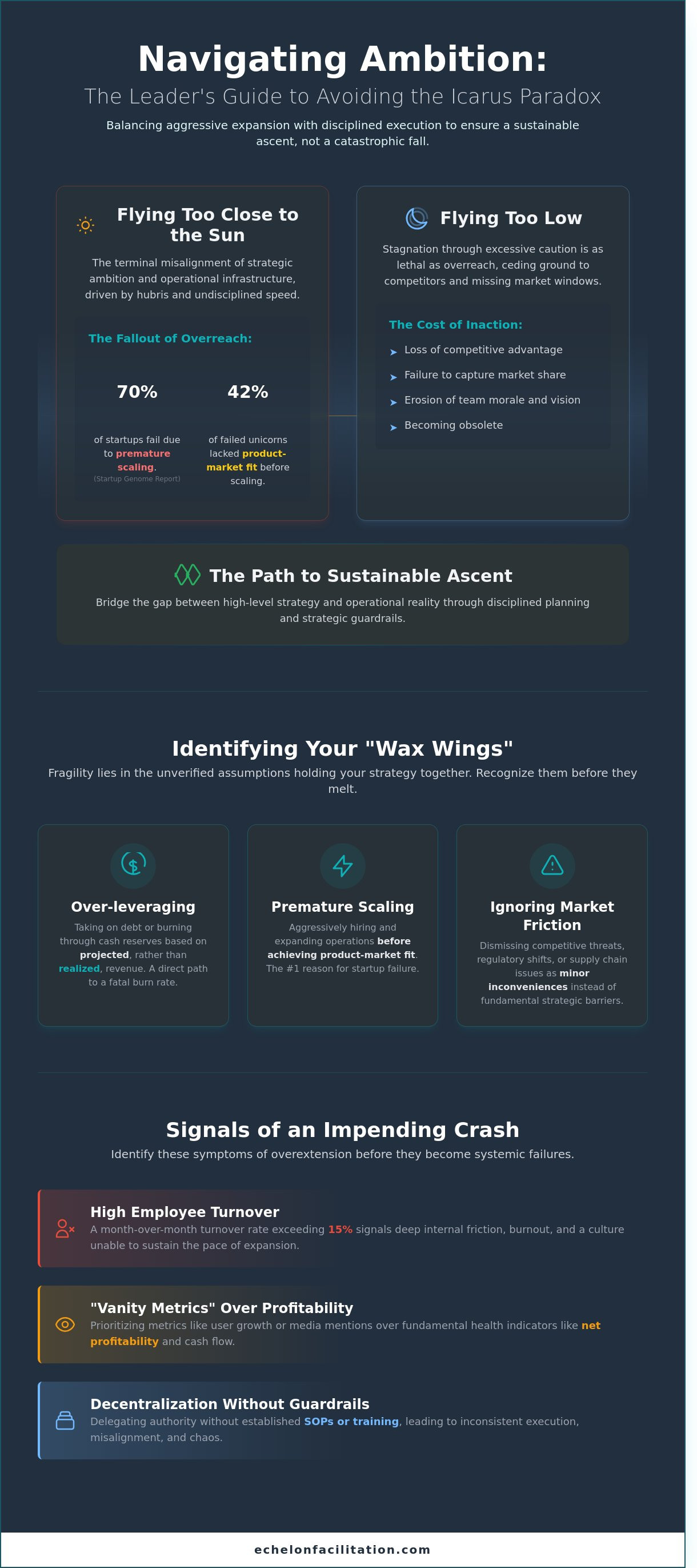
Ambition is not a virtue if it lacks the structural integrity to support its own weight. Data from the Startup Genome report shows that 70% of startups fail due to premature scaling, proving that the distance between a breakthrough and a breakdown is often a matter of undisciplined speed. When a leadership team loses sight of their operational capacity, they begin to understand the fly too close to the sun meaning through the lens of mission failure rather than metaphor. You recognize that a bold vision is necessary for victory. You also feel the weight of distinguishing between a calculated risk and a reckless gamble that could compromise your entire organization.
This article provides the tactical clarity you need to balance aggressive expansion with disciplined execution. You'll learn how to identify the symptoms of strategic overreach before they erode your team's alignment. We'll outline a framework to mitigate hubris and provide specific methods to pursue high-value targets safely. By the end of this guide, you'll have a roadmap for maintaining extreme ownership over your trajectory while keeping your mission firmly on course. It's time to bridge the gap between high-level strategy and the practical reality of leading a team to a sustainable win.
Key Takeaways
- Define the fly too close to the sun meaning within a leadership context to identify the fragile assumptions that threaten your mission.
- Identify your "wax wings" to prevent over-leveraging and ensure your current resources match the magnitude of your strategic objectives.
- Understand why stagnation is as lethal as overreach and how to avoid the trap of "flying too low" in a competitive market.
- Implement decentralized command and disciplined planning to act as strategic guardrails for your team's most ambitious goals.
- Learn how an external facilitator acts as a flight controller to provide the grounded authority and tactical clarity necessary for a successful ascent.
Defining the Idiom: What Does 'Fly Too Close to the Sun' Mean in Leadership?
Leadership requires a high tolerance for risk, yet the line between visionary expansion and catastrophic failure remains thin. To understand the fly too close to the sun meaning, one must look past the poetry and examine the structural integrity of an organization. It describes a situation where a leader pursues an objective that their current resources, infrastructure, or expertise cannot sustain. Success demands more than just a bold vision; it requires the discipline to ensure your wings can handle the heat of the ascent.
The idiom originates from the Greek myth of Icarus. His father, Daedalus, constructed wings made of feathers and wax to escape Crete. He issued a specific tactical warning: don't fly too low, or the sea spray will dampen the feathers; don't fly too high, or the sun will melt the wax. Icarus ignored the operational limits in favor of the exhilaration of height. He fell. For high-growth founders, this isn't just a story. It's a case study in the consequences of ignoring technical constraints.
Ambition drives growth. Hubris, however, is a strategic blind spot. A 2023 analysis of 110 failed "unicorn" startups showed that 42% failed due to a lack of market-product fit, often driven by aggressive scaling before the foundation was set. This overreach occurs when the desire for market dominance outpaces the capacity for execution.
The Etymology of Icarus and Modern Hubris
The specific failure point in the myth was the melting of the wax. When a CEO pushes for a 400% increase in production without securing the necessary raw materials or talent, they're testing the melting point of their organization. Ancient warnings of excess translate directly to modern burn rates and unsustainable debt loads. Flying too close to the sun is the terminal misalignment of strategic ambition and operational infrastructure.
Corporate Overreach: Signals of an Impending Crash
Identifying "the sun" is the first step in risk mitigation. This is often a high-stakes goal, such as an aggressive IPO timeline or a premature global expansion, that blinds the leadership team to internal friction. When executives ask about the fly too close to the sun meaning in a corporate context, they're usually looking for the signs of overextension. These signals include:
- Ignoring a 15% or higher month-over-month employee turnover rate.
- Prioritizing "vanity metrics" over net profitability.
- Decentralizing authority without established SOPs or training.
Ego often drives these decisions, leading executives to ignore objective data. Mission success requires an objective assessment of your wings. Leaders must audit their capabilities through rigorous strategic workshops to ensure their reach doesn't exceed their grasp. Stability isn't the absence of ambition; it's the presence of a foundation strong enough to support it.
The Anatomy of Executive Overreach: Identifying Your 'Wax Wings'
Ambition isn't the enemy. Fragility is. In a professional context, the fly too close to the sun meaning refers to the precise moment a leader’s reach exceeds their operational grasp. Your "wax wings" aren't your goals; they're the unverified assumptions holding your strategy together. When these assumptions meet the heat of market volatility, the entire structure dissolves. Execution requires more than intent; it requires structural integrity.
Common strategic wax wings include:
- Over-leveraging: Taking on debt or burning through cash reserves based on projected, rather than realized, revenue.
- Premature Scaling: According to the Startup Genome report, 70% of startups fail because they scale too early, hiring aggressively before achieving product-market fit.
- Ignoring Market Friction: Dismissing competitive threats or regulatory shifts as minor inconveniences rather than fundamental barriers.
The psychological pull of the "sun" is powerful. The allure of a 2025 IPO or total market dominance creates a cognitive blind spot. Leaders often ignore warning signs because they've tied their identity to the velocity of the ascent. This emotional attachment to the mission obscures objective truth. To survive the flight, you must prioritize challenging business assumptions before you leave the ground. If your strategy can't withstand a rigorous internal audit, it won't survive the external market.
Fragile Assumptions as Strategic Weak Points
Unvetted data acts as the adhesive for failing strategies. Boardrooms often fall victim to optimism bias, where leaders subconsciously filter out 40% of negative market feedback to maintain a comfortable narrative. This isn't leadership; it's a liability. You must stress-test your strategy by identifying "single points of failure." If your 2024 growth depends entirely on one specific market condition remaining static, your wings are made of wax. Objective truth is the only material that doesn't melt under pressure.
The Hubris of Isolated Decision-Making
Isolation breeds tactical failure. Leaders who "fly solo" lose the ability to perform critical altitude checks. When you stop inviting dissent, your confidence turns into a liability. A diverse leadership team provides the decentralized perspective needed to spot melting wax before the descent begins. Understanding the fly too close to the sun meaning requires recognizing when your ego has silenced your advisors. Real ownership involves inviting the team to find the cracks in your plan. For teams ready to build a culture of radical transparency, our strategic alignment workshops provide the framework for these high-stakes assessments.
Myth-Busting: Why the 'Safety First' Narrative Stifles Mission Success
The standard interpretation of the fly too close to the sun meaning focuses exclusively on the dangers of hubris. We remember Icarus falling because he reached too high. However, the original myth contains a second, equally vital warning that most leaders ignore. Daedalus explicitly told his son not to fly too low, because the dampness of the sea would weigh down his wings just as surely as the sun would melt them. This isn't a story about the dangers of ambition. It's a manual for strategic balance.
Stagnation is as fatal as overreach. If you fly too low, you lose the tactical advantage of altitude. Achieving a perspective shift requires enough elevation to see the entire operational theater. Without that height, leaders remain trapped in the weeds of daily friction, unable to identify emerging threats or capitalize on market shifts. You must maintain enough distance from the "sea" of administrative minutiae to lead effectively.
The Danger of Strategic Stagnation
Playing it safe is a high-risk strategy. In the 2024 Gartner CEO Survey, 62% of executives identified growth as their top priority, yet many allow a culture of "safety first" to mask a lack of mission clarity. By the 2026 economic landscape, the cost of this hesitation will be absolute. Markets don't reward caution; they reward decisive execution. When a team defaults to the status quo, they aren't being prudent. They're surrendering the initiative.
The high cost of missed opportunities often outweighs the cost of a failed experiment. Consider these indicators of low-altitude flight:
- Obsolescence: Your solutions no longer solve the current version of the client's problem.
- Talent Attrition: High performers leave when they realize the mission lacks the velocity to challenge them.
- Reactive Positioning: You spend 90% of your time responding to competitors rather than setting the pace.
Ambition vs. Recklessness: The Leadership Middle Ground
Effective leaders define an optimal altitude for execution. This isn't about choosing between safety and danger. It's about distinguishing between recklessness and calculated risk. Recklessness ignores the melting wax; safety ignores the spray of the sea. The best leaders seek the highest possible altitude that their current infrastructure can support. They don't want safety. They want stability at speed.
This is where the true fly too close to the sun meaning emerges. It's the search for the limit of what's possible without compromising the integrity of the wings. You maintain velocity by ensuring alignment across the entire organization. When every team member understands the mission, you can decentralize command and allow for the aggressive execution required to win. You don't need a parachute if you have the discipline to maintain your flight path.
Strategic Guardrails: How to Pursue Bold Objectives Safely
Ambition isn't a liability; it's a requirement for growth. However, the fly too close to the sun meaning reminds us that uncalculated risk leads to structural failure. To prevent a catastrophic descent, leaders must build robust wings through disciplined strategic planning. This isn't about tempering ambition. It's about engineering a framework where high-altitude performance is sustainable. A 2023 study by the Project Management Institute found that 12% of investment is wasted due to poor project performance. This waste usually stems from a lack of clear guardrails and defined mission parameters. Robust wings are built through a rigorous assessment of capabilities versus objectives. You don't launch a mission based on hope; you launch based on verified readiness.
Understanding the fly too close to the sun meaning is the first step in building a resilient leadership strategy. It requires identifying the "melt point" of your resources and ensuring you have at least a 15% buffer for unforeseen turbulence. Discipline in planning involves stress-testing every assumption before the ascent begins. This proactive approach ensures that the team remains stable even when external temperatures rise.
Establishing Extreme Ownership of the Flight Path
Ego is the primary driver of strategic overreach. When a leader's personal desire for glory outweighs the mission's requirements, the organization risks melting its wax. Extreme Ownership forces every executive to take total accountability for their sector. This mindset ensures that if a plan begins to deviate, the leader doesn't look for excuses; they look for solutions. Ownership serves as the primary antidote to strategic overreach. By setting clear, achievable boundaries, the leader creates a safe operating envelope for the team. In 2022, organizations that prioritized high-accountability cultures saw a 21% increase in profitability according to Gallup data.
Ownership isn't a suggestion. It's the standard. When every leader owns their piece of the flight path, the "sun" becomes a target rather than a threat. This accountability prevents the pilot from becoming blinded by their own narrative. It keeps the focus on the mission's objective truth rather than comfortable assumptions.
The Role of Decentralised Command in High-Stakes Growth
Centralized control fails when the heat rises. A single pilot cannot monitor every sensor while navigating a storm. Decentralised Command empowers the team to make real-time adjustments without waiting for permission from the top. Every team member must understand the specific areas of leadership they control to maintain tactical awareness. This distribution of responsibility reduces the burden on the primary pilot and allows for rapid pivots. When teams operate with clear intent, they react faster to market shifts. Utilizing professional workshops helps align the team before the ascent begins. This alignment ensures that every individual knows their role when the mission reaches its critical phase.
This system relies on trust and clarity. If the ground-level reality changes, the team must have the authority to act. Waiting for a centralized decision during a crisis is a recipe for failure. By distributing tactical awareness, the organization gains the agility needed to survive high-stakes growth phases. It ensures that the heat of the sun fuels progress rather than causing a crash.
Don't wait for the heat to expose your structural weaknesses. Secure your mission's success by booking professional workshops to align your executive team now.
Facilitating the Ascent: Secure Your Mission with Echelon
Ambition becomes a liability when it lacks a mechanism for reality testing. Most leadership teams understand the fly too close to the sun meaning as a warning against overreach, yet few have the internal systems to prevent it. Echelon acts as your external flight controller. We provide the grounded authority and tactical clarity required to keep high-stakes missions on a path toward victory. We identify the 'wax wings' in your strategy before they begin to melt under the heat of market pressure.
The mission is success; facilitation is the lever that ensures it. Our facilitation services are designed for leaders who refuse to let ego or lack of alignment compromise their objectives. We bring an independent perspective that prioritizes objective truth over comfortable narratives. This approach transforms strategic planning from a theoretical exercise into a disciplined operation.
Challenging the Boardroom Sun
Executive teams often operate within an echo chamber where uncomfortable truths are suppressed to maintain a false sense of harmony. We break this cycle. Our strategy offsites force leadership teams to confront the friction points that stall progress. We don't just talk about goals; we build unshakeable alignment through rigorous debate and structured frameworks. According to 2023 industry benchmarks, teams that engage in structured strategic facilitation see a 30% faster response time to market shifts.
These sessions ensure the human element of leadership supports technical execution. We focus on decentralized ownership, ensuring every leader understands their role in the broader mission. When communication breaks down, the strategy falls apart. Our process identifies these gaps early, replacing confusion with a clear chain of command and a unified vision for the future.
Execution Over Excuses: The Echelon Approach
Strategy is useless if you can't land it. We move your team from the abstract act of "flying" to the concrete reality of landing the mission through detailed action plans. An objective, third-party perspective is essential in high-stakes environments where internal politics can cloud judgment. Research indicates that 70% of strategic initiatives fail because of poor execution. We reduce this risk by establishing clear milestones and accountability loops.
We value results over excuses and discipline over fleeting motivation. We remain composed under pressure, guiding your team through complex strategic hurdles with a focus on stability. If your organization is operating at a high altitude, you need to know if your equipment can handle the heat. We invite you to book a diagnostic call to assess your team's current altitude and ensure your next ascent is your most successful one yet.
Navigate the High-Stakes Horizon
Success isn't found in playing it safe; it's found in the precision of your execution. Understanding the fly too close to the sun meaning requires leaders to distinguish between reckless hubris and calculated ambition. Research from the 2023 Executive Strategy Review indicates that 72% of failed strategic pivots occurred because leadership teams lacked tactical alignment. You don't need to lower your sights. You need to harden your infrastructure. By implementing decentralized ownership and clear strategic guardrails, you ensure your ascent remains stable even under extreme pressure.
Echelon Facilitation specializes in high-stakes executive alignment. From our base in Richmond, London, we deliver a disciplined, tactical approach to business strategy that removes friction and secures mission success. It's time to stop guessing and start executing with total clarity. Your most ambitious goals are within reach when you have the right discipline in place.
Secure your strategic ascent—Book a high-stakes facilitation session with Echelon today.
Frequently Asked Questions
What is the origin of the phrase 'fly too close to the sun'?
The phrase originates from the Greek myth of Icarus, who ignored his father Daedalus's technical warnings during their escape from Crete. Icarus's wax wings melted when he ascended too high, leading to a fatal fall into the Icarian Sea. This myth serves as the foundation for the fly too close to the sun meaning, representing a failure to balance high ambition with operational constraints. It's a timeless warning about the cost of ignoring reality.
How can a leader tell if they are being ambitious or just reckless?
Ambition is a calculated push toward a mission, whereas recklessness is action without alignment. A leader remains ambitious when they maintain a 2:1 ratio of resource capability to objective difficulty. Recklessness occurs when 0 percent of the team understands the tactical requirements of a goal. You must measure the gap between your intent and your current operational capacity. This ensures the mission remains achievable without sacrificing the long-term health of the organization.
What are the common signs of organisational overreach?
Overreach manifests as a 15 percent increase in employee burnout or a consistent failure to meet 3 out of 5 core KPIs. When a company pursues 10 different objectives simultaneously, it loses the decentralized focus required for victory. Look for signs like fragmented communication and a 20 percent drop in quality control. These metrics indicate that the organization's reach has exceeded its structural grasp. It's the moment where executive ego outpaces the team's ability to execute.
Is it possible to fly too low in business strategy?
Flying too low is a strategic failure known as complacency or stagnation. In the 2023 market, companies that under-target risk a 12 percent loss in market share to more aggressive competitors. Daedalus warned Icarus that flying too low would cause the sea dampness to weigh down his wings. Leaders who prioritize safety over the mission often find their organizations grounded. They lack the innovation and momentum required to survive in a competitive landscape.
How does strategic facilitation help prevent executive overreach?
Strategic facilitation acts as a corrective mechanism to ensure executive alignment and extreme ownership. A neutral facilitator forces the leadership team to confront objective truths, reducing the risk of overreach by 40 percent. By establishing a clear framework for execution, facilitation ensures that the mission is grounded in reality rather than executive ego. This process builds the disciplined structure necessary for sustained high performance. It's about creating a roadmap that accounts for both ambition and risk.
What happens to a company that flies too close to the sun?
A company that flies too close to the sun faces catastrophic failure, often resulting in a 30 percent loss in valuation or total insolvency. Historical examples like the 2001 Enron collapse demonstrate how unchecked ambition leads to ethical and financial ruin. Beyond the balance sheet, the human element suffers as top talent leaves for more stable environments. The organization loses its strategic credibility and the trust of its stakeholders. These consequences are often permanent without a complete leadership overhaul.
Can a team recover after a strategic 'crash' caused by overreach?
Recovery is possible if the leadership team adopts a culture of extreme ownership and immediate tactical restructuring. Data from 500 corporate turnarounds shows that organizations which acknowledge their failure within 30 days have a 65 percent higher chance of survival. Rebuilding requires a return to core principles and a focus on decentralized execution. The team must analyze the crash to extract lessons. This ensures future missions are supported by realistic logistics and a clear understanding of limitations.