
Why do executives nod in agreement during your presentation, only to withhold the budget and headcount when the meeting ends? This disconnect suggests that your current approach to getting buy-in for a new project is failing to bridge the gap between polite consensus and genuine commitment, yet getting buy-in for a new project remains the only path to strategic success.
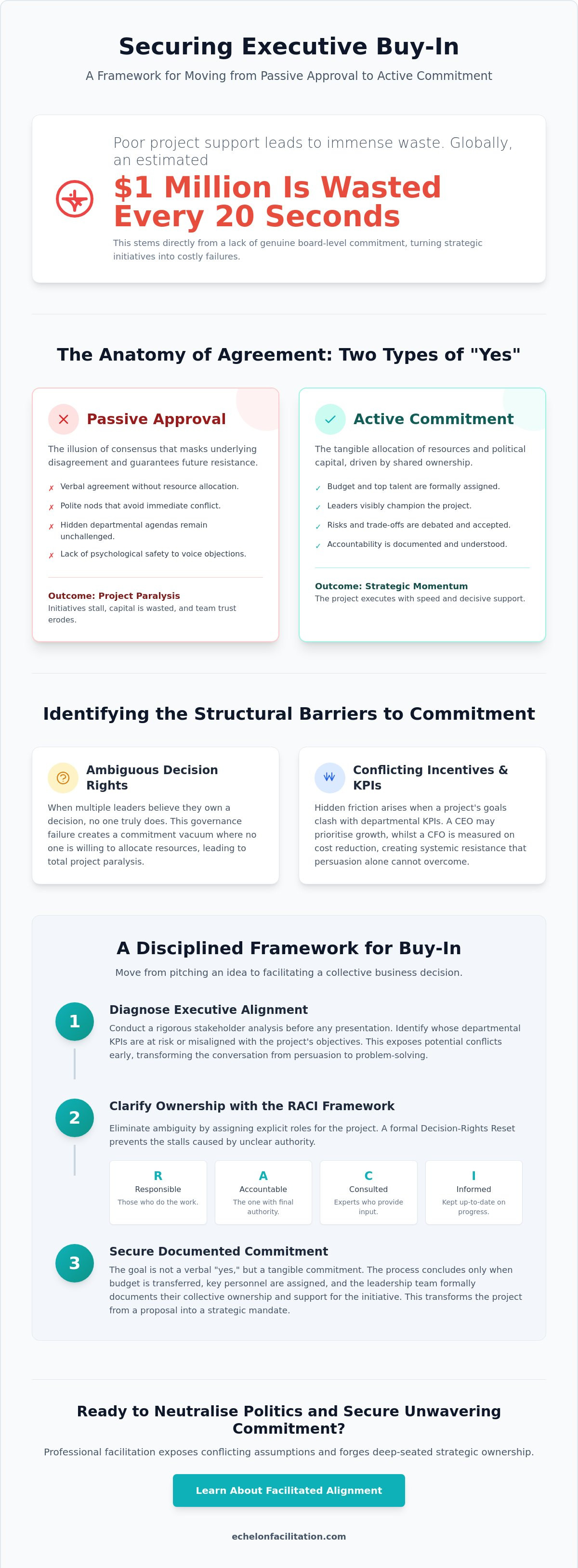
The financial and operational price of failing at getting buy-in for a new project is staggering. Research indicates that an estimated $1 million is wasted globally every 20 seconds due to poor project management and execution, often rooted in a lack of board-level support. When leaders fail to provide resource commitment for getting buy-in for a new project, initiatives enter a state of terminal paralysis. You lose capital and team trust whilst competitors move with decisive speed. Indecision is a silent drain on your firm’s future.
You likely understand the frustration of seeing a strategically sound proposal stall because of departmental competition or vague decision rights. This article provides a disciplined framework for getting buy-in for a new project by transforming passive approval into active executive ownership. Expect to gain total clarity on project ownership and the mechanics of getting buy-in for a new project whilst securing a clear path from proposal to execution.
Key Takeaways
- Distinguish between passive verbal agreement and the active allocation of resources and political capital required for genuine project success.
- Identify how misaligned KPIs and ambiguous decision rights amongst the leadership team create invisible barriers to execution.
- Implement a disciplined framework for getting buy-in for a new project by conducting an objective diagnostic of executive alignment.
- Utilise professional facilitation to neutralise internal politics and expose the conflicting assumptions that cause decision paralysis.
- Secure unwavering resource commitment from the board by moving beyond surface-level consensus to deep-seated strategic ownership.
Getting Buy-in for a New Project: Distinguishing Surface Approval from Strategic Commitment
Real buy-in is not a verbal agreement. It is the active allocation of resources and political capital. When an executive says "yes" but refuses to shift their best talent or budget to the initiative, they haven't bought in. They have merely offered passive approval. This distinction is critical because passive approval creates a "false consensus". In high-stakes environments, this consensus masks underlying disagreements that inevitably surface as resistance during execution. Getting buy-in for a new project requires moving beyond these polite nods to secure a commitment that survives the first sign of organisational pressure.
Why Passive Approval Stalls High-Stakes Initiatives
Passive approval is dangerous. It allows leaders to avoid immediate conflict whilst maintaining their own hidden agendas. When the project begins, these leaders often poach resources for their own departmental priorities. This happens because the initial agreement lacked psychological safety. If executives feel they cannot voice genuine objections during the proposal phase, they will express that dissent through systemic friction later. Success requires a culture where "no" is an acceptable answer, as a "no" today is better than a stalled project in six months.
Moving from Persuasion to Professional Alignment
Securing deep-seated commitment requires a shift from persuasion to professional alignment. Many project leads treat the board like a customer to be sold to, focusing on features rather than organisational objectives. This "sales pitch" approach often fails because it ignores the internal competition for resources. Senior leaders naturally prioritise their own silos unless they see how the project serves the collective strategy.
Effective alignment starts with a rigorous stakeholder analysis to identify whose KPIs are at risk. Instead of trying to convince leaders to like the project, you must facilitate a process that exposes conflicting assumptions. This shifts the burden of success from the project lead to the leadership team. Personal accountability is the only sustainable fuel for high-stakes initiatives. Without it, the project is merely a suggestion rather than a strategic mandate. Utilising a structured Transformation Alignment session ensures these accountabilities are documented and owned by the board from day one.
Identifying the Structural Barriers to Getting Buy-in for a New Project
Structural barriers often prevent success before the first meeting. If the organisational architecture is flawed, getting buy-in for a new project becomes impossible. Unclear decision rights create a vacuum where no one is willing to commit resources because no one is certain who truly owns the outcome. This structural ambiguity is not a communication failure; it is a governance failure. Leaders cannot support what they do not control or understand in the context of their own accountabilities.
The Role of Unclear Ownership in Project Failure
Consider a scenario where a mid-sized financial services firm attempted a core system overhaul. The Chief Operating Officer, Chief Technology Officer, and the Head of Digital all believed they held final approval on the software budget. This overlap led to three separate vendor evaluations and a total stall in execution. To prevent this, teams must employ the RACI framework:
- Responsible: Those who perform the work.
- Accountable: The one individual with the final "yes" or "no" authority.
- Consulted: Stakeholders who provide expertise and two-way communication.
- Informed: Those kept updated via one-way communication.
Initiating a Decision-Rights Reset is the most efficient way to clear these structural hurdles before the proposal reaches the board.
Evaluating the Incentive Gap Amongst Stakeholders
Misaligned KPIs create hidden friction. Whilst the CEO may prioritise long-term growth, the CFO might be measured on quarterly cost reduction. A project that drives revenue but increases short-term expenditure will naturally face resistance from the finance department. To gain buy-in for a new idea, you must first surface these conflicting incentives. An Executive Alignment Sprint provides the structured environment necessary to expose these departmental silos and resolve the competition for resources. This diagnostic phase is essential for getting buy-in for a new project that requires cross-functional sacrifice and total board commitment.
A Disciplined Framework for Getting Buy-in for a New Project
Securing commitment is an exercise in leadership, not just administration. Moving from a passive nod to active ownership requires a structured approach that leaves no room for ambiguity. To get real buy-in, you must implement a four-step framework that prioritises objective truth over comfortable narratives:
- Step 1: Conduct an objective diagnostic of current leadership alignment.
- Step 2: Facilitate a structured session to expose conflicting assumptions.
- Step 3: Define Success Criteria that all stakeholders must sign off on.
- Step 4: Establish a clear governance structure for the project duration.
This sequence ensures that getting buy-in for a new project is not a gamble but a calculated strategic outcome.
The Pre-Alignment Diagnostic: Identifying the Real Objections
Conduct 1:1 interviews with key stakeholders before the collective meeting. This diagnostic phase surfaces unspoken resistance that leaders often hesitate to mention in a group setting. You must distinguish between technical objections, such as budget constraints, and political ones, such as perceived loss of influence. Addressing these concerns privately allows you to refine the proposal and prevents the alignment session from devolving into a battleground of hidden agendas.
Facilitating the Alignment Workshop
Neutrality is essential during the alignment session. An internal project lead often carries historical bias or departmental baggage that prevents honest dialogue. A neutral third party manages group dynamics and ensures all voices are heard without fear of retribution. This environment is necessary for effective leadership team decision making. By exposing conflicting assumptions in a controlled setting, you force the board to resolve their differences before resources are committed.
Finalise the framework by defining Success Criteria. If the board hasn't agreed on what success looks like, they haven't bought in. Document these criteria and the governance structure to ensure ongoing accountability. If your project is currently stalled by conflicting board priorities, book a Strategy Sprint to reset the trajectory and secure the commitment you need.
Utilising Professional Facilitation to Overcome Stalled Decisions
Professional facilitation is the catalyst that turns a stalled proposal into a funded initiative. Internal leaders often find their influence curtailed by existing organisational hierarchies. Even the most qualified internal expert can be ignored because colleagues associate them with specific departmental interests. Getting buy-in for a new project requires a neutral environment where the focus remains on objective truth rather than internal status. A professional facilitator possesses the structural authority to challenge senior leaders and ensure that difficult conversations aren't bypassed in favour of a comfortable but false consensus.
A professional facilitator does not just manage the clock; they manage the emotional and political temperature of the room. They identify when a leader is withdrawing from the conversation and bring them back into the fold to ensure their concerns are aired and resolved. This level of intervention is rarely possible for an internal employee who must work with these leaders the following day. This discipline is vital during a Transformation Alignment workshop, which is specifically designed to resolve the complexities of high-stakes organisational shifts.
Why Internal Leaders Struggle to Facilitate Their Own Buy-in
Internal facilitators are often perceived as having a "side" to defend, which stifles honest dialogue amongst the board. A professional facilitator maintains the composure required to navigate heated debates whilst keeping the group focused on strategic outcomes. Every successful facilitation concludes with documented, individual accountability. This paper trail of commitment ensures that the buy-in secured in the meeting does not dissipate once leaders return to their respective silos. Without this formal record, "false consensus" will inevitably lead to resource poaching and project delays.
From Boardroom Agreement to Operational Reality
The successful completion of a workshop is only the beginning. To ensure that getting buy-in for a new project translates into daily behaviour, the leadership team must commit to a structured 30-day execution plan. This plan acts as the bridge between strategic intent and operational reality, setting clear milestones for the first month of the project.
Once the board is aligned, a Team-Alignment Retreat cascades this commitment down the organisation. This process ensures that every tier of management understands their role in the project’s success and accepts total accountability for the execution. By moving from the boardroom to the operational front lines, you ensure the project maintains the momentum required to deliver its promised value.
Securing the Commitment Required for Strategic Execution
Executive alignment is the definitive boundary between a project that delivers strategic value and one that drains organisational capital. You have seen how surface-level consensus often masks deep-seated resistance and how unclear decision rights create a vacuum where accountability cannot survive. Getting buy-in for a new project is not determined by the quality of a pitch. It is determined by the rigour of the facilitation process used to expose and resolve conflicting assumptions amongst the board.
By implementing a disciplined framework that includes objective diagnostics and structured alignment sessions, you shift the burden of success from an individual lead to the collective leadership team. Neutrality remains the most effective tool for resolving these high-stakes conflicts. Echelon Facilitation is led by Dr Andrew Greenland, a medical doctor who has spent years running large, high-stakes working sessions for senior expert groups, and specialises in resolving executive misalignment through structured frameworks like Strategy Sprints and Decision-Rights Resets. We help the board move beyond polite agreement to unwavering resource commitment.
Take the first step toward project success today. Book a Diagnostic Call to Align Your Leadership Team and secure the clarity your initiative deserves. Your team is ready to execute; ensure your leadership is ready to lead.
Frequently Asked Questions
What is the most common reason executives refuse to give buy-in for a new project?
Executives typically withhold support because the project threatens their specific departmental KPIs or budget. Whilst they may agree with the strategic intent, they prioritise their own siloed objectives. Success in getting buy-in for a new project requires aligning the initiative with the personal accountabilities of every board member. If a leader perceives a loss of power or a risk to their quarterly targets, they will offer passive approval rather than genuine commitment.
How does professional facilitation differ from a standard project kick-off meeting?
Standard kick-off meetings are administrative sessions focused on timelines and tasks. Professional facilitation is a strategic intervention designed to expose and resolve leadership friction. A facilitator uses structural authority to challenge senior leaders and ensure that difficult conversations aren't bypassed. This process transforms a group of individuals into a cohesive leadership team with shared ownership of the project outcome.
Can we get buy-in without a formal workshop or offsite session?
You can achieve compliance through informal channels, but you cannot secure deep-seated commitment for high-stakes initiatives without dedicated alignment sessions. Informal discussions often lead to false consensus, where leaders agree in private but fail to act in public. Formal workshops provide the psychological safety and structure required for executives to voice genuine objections and resolve them before resources are wasted.
How do I handle a single blocker stakeholder who refuses to align with the rest of the team?
Address a blocker through a private diagnostic interview to identify the root cause of their resistance. Distinguish between valid technical concerns and political objections related to status or control. Once you identify the friction, use the collective alignment of the rest of the leadership team to resolve the impasse. If the project remains strategically sound, the group commitment usually forces the blocker to align or exit the decision path.
What metrics should I use to prove that executive buy-in has actually been achieved?
The primary metric for successful buy-in is the immediate and active allocation of resources, specifically budget and high-performing headcount. Documented accountability through a RACI framework also serves as a clear indicator of commitment. Another vital measure is the speed of decision-making. When executives have truly bought in, the organisational friction that typically causes project paralysis disappears, allowing execution to proceed with unwavering momentum.