
You leave a three-hour board meeting believing a direction is set, only to discover a week later that three different departments are pursuing three different versions of the plan. This disconnect occurs when leadership teams lack structured techniques for better decision making in groups, relying on seniority rather than process to drive choices.
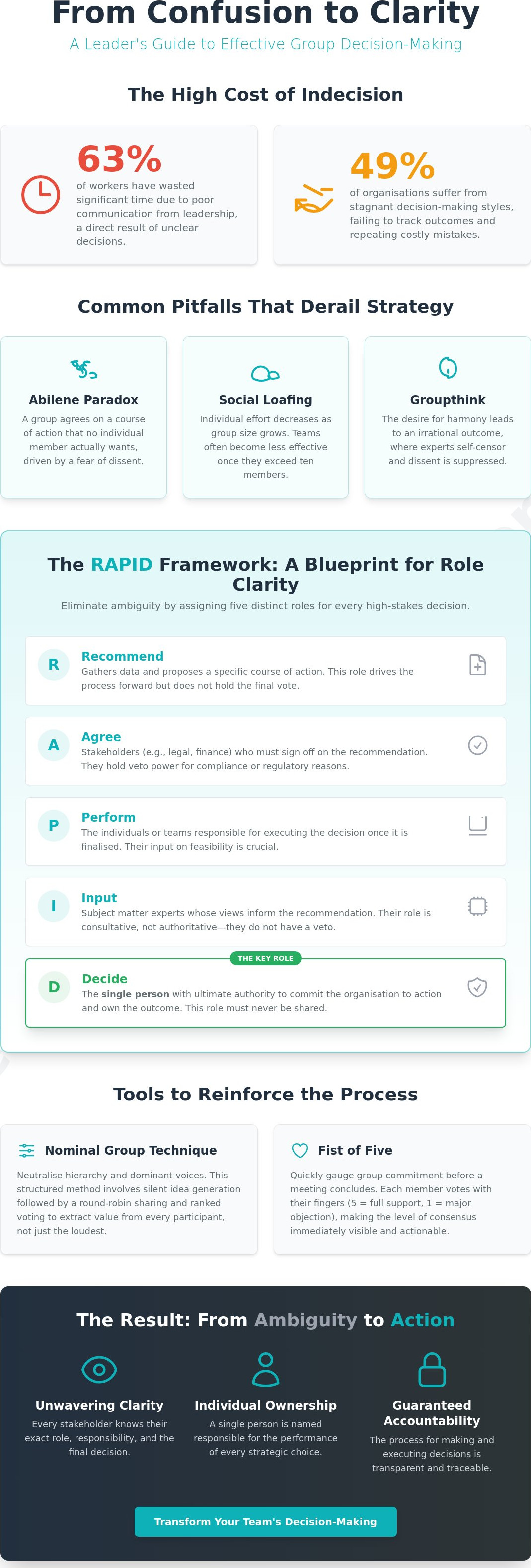
The financial impact of such ambiguity is severe. Research by Project.co reveals that 63% of workers have wasted significant time due to poor communication and collaboration, a direct result of ill-defined executive mandates. Data from Cloverpop indicates that 49% of organisations suffer from stagnant decision-making styles, failing to track or learn from their outcomes. Without implementing specific techniques for better decision making in groups, your organisation risks drifting into a state of permanent hesitation where dominant voices overshadow expertise and accountability is non-existent.
Senior leaders often feel the frustration of meetings that end without clear ownership. You must master the rigorous frameworks required to eliminate groupthink and secure unwavering clarity on strategic outcomes. Implementing systems like the RAPID framework ensures that every high-stakes choice results in a named individual responsible for the next step.
Key Takeaways
- Identify the psychological constraints like the Abilene Paradox that cause leadership teams to pursue strategies no individual actually supports.
- Utilise the RAPID framework to assign specific decision rights, ensuring every stakeholder understands their role in the approval and execution process.
- Apply structured techniques for better decision making in groups, including the Nominal Group Technique, to neutralise hierarchy and extract value from every participant.
- Secure immediate accountability by using the Fist of Five method to measure group commitment before any session concludes.
- Transition from collective hesitation to individual ownership by naming a single person responsible for the performance of every strategic choice.
The Hidden Constraints of Conventional Group Decision Making
Effective group decision-making is not the absence of conflict. It is a disciplined process designed to aggregate diverse expertise into a single, unified commitment. Most leadership teams operate under the assumption that proximity equals alignment. This is a fallacy. Without rigorous techniques for better decision making in groups, the boardroom becomes an echo chamber where the loudest voice dictates the direction, regardless of the underlying data.
Consider the Abilene Paradox. This occurs when a group collectively agrees to a path that no individual member actually desires. It stems from a misplaced desire for harmony and a fear of being the sole dissenter. When directors value comfort over truth, they fall into the trap of false consensus. They overestimate the level of agreement amongst their peers, leading to strategic choices that lack genuine conviction or support from the people expected to execute them.
Efficiency also erodes as numbers increase. Social loafing is a documented psychological phenomenon where individual effort reduces whilst the group size grows. McKinsey reports that teams tend to become less effective once they exceed ten members. In larger groups, the diffusion of responsibility sets in. Individuals feel less accountable for the final outcome, assuming someone else will catch the errors or drive the momentum.
Recognising Groupthink in the Boardroom
Groupthink manifests as an illusion of invulnerability. Senior directors may believe their market position is unassailable, leading to reckless strategic choices. Watch for self-censorship amongst your most quiet experts. When the specialist in the room stays silent whilst a dominant voice pushes a flawed agenda, your decision process has failed. This silence is often a survival mechanism in cultures that lack the necessary techniques for better decision making in groups to protect minority dissent.
The Financial Impact of Strategic Paralysis
Strategic paralysis carries a heavy price. Many teams disguise their fear of accountability as a need for more data. This decision latency allows competitors to seize market share whilst you remain locked in endless cycles of review. Cloverpop research highlights that 49% of companies have stagnant decision-making styles. They fail to track outcomes, which means they repeat the same expensive mistakes. High-performance teams prioritise speed and ownership over the false security of exhaustive, circular analysis.
Utilising the RAPID Framework for Role Clarity
Ambiguity is the enemy of execution. When a leadership team approaches a high-stakes choice without defined roles, they default to a messy consensus that dilutes accountability. The RAPID framework, a registered trademark of Bain & Company, provides the structural rigour necessary to avoid this trap. It stands as one of the most effective techniques for better decision making in groups because it separates the act of gathering information from the act of making the final call.
The framework assigns five distinct roles to ensure every participant knows their specific responsibility:
- Recommend: The individual responsible for gathering data and proposing a specific course of action. They drive the process but do not hold the final vote.
- Agree: Stakeholders who must sign off on the recommendation. This role is usually reserved for legal, financial, or regulatory experts.
- Perform: The people responsible for executing the decision once it's finalised.
- Input: Subject matter experts whose views inform the recommendation. They provide the "why" but do not have a veto.
- Decide: The single person with the ultimate authority to commit the organisation to action.
Assigning exactly one person to the "Decide" role is non-negotiable. If two people share this role, nobody truly owns the outcome. For a deeper look at how this framework fits into broader leadership team dynamics, read our guide on Leadership Team Decision Making.
Differentiating Input from Authority
Confusion between "Input" and "Agree" creates significant friction. Input is consultative. It's a request for expertise, not a request for permission. When senior leaders treat every input as a veto, the process grinds to a halt. The "Agree" role should be used sparingly. It belongs only to those who have a legitimate right to block a proposal on critical grounds, such as compliance or safety. This distinction is one of the essential techniques for better decision making in groups that prevents the "Recommend" role from becoming a purely administrative task.
Implementing RAPID in Your Next Strategy Offsite
Role mapping should be a central component of any strategic gathering. During your next session, list your most critical objectives and explicitly name the individuals for each RAPID role. This clarity prevents the re-litigation of decisions weeks after the meeting ends. If your team struggles with this level of specificity, a Strategy Sprint can provide the external facilitation required to reset these decision rights permanently.
Implementing the Nominal Group Technique to Neutralise Hierarchy
Traditional brainstorming often fails in executive suites because the most senior person's opinion carries disproportionate weight. To counter this, leadership teams must adopt techniques for better decision making in groups that decouple the value of an idea from the status of its author. The Nominal Group Technique (NGT) is a rigorous four-stage process: silent generation of ideas, round-robin recording, collective discussion, and secret voting.
Secret voting is the most critical component for executive alignment. It ensures that a junior director's perspective carries the same weight as the CEO's. Without this anonymity, groups often suffer from "mirroring," where participants align their votes with the perceived preference of the most senior leader. By removing social pressure, NGT surfaces "Black Swan" risks, which are low-probability, high-impact threats that experts might otherwise suppress. Whilst NGT works best in synchronous environments, the Delphi Technique offers a similar benefit for remote teams by using multiple rounds of anonymous surveys. If your leadership sessions currently feel like a rubber-stamping exercise, professional Facilitation Services can reset the dynamic.
Facilitating Silent Generation of Ideas
Silence is a tool, not a void. During this phase, individuals document their perspectives independently without outside influence. A facilitator must protect this period of total focus, preventing dominant personalities from making off-the-cuff remarks that bias the room. This discipline ensures that every piece of expertise is captured before any debate begins. It is one of the most effective techniques for better decision making in groups to ensure quiet experts are heard.
Ranking and Scoring for Objective Alignment
Transitioning from a list of ideas to a prioritised action plan requires mathematical rigour. Participants score items based on pre-defined criteria rather than emotional preference. This data-driven approach handles divergent views by highlighting where the group's collective intelligence actually centres. It avoids the watered-down compromise that often plagues conventional committees, ensuring the final choice is the most strategic option available.
Securing Ownership and Execution After the Vote
A decision without a named owner is merely a suggestion. At Echelon, we maintain that the finalisation of a vote is not the end of the process, but the start of the execution phase. Many leadership teams mistakenly believe that collective responsibility is a substitute for individual accountability. It is not. True techniques for better decision making in groups must conclude with a clear transition from deliberation to ownership.
Before leaving the room, use the "Fist of Five" method to gauge group commitment levels. Each participant holds up fingers from one (major disagreement) to five (full champion). If anyone shows fewer than three fingers, the group has not reached alignment. Re-opening the discussion immediately is far more efficient than dealing with passive resistance during the execution phase. To maintain this momentum, document every outcome in a formal Decision Log. This log should record the data considered and the rationale chosen, serving as a shield against retrospective bias when market conditions shift. For a broader view on managing these sessions, consult our guide on Strategic Alignment.
The 24-Hour Alignment Rule
Execution fails when directors leave the boardroom and offer lukewarm or contradictory explanations to their departments. The 24-hour alignment rule requires every stakeholder to communicate the agreed decision consistently across the organisation. There is no room for "corridor talk" or subtle distancing from the group choice. If you were in the room, you own the result. This discipline is what separates high-performance boards from those that merely discuss techniques for better decision making in groups without ever applying the necessary rigour.
Defining the "Perform" Role
The "Perform" role bridges the gap between executive choice and operational reality. Once the decision is made, the focus shifts to the individuals responsible for the delivery. They require absolute clarity on who does what next. If the pathway to execution remains clouded, a Strategy Sprint can rapidly turn these high-level commitments into a sequenced plan of action with defined milestones and clear accountability.
Transforming Collective Insight into Strategic Ownership
Strategic clarity is the byproduct of disciplined process, not accidental agreement. Leadership teams that successfully neutralise hierarchy through the Nominal Group Technique and define clear decision rights via RAPID eliminate the ambiguity that leads to execution failure. Moving beyond the Abilene Paradox requires more than just intent; it necessitates a commitment to frameworks that protect dissent whilst demanding individual ownership of the final result.
Implementing these techniques for better decision making in groups ensures that every boardroom session translates into measurable operational momentum. Echelon Facilitation, founder-led by Richard Kasriel, specialises in these high-stakes executive alignment scenarios. Based in Twickenham and serving global organisations, we provide the expert facilitation required to bridge the gap between high-level strategy and the practical reality of leading a team.
Secure the clarity your objectives deserve. Book a Leadership Team Decision Making Sprint to establish a rigorous decision-rights framework and end the cycle of unproductive meetings. Your leadership team is ready for the next level of performance.
Frequently Asked Questions
What are the best techniques for better decision making in groups with dominant leaders?
The Nominal Group Technique (NGT) is the most effective method for neutralising dominant personalities in the boardroom. By mandating a period of silent generation followed by anonymous voting, NGT ensures that seniority does not dictate the outcome. This structure allows the group to evaluate contributions based on merit rather than the status of the speaker, protecting quiet experts from being overshadowed.
How does the RAPID framework improve executive alignment?
RAPID creates alignment by defining exactly who has the right to make a final call and who is responsible for providing expertise. By separating those who provide input from the single individual who decides, the framework prevents the consensus trap where every stakeholder feels they have a veto. This clear hierarchy of roles ensures that once a decision is made, the entire executive team understands their specific execution responsibilities.
Can the Nominal Group Technique be used for remote leadership teams?
Remote leadership teams can successfully implement NGT using digital facilitation platforms that support anonymous input. The core principles of silent ideation and secret voting translate well to virtual environments, provided the facilitator uses tools that guarantee participant anonymity. These techniques for better decision making in groups are essential for maintaining psychological safety and objective truth in a distributed workforce.
What is the difference between consensus and alignment in group decisions?
Consensus is an agreement where everyone likes the choice; alignment is a commitment where everyone supports the choice. Seeking consensus often leads to mediocrity and unnecessary delays. Alignment allows for vigorous debate followed by a "disagree and commit" behaviour, ensuring the organisation moves forward as a single unit once the designated decision-maker has reached a conclusion.
How much time should an executive team spend on a high-stakes decision?
High-stakes decisions require a duration proportionate to their impact and reversibility. Irreversible strategic choices demand rigorous frameworks and may span several sessions of deep analysis to surface all potential risks. Reversible operational choices should be made within a single session. Executive teams must focus on reducing decision latency to prevent competitors from seizing market advantages whilst they remain in circular review cycles.

Article by
Andrew Greenland
Dr Andrew Greenland is the founder of Echelon Facilitation, a UK practice that designs and runs high-stakes leadership sessions for executive teams who need decisions, not more discussion. A medical doctor and medical educator, Andrew brings a clinician's discipline to the messy, political work of leadership alignment - surfacing the real disagreement, forcing the real choices, and ensuring every session produces a documented decision log with named owners and deadlines. He works with CEOs, executive teams, transformation leads, and boards across the UK and internationally. Based in Twickenham.