
Your board meeting has devolved into a circular debate for the fourth time this hour, stalling a high-stakes transformation project whilst the executive team remains deadlocked. The silence from the rest of the room is not consensus; it is the sound of a leadership team that has lost its momentum and its clarity.
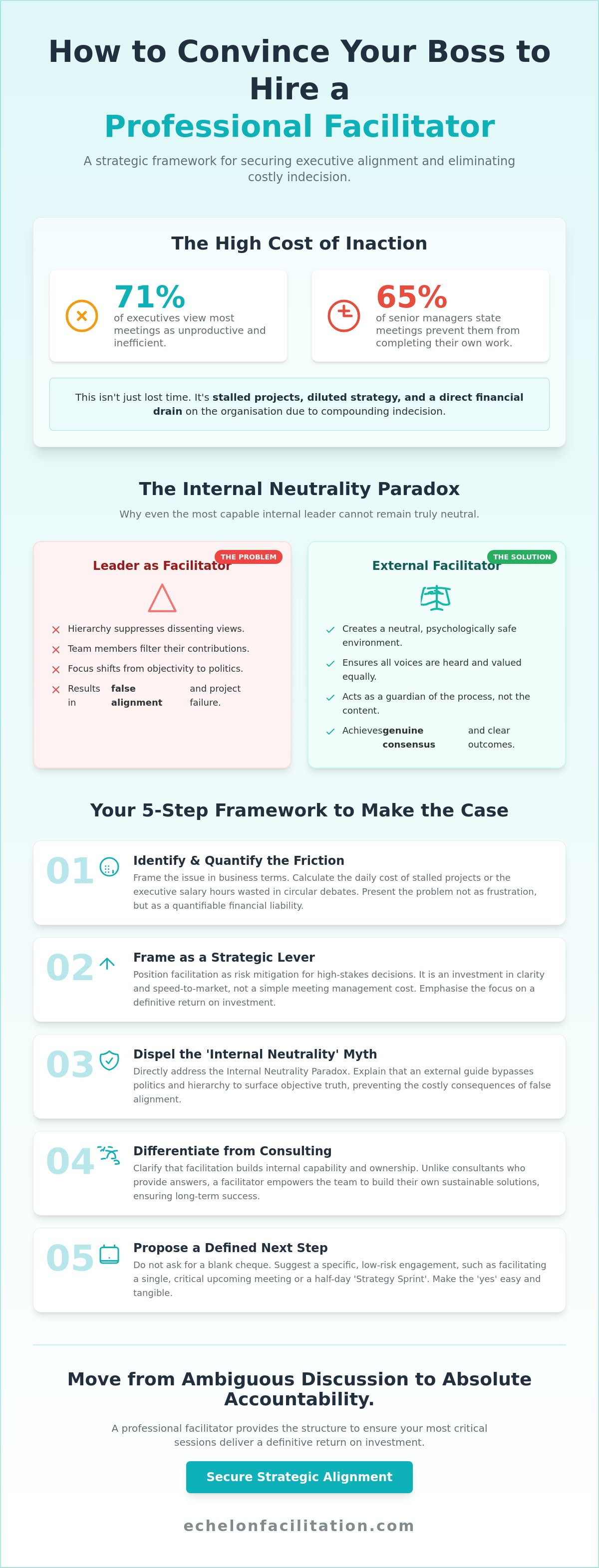
Understanding how to convince my boss we need a facilitator is the first step in addressing the fact that 65% of senior managers feel meetings prevent them from completing their work. With 71% of executives viewing these sessions as unproductive, the status quo is a liability that costs businesses billions in lost output. This is not about admitting failure. It's about protecting the company from the compounding interest of indecision and ensuring that critical sessions deliver a definitive return on investment.
You require a leadership environment where decisions are final and alignment is absolute. This article outlines how to present professional facilitation as a strategic lever that restores team cohesion and accelerates the execution of your most critical organisational goals.
Key Takeaways
- Frame professional facilitation as a disciplined mechanism for risk mitigation and strategic alignment rather than a simple administrative function.
- Learn how to convince my boss we need a facilitator by using a structured five-step pitch framework that focuses on organisational constraints and the cost of the status quo.
- Quantify the financial impact of leadership team friction by calculating the daily burn rate of stalled projects and circular board debates.
- Identify why internal neutrality is an illusion and how external guidance bypasses existing hierarchies to secure objective truth.
- Utilise clear decision-rights frameworks to move from ambiguous discussions to absolute accountability and accelerated execution.
Recognising Friction: How to Convince My Boss We Need a Facilitator
Professional facilitation is a disciplined framework designed to manage group dynamics and ensure decision-making clarity. It moves a team from subjective debate to objective resolution. When considering how to convince my boss we need a facilitator, you must frame the role correctly. A professional facilitator is a guardian of the process, not a contributor to the content. Their presence ensures that the organizational facilitation remains focused on outcomes rather than internal politics.
There are three primary triggers that necessitate external intervention. First, high-stakes ambiguity where the path forward is unclear. Second, entrenched conflict that prevents progress. Third, a strategic stall where the team repeats the same arguments without resolution. Recognising these signals is vital for any senior professional aiming to protect project timelines and budget integrity.
The Internal Neutrality Paradox
Senior leaders often believe they can facilitate their own strategy sessions. This is a fallacy. Hierarchy inherently suppresses dissenting views whilst maintaining the status quo. When a leader facilitates, team members often filter their contributions to align with perceived expectations rather than objective truth. An external facilitator removes this power dynamic, creating a neutral environment where the best ideas, not the loudest voices, prevail.
When Internal Resources Fail
Internal volunteer facilitators often lack the authority to challenge a CEO or redirect a dominant executive. This creates a state of false alignment. Consider a technology firm that asks an internal HR lead to facilitate a Vision Offsite. The likely result is a superficial agreement that collapses within weeks because the underlying dissent is never surfaced. Learning how to convince my boss we need a facilitator involves highlighting these risks of false harmony which eventually lead to project failure and wasted capital.
Positioning Facilitation as a Strategic Lever for Alignment
Securing executive alignment is the primary objective of professional intervention. When you consider how to convince my boss we need a facilitator, stop describing the role as someone who merely manages a meeting. This is a strategic error that diminishes the value of the service. Instead, position facilitation as a mechanism for clarifying Decision Rights and establishing absolute accountability amongst the leadership team. This clarity is the foundation of a successful Strategy Sprint, ensuring that every participant understands their specific responsibility in the execution phase.
Facilitators provide the most value by removing the friction that slows speed-to-market. Indecision is a silent drain on capital. By implementing a disciplined process, a facilitator ensures that leadership teams do not just talk, but decide. If your organisation struggles with stalled initiatives, a structured approach to alignment can reclaim months of lost time and protect your strategic investments from stagnation.
Facilitation vs. Traditional Consulting
Traditional consulting operates on an expert model where the consultant provides the answers. Facilitation uses a process model that requires the team to own their own solutions. This distinction is critical. Answers provided by outsiders often face internal resistance during implementation. However, when a team builds the strategy themselves through facilitated sessions, they develop the high-level leadership team decision making skills necessary for long-term success. This ownership ensures that strategic goals are fulfilled rather than left on a slide deck.
The Cynefin Framework in Action
Leaders often face Complex problems where cause and effect are only clear in hindsight. A facilitator uses frameworks like Cynefin to help teams probe, sense, and respond to this ambiguity. The goal is to move the challenge from the Complex domain into the Complicated or Simple domains where tasks become executable. This transition requires a facilitator who can remain composed under pressure whilst guiding the group through the fog of organisational uncertainty. Understanding how to convince my boss we need a facilitator means demonstrating that you aren't just asking for a meeting lead; you're requesting a tool to simplify the complex.
The Business Case: How to Convince My Boss We Need a Facilitator
Quantifying the value of alignment requires shifting the focus from the cost of the session to the cost of failure. A facilitator's fee functions as an insurance policy against the botched execution of a multi-million pound strategy. If a leadership team remains misaligned, the resulting delays and contradictory directives create a silent drain on capital. According to McKinsey, high-performing teams are 1.9 times more likely to have above-average financial returns. This demonstrates that high performing executive teams are a primary driver of revenue rather than a secondary cultural benefit.
When determining how to convince my boss we need a facilitator, you must present the daily burn rate of a stalled project. Calculate the combined hourly rate of the senior leaders involved in circular debates. This figure represents the immediate financial loss of indecision. A professional facilitator halts this waste by forcing a resolution and ensuring the organisation moves from discussion to delivery.
Calculating the ROI of Alignment
The return on investment for professional facilitation is found in a simple formula: (Value of Strategic Goal x Probability of Success) / Time to Execution. Facilitation increases the probability of success by surfacing hidden risks and decreases the time to execution by removing interpersonal friction. This mathematical reality transforms a workshop from a soft team-building expense into a hard strategic investment. To secure this level of operational clarity, book a consultation to discuss your specific organisational constraints.
Risk Mitigation and Accountability
A facilitator prevents "Strategy Drift," the phenomenon where teams reach a superficial agreement in the room but diverge once they return to their respective departments. By utilising the RACI framework as a post-session output, the facilitator ensures that every individual accepts total accountability for specific deliverables. This structured transition from dialogue to duty ensures that the objectives defined during the session are fulfilled with discipline and precision.
How to Convince My Boss We Need a Facilitator: A 5-Step Pitch Framework
Securing approval for external support requires a pitch rooted in operational reality rather than emotional appeal. When determining how to convince my boss we need a facilitator, follow this structured five-step framework to ensure the proposal is viewed as a strategic necessity. This approach moves the conversation away from "asking for help" and toward "optimising performance."
- Step 1: Identify the specific organisational constraint. Point to a concrete stall, such as a board that has spent three months debating the same strategic pivot without reaching a resolution.
- Step 2: Define the unfiltered cost of the status quo. Quantify the missed market opportunity or the daily burn rate of a leadership team that remains misaligned on execution.
- Step 3: Present the neutral expert solution. Frame the facilitator’s value as a process expert who remains objective. This is a core component of how to convince my boss we need a facilitator, as it highlights the need for a guardian of the process who has no stake in the internal politics.
- Step 4: Offer a low-risk pilot. Suggest an Executive Alignment Sprint to demonstrate immediate value and break the current deadlock without a long-term commitment.
- Step 5: Ask for a decision based on the strategic timeline. Force a choice based on the urgency of the organisational objectives rather than the perceived constraints of the budget.
Handling Common Objections
If a senior leader claims they can facilitate the session themselves, respond by highlighting the need for them to be a 100% participant in the content. A leader who facilitates cannot fully engage with the strategic debate whilst simultaneously policing the room's dynamics. Directly address concerns about an outsider’s lack of context by explaining that a lack of bias is their greatest asset. It allows them to challenge assumptions and surface objective truths that internal staff might be too compromised to mention.
The 30-Second Elevator Pitch
Use this script to initiate the conversation: "We are facing a £1.2 million opportunity, but our current misalignment is costing us £15,000 per week in delayed execution. I recommend an external facilitator to break this deadlock in a single day." To refine this approach for your specific leadership dynamic, contact Echelon for a diagnostic call to sharpen your pitch and ensure your next high-stakes session delivers a definitive result.
Secure Your Strategic Objectives
Professional facilitation is the difference between a stalled transformation and a high-performing leadership team. By framing this intervention as a risk-mitigation tool, you shift the narrative from an administrative request to a strategic necessity. Mastering how to convince my boss we need a facilitator allows you to present a clear ROI based on the cost of indecision and the daily burn rate of misaligned executives. Relying on an external expert ensures that your team moves beyond superficial agreement to absolute accountability.
Echelon Facilitation, founder-led by Dr Andrew Greenland, specialises in these high-stakes executive alignment sessions. We utilise proven frameworks like RACI and Cynefin to resolve organisational friction and accelerate the execution of your most critical goals. Don't let circular debates compromise your strategy. Book a complimentary diagnostic call to build your business case and ensure your leadership team remains focused on objective truth. You have the opportunity to restore team cohesion and secure the results your organisation requires.
Frequently Asked Questions
Is it a sign of weakness to suggest we need an external facilitator?
No, it's a sign of strategic maturity. Leaders who recognise the inherent limitations of internal hierarchy demonstrate a commitment to objective truth over individual ego. External guidance ensures the leader remains a full participant in the content whilst a neutral professional manages the group dynamics. This approach mitigates the risk of false alignment and protects the organisation's investment in its most critical strategic objectives.
How much does a professional facilitator typically cost for a leadership offsite?
Industry benchmarks for corporate facilitators indicate a median day rate of approximately $3,200. Specialised experts for executive sessions typically charge between $300 and $500 per hour, whilst high-demand specialists can exceed $10,000 per day. Understanding these figures is part of how to convince my boss we need a facilitator, as it allows you to compare the investment against the $399 billion lost annually to unproductive meetings.
What is the difference between a facilitator and a management consultant?
A management consultant operates on an expert model to provide specific answers or strategic recommendations. In contrast, a facilitator uses a process model to help the team surface and own their own solutions. Facilitation ensures that the leadership team maintains total accountability for the final decisions, which is vital for long-term execution. Consultants provide the 'what', whilst facilitators ensure the team's got the 'how' to decide.
Can we use an internal HR person to facilitate our leadership meeting?
Internal staff often struggle with the neutrality paradox because their position in the hierarchy prevents true objectivity. HR professionals may lack the authority to challenge senior executives or redirect a dominant CEO without risking their internal relationships. This often results in superficial consensus. An external facilitator provides the necessary distance to probe uncomfortable truths that internal employees can't safely navigate.
How do I measure the success of a facilitated workshop?
Don't measure success by sentiment; measure it by the clarity of the outputs and the speed of execution. A successful session results in a documented decision-rights framework, such as a RACI matrix, and a clear timeline for organisational goals. You should also observe a definitive reduction in circular debates during follow-up meetings. If the team moves from ambiguity to action without revisiting the same arguments, the facilitator has achieved executive alignment.

Article by
Andrew Greenland
Dr Andrew Greenland is the founder of Echelon Facilitation, a UK practice that designs and runs high-stakes leadership sessions for executive teams who need decisions, not more discussion. A medical doctor and medical educator, Andrew brings a clinician's discipline to the messy, political work of leadership alignment - surfacing the real disagreement, forcing the real choices, and ensuring every session produces a documented decision log with named owners and deadlines. He designs Echelon’s sessions for CEOs, executive teams, transformation leads and boards. Based in Twickenham.