
You watch your executive team nod in silent agreement during the final session, yet you know that by Monday morning, the same misalignments will paralyse your operations. Learning how to run a leadership offsite effectively requires moving beyond superficial team bonding to focus on absolute strategic ownership and objective truth.
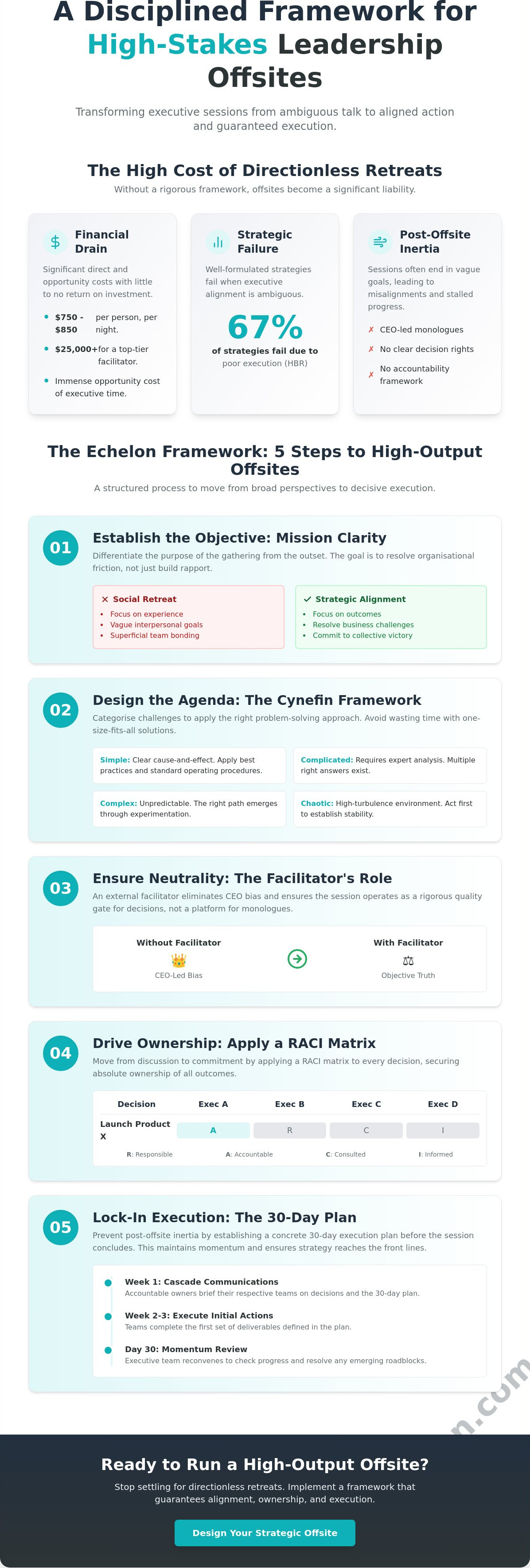
The global corporate retreats market is projected to reach $73.7 billion by 2034, with companies typically budgeting between $750 and $850 per person, per night, for high-level gatherings. When you add the $25,000 fee for a top-tier facilitator and the staggering opportunity cost of your executive team's time, a directionless retreat becomes a significant financial liability. Without a disciplined framework, these sessions often descend into CEO-led monologues that fail to resolve the underlying friction stalling your organisation's progress.
You likely recognise that your current retreat model produces more heat than light, leaving your team with vague goals and no accountability. This article provides a rigorous framework to transform your strategy sessions into high-output environments that establish unanimous alignment. These principles establish clear decision rights and a concrete 30-day execution plan to ensure strategic objectives reach the front lines whilst maintaining momentum.
Key Takeaways
- Differentiate between social retreats and strategic alignment to focus the team on resolving organisational friction.
- Categorise complex business challenges using the Cynefin framework to move the agenda from broad perspectives to decisive execution.
- Understand how to run a leadership offsite using neutral facilitation to eliminate CEO bias and maintain a rigorous quality gate.
- Secure absolute ownership of all outcomes by applying a RACI matrix to every decision made during the session.
- Prevent post-offsite inertia by establishing a concrete 30-day execution plan before the session concludes.
Establishing the Objective: The Foundation of Executive Alignment
A leadership offsite is not an escape from work; it's the most intensive work an executive team performs. Many organisations mistake these sessions for social retreats, prioritising experience over concrete outcomes. This approach fails because it ignores the fundamental purpose of high-stakes strategic management: resolving the friction that prevents a team from moving as a single unit. Whilst team building focuses on interpersonal rapport, executive alignment focuses on the mechanics of collective victory. Executive alignment is the state where every leader understands their specific ownership of the collective result.
Identify the primary challenge before drafting the agenda to ensure the session remains focused. Is the organisation facing a strategy reset, a decision-rights crisis, or the complexities of post-merger integration? Defining this mission early prevents the session from becoming a generic discussion. Learning how to run a leadership offsite effectively begins with this objective clarity.
The High Cost of Misaligned Leadership
Research from the Harvard Business Review indicates that 67% of well-formulated strategies fail due to poor execution. This failure rarely stems from a lack of effort; it is the direct result of executive ambiguity. When the leadership team lacks clarity, a ripple effect of hesitation and conflicting priorities cascades through middle management, stalling operational efficiency. Investing in a professionally facilitated Strategy & Vision Offsite is a minor expense compared to the multi-million pound cost of strategic drift and wasted resources.
Setting the Quality Gate for Participation
Understanding how to run a leadership offsite requires controlling who enters the room. Participation must be limited to those with direct decision rights over the organisation's resources and direction. Including observers or junior staff dilutes the intensity of debate and slows the path to consensus. Every individual in the room must have the authority to commit their department to the final plan.
The session must start at the point of decision. This requires rigorous pre-work, including data gathering and sentiment analysis, to ensure time is spent on resolution rather than information sharing. Demand that all participants complete their pre-reading and analysis 48 hours before the session begins. This discipline ensures the offsite functions as a strategic lever rather than a data-review meeting.
Designing the Agenda: How to Run a Leadership Offsite with Strategic Precision
High-stakes agendas require more than guided journaling or open-ended discussions. They demand a structure that forces resolution. To design an offsite that delivers lasting results, the schedule must move deliberately from a broad perspective shift to rigid strategic execution. This transition ensures that the team doesn't just identify problems but also commits to the mechanics of solving them. Understanding how to run a leadership offsite effectively means replacing vague "sharing sessions" with high-intensity work blocks focused on organisational victory.
Consider the case of a London-based fintech firm in early 2024. Following a major acquisition, the executive team faced severe operational friction. By utilising a Strategy Sprint, they identified that 42% of their project delays were caused by overlapping decision rights. They dedicated a specific two-hour block to a Decision-Rights Reset, which eliminated bottlenecks that had plagued the merged entity for six months. This level of precision is only possible when the agenda prioritises outcome over experience.
Applying the Cynefin Framework to Executive Decisions
Teams often waste hours applying best-practice solutions to problems that have no clear cause-and-effect relationship. The Cynefin framework allows leaders to categorise their top three organisational constraints into four domains:
- Simple: Issues with clear solutions requiring standard operating procedures.
- Complicated: Problems needing expert analysis and multiple technical options.
- Complex: Scenarios where the right path only emerges through experimentation.
- Chaotic: High-pressure situations requiring immediate action to establish order.
Categorising challenges this way prevents the team from over-simplifying complex cultural issues or over-analysing simple operational fixes. It brings a stoic clarity to the room, ensuring the team applies the correct level of cognitive effort to each mission-critical task.
The 90-Minute Sprint Cycle
Cognitive focus declines rapidly after two hours of intensive debate. Break the day into 90-minute high-intensity sprints, followed by brief periods of total detachment. This rhythm maintains the mental stamina required for difficult strategic choices. Avoid "unstructured time" during working hours, as this often allows the loudest voice in the room to dominate the narrative and suppress dissenting views. A disciplined schedule protects the integrity of the process and ensures every leader's perspective is weighed against objective truth. If your current sessions feel like an endless talking shop, a Decision-Rights Reset can provide the necessary structural overhaul.
Neutral Facilitation: How to Run a Leadership Offsite Without Internal Bias
A CEO cannot facilitate their own offsite whilst simultaneously participating as a primary stakeholder. The power dynamics inherent in the executive suite create an "Observer Effect" where the leader's presence or early input suppresses dissenting views and stifles critical analysis. To understand how to run a leadership offsite that surfaces objective truth, one must acknowledge that the person holding the budget cannot be the neutral arbiter of the debate. An external facilitator maintains a rigorous "Quality Gate" by challenging assumptions that internal staff may be too cautious to question. This objectivity ensures the session remains focused on strategic resolution rather than hierarchy preservation.
Internal facilitation is frequently biased and constrained by existing organisational politics. In contrast, external facilitation is results-driven and unburdened by internal history. Review this Internal vs. External Facilitator comparison to understand the structural risks of keeping the process in-house. A neutral partner forces the team to confront uncomfortable data and prevents the session from descending into a series of polite but unproductive monologues.
The CEO Trap: Why You Cannot Lead the Discussion and the Business Simultaneously
When the boss speaks first, the debate ends. This psychological reality prevents the executive team from exploring high-stakes alternatives or identifying fatal flaws in a proposed plan. A neutral facilitator creates a "Safe to Fail" environment, allowing leaders to critique the strategy without fear of political retribution. This separation of roles is essential for achieving the unanimous alignment required for complex execution. It allows the CEO to listen, observe, and contribute as a peer during the ideation phase, rather than acting as the session's architect and judge.
Facilitator Selection Criteria for the UK Market
Selection should prioritise expertise in Leadership Team Decision Making and strategic execution. Avoid facilitators who focus on the emotional "experience" or rapport building at the expense of hard outcomes. A battle-tested advisor focuses on the mechanics of ownership and the resolution of organisational friction. They should possess a grounded, stoic confidence that reassures the team even during high-pressure debates. If you require an objective partner to lead your next strategy session, our Facilitation Services provide the disciplined authority needed to ensure mission success.
From Discussion to Ownership: How to Run a Leadership Offsite That Guarantees Execution
Inspiration is a fleeting emotion; ownership is a structural requirement. Many offsites end with a sense of vague enthusiasm that evaporates within 48 hours. To understand how to run a leadership offsite that produces results, you must move beyond action items to a rigid system of accountability. Every decision made during the session must be anchored to an individual who accepts extreme ownership of the outcome, not just the task. This transition from debate to execution defines the difference between a successful strategy session and an expensive talking shop.
Establishing the 30-Day Execution Plan before the team leaves the room is a non-negotiable requirement for mission success. This plan must detail the immediate actions required to move from the boardroom to the front line. When determining how to run a leadership offsite, the focus must remain on the mechanics of the first four weeks. This period is critical for cementing the new strategic direction and demonstrating that the offsite was a strategic lever, not a social distraction.
The RACI Framework: Eliminating Ambiguity
Collective responsibility often results in no responsibility. If three people are responsible for a result, no one is. Mandate the use of a RACI matrix for every strategic objective identified during the session. This framework ensures that one individual is Accountable for the final result, whilst others are Responsible for the execution, Consulted for expertise, or Informed of progress. Establishing this clarity prevents the post-offsite inertia that typically stalls corporate initiatives. Use the following template to assign ownership:
- Accountable: The single leader who owns the success or failure of the result.
- Responsible: The individuals tasked with the operational execution.
- Consulted: Stakeholders whose input is required before a decision is finalised.
- Informed: Those who must be updated on the outcome but do not have a vote.
The Post-Offsite Rhythm: Maintaining Momentum
Maintaining momentum requires a disciplined follow-up rhythm that begins immediately. Within 24 hours, the facilitator must distribute the decision log and the completed RACI matrix to all participants. By day seven, leaders must have communicated these outcomes to their respective departments to ensure the organisation is aligned. On day 30, the executive team must reconvene to review the execution plan and resolve any new friction that has emerged. Integrating these outcomes into your Strategic Planning Processes ensures that the offsite serves as a catalyst for long-term organisational victory. To discuss the specific needs of your executive team, book a diagnostic call to begin the alignment process.
Securing Strategic Victory Through Disciplined Execution
High-stakes strategy sessions succeed only when they transition from theoretical debate to absolute accountability. Effectiveness depends on moving beyond the CEO's perspective and applying rigorous frameworks like Cynefin to categorise constraints and RACI to enforce ownership. Understanding how to run a leadership offsite requires a commitment to objective truth over comfortable narratives. This discipline ensures that every minute spent away from the office translates into operational momentum and the resolution of organisational friction.
Since 2019, Richard Kasriel and the Echelon Facilitation team have specialised in transforming executive retreats into high-output strategic sessions. By serving as a neutral authority, we provide the stability and clarity needed to navigate complex decision-rights crises. Strategic clarity is the only antidote to the inertia that stalls executive teams. Secure your collective victory and organise your results-driven leadership offsite with Echelon Facilitation. Your team's alignment is the foundation of your success.
Frequently Asked Questions
How long should a leadership offsite actually last to get results?
A leadership offsite should last between 1.5 and 2 days to achieve deep strategic alignment without inducing decision fatigue. Whilst the global average corporate retreat lasts 3.78 days, high-stakes sessions require a condensed, high-intensity schedule to maintain momentum. This timeframe allows enough space to move from broad perspective shifts to rigid 30-day execution plans. Longer durations often lead to a decline in cognitive focus and a shift towards social activities that dilute the strategic mission.
Should we include the wider management team in a strategy offsite?
Restrict attendance to the executive leaders who hold direct decision rights over the organisation’s resources. Including the wider management team often stifles honest debate as senior leaders feel the need to maintain a facade of total certainty. Effective alignment requires a "Safe to Fail" environment where the core team can critique the current strategy without an audience. Use the offsite to establish unanimous agreement, then communicate the specific ownership tasks to the broader organisation afterwards.
What is the most effective venue for a results-driven executive session?
The most effective venue is a neutral, external business centre that physically removes the team from operational distractions. Removing the team from the office environment is essential for breaking the "Simple" problem-solving habits that dominate daily work. A professional setting with high-quality facilities ensures the team remains focused on "Complex" strategic challenges. Neutrality is key; it prevents any single department from feeling a "home-turf" advantage during difficult negotiations regarding resource allocation.
Can we run a leadership offsite virtually with the same effectiveness?
Virtual sessions are rarely as effective as in-person gatherings for resolving deep organisational friction and establishing absolute ownership. Research indicates that in-person events are 47.8% more expensive than virtual alternatives, yet they remain the preferred model for 91% of hybrid companies. When determining how to run a leadership offsite in a remote context, you must use shorter, more frequent "micro-events" to maintain engagement. However, for high-stakes strategy resets, the physical presence of the executive team is non-negotiable.
How much does a professional executive facilitator cost in the UK?
External facilitator fees for high-stakes sessions vary according to the consultant's track record and the complexity of the mission. Top-tier facilitators typically command fees between $25,000 and $50,000, whilst mid-tier experts range from $10,000 to $20,000. These costs represent a strategic investment to prevent the multi-million pound losses associated with strategic drift and executive misalignment. A single day of expert on-site consulting can range from $5,000 to $10,000, ensuring the session maintains a rigorous quality gate throughout.

Article by
Andrew Greenland
Dr Andrew Greenland is the founder of Echelon Facilitation, a UK practice that designs and runs high-stakes leadership sessions for executive teams who need decisions, not more discussion. A medical doctor and medical educator, Andrew brings a clinician's discipline to the messy, political work of leadership alignment - surfacing the real disagreement, forcing the real choices, and ensuring every session produces a documented decision log with named owners and deadlines. He works with CEOs, executive teams, transformation leads, and boards across the UK and internationally. Based in Twickenham.